Categoria: congresso-2025

  • Tassonomia e implicazioni cliniche del controllo motorio nel dolore muscoloscheletrico lombare: una scoping review

    Tassonomia e implicazioni cliniche del controllo motorio nel dolore muscoloscheletrico lombare: una scoping review

    Taxonomy and Clinical Implications of Motor Control in Musculoskeletal Low Back Pain. A Scoping Review

    Autori

    Federico Fiorini (University of Rome La Sapienza Department of Human Neuroscience, Rome,Italy)

    Mirko Zitti (University of Rome La Sapienza Department of Human Neuroscience, Rome,Italy)

    Rebecca Andreutto (University of Rome La Sapienza Department of Human Neuroscience, Rome,Italy)

    Graziano Raffaele(University of Rome La Sapienza Department of Human Neuroscience, Rome,Italy)

    Fabio Fiorentino(University of Rome La Sapienza Department of Human Neuroscience, Rome,Italy)

    Rachele Paciotti(University of Rome La Sapienza Department of Human Neuroscience, Rome,Italy)

    Lorenzo Storari(University of Rome La Sapienza Department of Human Neuroscience, Rome,Italy)

    Fabiola Garzonio(University of Rome La Sapienza Department of Human Neuroscience, Rome,Italy)

    Giulia Ganassin(University of Rome La Sapienza Department of Human Neuroscience, Rome,Italy)

    FIlippo Maselli(University of Rome La Sapienza Department of Human Neuroscience, Rome,Italy)

    Background and aims

    Motor control impairments (MCI) are a clinical manifestation of musculoskeletal low back pain (MSK-LBP). However, no consensus exists on the definition of motor control (MC). Various definitions highlight neurological and musculoskeletal aspects, while the most effective strategies for managing MC impairments in MSK-LBP remain unclear.

    This review aims to map different MC definitions, understand its role, and explore its influence within MSK-LBP.

    Methods

    A comprehensive literature search was conducted across four databases (MEDLINE, Cochrane Library, Scopus, and Web of Science) for articles published up to November 15, 2024. Eligible sources included systematic reviews, narrative reviews, randomized controlled trials, expert opinions, validation studies, editorials, and clinical commentaries. No publication date restrictions were applied.

    Only articles published in English were considered for inclusion.

    The drafting of the manuscript adhered to the Preferred Reporting Items for Systematic Reviews and Meta-Analyses extension for Scoping Reviews (PRISMA-ScR) guidelines.

    The study protocol was prospectively registered on the Open Science Framework (OSF) at OSF.IO/D4TAC

    Results

    A total of 3596 records were identified, of which only 26 studies met the eligibility criteria.

    The most recent literature defines MC as “an area of physics exploring laws of nature defining how the nervous system interacts with other body parts and the environment to produce purposeful, coordinated actions”.

    Motor control exercise has medium and long-term positive effects in the rehabilitation of musculoskeletal chronic low back pain. However, it appears to be comparable to other forms of exercise.


    Conclusion

    MC depends on central nervous system function, but its direct correlation with MSK-LBP remains unclear. Current evidence does not support MC exercises for acute or subacute MSK-LBP, potentially due to misclassification of interventions not adhering to MC principles. It remains uncertain whether MCI is a primary pain generator in MSK-LBP or a consequence of the condition.

    REFERENCES

    1. Low M. A Time to Reflect on Motor Control in Musculoskeletal Physical Therapy.The Journal of orthopaedic and sports physical therapy 201848(11): 833–836.
    2. Levin, M. F., & Piscitelli, D. Motor Control: A Conceptual Framework for Rehabilitation.Motor control 202226(4): 497–517.
    3. Ganesh, G. S., Kaur, P., & Meena, S. Systematic reviews evaluating the effectiveness of motor control exercises in patients with non-specific low back pain do not consider its principles – A review. Journal of bodywork and movement therapies 202126: 374–393
    4. Kantak, S. S., Johnson, T., & Zarzycki, R. Linking Pain and Motor Control: ConceptualizationMovement Deficits in Patients With Painful Conditions.Physical therapy 2022102(4).
    5. Van Dieën, J. H., Reeves, N. P., Kawchuk, G., van Dillen, L. R., & Hodges, P. W. Motor Control Changes in Low Back Pain: Divergence in Presentations and Mechanisms. The Journal of orthopaedic and sports physical therapy 201949(6): 370–379
  • Valutazione della relazione tra affaticamento neuromuscolare e destrezza manuale nei fisioterapisti: uno studio osservazionale

    Valutazione della relazione tra affaticamento neuromuscolare e destrezza manuale nei fisioterapisti: uno studio osservazionale

    Evaluation of relationship between neuromuscular fatigue and manual dexterity in physiotherapists: an observational study

    Autori

    Libiani Gianluca [Istituti Clinici Scientifici Maugeri IRRCS, Department of Physical and Rehabilitation Medicine Unit, Institute of Veruno, Italy]

    Arcolin Ilaria [Istituti Clinici Scientifici Maugeri IRRCS, Department of Physical and Rehabilitation Medicine Unit, Institute of Veruno, Italy]

    Giardini Marica [Istituti Clinici Scientifici Maugeri IRRCS, Department of Physical and Rehabilitation Medicine Unit, Institute of Veruno, Italy]

    Phan Florian [Istituti Clinici Scientifici Maugeri IRRCS, Department of Physical and Rehabilitation Medicine Unit, Institute of Veruno, Italy]

    Sartorio Francesco [Istituti Clinici Scientifici Maugeri IRRCS, Department of Physical and Rehabilitation Medicine Unit, Institute of Veruno, Italy]

    Godi Marco [Istituti Clinici Scientifici Maugeri IRRCS, Department of Physical and Rehabilitation Medicine Unit, Institute of Veruno, Italy]

    Background and aims

    Neuromuscular fatigue (NMF), localized in the upper limbs, is a common non-specific symptom that can impair strength and manual dexterity in many workers, including healthcare providers [1,2]. Among them, physiotherapists (PTs) are particularly vulnerable to this due to the physically demanding nature of their job, which often requires repetitive and prolonged use of the hands and forearms [3]. The primary aim of this observational study was to evaluate whether the NMF, expressed as a reduction in the manual dexterity, occurs over the course of a workday or workweek in a population of PTs. The secondary aim was to examine whether there are relationships between the reduction in manual dexterity and independent variables such as sex and age.

    Methods

    23 PTs (11 men, age 43 ± 12 years), working in hospital setting 5/7 days for 7 h/day, were recruited. The Functional Dexterity Test (FDT) was administered to each participant before and after the work shift, both at the beginning and at the end of the workweek, three times in each assessment. Mean values, separately for dominant and non-dominant hand, were analyzed by a two-way ANOVA between days (Monday, Friday) and within repeated measures (morning, evening). Subsequently, the post-hoc Tukey test was conducted. A linear regression model was applied for assessing the association between the workday change in FDT and the clinical independent measure (PT’s age and gender).

    Results

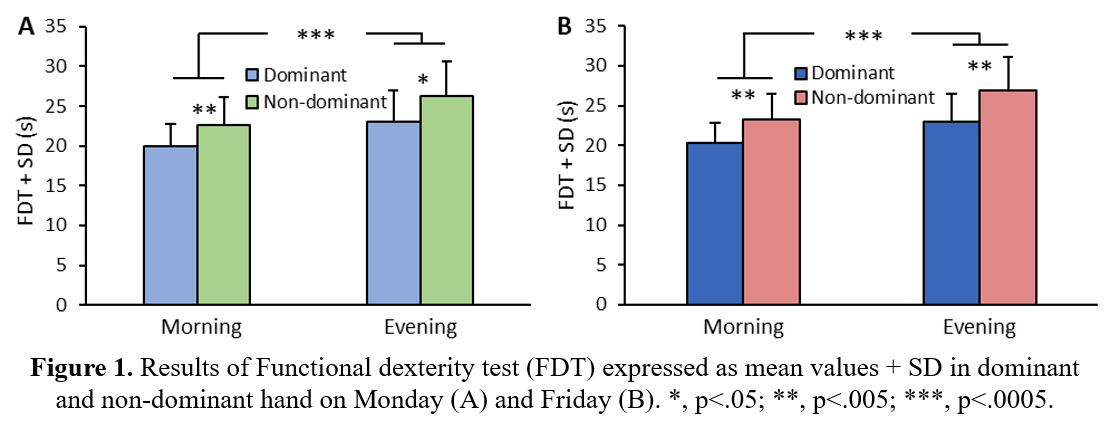
    All PTs were right-handed and the time employed by the dominant hand was less than the one taken by the non-dominant hand in each assessment (p<0.0005; Figure 1). ANOVA showed a significant worsening in FDT performance after the daily work shift in both hands (p<0.0005), without interaction with the first and last day of the week (Figure 1).

    Regression analysis showed a relationship between FDT and age, both in dominant (R2=0.23, p<0.05) and non-dominant hand (R2=0.16, p<0.05); in particular, younger PTs showed a lesser performance degradation following the daily work shift.

    Conclusion

    Work-related neuromuscular fatigue negatively affected the manual dexterity of PTs during the workday, but not between the beginning and end of the workweek. NMF builds up severely during the workday and it is influenced by age. Factors such as physical workload, work time, posture, and lack of adequate breaks may contribute to the onset of NMF [4,5]. Future studies should explore preventive solutions in order to reduce NMF in PTs.

    REFERENCES

    [1] Wan JJ, et al. Exp Mol Med. 2017;49(10):e384.

    [2] Jacquier-Bret J, Gorce P. Int J Environ Res Public Health. 2023;20(1):841.

    [3] Okhiria M, et al. Int J Occup Saf Ergon. 2020;26(2):406–412.

    [4] Vieira ER, et al. J Back Musculoskelet Rehabil. 2016;29(3):417-428.

    [5] Yasobant S, Rajkumar P. Indian J Occup Environ Med. 2014;18(2):75-81.

  • L’impatto di genere sull’attività fisica nella prevenzione dei disturbi muscoloscheletrici cronici: un’indagine web in Regione Lombardia (WeMoveForHealth)

    Gender impact on physical activity in musculoskeletal disorders prevention: a survey-based cross-sectional study in Lombardy Region, Italy (WeMoveForHealth)

    Autori

    Bargeri Silvia [IRCCS Istituto Ortopedico Galeazzi, Unit of Clinical Epidemiology, Milan, Italy]

    Palladino Chiara [University of Milan, Italy]

    Guida Stefania [IRCCS Istituto Ortopedico Galeazzi, Unit of Clinical Epidemiology, Milan, Italy]

    Bernardelli Giuseppina [Exercise Medicine Unit, Istituto Auxologico Italiano IRCCS, 20135 Milan, Italy; DISCCO Department, Dipartimento di Eccellenza 2023–2027 – University of Milan, 20122 Milan, Italy – IRCCS Istituto Auxologico Italiano – Servizio di Medicina dell’Esercizio, 20135 Milano, Italy]

    Banfi Giuseppe [IRCCS Istituto Ortopedico Galeazzi, Milan, Italy; Faculty of Medicine, Vita-Salute San Raffaele University, Milan, Italy]

    Background and aims

    Musculoskeletal disorders (MskDs) are among the leading causes of disability worldwide, with women experiencing a disproportionately higher burden. Although the preventive benefits of physical activity are well established by the World Health Organization (WHO), gender disparities in participation remain, particularly in Southern Europe. This study aims to examine gender differences in adherence to WHO physical activity recommendations in the Lombardy region, Italy.

    Methods

    We are conducting a cross-sectional online survey among adults aged 18–64 in the Lombardy region (Italy), launched in February 2025. The study was registered on ClinicalTrials.gov (NCT06747052) and approved by the Ethics Committee. The questionnaire was disseminated through flyers and online channels with support from Ospedale Galeazzi-Sant’Ambrogio, Milan. The primary outcome was adherence to WHO physical activity recommendations. We also collected socio-environmental variables, awareness about physical activity and MskD prevention, and perceived barriers. This preliminary analysis reports descriptive data from the first three (out of six) months recruitment.

    Results

    Preliminary results show that 723 participants answered the survey (55% of the estimated sample size) and 78% of them completed it fully. The sample included 69% women, 31% men, and 0.5% non-binary individuals, with a median age of 39 years. Most lived in medium-density urban areas (47%) and held a university degree (64%). Good health status was reported by 89%, and 50% reported at least one MskD. Overall, 61% of participants met WHO physical activity recommendations, with higher adherence among men (66%) than women (60%) and non-binary individuals (33%). Gender differences were found in household task division (73% women vs. 20% men), caregiving roles (14% women vs. 10% men), and full-time employment (69% women vs. 81% men). Awareness of physical activity’s preventive role was high across all groups (99%). Reported barriers included lack of time (69% women vs. 31% men), lack of motivation (65% women vs. 33% men vs. 2% non-binary), tiredness due to multiple commitments (76% women vs. 24% men), and family care responsibilities (75% women vs. 25% men).

    Conclusion

    Preliminary findings highlight gender disparities in physical activity participation. These insights can guide the development of inclusive and gender-sensitive strategies for the prevention of MskD, with particular attention to the needs and barriers faced by women and gender minorities.

    REFERENCES

    Liu S, Wang B, Fan S, Wang Y, Zhan Y, Ye D. Global burden of musculoskeletal disorders and attributable factors in 204 countries and territories: a secondary analysis of the Global Burden of Disease 2019 study. BMJ Open. 2022 Jun 29;12(6):e062183.

    Cule M, Guliani H. Are there gender based differences in participation and time spent in physical activity in Albania? Evidence from 2017-18 demographic and health survey. Arch Public Health. 2022 Aug 11;80(1):187.

    Ding D, Lawson KD, Kolbe-Alexander TL, Finkelstein EA, Katzmarzyk PT, van Mechelen W, Pratt M; Lancet Physical Activity Series 2 Executive Committee. The economic burden of physical inactivity: a global analysis of major non-communicable diseases. Lancet. 2016 Sep 24;388(10051):1311-24.

    Oliveira AJ, Lopes CS, Rostila M, Werneck GL, Griep RH, Leon AC, Faerstein E. Gender differences in social support and leisure-time physical activity. Rev Saude Publica. 2014 Aug;48(4):602-12.

    Guthold R, Stevens GA, Riley LM, Bull FC. Worldwide trends in insufficient physical activity from 2001 to 2016: a pooled analysis of 358 population-based surveys with 1.9 million participants. Lancet Glob Health. 2018 Oct;6(10):e1077-e1086.

  • Esplorazione delle definizioni di gender bias nella letteratura: una scoping review

    Exploring the definitions of gender bias in healthcare literature: a scoping review

    Autori

    Bargeri Silvia [IRCCS Istituto Ortopedico Galeazzi, Unit of Clinical Epidemiology, Milan, Italy; Department of Health Sciences, Faculty of Science, Vrije Universiteit Amsterdam, Amsterdam, the Netherlands]

    Schaap Laura [Department of Health Sciences, Faculty of Science, Vrije Universiteit Amsterdam, Amsterdam, the Netherlands; Amsterdam Public Health Research Institute, the Netherlands; Amsterdam Movement Sciences, Vrije Universiteit Amsterdam, the Netherlands]

    Innocenti Tiziano [Department of Health Sciences, Faculty of Science, Vrije Universiteit Amsterdam, Amsterdam, the Netherlands; GIMBE Foundation, Bologna, Italy]

    Ostelo Raymond [Department of Health Sciences, Faculty of Science, Vrije Universiteit Amsterdam, Amsterdam, the Netherlands; Amsterdam Movement Sciences, Vrije Universiteit Amsterdam, the Netherlands; Department of Epidemiology and Data Science, Amsterdam UMC, Vrije Universiteit & Amsterdam Movement Sciences, Musculoskeletal Health, Amsterdam, The Netherlands]

    Tomaiuolo Rossella [IRCCS Istituto Ortopedico Galeazzi, Milan, Italy; Faculty of Medicine, Vita-Salute San Raffaele University, Milan, Italy]

    Vidal-Itriago Andres [Medical Library, Vrije Universiteit Amsterdam, Amsterdam, The Netherlands]

    Rubinstein Sidney [Department of Health Sciences, Faculty of Science, Vrije Universiteit Amsterdam, Amsterdam, the Netherlands; Amsterdam Movement Sciences, Vrije Universiteit Amsterdam, the Netherlands]

    Background and aims

    There is a lack of clarity how gender bias is defined and understood in the literature, despite growing recognition in healthcare. Theoretical and conceptual definitions vary widely, and little is known about their relevance and transferability in different clinical contexts, including the musculoskeletal field. We aimed to systematically explore how gender bias is defined and characterized.

    Methods

    Study design: scoping review prospectively registered on Open Science Framework (https://osf.io/qxrwh). We searched MEDLINE, EMBASE, and Scopus up to January 2025, including studies providing structured definitions or conceptual frameworks to define and/or understand gender bias in any healthcare contexts. Analysis: General characteristics (e.g., healthcare populations, contexts) were extracted and definitions were grouped by main themes emerged. A checklist on gender constructs was adapted to describe relevance from an analytical perspective (e.g., inclusion, intersectionality) and potential for implementation (e.g., transferability in different contexts).

    Results

    The selection of studies has not yet been completed, however, based on the first half of full texts assessed for eligibility, 7 studies were included. All were conducted in high-income countries between 2008 and 2024. Most were theoretical papers or theory-guided reviews (71%). Gender bias was examined in multi-specialty fields (e.g., musculoskeletal, cardiology) (29%), pain-related conditions (e.g., back pain) (29%), and health systems-levels (43%). Two main themes emerged: (i) gender bias as unjustified clinical assumptions about sex or gender differences, reflected in stereotypes (e.g., brave man, emotional women) or gender neglect (43%); (ii) gender bias as structural issue driven by institutional norms and systemic inequality (e.g., embedded gender norms) (43%). From an analytical perspective, the studies on health-systems contexts used intersectional perspectives and inclusive language beyond male-female binary. In terms of potential for implementation, two studies proposed potentially transferable frameworks to other contexts.

    Conclusion

    Preliminary findings suggest that existing definitions of gender bias in healthcare vary in conceptual focus, with few providing inclusive, non-binary and potentially transferable frameworks for clinical context. These gaps highlight the need to better understand how gender bias is conceptualized and addressed within health systems and clinical practice, such as in the musculoskeletal field.

    REFERENCES

    1. Miani C, Wandschneider L, Niemann J, Batram-Zantvoort S, Razum O. Measurement of gender as a social determinant of health in epidemiology-A scoping review. PLoS One. 2021;16:e0259223.
    2. Hamberg K. Gender bias in medicine. Womens Health (Lond). 2008;4:237-43.
    3. Risberg G, Johansson EE, Hamberg K. A theoretical model for analysing gender bias in medicine. Int J Equity Health. 2009;8:28.
    4. Peters MDJ, Godfrey C, McInerney P, Munn Z, Tricco AC, Khalil, H. Scoping Reviews (2020). Aromataris E, Lockwood C, Porritt K, Pilla B, Jordan Z, editors. JBI Manual for Evidence Synthesis. JBI; 2024. Available from: https://synthesismanual.jbi.global. Accessed on 24/11/2024.
    5. Tricco AC, Lillie E, Zarin W, O’Brien KK, Colquhoun H, Levac D, et al. PRISMA Extension for Scoping Reviews (PRISMA-ScR): Checklist and Explanation. Ann Intern Med. 2018;169:467-73.
  • Il punteggio totale della Short Physical Performance Battery dovrebbe essere utilizzato, ma non ciascun singolo item: una revisione sistematica con meta-analisi di studi di affidabilità

    Il punteggio totale della Short Physical Performance Battery dovrebbe essere utilizzato, ma non ciascun singolo item: una revisione sistematica con meta-analisi di studi di affidabilità

    The total score of the Short Physical Performance Battery should be used but not each item separately: a systematic review with meta-analysis of reliability studies

    Autori

    Eusepi Davide [UniCamillus, International Medical University in Rome, Rome, Italy]

    Piscitelli Daniele [Department of Kinesiology, University of Connecticut, Storrs, CT, USA; School of Medicine and Surgery, University of Milano-Bicocca, Monza, Italy]

    Ugolini Alessandro [Private Practice, Empoli (FI), Italy]

    Graziani Lorenzo [Program in Physical Therapy, University of Florence, Florence, Italy]; Coppari Andrea [Physical and Rehabilitation Medicine Unit, Azienda Sanitaria Territoriale, Jesi (AN), Italy]

    Carlizza Alessandra [UniCamillus, International Medical University in Rome, Rome, Italy]

    Caselli Serena [Unità Operativa Complessa di Medicina Riabilitativa, Azienda Ospedaliero-Universitaria di Modena, Modena, Italy]

    La Porta Fabio [IRCCS Istituto delle Scienze Neurologiche di Bologna, Bologna, Italy]

    Paci Matteo [Department of Allied Health Professions, Azienda USL Toscana Centro, Florence, Italy; Department of Experimental and Clinical Medicine, University of Florence, Florence, Italy]

    Di Bari Mauro [Department of Experimental and Clinical Medicine, University of Florence, Florence, Italy; Department of Medicine and Geriatrics, Unit of Geriatrics, Azienda Ospedaliero-Universitaria Careggi, Florence, Italy]

    Pellicciari Leonardo [IRCCS Istituto delle Scienze Neurologiche di Bologna, Bologna, Italy]

    Background and aims

    Short Physical Performance Battery (SPPB) assesses lower limb function and mobility in older adults. SPPB is composed of three tests balance, walking ability, strength of the lower limbs), scored by a 5-point Likert scale. Its total score is calculated by summing each item’s score and ranges from 0 (lowest performance) to 12 (highest performance) points.

    Although there is evidence of its predictive validity in various health outcomes, quantitative data on the SPPB reliability lacks. Therefore, this study aims to assess the reliability (i.e., intra-, inter-rater reliability and measurement error) in adult patients with a systematic review with meta-analysis.

    Methods

    This study protocol was prospectively registered on PROSPERO (CRD420251003320). PubMed, EMBASE, CINAHL, PsycINFO and Scopus were queried from their inception to March 2025 with a two-part search strategy framework of assessment tool (i.e., SPPB) and measurement properties (i.e., reliability and measurement error). Studied were included if they assessed SPPB intra- and inter-rater reliability and measurement error in adult patients. Studies reporting alternate SPPB versions (e.g., electronic or remote versions) were excluded. Two independent reviewers conducted the study selection, extrapolated the data, assessed the methodological quality (COSMIN Risk of Bias) and quality of evidence (CoE) (GRADE approach). Random effect meta-analyses were performed when at least two studies assessed the same property of the total score or the same subscale.

    Results

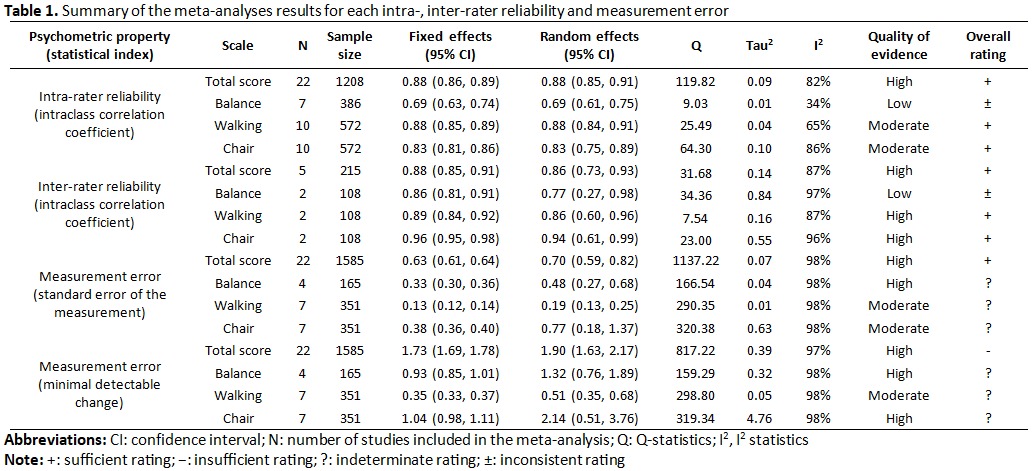
    Twenty-two studies were included for a total of 1,730 subjects. For total score, intra-rater (ICC=0.88) and inter-rater reliability (ICC=0.86) were rated sufficiently (high QoE), while the measurement error (MDC=1.90) was rated insufficiently (high QoE). For balance subscale, intra-rater (ICC=0.69) and inter-rater reliability (ICC=0.77) were rated inconsistently (low QoE), while the measurement error (MDC=1.32) was rated as indeterminate (high QoE). For walking subscale, intra-rater (ICC=0.88) and inter-rater reliability (ICC=0.86) were rated sufficiently (moderate and high QoE, respectively), while the measurement error (MDC=0.51 points) was rated indeterminately (moderate QoE). For chair subscale, intra-rater (ICC=0.83) and inter-rater reliability (ICC=0.94) were rated sufficiently (moderate and high QoE, respectively), while the measurement error (MDC=2.14 points equal to 53.4% of the total score) was rated indeterminately (high QoE).

    Conclusion

    SPPB provides similar results if administered by the same (intra-rater reliability) or two different assessors (inter-rater reliability). However, measurement error of each subscale (except for the walking subscale) is higher than the measurement error of the total score. Therefore, the total score of the Short Physical Performance Battery should be used, but not each item separately.

    REFERENCES

    Gagnier JJ, de Arruda GT, Terwee CB, Mokkink LB; Consensus group. COSMIN reporting guideline for studies on measurement properties of patient‑reported outcome measures: version 2.0. Qual Life Res. 2025 Mar 28. doi: 10.1007/s11136-025-03950-x.

    Guralnik JM, Simonsick EM, Ferrucci L, Glynn RJ, Berkman LF, Blazer DG, Scherr PA, Wallace RB. A short physical performance battery assessing lower extremity function: association with self-reported disability and prediction of mortality and nursing home admission. J Gerontol. 1994 Mar;49(2):M85-94. doi: 10.1093/geronj/49.2.m85. PMID: 8126356.

    Mokkink LB, Boers M, van der Vleuten CPM, Bouter LM, Alonso J, Patrick DL, de Vet HCW, Terwee CB. COSMIN Risk of Bias tool to assess the quality of studies on reliability or measurement error of outcome measurement instruments: a Delphi study. BMC Med Res Methodol. 2020 Dec 3;20(1):293. doi: 10.1186/s12874-020-01179-5.

    Pavasini R, Guralnik J, Brown JC, di Bari M, Cesari M, Landi F, Vaes B, Legrand D, Verghese J, Wang C, Stenholm S, Ferrucci L, Lai JC, Bartes AA, Espaulella J, Ferrer M, Lim JY, Ensrud KE, Cawthon P, Turusheva A, Frolova E, Rolland Y, Lauwers V, Corsonello A, Kirk GD, Ferrari R, Volpato S, Campo G. Short Physical Performance Battery and all-cause mortality: systematic review and meta-analysis. BMC Med. 2016 Dec 22;14(1):215. doi: 10.1186/s12916-016-0763-7.

  • L’impatto di una student-led clinic di fisioterapia sul ragionamento clinico degli studenti

    The impact of an Italian student led physiotherapy clinic on student clinical reasoning

    Autori

    Sabot Raffaele Clinical Department of Medical, Surgical and Health Sciences, University of Trieste, Trieste, Italy

    Buoite Stella Alex Clinical Department of Medical, Surgical and Health Sciences, University of Trieste, Trieste, Italy

    Galmonte Alessandra Clinical Department of Medical, Surgical and Health Sciences, University of Trieste, Trieste, Italy

    Turolla Andrea Department of Biomedical and Neuromotor Sciences – DIBINEM, Alma Mater Studiorum Università di Bologna, Bologna, Italy; Unit of Occupational Medicine, IRCCS Azienda Ospedaliero-Universitaria di Bologna, Bologna, Italy

    Canton Gianluca University Clinical Department of Medical, Surgical and Health Sciences, University of Trieste, Trieste, Italy

    Murena Luigi University Clinical Department of Medical, Surgical and Health Sciences, University of Trieste, Trieste, Italy

    Deodato Manuela University Clinical Department of Medical, Surgical and Health Sciences, University of Trieste, Trieste, Italy

    Background and aims

    Student-led clinics represent innovative academic-service models that enhance clinical reasoning (1) and practice through collaborative interactions among physiotherapy students, patients, and academic supervisors within dedicated clinical environments. Clinical reasoning constitutes a fundamental competency in physiotherapy education, enabling students to transition from theoretical knowledge to effective clinical decision-making (2,3). For bachelor-level students, developing robust clinical reasoning skills supports the delivery of safe, individualized, and evidence-based care. Previous research has demonstrated that clinical reasoning among physiotherapy students was significantly improved in student-led clinics compared to traditional educational models (4, 5). Consequently, the primary aim of this study was to evaluate and compare the impact of a student-led clinic model versus conventional clinical placement settings on clinical reasoning development in physiotherapy students.

    Methods

    A quantitative cross-sectional survey following STROBE guidelines was conducted among second- and third-year BSc physiotherapy students from University of Trieste who completed internships in both the Professional Development (PD) student-led clinic and traditional clinical settings. The study utilized a newly developed “Evaluation of Clinical reasoning during internship” questionnaire assessing eight domains of clinical reasoning, with responses scored from 1 (definitely not) to 5 (definitely). Data collection occurred between May-December 2024. Statistical analysis employed chi-square tests comparing “Good outcomes” (scores 4-5) versus “Bad outcomes” (scores 1-3), with significance set at p<0.05. The questionnaire demonstrated excellent internal consistency (α=0.921) and good test-retest reliability.

    Results

    A total of 102 students completed the questionnaire anonymously. The sample consisted of 38 women (37.25%) and 64 men (62.75%), with a mean age of 22.8 years (SD ± 2.1). The PD model demonstrated statistically significant superior student-perceived effectiveness compared to traditional models (territorial rehabilitation systems, hospitals, private centers, sports facilities, and elderly residences) across nearly all assessed domains. Specifically, the PD model showed substantial advantages in medical history taking, physiotherapy assessment and goal setting (25-30% higher positive responses), treatment progression and patient education (87% vs. 57-60% positive scores), discussion with peers (91.8% vs. 41.4%) and student-perceived autonomy in clinical reasoning (89% vs. 56.5%).

    Conclusion

    This study provides the first investigation of an Italian student-led physiotherapy clinic’s impact on clinical reasoning development. The PD model significantly enhanced clinical

    reasoning across seven of eight evaluated domains compared to traditional placement models. These findings support previous research recognizing student-led clinics as sustainable, innovative models benefiting both regional healthcare systems and universities, while demonstrating their superior effectiveness in developing critical clinical reasoning skills among physiotherapy students.

    REFERENCES

    1. Daniel M, Rencic J, Durning SJ, Holmboe E, Santen SA, Lang V, et al. Clinical Reasoning Assessment Methods: A Scoping Review and Practical Guidance. Vol. 94, Academic Medicine. 2019.

    2. Furze JA, Black L, Mcdevitt AW, Kobal KL, Durning SJ, Jensen GM. Clinical Reasoning: The Missing Core Competency in Physical Therapist Education and Practice. Vol. 102, Physical Therapy. 2022.

    3. Gilliland S, Wainwright SF. Patterns of clinical reasoning in physical therapist students. Phys Ther. 2017;97(5).

    4. Wynne D, Cooper K. Students’ perceptions of a UK physiotherapy student-led clinic. Clinical Teacher. 2023;20(6).

    5. O’Connor A, Liston E, O’Donnell M. Student-led community placement in physiotherapy. Clinical Teacher. 2019;16(6).

  • Studio pilota per la validazione del processo di progettazione e sviluppo di protesi e ortesi personalizzate per l’arto superiore mediante stampa 3D.

    Pilot study for the validation of the design and development process of customized upper limb prostheses and orthoses using 3D printing.

    Autori

    Azzurra Speroni [Bambino Gesù Children’s Hospital, IRCCS, Rome, Italy]

    Fabrizio Taffoni [Advanced Robotics and Human-Centered Technologies Research Unit – Creo lab, Università Campus Bio-Medico di Roma, Rome, Italy]

    Maurizio Petrarca [Bambino Gesù Children’s Hospital, IRCCS, Rome, Italy]

    Francesca Cordella [Advanced Robotics and Human-Centered Technologies Research Unit – Creo lab, Università Campus Bio-Medico di Roma, Rome, Italy]

    Claudia Bigas [Bambino Gesù Children’s Hospital, IRCCS, Rome, Italy]

    Gessica Della Bella [Bambino Gesù Children’s Hospital, IRCCS, Rome, Italy]

    Loredana Zollo [Advanced Robotics and Human-Centered Technologies Research Unit – Creo lab, Università Campus Bio-Medico di Roma, Rome, Italy]]

    Background and aims

    The human hand is crucial for performing daily activities, and its loss or functional impairment can significantly reduce an individual’s autonomy. Amputation may lead to a disability rating of up to 54% [1], while trauma- or congenital-related dysfunctions of individual fingers can result in variable functional limitations. Robotic prostheses and orthoses represent a promising approach to compensate for these deficits, despite most existing devices lack patient-centered design. Customization and affordability remain key challenges, especially in pediatric applications. The 3D-AID study addresses these issues by focusing on the customization of the mechanical structure of hand prostheses and orthoses, with the goal of improving wearability and reducing production costs.

    Methods

    The 3D-AID pilot study aims to define a procedure for acquiring data useful for identifying inter-joint coupling patterns and anatomical shapes for customized mechanical design. These data are also used to evaluate the quality and effectiveness of the resulting design. Two groups will be recruited: healthy pediatric volunteers (Group Vp), for kinematic data acquisition and 3D limb scanning to test motion reconstruction protocols and CAD parameterization; and pediatric patients with hand agenesis or transradial amputation (Group Ap), divided into three age groups (3–5, 6–10, and 11–14 years). In the first phase, anthropometric and unassisted flexion-extension kinematic data will be collected through digital scanning and stereophotogrammetry (BTS). In the second phase, these data will be used to design personalized virtual prototypes, which will be fabricated using Selective Laser Sintering (SLS) technology. Each device will undergo technical and functional evaluation to validate and optimize the proposed methodology. [2,3]

    Results

    The study collected pediatric hand anthropometric data and flexion-extension trajectories [4], using conventional methods and the EINSCAN HX 3D scanner, generating digital models through EXScanHX software for CAD integration. Flexion-extension trajectories were recorded with an 8-camera stereophotogrammetric system (SMART-DX, BTS) using reflective markers. Key parameters included finger joint angles, range of motion (ROM), and inter-joint angular couplings. [5] These initial data enabled the establishment of reliable protocols and baseline metrics for the customized design of pediatric prostheses.

    Conclusion

    Preliminary results of the 3D-AID study confirm the feasibility of combining 3D scanning, biomechanical analysis, and additive manufacturing to generate quantitative data for device customization, including pediatric applications. The proposed setup enables a data-driven manufacturing workflow for patient-specific designs. These findings support future clinical validation and highlight the potential to enhance personalization, functionality, and accessibility of upper limb assistive technologies in children.

    REFERENCES

    [1] Ziegler-Graham K, MacKenzie EJ, Ephraim PL, Travison TG, Brookmeyer R. Archives of Physical Medicine and Rehabilitation 2008;89(3):422-429.

    [2] Cordella F, Zollo L, Salerno A, Accoto D, Guglielmelli E, Siciliano B. Int J Adv Robot Syst 2014;11(3):37

    [3] Cordella F, Ciancio AL, Sacchetti R, Davalli A, Cutti AG, Guglielmelli E, Zollo L. Front Neurosci 2016;10:209.

    [4] Nini L, Ceccarelli A, Tagliamonte NL, Zollo L, Taffoni F. Parametric 3D modeling of a customized prosthetic hand finger for additive manufacturing. In: 2024 10th IEEE RAS/EMBS International Conference for Biomedical Robotics and Biomechatronics (BioRob). IEEE; 2024:1328–1333.

    [5] Lapresa M, Ceccarelli A, Taffoni F, Tagliamonte NL, Zollo L, Cordella F. Analysis of hand intra-finger couplings during flexion movements in the free space. IEEE Access 2023; 11:90084–90093.

  • Il Fisioterapista Territoriale negli Ospedali di Comunità: Studio di Fattibilità e Analisi Normativa nella Regione Marche

    Territorial Physiotherapist in Community Hospitals: A Feasibility Study and Regulatory Analysis in the Marche Region (Italy)

    Autori

    Grasso Anna Maria (UOC Medicina Fisica e Riabilitazione AST Fermo, Porto San Giorgio, Italy)

    Background and aims

    In recent years, the Italian National Health Service (NHS) has launched a profound reform process, accelerated by the National Recovery and Resilience Plan (PNRR) and key regulatory references such as Ministerial Decrees 70/2015 and 77/2022. Strengthening territorial care, reducing avoidable hospitalizations, and improving care continuity are central objectives of this transformation.

    Within this context, a new professional figure has emerged: the Territorial Physiotherapist (TP), already piloted in Tuscany and under national legislative consideration. This study aims to evaluate the feasibility of integrating the TP into Community Hospitals (CHs) of the AST Ascoli Piceno and AST Fermo in the Marche region.

    Methods

    A two-year organizational feasibility study (2025–2027) was conducted using an observational-descriptive approach. Two CHs were selected based on a high prevalence of chronic patients and the presence of multiprofessional teams. The project included:
    – Initial training of territorial physiotherapists
    – Definition of job descriptions and operational responsibilities
    – Integration into chronic care pathways
    – Monitoring via indicators (access, hospitalization reduction, patient satisfaction)

    Planning and evaluation tools included:
    – SWOT Analysis
    – GANTT Implementation Timeline

    Results

    The implementation phase showed:
    – Increased access to territorial rehabilitation services (projected >30% increase)
    – Estimated 15% reduction in avoidable hospitalizations for chronic conditions
    – High satisfaction levels among patients and caregivers
    – Strengthened team collaboration between TPs, GPs, and community nurses

    Case studies (stroke, COPD, post-surgical, orthopedic patients) showed significant clinical improvements and enhanced functional independence.

    Conclusion

    The Territorial Physiotherapist represents a strategic resource to achieve the objectives of DM 77/2022 and the PNRR: proximity, care continuity, multidisciplinarity, and person-centered care. Results confirm consistency with national and international literature on chronic disease management. However, institutional recognition, dedicated funding, and regional system planning are still needed.

    The integration of the TP has a positive impact on clinical practice, improving rehabilitation outcomes, care appropriateness, and system sustainability. The proposed model is replicable and represents a concrete innovation opportunity for the future of territorial healthcare in Italy.

    REFERENCES

    Italian Ministry of Health. (1994). Ministerial Decree 741/1994: Professional profile of the physiotherapist. Official Gazette of the Italian Republic, No. 6, January 9.

    Italian Ministry of Health. (2015). Ministerial Decree 70/2015: Standards for hospital care. Official Gazette of the Italian Republic, No. 127, June 4.

    Italian Ministry of Health. (2022). Ministerial Decree 77/2022: Organizational models and standards for community healthcare. Official Gazette of the Italian Republic, No. 144, June 22.

    USL Toscana Centro. (2019). Resolution No. 1057: Introduction of the family and community physiotherapist. Florence, Italy.

    Council of State. (2023). Judgment No. 1132: Recognition of the territorial physiotherapist as a new professional figure. Rome, Italy.

    Italian Senate. (2021). Senate Bill No. 2339 (Boldrini) and No. 2257 (Pagano): Legislative proposals on the territorial physiotherapist. Rome, Italy.

    World Health Organization. (2011). Global status report on noncommunicable diseases 2010. Geneva: WHO Press.

    World Health Organization. (2013). Follow-up to the Political Declaration of the High-level Meeting of the General Assembly on the Prevention and Control of Non-communicable Diseases (WHA66.10). Geneva: WHO Press.

  • Efficacia di un trattamento dual task su parametri neurofisiologici e clinici in pazienti con emicrania: un trial randomizzato controllato

    Efficacia di un trattamento dual task su parametri neurofisiologici e clinici in pazienti con emicrania: un trial randomizzato controllato

    Efficacy of a dual task protocol on neurophysiological and clinical outcomes in migraine: a randomized control trial

    Autori

    Manuela Deodato (Department of Medical, Surgical and Health Sciences, University of Trieste, Trieste, Italy )

    Background and aims

    The main aim of this study was to investigate the efficacy of a dual task protocol in people with episodic migraine with respect to both active exercises only and cognitive task only treatments, concerning some neurophysiological and clinical outcomes.

    Methods

    A randomized control trial was adopted. It was approved by the institutional review board (CEUR ID3672) and it was registered on ClinicalTrials.gov (NCT05596058). The inclusion criteria were: Episodic migraine diagnosis (ICHD-3); Age between 18 and 65 years. While exclusion criteria were: migraine with aura; contraindications to TMS; other neurological or psychiatric disorders; cardiac implantable devices; drug intake that may change the cortical excitability; migraine prophylaxis treatment in the last 3 months; comorbidities such as depression, anxiety, sleep disorders.

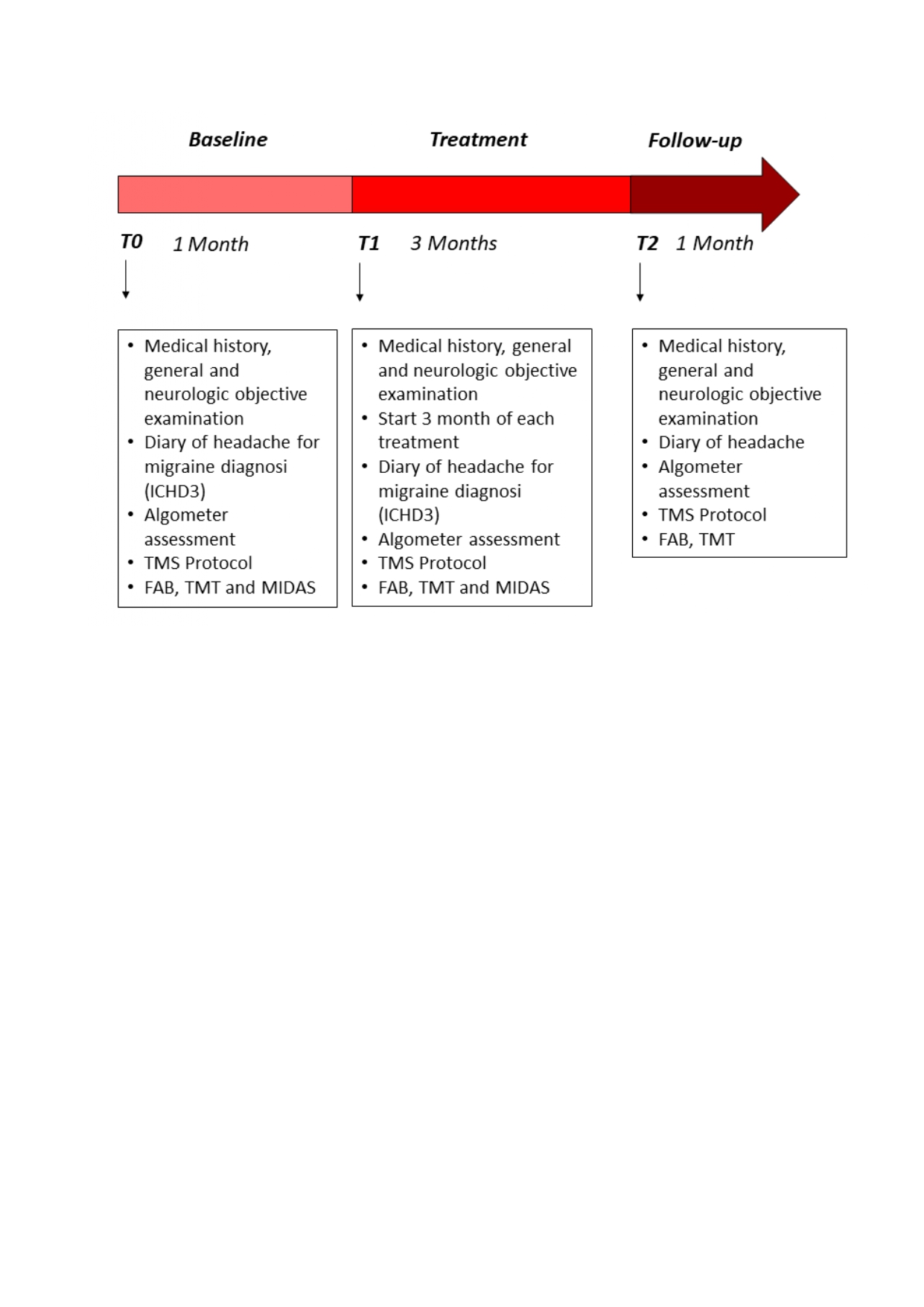
    Some neurophysiological and clinical outcomes were collected: resting motor threshold (rMT), short intracortical inhibition (SICI) and facilitation (ICF), pressure pain threshold (PPT), trail making test (TMT), frontal assessment battery (FAB), headache-related disability (MIDAS) and headache parameters. Then, participants were randomized into three groups: active exercise only (n = 10), cognitive task only (n = 10) and dual task protocol (n = 10). After 3 months of each treatment and after 1-month follow-up the same neurophysiological and clinical outcomes were revaluated.


    Results

    A total of 30 adults with episodic migraine were included. The active exercise-only group consisted of 2 men and 8 females (36.5 ± 13.9); the cognitive task-only group consisted of 2 men and 8 females (mean age 42.7 ± 11.2); the dual task protocol group consisted of 2 men and 8 females (mean age 48.3 ± 9.7). A significant time x group effect was only found for the trapezius muscle (p = 0.012, pη2 = 0.210), suggesting that PPT increased significantly only in active exercise and dual task protocol groups. A significant time effect was found for rMT (p < 0.001, pη2 = 0.473), MIDAS (p < 0.001, pη2 = 0.426), TMT (p < 0.001, pη2 = 0.338) and FAB (p < 0.001, pη2 = 0.462). A repeated measures ANOVA for SICI at 3 ms highlighted a statistically significant time effect for the dual task group (p < 0.001, pη2 = 0.629), but not for the active exercises group (p = 0.565, pη2 = 0.061), and for the cognitive training (p = 0.357, pη2 = 0.108).


    Conclusion

    The dual task protocol seems to have a more evident effect on both habituation and sensitization outcomes than the two monotherapies taken alone in people with migraine.

    REFERENCES

    • Goadsby PJ, Holland PR, Martins-Oliveira M, et al (2017) Pathophysiology of migraine: A disorder of sensory processing. Physiol Rev 97:. 10.1152/physrev.00034.2015
    • Coppola G, Pierelli F, Schoenen J (2009) Habituation and migraine. Neurobiol Learn Mem 92:. 10.1016/j.nlm.2008.07.006
    • Lemmens J, de Pauw J, van Soom T, et al (2019) The effect of aerobic exercise on the number of migraine days, duration and pain intensity in migraine: A systematic literature review and meta-analysis. J Headache Pain 20. 10.1186/s10194-019-0961-8
    • Deodato M, Granato A, Martini M, et al. Neurophysiological and Clinical Outcomes in Episodic Migraine Without Aura: A Cross-Sectional Study. J Clin Neurophysiol. 2023 doi: 10.1097/WNP.0000000000001055.
  • UN CASE REPORT: TRATTAMENTO DELLA PROTESI INVERSA DI SPALLA CON METODICHE A SECCO E IDROKINESITERAPIA

    A CASE REPORT: TREATMENT OF REVERSE SHOULDER PROSTHESIS WITH DRY METHODS AND HYDROKINESIOTHERAPY

    Autori

    Bruschini Marco (Università Sapienza di Roma e Ospedale Pediatrico Bambino Gesù – S. Marinella)

    Lanciotti Giulia (Laureata Università Sapienza di Roma)

    Introduction to clinical case

    The reverse shoulder prosthesis is now considered a surgical solution for patients with pathologies not treatable with anatomical prostheses, such as serious lesions of the rotator cuff. Hydrokinesistherapy, thanks to the water and its unique properties, has established itself as a valid method as support for dry post-operative rehabilitation. The objective of this study is to evaluate the effectiveness of hydrokinesitherapy integrated with dry rehabilitation in improving functional recovery and quality of life of patients undergoing reverse shoulder prosthesis. The protocol provides a combination of exercises adapted to the aquatic environment to promote an optimal return to function.

    Methods

    A case report was conducted on a 55-year-old patient who underwent reverse shoulder prosthesis and was subsequently included in a mixed rehabilitation program, including hydrokinesitherapy and dry therapy. The clinical evaluation was carried out in three moments (T0, T1, T2) through the scales NRS for pain and DASH for functionality, in addition to qualitative observations.

    Results

    The results show a significant improvement in pain and disability scores, with a progressive recovery of mobility and joint stability. The patient reported a reduction in pain already after the first sessions of hydrokinesitherapy, with a continuous improvement in movement control and ROM.

    Discussion and clinical relevance

    Hydrokinesistherapy, integrated with traditional rehabilitation, has proven to be an effective method in the post-operative recovery process for patients with reverse shoulder prosthesis, favoring the rehabilitation process. The results show a clear improvement between T0 and T1, highlighting how this approach can be considered as a valid therapeutic option, especially in the early stages of rehabilitation, but also adaptable to more advanced phases. In the proposed study, results were compared with contemporary scientific literature. In the first line it is noted that there are not a large number of articles on this subject and that they also involve other pathologies such as the reconstruction of the rotator cuff.

    REFERENCES

    Lädermann, A., Cikes, A., Zbinden, J., Martinho, T., Pernoud, A., & Bothorel, H. (2024). Hydrotherapy after Rotator Cuff Repair Improves Short-Term Functional Results Compared with Land-Based Rehabilitation When the Immobilization Period Is Longer. Journal of Clinical Medicine, 13(4), 954.  https://doi.org/10.3390/jcm13040954


    Cikes, A., Kadri, F., Van Rooij, F., & Lädermann, A. (2023). Aquatic therapy following arthroscopic rotator cuff repair enables faster improvement of Constant score than land‐based therapy or self‐rehabilitation therapy. Journal of Experimental Orthopaedics, 10(1), 2. https://doi.org/10.1186/s40634-022-00554-z


    Dufournet, A., Chong, X. L., Schwitzguébel, A., Bernimoulin, C., Carvalho, M., Bothorel, H., & Lädermann, A. (2022). Aquatic Therapy versus Standard Rehabilitation after Surgical Rotator Cuff Repair: A Randomized Prospective Study. Biology, 11(4), 610. https://doi.org/10.3390/biology11040610


    Burmaster, C., Eckenrode, B. J., & Stiebel, M. (2016). Early Incorporation of an Evidence-Based Aquatic-Assisted Approach to Arthroscopic Rotator Cuff Repair Rehabilitation: Prospective Case Study.  https://doi.org/10.2522/ptj.20140178