Evaluation of relationship between neuromuscular fatigue and manual dexterity in physiotherapists: an observational study
Autori
Libiani Gianluca [Istituti Clinici Scientifici Maugeri IRRCS, Department of Physical and Rehabilitation Medicine Unit, Institute of Veruno, Italy]
Arcolin Ilaria [Istituti Clinici Scientifici Maugeri IRRCS, Department of Physical and Rehabilitation Medicine Unit, Institute of Veruno, Italy]
Giardini Marica [Istituti Clinici Scientifici Maugeri IRRCS, Department of Physical and Rehabilitation Medicine Unit, Institute of Veruno, Italy]
Phan Florian [Istituti Clinici Scientifici Maugeri IRRCS, Department of Physical and Rehabilitation Medicine Unit, Institute of Veruno, Italy]
Sartorio Francesco [Istituti Clinici Scientifici Maugeri IRRCS, Department of Physical and Rehabilitation Medicine Unit, Institute of Veruno, Italy]
Godi Marco [Istituti Clinici Scientifici Maugeri IRRCS, Department of Physical and Rehabilitation Medicine Unit, Institute of Veruno, Italy]
Background and aims
Neuromuscular fatigue (NMF), localized in the upper limbs, is a common non-specific symptom that can impair strength and manual dexterity in many workers, including healthcare providers [1,2]. Among them, physiotherapists (PTs) are particularly vulnerable to this due to the physically demanding nature of their job, which often requires repetitive and prolonged use of the hands and forearms [3]. The primary aim of this observational study was to evaluate whether the NMF, expressed as a reduction in the manual dexterity, occurs over the course of a workday or workweek in a population of PTs. The secondary aim was to examine whether there are relationships between the reduction in manual dexterity and independent variables such as sex and age.
Methods
23 PTs (11 men, age 43 ± 12 years), working in hospital setting 5/7 days for 7 h/day, were recruited. The Functional Dexterity Test (FDT) was administered to each participant before and after the work shift, both at the beginning and at the end of the workweek, three times in each assessment. Mean values, separately for dominant and non-dominant hand, were analyzed by a two-way ANOVA between days (Monday, Friday) and within repeated measures (morning, evening). Subsequently, the post-hoc Tukey test was conducted. A linear regression model was applied for assessing the association between the workday change in FDT and the clinical independent measure (PT’s age and gender).
Results
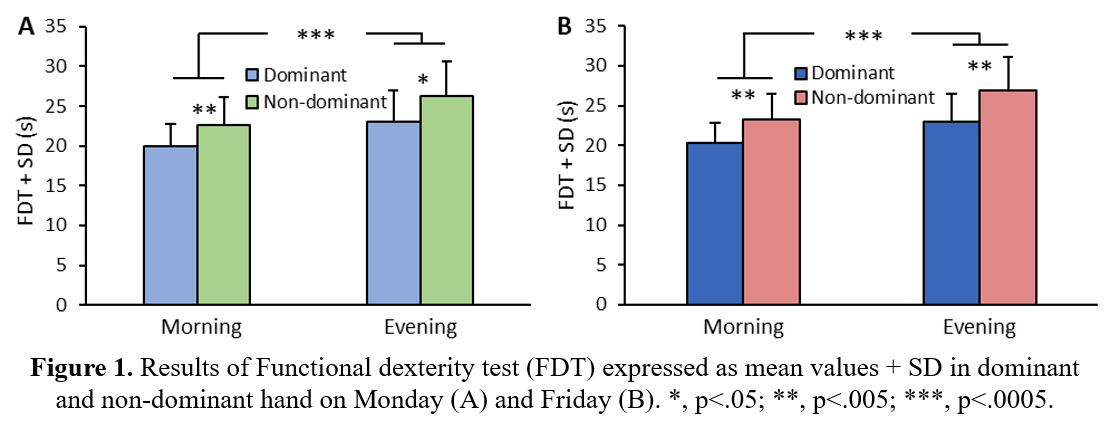
All PTs were right-handed and the time employed by the dominant hand was less than the one taken by the non-dominant hand in each assessment (p<0.0005; Figure 1). ANOVA showed a significant worsening in FDT performance after the daily work shift in both hands (p<0.0005), without interaction with the first and last day of the week (Figure 1).
Regression analysis showed a relationship between FDT and age, both in dominant (R2=0.23, p<0.05) and non-dominant hand (R2=0.16, p<0.05); in particular, younger PTs showed a lesser performance degradation following the daily work shift.
Conclusion
Work-related neuromuscular fatigue negatively affected the manual dexterity of PTs during the workday, but not between the beginning and end of the workweek. NMF builds up severely during the workday and it is influenced by age. Factors such as physical workload, work time, posture, and lack of adequate breaks may contribute to the onset of NMF [4,5]. Future studies should explore preventive solutions in order to reduce NMF in PTs.
REFERENCES
[1] Wan JJ, et al. Exp Mol Med. 2017;49(10):e384.
[2] Jacquier-Bret J, Gorce P. Int J Environ Res Public Health. 2023;20(1):841.
[3] Okhiria M, et al. Int J Occup Saf Ergon. 2020;26(2):406–412.
[4] Vieira ER, et al. J Back Musculoskelet Rehabil. 2016;29(3):417-428.
[5] Yasobant S, Rajkumar P. Indian J Occup Environ Med. 2014;18(2):75-81.