Categoria: congresso-2025

  • VALUTAZIONE FISIOTERAPICA DELLE ALTERAZIONI DELLA MIMICA FACCIALE IN PAZIENTI CON NEVRALGIA DEL TRIGEMINO

    FACIAL MIMIC ALTERATIONS IN TRIGEMINAL NEURALGIA: A PHYSIOTHERAPY ASSESSMENT

    Autori

    Valtorta Filippo [Neuroimaging Research Unit, Division of Neuroscience, IRCCS San Raffaele Scientific Institute, Milan, Italy]

    Basaia Silvia [Neuroimaging Research Unit, Division of Neuroscience, IRCCS San Raffaele Scientific Institute, Milan, Italy]

    Albano Luigi [Neuroimaging Research Unit, Division of Neuroscience, IRCCS San Raffaele Scientific Institute, Milan, Italy; and Vita-Salute San Raffaele University, Milan, Italy; and Neurosurgery and Gamma Knife Radiosurgery Unit, IRCCS Ospedale San Raffaele, Milan, Italy]

    Sibilla Elisa [Neuroimaging Research Unit, Division of Neuroscience, IRCCS San Raffaele Scientific Institute, Milan, Italy; and Neurology Unit, IRCCS San Raffaele Scientific Institute, Milan, Italy]

    Sarasso Elisabetta [Neuroimaging Research Unit, Division of Neuroscience, IRCCS San Raffaele Scientific Institute, Milan, Italy; and Vita-Salute San Raffaele University, Milan, Italy; and Department of Neuroscience, Rehabilitation, Ophthalmology, Genetics and Maternal Child Health, University of Genoa, Genoa, Italy]

    Emedoli Daniele [Department of Rehabilitation and Functional Recovery, IRCCS Ospedale San Raffaele, Milan, Italy]

    Pompeo Edoardo [Vita-Salute San Raffaele University, Milan, Italy; and Neurosurgery and Gamma Knife Radiosurgery Unit, IRCCS Ospedale San Raffaele, Milan, Italy]

    Mortini Pietro [Vita-Salute San Raffaele University, Milan, Italy; and Neurosurgery and Gamma Knife Radiosurgery Unit, IRCCS Ospedale San Raffaele, Milan, Italy]

    Filippi Massimo [Neuroimaging Research Unit, Division of Neuroscience, and Neurology Unit, and Neurorehabilitation Unit, and Neurophysiology Service, IRCCS San Raffaele Scientific Institute, Milan, Italy; and Vita-Salute San Raffaele University, Milan, Italy]

    Agosta Federica [Neuroimaging Research Unit, Division of Neuroscience, IRCCS San Raffaele Scientific Institute, Milan, Italy; and Neurology Unit, IRCCS San Raffaele Scientific Institute, Milan, Italy; and Vita-Salute San Raffaele University, Milan, Italy]

    Background and aims

    Trigeminal Neuralgia (TN) is a chronic neuropathic pain disorder characterized by paroxysmal episodes of facial pain in the distribution of the fifth cranial nerve. First-line treatment is pharmacological, while Gamma Knife radiosurgery (GKRS) becomes an option if medications fail. This study aimed to investigate facial mimicry alterations and the potential for recovery through a virtual reality (VR) rehabilitation.

    Methods

    Thirteen TN patients and 29 controls age- and sex-matched underwent facial mimicry assessment. TN patients were evaluated at baseline (pre-GKRS) and 3-months post-GKRS, while controls were assessed only at baseline. Seven TN patients also underwent VR-based facial mimic rehabilitation between the two timepoints. Fourteen photographs were taken during specific facial actions, and images were processed using two specific software to extract 40 facial metrics by applying 70 virtual face markers. Metrics were compared across timepoints and between rest and action positions. Comparisons were conducted between TN patients and controls, between the pain side and the no-pain side with controls, and between TN patients at baseline and follow-up.

    Results

    At baseline, significant differences in facial expressions were observed between all TN patients and controls during eyebrow furrowing, lip protrusion, and smiling. No significant differences were found between the TN pain side and the no-pain side in TN patients; however, both sides differed significantly from controls in eyebrow furrowing and smiling. Finally, longitudinal analysis revealed a significant improvement in eyebrow elevation at follow-up in TN patients, although no differences were observed between the VR and non-VR groups.

    Conclusion

    Results suggested TN patient exhibited reduced movement in different facial muscles compared to controls, and that limitations affect significantly both pain and no-pain side. Longitudinal results highlighted that both pain and no pain sides show improvements, with more notable changes in the no pain side for VR group, but a bigger sample size in needed to explore and confirm these results. These findings suggest altered facial mimicry due to TN, with potential for recovery. The role of physiotherapy in restoring facial movement over time remains an intriguing area for future research.

    REFERENCES

    [1] Emedoli D, Alemanno F, Houdayer E, Brugliera L, Iannaccone S, Tettamanti A. Mobile application tool for remote rehabilitation after discharge from coronavirus disease-19 rehabilitation unit. Healthc Technol Lett. 2022 Aug 8;9(4-5):70-76. doi: 10.1049/htl2.12033. PMID: 36225346; PMCID: PMC9535743.

    [2] Dusseldorp JR, van Veen MM, Mohan S, Hadlock TA. Outcome Tracking in Facial Palsy. Otolaryngol Clin North Am. 2018 Dec;51(6):1033-1050. doi: 10.1016/j.otc.2018.07.003. Epub 2018 Aug 29. PMID: 30172554.

    Fundings. Italian Ministry of Health (GR-2021-12374601).
  • CORRELATI NEURALI DEL DOLORE CENTRALE IN PAZIENTI CON NEVRALGIA TRIGEMINALE: ANALISI DI RISONANZA MAGNETICA FUNZIONALE

    NEURAL CORRELATES OF CENTRAL PAIN IN TRIGEMINAL NEURALGIA: A FUNCTIONAL MRI ANALYSIS

    Autori

    Valtorta Filippo [Neuroimaging Research Unit, Division of Neuroscience, IRCCS San Raffaele Scientific Institute, Milan, Italy]

    Basaia Silvia [Neuroimaging Research Unit, Division of Neuroscience, IRCCS San Raffaele Scientific Institute, Milan, Italy]

    Albano Luigi [Neuroimaging Research Unit, Division of Neuroscience, IRCCS San Raffaele Scientific Institute, Milan, Italy; and Vita-Salute San Raffaele University, Milan, Italy; and Neurosurgery and Gamma Knife Radiosurgery Unit, IRCCS Ospedale San Raffaele, Milan, Italy]

    Pompeo Edoardo [Vita-Salute San Raffaele University, Milan, Italy; and Neurosurgery and Gamma Knife Radiosurgery Unit, IRCCS Ospedale San Raffaele, Milan, Italy]

    Sibilla Elisa [Neuroimaging Research Unit, Division of Neuroscience, IRCCS San Raffaele Scientific Institute, Milan, Italy; and Neurology Unit, IRCCS San Raffaele Scientific Institute, Milan, Italy]

    Sarasso Elisabetta [Neuroimaging Research Unit, Division of Neuroscience, IRCCS San Raffaele Scientific Institute, Milan, Italy; and Vita-Salute San Raffaele University, Milan, Italy; and Department of Neuroscience, Rehabilitation, Ophthalmology, Genetics and Maternal Child Health, University of Genoa, Genoa, Italy]

    Emedoli Daniele [Department of Rehabilitation and Functional Recovery, IRCCS Ospedale San Raffaele, Milan, Italy]

    Mortini Pietro [Vita-Salute San Raffaele University, Milan, Italy; and Neurosurgery and Gamma Knife Radiosurgery Unit, IRCCS Ospedale San Raffaele, Milan, Italy]

    Filippi Massimo [Neuroimaging Research Unit, Division of Neuroscience, and Neurology Unit, and Neurorehabilitation Unit, and Neurophysiology Service, IRCCS San Raffaele Scientific Institute, Milan, Italy; and Vita-Salute San Raffaele University, Milan, Italy]

    Agosta Federica [Neuroimaging Research Unit, Division of Neuroscience, IRCCS San Raffaele Scientific Institute, Milan, Italy; and Neurology Unit, IRCCS San Raffaele Scientific Institute, Milan, Italy; and Vita-Salute San Raffaele University, Milan, Italy]

    Background and aims

    Resting-state functional imaging (rs-fMRI) in trigeminal neuralgia (TN) is known to show hyperactivity in sensorimotor and affective‐pain regions with concurrent insular hypoactivity. The goal of this study was to investigate functional connectivity (FC) alterations in TN patients and their modifications after GKRS.

    Methods

    Forty-one TN patients and 54 healthy controls, age- and sex-matched, underwent a brain MRI protocol, including rs-fMRI on a 3 Tesla scanner. Patients were scanned at baseline (pre-GKRS) and 3 months after GKRS, while controls were scanned only at baseline. After FSL-standard preprocessing, rs-fMRI data set was decomposed into independent components (ICs) using MELODIC (Multivariate Exploratory Linear Optimized Decomposition into Independent Components), with a free estimation of the number of components. To identify differences in rs-FC networks, General Linear Models (GLMs) were applied in FSL, comparing each original network between patients and controls. Analyses were performed between patients and controls at baseline and 3 months post-GKRS, and within TN subgroups, comparing patients with right-side onset (TNR) and left-side onset (TNL).

    Results

    Before GKRS, patients showed reduced connectivity(p<0.05) in the ventral default mode network (vDMN), affecting areas such as the precuneus and cingulate gyrus. Conversely, patients had increased connectivity(p<0.05) in the posterior salience, sensorimotor, and basal ganglia networks compared to controls, involving regions like the postcentral gyrus, putamen, and amygdala. At 3-month follow-up, the vDMN reduction remained similar to preoperative levels, while additional reductions(p<0.05) were observed in the precuneus and cerebellum networks. Moreover, patients still showed increased connectivity(p<0.05) in the posterior salience network, though less extensive. Longitudinal analysis indicated that basal ganglia, posterior salience, and sensorimotor networks approaching levels similar to controls, while cerebellum connectivity significantly decreased. Considering TN subgroups, TNR largely drove the overall results due to its higher prevalence, but no significant differences in connectivity were found between subgroups, both preoperatively and post-GKRS.

    Conclusion

    This study identifies significant alterations in FC in TN patients before and after GKRS compared to controls. These changes may reflect neural adaptations associated with chronic pain in TN. The modifications observed 3 months post-GKRS further support the role of pain in shaping FC. However, the specific networks involved and the mechanisms driving these alterations remain unclear. The similarity between TNR and TNL groups suggests a shared underlying mechanism in TN-related connectivity changes. These findings indicate treatment-induced neuroplasticity, but further research is required to assess the long-term effects of GKRS on brain network reorganization.

    REFERENCES

    [1] Nardoni L, Tullo MG, Giulia DS, Fiorelli M, Caramia F. Structural brain alterations and changes in resting-state functional connectivity in patients with trigeminal neuralgia: A meta-analysis. Neuroimage Clin. 2025 Feb 27;46:103759. doi: 10.1016/j.nicl.2025.103759. Epub ahead of print. PMID: 40086208; PMCID: PMC11954123.

    [2] Canu E, Calderaro D, Castelnovo V, Basaia S, Magno MA, Riva N, Magnani G, Caso F, Caroppo P, Prioni S, Villa C, Pain D, Mora G, Tremolizzo L, Appollonio I, Poletti B, Silani V, Filippi M, Agosta F. Resting state functional brain networks associated with emotion processing in frontotemporal lobar degeneration. Mol Psychiatry. 2022 Nov;27(11):4809-4821. doi: 10.1038/s41380-022-01612-9. Epub 2022 May 20. PMID: 35595978; PMCID: PMC9734056.

    Fundings. Italian Ministry of Health (GR-2021-12374601).
  • ALTERAZIONI CLINICHE E STRUTTURALI CEREBELLARI IN PAZIENTI CON MALATTIA DI PARKINSON E FREEZING DEL CAMMINO

    CLINICAL AND CEREBELLAR STRUCTURAL ALTERATIONS IN PARKINSON’S DISEASE PATIENTS WITH FREEZING OF GAIT

    Autori

    Grassi Andrea (Neuroimaging Research Unit, Division of Neuroscience, IRCCS San Raffaele Scientific Institute, Milan, Italy; Neurotech Hub, Vita-Salute San Raffaele University, Milan, Italy)

    Sarasso Elisabetta (Vita-Salute San Raffaele University, Milan, Italy; Neuroimaging Research Unit, Division of Neuroscience, IRCCS San Raffaele Scientific Institute, Milan, Italy; Department of Neuroscience, Rehabilitation, Ophthalmology, Genetics and Maternal Child Health, University of Genoa, Genoa, Italy; Neurotech Hub, Vita-Salute San Raffaele University, Milan, Italy); Gardoni Andrea (Vita-Salute San Raffaele University, Milan, Italy; Neuroimaging Research Unit, Division of Neuroscience, IRCCS San Raffaele Scientific Institute, Milan, Italy; Neurotech Hub, Vita-Salute San Raffaele University, Milan, Italy); Zenere Lucia (Neuroimaging Research Unit, Division of Neuroscience, IRCCS San Raffaele Scientific Institute, Milan, Italy; Neurotech Hub, Vita-Salute San Raffaele University, Milan, Italy)

    Basaia Silvia (Neuroimaging Research Unit, Division of Neuroscience, IRCCS San Raffaele Scientific Institute, Milan, Italy; Neurotech Hub, Vita-Salute San Raffaele University, Milan, Italy); Bonardi Giulia (University of Verona, Verona, Italy); Carta Sara (University of Verona, Verona, Italy)

    Mariotto Sara (University of Verona, Verona, Italy); Di Vico Ilaria (University of Verona, Verona, Italy); Mantovani Elisa (University of Verona, Verona, Italy)

    Canu Elisa (Neuroimaging Research Unit, Division of Neuroscience, IRCCS San Raffaele Scientific Institute, Milan, Italy; Neurology Unit, IRCCS San Raffaele Scientific Institute, Milan, Italy; Neurotech Hub, Vita-Salute San Raffaele University, Milan, Italy); Bressan Miriana (University of Verona, Verona, Italy); Castelnovo Veronica (Neuroimaging Research Unit, Division of Neuroscience, IRCCS San Raffaele Scientific Institute, Milan, Italy; Neurotech Hub, Vita-Salute San Raffaele University, Milan, Italy)

    Sibilla Elisa (Neuroimaging Research Unit, Division of Neuroscience, IRCCS San Raffaele Scientific Institute, Milan, Italy; Neurotech Hub, Vita-Salute San Raffaele University, Milan, Italy); Tripodi Chiara (Vita-Salute San Raffaele University, Milan, Italy; Neuroimaging Research Unit, Division of Neuroscience, IRCCS San Raffaele Scientific Institute, Milan, Italy; Neurotech Hub, Vita-Salute San Raffaele University, Milan, Italy); Freri Fabiola (Neuroimaging Research Unit, Division of Neuroscience, IRCCS San Raffaele Scientific Institute, Milan, Italy; Neurotech Hub, Vita-Salute San Raffaele University, Milan, Italy)

    Balestrino Roberta (Neurology Unit, IRCCS San Raffaele Scientific Institute, Milan, Italy; Neurorehabilitation Unit, IRCCS San Raffaele Scientific Institute, Milan, Italy; Neurotech Hub, Vita-Salute San Raffaele University, Milan, Italy); Trentinaglia Milena (University of Verona, Verona, Italy); Maffei Francesco (University of Verona, Verona, Italy)

    Chiodega Vanessa (University of Verona, Verona, Italy); Taburin Stefano (University of Verona, Verona, Italy)

    Volontè Maria Antonietta (Neuroimaging Research Unit, Division of Neuroscience, IRCCS San Raffaele Scientific Institute, Milan, Italy); Tinazzi Michele (University of Verona, Verona, Italy)

    Filippi Massimo (Vita-Salute San Raffaele University, Milan, Italy; Neuroimaging Research Unit, Division of Neuroscience, IRCCS San Raffaele Scientific Institute, Milan, Italy; Neurology Unit, IRCCS San Raffaele Scientific Institute, Milan, Italy; Neurorehabilitation Unit, IRCCS San Raffaele Scientific Institute, Milan, Italy; Neurophysiology service, IRCCS San Raffaele Scientific Institute, Milan, Italy; Neurotech Hub, Vita-Salute San Raffaele University, Milan, Italy); Agosta Federica (Vita-Salute San Raffaele University, Milan, Italy; Neuroimaging Research Unit, Division of Neuroscience, IRCCS San Raffaele Scientific Institute, Milan, Italy; Neurology Unit, IRCCS San Raffaele Scientific Institute, Milan, Italy; Neurotech Hub, Vita-Salute San Raffaele University, Milan, Italy)

    Background and aims

    Cerebellum plays an increasingly recognized role in gait modulation and FoG in PD patients [1]. This study aimed at assessing clinical and cerebellar volume differences in Parkinson’s disease (PD) patients with and without freezing of gait (PD-FoG and PD-NOFoG).

    Methods

    Thirty-four PD-FoG, 35 PD-NOFoG, and 23 healthy controls underwent clinical assessment and structural MRI. Clinical evaluation included walking, balance, and a comprehensive neuropsychological battery. Grey matter cerebellar volumes were assessed using SUIT atlas. Analyses were Bonferroni-corrected for number of groups.

    Results

    Compared to healthy controls, both PD-FoG and PD-NOFoG groups showed reduced walking speed, lower balance confidence (ABC scale), impaired balance (MiniBESTest), and an increased number of steps to walk 10 meters both at comfortable and maximal speed. Additionally, they exhibited a worse performance in memory, attention, and executive functions. Only PD-FoG patients showed increased Timed-Up-and-Go test (TUG) completion time both with and without a cognitive dual-task, and a worse visuospatial performance, delayed recall of Rey’s word list, Trail-Making-Test B-A, and phonemic fluency. Both PD groups exhibited reduced cerebellar lobule X volumes, but only PD-FoG patients had a reduced vermis VIIb volume compared to controls. When directly compared, PD-FoG patients demonstrated a greater number of steps in the 10-meter walking test at maximal speed, lower balance confidence, and worse phonemic fluency relative to PD-NOFoG patients. Additionally, PD-FoG patients exhibited increased volumes in cerebellar lobules VIIIb and IX, as well as vermis crus II.

    Conclusion

    These findings suggest that structural alterations in specific cerebellar regions, involved in motor and cognitive control of movement, may be linked to the pathophysiology of FoG in patients with PD. Further research is needed to determine if these changes reflect compensatory mechanisms or contribute directly to the development of FoG.

    REFERENCES

    [1] Gardoni A, Agosta F, Sarasso E, Basaia S, Canu E, Leocadi M, Castelnovo V, Tettamanti A, Volontè MA, Filippi M. Cerebellar alterations in Parkinson’s disease with postural instability and gait disorders. J Neurol. 2023 Mar;270(3):1735-1744. doi: 10.1007/s00415-022-11531-y. Epub 2022 Dec 19. PMID: 36534200.

  • Risultati clinici della combinazione di ansiolitico, blocco del nervo soprascapolare, infiltrazione di corticosteroidi e fisioterapia in soggetti con spalla congelata: uno studio retrospettivo.

    Risultati clinici della combinazione di ansiolitico, blocco del nervo soprascapolare, infiltrazione di corticosteroidi e fisioterapia in soggetti con spalla congelata: uno studio retrospettivo.

    THE CLINICAL RESULTS OF COMBINATION OF ANXIOLYSIS, SUPRASCAPULAR NERVE BLOCK, CORTICOSTEROID INJECTION AND PHYSIOTHERAPY ON SUBJECTS WITH FROZEN SHOULDER: A RETROSPECTIVE STUDY

    Autori

    Martino Gabriele (University of Molise, Campobasso, Italy)

    Venturin Davide (University of Molise, Campobasso, Italy)

    Pellicciari Leonardo (IRCCS Istituto delle Scienze Neurologiche di Bologna, Bologna, Italy)

    Casagrande Lucia (Azienda ULSS 2, Marca trevigiana, Treviso, Italy)

    Brindisino Fabrizio (University of Molise, Campobasso, Italy)

    Poser Antonio (University of Siena, Siena, Italy)

    Background and aims

    Frozen shoulder (FS) is a gleno-humeral pathology characterized by an insidious onset, increasing pain and loss of active and passive range of motion. The restriction of mobility is related to modification of collagen, overexpression of proteins and to presence of muscle guarding. The presence of muscle guarding and pain could reduce the efficacy of the physiotherapy, the adherence to the treatment and could increase emotional commitment during rehabilitation. The aim of this study was to evaluate the clinical results of a combined treatment of anxiolysis and SupraScapular Nerve Block (SSNB) with intra-articular corticosteroid injection and physiotherapy in subjects with FS.

    Methods

    29 subjects received SSNB, intra-articular corticosteroid injections, and intravenous anxiolysis, followed 30 minutes later by physiotherapy involving end-range, high-grade, and painful glenohumeral mobilizations, repeated throughout the first month. Participants were also instructed to perform 5 home stretching exercises for three months. Outcomes—pROM, SF-36 (and subscores), DASH, and SPADI—were assessed at baseline (T0), day 10 (T1), and 3-month follow-up (T5).

    Results

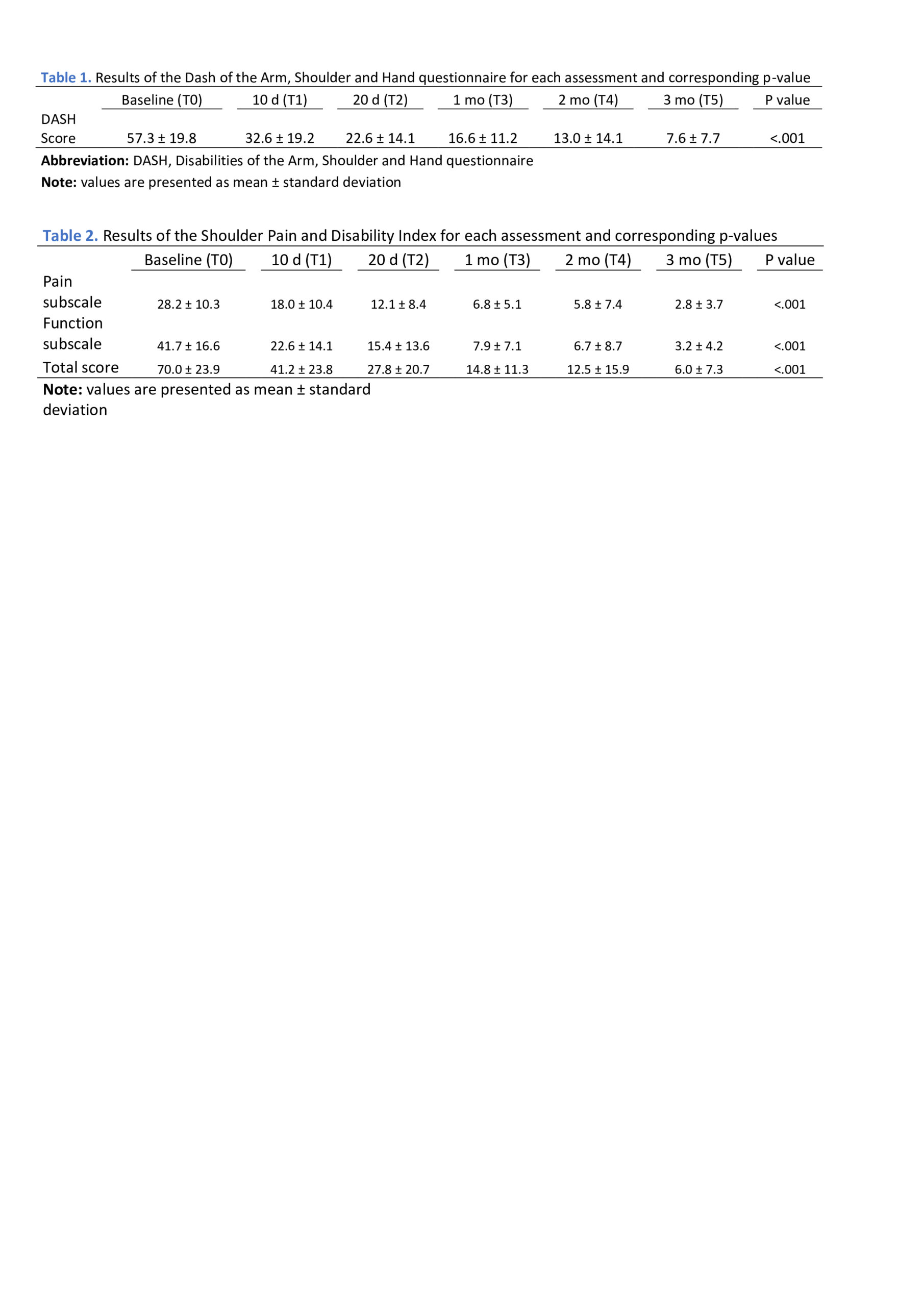
    SPADI and DASH scores showed significant improvement from T1 (p = .000), maintained through T5 (Table 1-2). SF-36 subscales for Physical Functioning, Physical Role, and Emotional Role reached statistical significance at T3 (p = .007; .000; .034), T4 (.001; .000; .003), and T5 (.001; .000; .004). Bodily Pain and Social Functioning showed improvements from T2 (p = .003; .043) through T5 (.000; .000). Vitality and Mental Health were significant at T4 (.017; .007) and T5 (.000; .001) (Table 3). All average pROM scores improved significantly from T1 to T5, with clinically relevant gains in flexion, abduction, and external rotation at both 90° and 0° of abduction compared to T0 (Table 4).

    Conclusion

    The combination of anxiolysis, injection and SSNB could have been useful to create a therapeutic window in the first session, during which painful mobilization and stretching techniques could be applied more successfully and to allow a quicker recovery in the short term, orienting through a multi-professional path of care would be helpful for subjects with FS. Anxiolysis, SSNB, and intra-articular corticosteroid injections, combined with a detailed rehabilitation techniques and a simple home exercise program, were effective in improving shoulder pain, range of motion, and disability in the short term.

    REFERENCES

    1- Lewis J. Frozen shoulder contracture syndrome – Aetiology, diagnosis and management. Man Ther. 2015
    Feb 1;20(1):2–9.

    2- Hollmann L, Halaki M, Kamper SJ, Haber M, Ginn KA. Does muscle guarding play a role in range of motion loss in patients with frozenshoulder? Musculoskelet Sci Pract. 2018 Oct 1;37:64–68.

    3- Venturin D, Brindisino F, Ristori D, et al. The use of corticosteroid/anesthetic injections in conjunction with physical therapy in the treatment of idiopathic frozen shoulder: a case series. JOSPT Cases. 2021;1(4):248–265.

  • La disabilità è associata al dolore, al range of motion e alla qualità della vita correlata alla salute nei soggetti con spalla congelata? Uno studio trasversale.

    Is disability associated with pain, range of motion, and health-related quality of life in subjects with frozen shoulder? A Cross-sectional study

    Autori

    Poser Antonio (Kinè s.r.l, Viale della Quercia 2/B, Treviso, Italy – University of Siena c/o via Banchi di Sotto, 55, Siena, Italy)

    Brindisino Fabrizio (Department of Medicine and Health Science “Vincenzo Tiberio”, University of Molise)

    Lot Sebastiano (Physiotherapy private practice Kinè c/o Viale Venezia 13/Q San Vendemiano, Italy)

    Andriesse Arianna (Medical Translation Private Practice c/o Andriesse Medical Translator, Lecce, Italy)

    Rossi Alex (Kinè s.r.l, Viale della Quercia 2/B, Treviso, Italy – Tor Vergata University Via Columbia,2 00133 Rome, Italy)

    Feller Daniel (Provincial Agency for Health of the Autonomous Province of Trento, Trento, Italy – Centre of Higher Education for Health Sciences of Trento, Trento, Italy – Department of General Practice, Erasmus MC, University Medical Center, Rotterdam, The Netherlands)

    Germano Guerra (Department of Medicine and Health Science “Vincenzo Tiberio”, University of Molise)

    Venturin Davide ((Kinè s.r.l, Viale della Quercia 2/B, Treviso, Italy – University of Siena c/o via Banchi di Sotto, 55, Siena, Italy – Department of Medicine and Health Science “Vincenzo Tiberio”, University of Molise- Tor Vergata University Via Columbia,2 00133 Rome, Italy)

    Introduction to clinical case

    Frozen shoulder (FS) is a disabling condition characterized by pain and restricted shoulder range of motion (ROM), impacting daily activities and quality of life. While physical impairments are well-recognized contributors to disability, recent evidence highlights the role of psychosocial factors. This cross-sectional study aimed to investigate whether disability in FS patients is associated with pain, ROM limitation (specifically flexion and external rotation), and mental health-related quality of life aspects, as assessed through Patient-Reported Outcome Measures (PROMs).

    Methods

    A total of 123 individuals with clinically diagnosed FS were recruited from physiotherapy clinics in Italy. Passive ROM of shoulder flexion and external rotation were measured, and participants completed the DASH, SPADI (pain subscale), and SF-36 questionnaires (Vitality, Emotional Health, Mental Health, and Social Functioning subscores). A multivariable linear regression model was used to identify associations with disability (DASH score), adjusting for potential confounders (age, gender, limb dominance, and endocrine-metabolic conditions).

    Results

    Significant associations with disability were found for SPADI-pain (standardized coefficient = 8.83, p < 0.01), SF-36 Vitality (standardized coefficient = –3.43, p = 0.04), and shoulder flexion ROM (standardized coefficient = –3.34, p = 0.01). No significant associations emerged for external rotation ROM, Emotional Health, Mental Health, or Social Functioning.

    Discussion and clinical relevance

    Pain, reduced flexion ROM, and perceived vitality are key contributors to self-reported disability in FS. While ROM recovery strategies should focus on improving flexion, the inclusion of PROMs such as vitality may support a more comprehensive, biopsychosocial assessment. These findings highlight the multifactorial nature of FS-related disability and support the integration of psychological and physical health variables into treatment planning.

    REFERENCES

    1- Brindisino F., Silvestri E., Gallo C., Venturin D., Di Giacomo G., Peebles A. M., Provencher M. T., Innocenti T. 2022. Depression and Anxiety Are Associated With Worse Subjective and Functional Baseline Scores in Patients With Frozen Shoulder Contracture Syndrome: A Systematic Review. Arthroscopy, Sports Medicine, and Rehabilitation, 4(3), e1219–e1234.

    3- Mertens M. G., Struyf F., Verborgt O., Dueñas L., Balasch-Bernat M., Navarro-Ledesma S., Fernandez-Sanchez M., Luque-Suarez A., Lluch Girbes E., Meeus M. 2023. Exploration of the clinical course and longitudinal correlations in frozen shoulder: The role of autonomic function, central pain processing, and psychological variables. A longitudinal multicenter prospective observational study. Musculoskeletal Science and Practice, 67, 102857.

    2- De Cristofaro L., Brindisino F., Venturin D., Andriesse A., Pellicciari L., Poser A. 2024. Prognostic factors of nonsurgical intervention outcomes for patients with frozen shoulder: a retrospective study. Disability and Rehabilitation, 0(0), 1–8.

  • L’intelligenza artificiale è affidabile nel valutare la validità interna di studi clinici randomizzati in fisioterapia? Uno studio trasversale

    L’intelligenza artificiale è affidabile nel valutare la validità interna di studi clinici randomizzati in fisioterapia? Uno studio trasversale

    Is artificial intelligence reliable in assessing the internal validity of the randomized controlled trial in physiotherapy? A cross-sectional study

    Autori

    Giacomo Perugino – (Program in Physical Therapy, University of Florence, Florence, Italy)

    Camilla De Pedrini – (UniCamillus, International Medical University in Rome, Rome, Italy)

    Daniele Piscitelli – (School of Medicine and Surgery, University of Milano-Bicocca, Monza, Italy)

    Alessandro Ugolini – (Independent researcher, Empoli (FI), Italy)

    Alessandra Carlizza – (UniCamillus, International Medical University in Rome, Rome, Italy)

    Leonardo Pellicciari (IRCCS Istituto delle Scienze Neurologiche di Bologna, Bologna, Italy)

    Background and aims

    Artificial intelligence (AI) is defined as the ability of computer systems to perform tasks that would traditionally require human intelligence. Its application is widespread in physiotherapy science, supporting procedures such as gait analysis and diagnostic image interpretation.

    A crucial aspect of the critical appraisal in the evidence-based practice is assessing the internal validity of randomized clinical trials (RCTs) to ensure the reliability of results. Among instruments assessing the internal validity, the PEDro scale is used to evaluate the internal validity of RCTs.

    This study aims to evaluate the reliability and agreement of ChatGPT (i.e., a generative AI) in assigning the PEDro score by comparing AI-generated scores with human scores.

    Methods

    Artificial intelligence (AI) is defined as the ability of computer systems to perform tasks that would traditionally require human intelligence. Its application is widespread in physiotherapy science, supporting procedures such as gait analysis and diagnostic image interpretation.

    A crucial aspect of the critical appraisal in the evidence-based practice is assessing the internal validity of randomized clinical trials (RCTs) to ensure the reliability of results. Among instruments assessing the internal validity, the PEDro scale is used to evaluate the internal validity of RCTs.

    This study aims to evaluate the reliability and agreement of ChatGPT (i.e., a generative AI) in assigning the PEDro score by comparing AI-generated scores with human scores.

    Results

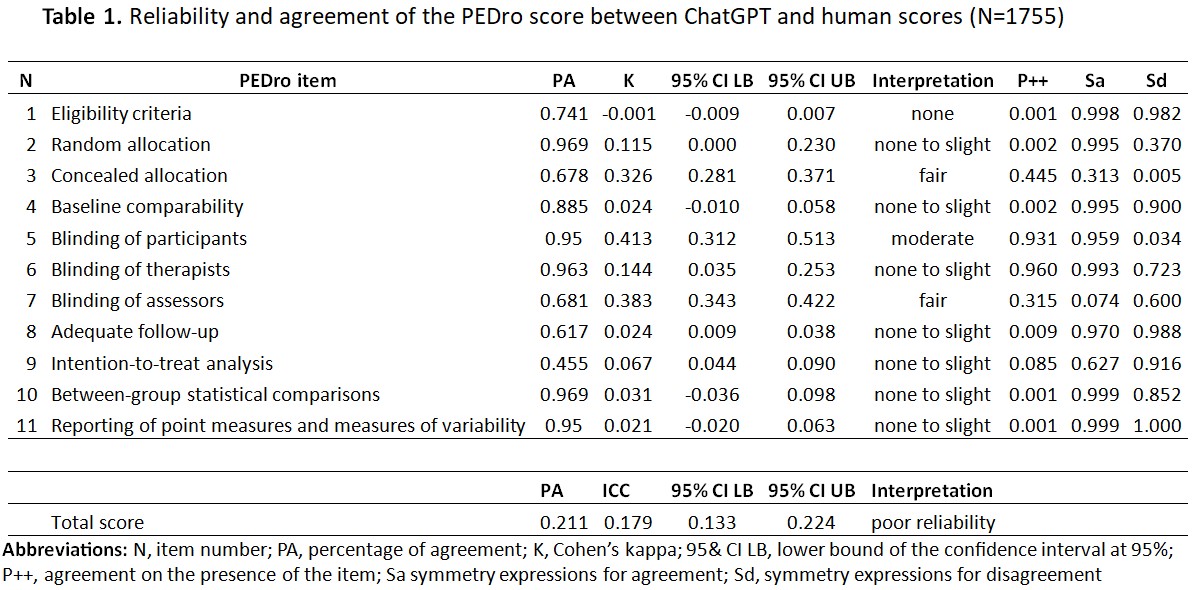
    1755 RCTs were included. The percentage of agreement ranged between 67.8% (Item#3) and 96.9% (Item#2 and Item#10). The k values were below 0.450, indicating slight to moderate reliability; however, these findings are influenced by the k paradox (i.e., higher percentage of agreement but lower k, consequent to the heterogeneity in the rating). P++ findings showed that the two assessors attributed few simultaneous “yes” responses, while the SA indicates that the concordance is mainly reported in “yes” responses, while the SD showed that one evaluator tends to say “yes” more than the other. Finally, the ICC for the total score indicates poor inter-rater reliability. Similar recurrent result patterns are reported for the analyses of the subcategories.

    Conclusion

    Our results show variability in agreement between ChatGPT and human reviewers depending on the items considered. Items with high agreement are related to the presence in the full texts of keywords recognizable by AI, while more complex items that require cognitive reasoning (i.e., Item#9). To date, ChatGPT could be used as a preliminary screening tool to assess certain PEDro items, but it cannot replace human assessment.

    REFERENCES

    Cashin AG, McAuley JH. Clinimetrics: Physiotherapy Evidence Database (PEDro) Scale. J Physiother. 2020 Jan;66(1):59. doi: 10.1016/j.jphys.2019.08.005.

    Maher CG, Sherrington C, Herbert RD, Moseley AM, Elkins M. Reliability of the PEDro scale for rating quality of randomized controlled trials. Phys Ther. 2003 Aug;83(8):713-21.

  • Integrazione tra Sistemi di Valutazione delle Performance Sanitarie e Misure di Esito Riportate dai Pazienti: protocollo di una scoping review.

    Integration between Healthcare Performance Evaluation Systems and Patient-Reported Measures (PROM and PREM): a Scoping Review protocol.

    Autori

    Donati Perla [Department of Technical Health Professions in Rehabilitation and Prevention – Unit of Health Professions in Functional Rehabilitation, Lucca (LU)]

    Borghi Sara [ Department of Biomedical and Neuromotor Sciences (DIBINEM), Alma Mater Studiorum – University of Bologna, Bologna, Italy] [Department of Physical Medicine and Rehabilitation, Azienda USL Bologna, Ospedale di San Giovanni in Persiceto, Bologna, Italy]

    Miccini Rebecca [Assistant Professor of Accounting, Department of Economics and Management, University of Florence, Florence, Italy]

    Background and aims

    Performance Evaluation Systems (PES) in healthcare are recognized as effective tools for improving care quality and optimizing resources(1-3).

    Numerous countries have implemented advanced performance evaluation systems that integrate patient-reported outcome measures (PROMs) and patient-reported experience measures (PREMs). PROMs assess health outcomes from the patient’s perspective. PREMs evaluate the patient’s experience with healthcare(1-2)

    To the best of our knowledge, no studies have highlighted the importance of investigating the relationship between healthcare performance indicators and PROMs and PREMs data within selected healthcare systems. Therefore, the aim of this scoping review is to understand how these tools can be integrated into performance evaluation systems to optimize resources, enhance care quality and improve patient experience(4)

    Methods

    This scoping review will be performed and reported according to the PRISMA-ScR (extension for Scoping Reviews) guidelines. PubMed, Scopus, Embase, Web of Science, Business Source Complete, Econlit with Full Text and CINAHL were searched from 2015 up to February 4th 2025. To be included, studies must meet the following inclusion criteria: published in journals only; they must investigate at least one performance evaluation measure; the performance measure must be quantitative; the measured outcomes must have an economic or managerial relevance; hospital or healthcare-related context. Exclusion criteria: exclusively clinical relevance of the measured outcome; languages other than Italian or English; “proceedings” or “book reviews” articles.

    Data extraction will be performed using RAYYAN QCRI online software by two blinded reviewers (PD and SB); a third one (RM) will be involved in case of disagreements.

    Results

    A total of 5719 records were retrieved by the bibliographic search, of which 1419 were duplicates. The remaining 4300 citations will be sceened by two blinded reviewers. Data extracted from the included studies will be presented in tabular forms and will include: authors, year of publication, country/state, study design, context characteristics, PROMs or PREMs, performance evaluation systems. Then, a word cloud diagram will be produced. The expected results will be to identify the existing research streams in the literature and the related gaps.

    Conclusion

    A narrative summary of the tabulated results will be provided, identifying the relationship between healthcare organizations’ performance evaluation systems and PROM and PREM and analyzing the reference context and analyizing gaps in existing literature. Finally, this study aims to contribute by providing an overview of what has been studied on the topic and what still needs to be explored, offering insights for future research.

    REFERENCES

    1 Bevan G, Evans A, Nuti S. Reputations count: why benchmarking performance is improving health care across the world. Health Econ Policy Law. 2019;14(2):141-161.


    2 Nuti, S., Noto, G., Vola, F., Vainieri, M. Let’s play the patients music: A new generation of performance measurement systems in healthcare. Management Decision. 2018;56(10), 2252-2272.

    3 Willmington, C., Belardi, P., Murante, A. M., Vainieri, M. The contribution of benchmarking to quality improvement in healthcare. A systematic literature review. BMC health services research. 2022;22(1):1-20.

    4 Bull C. and Callander E.J. Current PROM and PREM use in health system performance measurement: still a way to go. Patient Experience Journal. 2022;9(1):12-18.

  • Qualità del Reporting degli Interventi Non Farmacologici nei Trial Clinici Randomizzati sulle Malattie Reumatologiche Autoimmuni: Una Revisione Sistematica

    Reporting Quality of Non-Pharmacological Interventions in Randomized Clinical Trials for Autoimmune Rheumatic Diseases: A Systematic Review

    Autori

    Scotuzzi Matteo (University of Rome Tor Vergata, Rome, Italy)

    Luti Giovanni (University of Rome Tor Vergata, Rome, Italy)

    Salamone Chiara (University of Rome Tor Vergata, Rome, Italy)

    Gallotti Marco (University of Rome Tor Vergata, Rome, Italy)

    De Maio Fernando (University of Rome Tor Vergata, Rome, Italy)

    Pellicciari Leonardo (IRCCS Istituto delle Scienze Neurologiche di Bologna, Bologna, Italy)

    Bonetti Francesca (University of Rome Tor Vergata, Rome, Italy)

    Background and aims

    Autoimmune rheumatic diseases (ARDs) are chronic inflammatory conditions, including rheumatoid arthritis, systemic lupus erythematosus, ankylosing spondylitis, systemic sclerosis, and psoriatic arthritis. Besides pharmacological treatment, non-pharmacological interventions are crucial but often poorly described in the literature, limiting their reproducibility. This study aimed to evaluate the quality of reporting of non-pharmacological interventions for ARDs using the TIDieR  and CERT checklists.

    Methods

    A systematic review  was conducted across Medline, CENTRAL, CINAHL, and Web of Science January 2025, using MeSH terms and relevant free-text words. Randomized controlled trials (RCTs) assessing non-pharmacological interventions in adult patients with ARDs were included. Two independent reviewers performed the literature search, screening process, data extrapolation, risk of bias (RoB) assessment (using RoB 2.0) and assessed the quality of experimental and control interventions reporting with TIDieR and CERT checklists. Spearman coefficient correlations (rs) between TIDieR and CERT scores with Journals’ impact factor and publication year were calculated. Differences between the TIDieR and CERT scores and RoB assessment (i.e., low risk, some concern, high risk) were performed with a chi-squared test.

    Results

    Twenty-six RCTs were included, (rheumatoid arthritis=14 studies; ankylosing spondylitis=6; systemic sclerosis=4; psoriatic arthritis=2; systemic lupus erythematosus=0). Interventions included exercise, instrumental physiotherapy, balneotherapy and education. Regarding TIDieR, median score was 13.1 points out of 24; the most described items were Item#4 (89.6%), Item#8 (86.8%) and Item#1 (84.9% ); the least described were Item#10 (3.6%), Item#11 (27.4%) and Item#12 (33.0%). Regarding CERT, median total score was 9.9 points out of 19; the most reported items were Item#13 (94.7%), Item#8 (89.5%) and Item#4 (79.0%); the least reported were Item#16a (3.0%), Item#7b (15.8% ) and Item#5 (34.2%). RoB assessment revealed 65% studies with high risk, 27 % with some concern, and 8 % with low risk. Moderate correlation was found between TIDieR and publication year (rs=0.523), low correlation between the CERT and the publication year (rs=0.175) and between the TIDieR and CERT and impact factor (rs=0.074 and 0.205, respectively). No difference was found between TIDieR and CERT and RoB assessment (p>0.05).

    Conclusion

    The reporting of non-pharmacological interventions in the management of ARDs is inadequate, and clear evidence cannot be determined because of the significant heterogeneity and poor methodological quality. No clear relation was found between the methodological quality and the interventions’ reporting, but it seems that the TIDieR increases as the publication year increases. Future research should focus on improving intervention descriptions and methodological quality.

    REFERENCES

    Hoffmann TC, Glasziou PP, Boutron I, et al. Better reporting of interventions: Template for intervention description and replication (TIDieR) checklist and guide. BMJ (Online). 2014;348. doi:10.1136/bmj.g1687

    Slade SC, Dionne CE, Underwood M, Buchbinder R. Consensus on Exercise Reporting Template (CERT): Explanation and Elaboration Statement. Br J Sports Med. 2016;50(23):1428-1437. doi:10.1136/bjsports-2016-096651

    Yamato TP, Maher CG, Saragiotto BT, Hoffmann TC, Moseley AM. How completely are physiotherapy interventions described in reports of randomised trials? Physiotherapy (United Kingdom). 2016;102(2):121-126. doi:10.1016/j.physio.2016.03.001

    Gwinnutt JM, Wieczorek M, Cavalli G, et al. Effects of physical exercise and body weight on disease-specific outcomes of people with rheumatic and musculoskeletal diseases (RMDs): systematic reviews and meta-analyses informing the 2021 EULAR recommendations for lifestyle improvements in people with RMDs. RMD Open. 2022;8(1). doi:10.1136/rmdopen- 2021-002168

    Rausch Osthoff AK, Niedermann K, Braun J, et al. 2018 EULAR recommendations for physical activity in people with inflammatory arthritis and osteoarthritis. Ann Rheum Dis. 2018;77(9):1251-1260. doi:10.1136/annrheumdis-2018-213585

  • Efficacia della fisioterapia negli atleti con tendinopatia rotulea: una revisione sistematica della letteratura.

    Effectiveness of Physiotherapy in Athletes with Patellar Tendinopathy: A Systematic Review.

    Autori

    Borghi Sara [Department of Biomedical and Neuromotor Sciences (DIBINEM), Alma Mater Studiorum – University of Bologna, Bologna, Italy] [Department of Physical Medicine and Rehabilitation, Azienda USL Bologna, Ospedale di Bentivoglio, Bologna, Italy]

    Tiberii Asia [Degree in Physiotherapy – Alma Mater Studiorum – University of Bologna, 40138 Bologna (BO)]

    Peccerillo Vincenzo [Department of Biomedical and Neuromotor Sciences (DIBINEM), Alma Mater Studiorum – University of Bologna, Bologna, Italy] [Department of Physical Medicine and Rehabilitation, IRCCS – Istituto Ortopedico Rizzoli, Bologna, Italy]

    Background and aims

    Patellar tendinopathy (PT) is an overuse injury caused by repetitive mechanical stress on the patellar tendon, also called “jumper’s knee” due to its prevalence among athletes involved in jumping sports. Currently, there are no estabilished guidelines for the rehabilitation treatment of PT. The aim of this systematic review is to investigate the effectiveness of physiotherapy in athletes with PT.

    Methods

    A systematic review of the literature was conducted following the Preferred Reporting Items for Systematic Review and Meta-Analyses (PRISMA) statement. The databases PubMed, Embase, Cochrane Library, CINAHL, Scopus, PEDro, Web of Science and SPORTDiscus were searched up to August 1st, 2024. To be included, studies had to be randomized controlled trials (RCT) involving athletes affected by in-season PT; they had to evaluate at least one of the following relevant outcome: pain, functional status, psychosocial factors, in-season performance or quality of life; additionally, the experimental group had to receive a physiotherapy-based intervention. Studies written in languages other than English or Italian were excluded. Records were screened using the online software RAYYAN QCRI by two blinded reviewers (AT and SB) and a third blinded reviewer (VP) was involved in cases of disagreement. The risk of bias of the included RCT was assessed using the RoB 2.0 tool recommended by the Cochrane Collaboration.

    Results

    14 RCTs were included. The risk of bias was high in 9 studies and moderate in 5. A total of 615 athletes were included with a sample size ranging from 18 to 97 participants. Regarding pain outcome, kinesiology taping associated with squat and lunge exercises, the application of isometric exercise, isotonic exercise and eccentric exercise would seem to be effective in the post-intervention. For the outcome of functional state in the post-intervention only eccentric exercise showed effectiveness post-intervention. Finally, inconsistent evidence were found for quality of life.

    Conclusion

    To the best of our knowledge, this systematic review is the first to investigate the effectiveness of physiotherapy interventions in athletes with in-season PT. The findings suggest limited evidence supporting these treatments. Moreover, the results should be interpreted with great caution due to the heterogeneity in the types of physiotherapy interventions applied, the methods of application, the nature of control groups, the outcome measures used and the different time points of assessment. Further research will be necessary to produce clinical trials with greater methodological quality.

    REFERENCES

    1. van Ark M. et al. Do isometric and isotonic exercise programs reduce pain in athleteswith patellar tendinopathy in-season? A randomised clinical trial. J Sci Med Sport. 2016; 19(9):702-6.
    2. van Ark M. et al. Clinical Improvements Are Not Explained by Changes in Tendon Structure on Ultrasound Tissue Characterization After an Exercise Program for Patellar Tendinopathy. Am J Phys Med Rehabil. 2018; 97(10):708-714.
    3. Rio E. et al. Isometric Contractions Are More Analgesic Than Isotonic Contractions for Patellar Tendon Pain: An In-Season Randomized Clinical Trial. Clin J Sport Med. 2017 May; 27(3):253-259.
    4. Agergaard A. S. et al. Clinical Outcomes, Structure, and Function Improve With Both Heavy and Moderate Loads in the Treatment of Patellar Tendinopathy: A Randomized Clinical Trial. Am J Sports Med. 2021; 49(4):982-993.
    5. Ruffino D. et al. Inertial flywheel vs heavy slow resistance training among athletes with patellar tendinopathy: A randomised trial. Phys Ther Sport. 2021; 52:30-37.
  • Efficacia della Psychologically Informed Physical Therapy nei soggetti con lombalgia: una revisione sistematica con metanalisi

    Effectiveness of the Psychologically Informed Physical Therapy in Individuals With Low Back Pain: a Systematic Review With Meta-analysis

    Autori

    Borghi Sara [Department of Biomedical and Neuromotor Sciences (DIBINEM), Alma Mater Studiorum – University of Bologna, Bologna, Italy] [Department of Physical Medicine and Rehabilitation, Azienda USL Bologna, Ospedale di Bentivoglio, Bologna, Italy]

    Cappelletti Sonia [Private Practice, Bergamo, Italy ]

    Di Bari Mauro [Department of Experimental and Clinical Medicine, University of Florence, Florence, Italy] [Department of Medicine and Geriatrics, Unit of Geriatrics, Azienda Ospedaliero-Universitaria Careggi, Florence, Italy ]

    Paci Matteo [Department of Experimental and Clinical Medicine, University of Florence, Florence, Italy] [Department of Allied Health Professions, Azienda USL Toscana Centro, Florence, Italy]

    Background and aims

    The most recent National Institute for Health and Care Excellence (NICE) guidelines on LBP recommend conservative approaches, promoting self-management of pain, exercise and manual therapy, rather than pharmacological and invasive interventions. Among other conservative interventions, in recent years a new approach to LBP physiotherapy, called Psychologically Informed Physical Therapy (PIPT), has received wide research interest. The aim of this Systematic Review with Meta-analysis is to explore the effects of the behavioral and non-behavioral Psychologically Informed Physical Therapy (PIPT) approaches separately in patients with Low Back Pain (LBP).

    Methods

    A systematic review of the literature was conducted following the Preferred Reporting Items for Systematic Review and Meta-Analyses (PRISMA) statement. We searched PubMed, Embase, Cochrane Library, CINAHL, Scopus, PEDro, PsycInfo and Web of Science databases from inception to April 30th, 2024. Studies were included if they were randomized controlled trial (RCT) involving patients with LBP aged ≥ 18 years in which a PIPT-based intervention, behavioral or non-behavioral, was applied. Records were managed using the RAYYAN QCRI online software by two independent reviewers (SB and SC); a third blind reviewer (MDB) was involved in case of disagreements. We assessed risk of bias using the revised Cochrane risk-of-bias tool. Random effects meta-analysis was conducted separately for behavioral and non-behavioral PIPT approaches, pooling the individual estimates as standardized mean difference (SMD) with 95% confidence interval (CI).

    Results

    Twenty-two trials were included, 11 for each approach, of which two had low, 7 moderate and 13 high risk of bias. Meta-analyses were conducted only for pain and disability outcomes in the post-intervention: both approaches significantly improved pain; the non-behavioral PIPT significantly reduced disability and the behavioral PIPT showed results in the direction of improvement. Significant improvements in kinesiophobia and pain catastrophizing were found in the non-behavioral PIPT approaches; no differences were found for the other outcomes.

    Conclusion

    This systematic review suggests the effectiveness of PIPT, both behavioral and non-behavioral, for pain and disability in patients with LBP. Compared to other studies available in literature, in this study the PIPT was analyzed through a comprehensive view, rather than individual techniques. The results emerging from the present systematic review suggest the importance of integrating mental health strategies into physical therapy practice, which should be enriched with both theoretical and practical aspects that underlie PIPT. It suggests the importance of incorporating this approach into physical therapy practice integrating strategies from the mental health realm.

    REFERENCES

    1. National Institute for Health and Care Excellence. Low Back Pain and Sciatica in over 16s: Assessment and Management. Published November 30, 2016. https://www.nice.org.uk/guidance/ng59 Accessed January 22, 2025.
    2. Main CJ, George SZ. Psychologically informed practice for management of low back pain: future directions in practice and research. Phys Ther. 2011;91:820–4. https://doi.org/10.2522/ptj.20110060
    3. Coronado RA, Brintz CE, McKernan LC, et al. Psychologically informed physical therapy for musculoskeletal pain: current approaches, implications, and future directions from recent randomized trials. Pain Rep. 2020;5:e847. https://doi.org/10.1097/pr9.0000000000000847
    4. O’Sullivan PB, Caneiro JP, O’Keeffe M, et al. Cognitive Functional Therapy: An Integrated Behavioral Approach for the Targeted Management of Disabling Low Back Pain. Phys Ther. 2018;98:408–23. https://doi.org/10.1093/ptj/pzy022
    5. O’Sullivan P. It’s time for change with the management of non-specific chronic low back pain. Br J Sports Med. 2012;46:224-7. https://doi.org/10.1136/bjsm.2010.081638