Categoria: congresso-2025

  • Comprendere il Low Back Pain in soggetti con Malattia di Parkinson: una scoping review degli interventi fisioterapici

    Understanding Low Back Pain in Individuals with Parkinson’s Disease: a Scoping Review of Physiotherapy Interventions

    Autori

    Sara Borghi [Department of Biomedical and Neuromotor Sciences (DIBINEM), Alma Mater Studiorum – University of Bologna, Bologna, Italy] [Department of Physical Medicine and Rehabilitation, Azienda USL Bologna, Ospedale di Bentivoglio, Bologna, Italy]

    Angelo Russo [Physical Therapy and Rehabilitation Unit, Istituto Ortopedico Rizzoli, Via Pupilli 1, 40136 Bologna, Italy]

    Mattia Longo [Bachelor in Physiotherapy – Alma Mater Studiorum – University of Bologna, 40138 Bologna (BO)]

    Lorenzo D’Orio [Bachelor in Physiotherapy – Alma Mater Studiorum – University of Bologna, 40138 Bologna (BO)]

    Francesco Giuseppe Materazzi [Department of Biomedical and Neuromotor Sciences (DIBINEM), Alma Mater Studiorum – University of Bologna, Bologna, Italy] [Montecatone Rehabilitation Institute, Imola (BO), Italy]

    Background and aims

    Low back pain (LBP) is a common and disabling symptom in persons with Parkinson’s Disease (PwPD), resulting from complex interactions between neurodegeneration, sensory dysfunction, and motor impairments. Effective management requires personalized, multimodal physiotherapy addressing biomechanical, neuromuscular, and neuroplastic factors. The aim of the present scoping review is to explore current evidence on physiotherapy interventions for LBP in Parkinson’s disease.

    Methods

    This scoping review was performed and reported according to the PRISMA-ScR guidelines. MEDLINE, Embase, Scopus, Cochrane Library and PEDro were searched up to May 23rd 2025. To be included, studies must involve participants diagnosed with PD at any stage, describe or evaluate at least one physiotherapy or physical intervention, and assess LBP as an outcome. There were no restrictions on study design; records were excluded if they were not published in Italian or English. Data extraction was performed using RAYYAN QCRI online software by two blinded reviewers; a third one was involved in case of disagreements.

    Results

    A total of 6832 records were obtained by the bibliographic search; after deleting duplicates, the remaining 4598 citations were screened by two blinded reviewers. Eight studies met the eligibility criteria: 3 RCTs, 2 case reports, 1 feasibility study and 2 RCT Protocol. 

    Most interventions focused on exercise-based approaches aimed at enhancing postural alignment, mobility, and pain management. Studies evaluating pilates, yoga, postural re-education, and combined corrective exercise programs reported notable improvements in balance, functional capacity, and flexibility. Overall, improvements in pain, trunk mobility, and postural control were frequently reported. However, methodological heterogeneity limited comparison across studies.

    Conclusion

    Most of the available studies in literature discuss pain but do not focus on LBP specifically. The results of this scoping review suggest that LBP in PwPD is often underestimated in rehabilitation, with poorly understood neurophysiology and physiotherapy approaches remain unclear and inconsistent. 

    Furthermore, the results of this scoping review should be interpreted with caution due to the high heterogeneity of intervention, study designs, and outcome measures made direct comparison challenging. This review highlights the need for more knowledge of LBP neurophysiopathology in PwPD and standardized methodologies to better assess and compare the effectiveness of physiotherapy interventions.

    REFERENCES

    Etchepare F, Rozenberg S, Mirault T, et al. Back problems in Parkinson’s disease: an underestimated problem. Joint Bone Spine. 2006;73(3):298-302. https://doi.org/10.1016/j.jbspin.2005.05.006 

    Duncan RP, Van Dillen LR, Garbutt JM, Earhart GM, Perlmutter JS. Low Back Pain–Related Disability in Parkinson Disease: Impact on Functional Mobility, Physical Activity, and Quality of Life. Phys Ther. 2019;99(10):1346-1353. https://doi.org/10.1093/ptj/pzz094 

    Silveira Barezani AL, de Figueiredo Feital AMB, Gonçalves BM, Christo PP, Scalzo PL. Low back pain in Parkinson’s disease: A cross-sectional study of its prevalence, and implications on functional capacity and quality of life. Clin Neurol Neurosurg. 2020;194:105787. https://doi.org/10.1016/j.clineuro.2020.105787 

    Viseux FJF, Delval A, Simoneau M, Defebvre L. Pain and Parkinson’s disease: Current mechanism and management updates. Eur J Pain. 2023;27(5):553-567. https://doi.org/10.1002/ejp.2096 

    Watanabe K, Hirano T, Katsumi K, et al. Characteristics and exacerbating factors of chronic low back pain in Parkinson’s disease. Int Orthop. 2015;39(12):2433-2438. https://doi.org/10.1007/s00264-015-3011-4
  • DIFFICOLTÀ NELLA SCRITTURA IN PAZIENTI CON MALATTIA DI PARKINSON: VALUTAZION TECNOLOGICA E CORRELATI DI RM FUNZIONALE A RIPOSO

    HANDWRITING DIFFICULTIES IN PARKINSON’S DISEASE: TECHNOLOGICAL ASSESSMENT AND RESTING-STATE FMRI CORRELATES

    Autori

    Gardoni Andrea (Neuroimaging Research Unit, Division of Neuroscience, IRCCS San Raffaele Scientific Institute, Milan, Italy and Neurotech Hub, Vita-Salute San Raffaele University, Milan, Italy)

    Elisabetta Sarasso (Neuroimaging Research Unit, Division of Neuroscience, IRCCS San Raffaele Scientific Institute, Milan, Italy and Neurotech Hub, Vita-Salute San Raffaele University, Milan, Italy and Department of Neuroscience, Rehabilitation, Ophthalmology, Genetics and Maternal Child Health, University of Genoa, Genoa, Italy)

    Lucia Zenere (Neuroimaging Research Unit, Division of Neuroscience, IRCCS San Raffaele Scientific Institute, Milan, Italy and Neurotech Hub, Vita-Salute San Raffaele University, Milan, Italy). Roberta Balestrino (Neurology Unit, IRCCS San Raffaele Scientific Institute, Milan, Italy and Neurotech Hub, Vita-Salute San Raffaele University, Milan, Italy)

    Marco Forghieri (Vita-Salute San Raffaele University, Milan, Italy). Elisa Sibilla (Neuroimaging Research Unit, Division of Neuroscience, IRCCS San Raffaele Scientific Institute, Milan, Italy and Neurotech Hub, Vita-Salute San Raffaele University, Milan, Italy)

    Elisa Canu (Neuroimaging Research Unit, Division of Neuroscience, IRCCS San Raffaele Scientific Institute, Milan, Italy and Neurotech Hub, Vita-Salute San Raffaele University, Milan, Italy). Andrea Grassi (Neuroimaging Research Unit, Division of Neuroscience, IRCCS San Raffaele Scientific Institute, Milan, Italy and Neurotech Hub, Vita-Salute San Raffaele University, Milan, Italy)

    Silvia Basaia (Neuroimaging Research Unit, Division of Neuroscience, IRCCS San Raffaele Scientific Institute, Milan, Italy and Neurotech Hub, Vita-Salute San Raffaele University, Milan, Italy)

    Veronica Castelnovo (Neuroimaging Research Unit, Division of Neuroscience, IRCCS San Raffaele Scientific Institute, Milan, Italy and Neurotech Hub, Vita-Salute San Raffaele University, Milan, Italy). Massimo Malcangi (Neurology Unit and Neurorehabilitation Unit, IRCCS San Raffaele Scientific Institute, Milan, Italy)

    Maria Antonietta Volontè (Neurology Unit, IRCCS San Raffaele Scientific Institute, Milan, Italy). Davide Corbetta (Department of Rehabilitation and Functional Recovery, IRCCS Ospedale San Raffaele, Milan, Italy)

    Massimo Filippi (Neuroimaging Research Unit, Division of Neuroscience, Neurology Unit, Neurorehabilitation Unit, Neurophysiology Service, IRCCS San Raffaele Scientific Institute, Milan, Italy; Vita-Salute San Raffaele University, Milan, Italy and Neurotech Hub, Milan Italy)

    Federica Agosta (Neuroimaging Research Unit, Division of Neuroscience, and Neurology Unit IRCCS San Raffaele Scientific Institute, Milan, Italy and Neurotech Hub, Vita-Salute San Raffaele University, Milan, Italy)

    Background and aims

    Handwriting is a complex activity requiring cognitive and motor abilities, often impaired in people with Parkinson’s Disease (pwPD). Proper handwriting assessment is essential to develop and evaluate the effect of rehabilitation protocols [1]. The aims of the study were to assess handwriting alterations in pwPD compared to healthy controls (HC) and to identify the functional neural correlates of handwriting changes using resting-state functional connectivity (RS-FC) analysis.

    Methods

    Forty pwPD and 30 age- and sex-matched HC underwent handwriting and hand dexterity assessments, neuropsychological evaluation, and RS-functional MRI (fMRI). A tablet-based handwriting assessment included four tasks: Systematic Screening for Handwriting Difficulties-SOS test (copying a text), funnel test (coloring a shape), closed loop task (drawing specific symbols), and repetitive cursive loop task (writing repeated symbols). SOS test was executed also on paper. RS-fMRI analysis used MELODIC to identify RS-FC differences, and correlations with clinical variables significantly differing between groups were assessed.

    Results

    Compared to HC, pwPD showed smaller word size, slower drawing speed, and poorer performance in the handwriting tasks on tablet. SOS test on paper confirmed slower writing speed, smaller size, and lower writing quality in pwPD. RS-FC analysis revealed decreased connectivity in the basal ganglia, cerebellum, ventral default mode, and visual networks, alongside increased RS-FC in the salience and executive control networks. Smaller writing amplitude and poorer handwriting quality were associated with altered RS-FC in motor and cognitive networks.

    Conclusion

    PwPD exhibited handwriting impairments that were correlated with RS-FC changes in motor and cognitive networks, highlighting the neurological basis of handwriting difficulties in pwPD. These findings underscore the multifaceted nature of handwriting deficits in pwPD, emphasizing the need for future studies investigating the effects of specific handwriting rehabilitation strategies on clinical, kinematic and MRI parameters.
    Fundings: Italian Ministry of Health, grant number GR-2018-12366005

    REFERENCES

    [1] Gardoni A, Sarasso E, Basaia S, Corbetta D, Zenere L, Grassi A, Canu E, Castelnovo V, Sibilla E, Malcangi M, Balestrino R, Emedoli D, Volontè MA, Filippi M, Agosta F. Handwriting, touchscreen dexterity and bradykinesia measures in Parkinson’s disease: a feature selection study. J Neurol. 2025 May 11;272(6):389. doi: 10.1007/s00415-025-13121-0. PMID: 40349278.

  • MODELLI DI BUSINESS IN FISIOTERAPIA: UN QUADRO DI RIFERIMENTO PER INTERPRETARE LE TRAIETTORIE DELLA PROFESSIONE IN ITALIA

    BUSINESS MODELS IN PHYSIOTHERAPY: A FRAMEWORK TO INTERPRET THE PROFESSION’S TRAJECTORIES IN ITALY

    Autori

    Cordani Claudio [Department of Biomedical, Surgical and Dental Sciences – University of Milan and IRCCS Galeazzi Sant’Ambrogio Hospital, Milan, Italy]

    Pollet Joel [Department of Clinical and Experimental Sciences – University of Brescia and IRCCS Fondazione Don Carlo Gnocchi, Brescia, Italy]

    Baseotto Chiara [Ospedale di Vittorio Veneto – ULSS 2 Marca Trevigiana, Vittorio Veneto (TV), Italy]

    Altavilla Sabrina [Health Professions Directorate – ASL CN2, Verduno (CN), Italy]

    Picardi Salvatore [AORN-Ospedali dei Colli, Naples, Italy]

    Baroni Andrea [Department of Neuroscience and Rehabilitation – Ferrara University Hospital, Ferrara, Italy]

    Caselli Serena [Azienda Ospedaliero-Universitaria di Modena, Modena, Italy]

    Brindisino Fabrizio [Department of Medicine and Health Science “Vincenzo Tiberio” – University of Molise, Campobasso, Italy]; Contino Domenico [Azienda Sanitaria Provinciale di Enna, Enna, Italy]

    Del Vecchio Mario, Rappini Valeria, Giacomelli Giorgio [Government, Health and Not for Profit (GHNP) – SDA Bocconi School of Management, Milan, Italy]

    Staltari Maria Grazia, Simonelli Marta [Central Committee of the Orders of Physiotherapists National Federation, Rome, Italy]

    Background and aims

    Physiotherapy in Italy is delivered through a wide range of organizational models across both public and private sectors. In the National Health Service, services are provided by local health authorities and hospitals. In contrast, private practices vary significantly, from solo practitioners to complex multidisciplinary clinics. A major challenge is the lack of a shared, structured understanding of these models among institutional stakeholders, which hinders strategic planning and policy development. This study aims to create a comprehensive framework to identify, classify, and map the main physiotherapy business models. The objective is to support the national federation and regional professional boards in developing evidence-based strategies for professional growth, service integration, and market positioning.

    Methods

    An inductive qualitative approach was used to identify key variables and distinguish patterns within and across practice types. A Delphi process was conducted over six iterative rounds with a panel of 10 experts and two external facilitators. The panel reached consensus on the most relevant factors shaping the value proposition of physiotherapy settings, resulting in a refined list of classification variables. Four business model types emerged: 1) traditional physiotherapy practices, 2) physiotherapists’ business associations, 3) rehabilitation-focused polyclinics, and 4) multispecialty outpatient centers. Sixteen case studies were then purposefully selected to validate the models, ensuring geographic representation. The cases were analyzed based on team structure, service scope, patient access, remuneration, funding sources, and degree of multidisciplinary integration. These variables are informing a national data collection initiative involving local Order Presidents, data from the “Sistema Tessera Sanitaria,” and a large-scale survey of registered professionals.

    Results

    At this stage, no quantitative data are available. The results of the preliminary phases consist of a shared descriptive framework of physiotherapy business models. This has enabled the definition of critical variables to be included in the upcoming nationwide survey. These variables include organizational structure, care delivery models, integration with other professionals, patient pathways, and sustainability mechanisms.

    Conclusion

    This ongoing study represents the first attempt to conceptualize and comprehensively categorize business models in Italian physiotherapy. The emerging framework will guide a broad mapping process and generate insights into current trends, potential risks, and strategic opportunities for the profession. The involvement of the local boards and the National Federation of the Orders of Physiotherapists is anticipated to ensure representativeness and institutional relevance of the forthcoming initiatives.

    REFERENCES

    N/A

  • E’ veramente possibile prevenire la spasticità? Una scoping review

    E’ veramente possibile prevenire la spasticità? Una scoping review

    Is it really possible to prevent spasticity? A scoping review

    Autori

    Silvia Saraceno (Università degli studi di Messina, Messina, Italy)

    Francesca Sposito (Università degli studi di Messina, Messina, Italy)

    Antonio Di Dio (Università degli studi di Messina, Messina, Italy)

    Giada Di Marco (Università degli studi di Messina, Messina, Italy)

    Filippo Cavallaro (Università degli studi di Messina, Messina, Italy)

    Francesco Bonanno (Università degli studi di Messina, Messina, Italy)

    Background and aims

    Spasticity is one of the consequences of upper motor-neuron syndrome. Clinical signs are stiffness, velocity-dependent increased muscle tone, involuntary muscle activation and higher muscle resistance to passive stretch. It is also implicated  in contracture formation and loss of motion over time, which definitely aggravate the patients low quality of life. For the physiotherapist is very important the management of spasticity in order to modulate his intervention. The aim of this scoping review is to analyze the current literature about the prevention of spasticity, in order to answer to a question: is it really possible to prevent spasticity?


    Methods

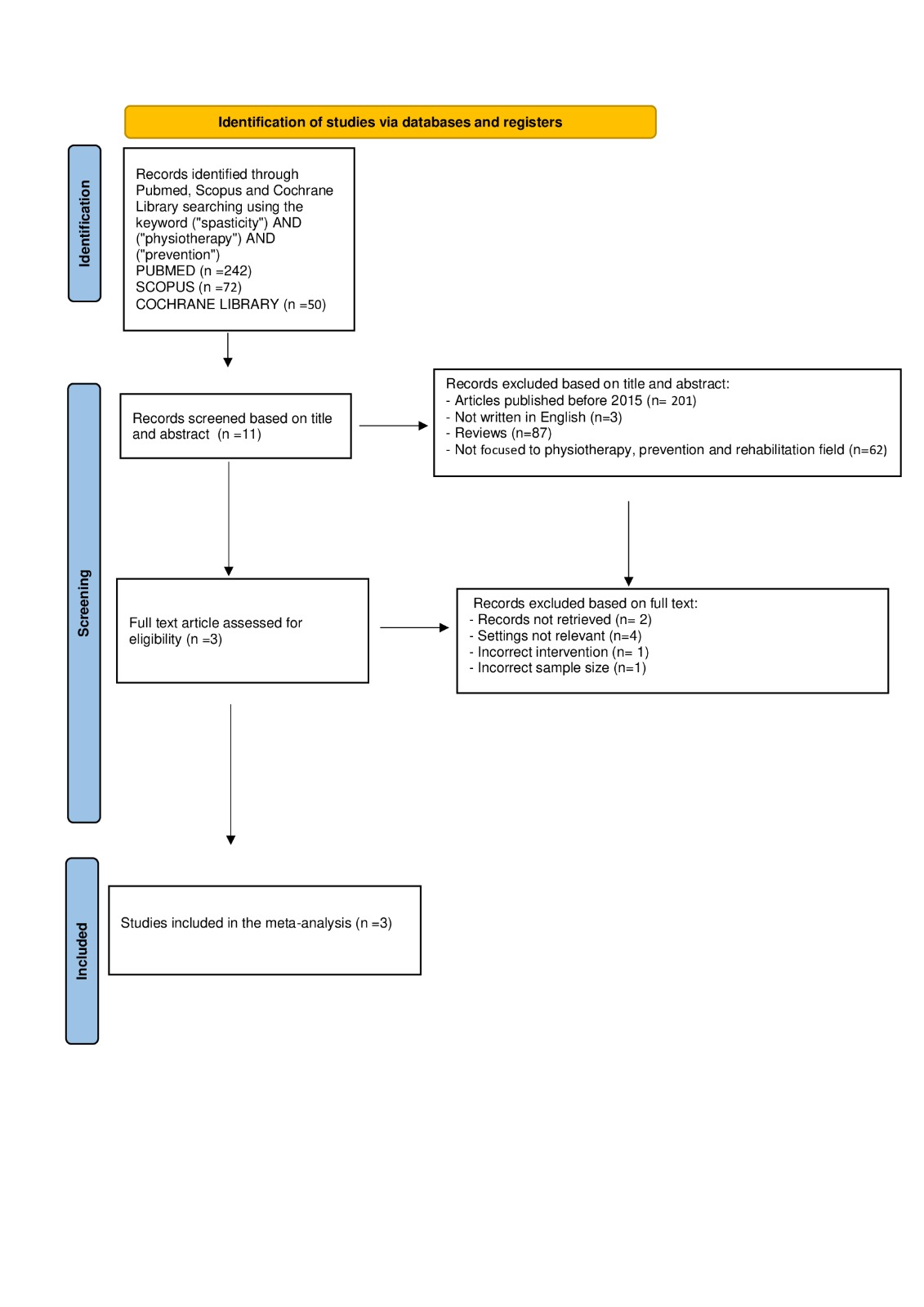
    Authors searched English articles published from 2015 to 2025 according to the Preferred Reporting Items for Systematic Reviews and Meta-Analyses (PRISMA) principles. The electronic databases PubMed, Scopus, Cochrane Library were investigated, using the following key words, which were combined to achieve maximum search strategy sensitivity: (“spasticity”) AND (“physiotherapy”) AND (“prevention”). First, articles were screened by title and abstract, using the following inclusion criteria for selection: (1) written in English; (2) published on indexed journals; and (3) dealing with the importance of spasticity prevention in a physiotherapy field . The exclusion criteria were  (1) published before 2015; (2) reviews; (3) papers written in other languages than English; and (4) data not strictly related to spasticity and not focused on physiotherapy, prevention and rehabilitation field. Secondly, the full texts of the selected articles were screened with further exclusions according to the previously described criteria. A PRISMA flowchart of the selection and screening method is provided in Figure 1.

    Results

    Figure 2 summaries the principal key point of each article analyzed. Only three articles investigated measures to prevent and restrain spasticity in patients with stroke and cerebral palsy, demonstrating the efficacy of transcranial magnetic stimulation, extracorporeal shockwave therapy, rehabilitation therapy and stretching exercises.

    Conclusion

    Evidence reported by these studies is not extensive yet. However, findings encourage some combined effective techniques requiring to be more investigated:

    (1) Botulinum-A Toxin injection (BTX) with modified constraint-induced movement therapy (mCIMT). (2) Execution of both transcranical magnetic stimulation (TMS) and extracorporeal shockwave therapy (ESWT), (3) Proprioceptive Neuromuscular Facilitation (PNF)  or static streching (SS). Physical therapy is a significant factor. Authors suggest to increase research in prevention and rehabilitation field.

    REFERENCES

    1. Graham, H.K.; Rosenbaum, P.; Paneth, N.; Dan, B.; Lin, J.-P.; Damiano, D.L.; Becher, J.G.; Gaebler-Spira, D.; Colver, A.;
      Reddihough, D.S.; et al. Cerebral palsy. Nat. Rev. Dis. Primers 2016, 2, 15082. [CrossRef] [PubMed]
    2.  Howard, J.J.; Herzog, W. Skeletal Muscle in Cerebral Palsy: From Belly to Myofibril. Front. Neurol. 2021, 12, 620852. [CrossRef]
      [PubMed]
    3. Pundik S, McCabe J, Skelly M, et al. Association of spasticity and motor dysfunction in chronic stroke. Ann Phys Rehabil Med
      2019;62:397–402.
    4.  Zeng D, Lei W, Kong Y, et al. Effects of vibration therapy for post-stroke spasticity: a systematic review and meta-analysis of
      randomized controlled trials. Biomed Eng Online 2023;22:121.
    5.  Cheng H, Fang X, Liao L, et al. Prevalence and factors influencing the occurrence of spasticity in stroke patients: a retrospective study.
      Neurol Res 2023;45:166–7
  • Quando l’armonia musicale si scontra con una disarmonia muscolo-scheletrica

    When musical harmony collides with musculoskeletal disharmony

    Autori

    Silvia Saraceno (Università degli studi di Messina, Messina, Italy)

    Francesco Bonanno (Università degli studi di Messina, Messina, Italy)

    Francesca Sposito (Università degli studi di Messina, Messina, Italy)

    Antonio Di Dio (Università degli studi di Messina, Messina, Italy)

    Filippo Cavallaro (Università degli studi di Messina, Messina, Italy)

    Veronica Bruno (Università degli studi di Messina, Messina, Italy)

    Background and aims

    A study by Cruder and colleagues analysed the prevalence of musculoskeletal disorders (MSDs) in 340 music students from various European institutions. Over 80% of the participants attributed their pain to musical activity. The most affected areas were neck, shoulders and upper limbs. Only 43% performed preparatory exercises before playing, and the management of breaks was often unstructured. The most surprising fact is that, despite their young age (average 22 years), many of these students were already living with chronic pain and functional limitations.

    Methods

    In the following years, we performed over one hundred postural assessments on people engaged in various non-musical activities. Despite the differences in contexts and activities, the problems encountered have many similarities with those highlighted in the study on musicians: cervical stiffness, scapular pain, low back pain and diffuse postural alterations. In 99% of cases, the triggering noxa is not an acute trauma, but the accumulation over time of micro-stress related to muscle weakness and lack of conscious movement. Even today, treatment is only sought when the pain is already chronic and often disabling.

    Results

    The role of the physiotherapist is not just to “cure pain”, but to help people prevent it. And this applies to everyone, regardless of their activity. Health also depends on conscious movement and good postural education. Preventive physiotherapy is, today more than ever, an essential public health tool. We have proposed a sheet of useful activities in order to make movement and posture conscious.

    Conclusion

    This comparison shows how prevention in physiotherapy should be considered a priority, not an option. An adequate functional assessment, accompanied by individualised movement education programmes, can significantly reduce the incidence of MSDs and improve quality of life, regardless of age or type of activity.

    REFERENCES

    Cruder, C., Barbero, M., Soldini, E. et al. Patterns of pain location in music students: a cluster analysis. BMC Musculoskelet Disord 22, 184 (2021). Kok LM et al. – the occurence of musculoskeletal complains among professional musicians: a sistematic review – int. arch. occup. environ health 2016

  • Prevalenza dell’incontinenza urinaria in pazienti con tosse cronica: revisione sistematica della letteratura

    Prevalence of urinary incontinence in patients with chronic cough: a systematic review

    Autori

    Scotti Ludovica [University of Udine, Udine, Italy]

    Salvitti Simone [Azienda Sanitaria Universitaria Friuli Centrale, University of Udine, Udine, Italy]

    Background and aims

    Individuals with diseases associated with chronic cough have a higher risk of developing urinary incontinence, due to repeated increasing endoabdominal pressure that is spread over the pelvic floor (1). Studies found in literature examine populations affected by a single disease and do not extend the analysis to the main problem, that is urinary incontinence. The aim of the study is to determine the prevalence of urinary incontinence in patients with diseases associated with chronic cough and to compare it with the prevalence of urinary incontinence in healthy populations.

    Methods

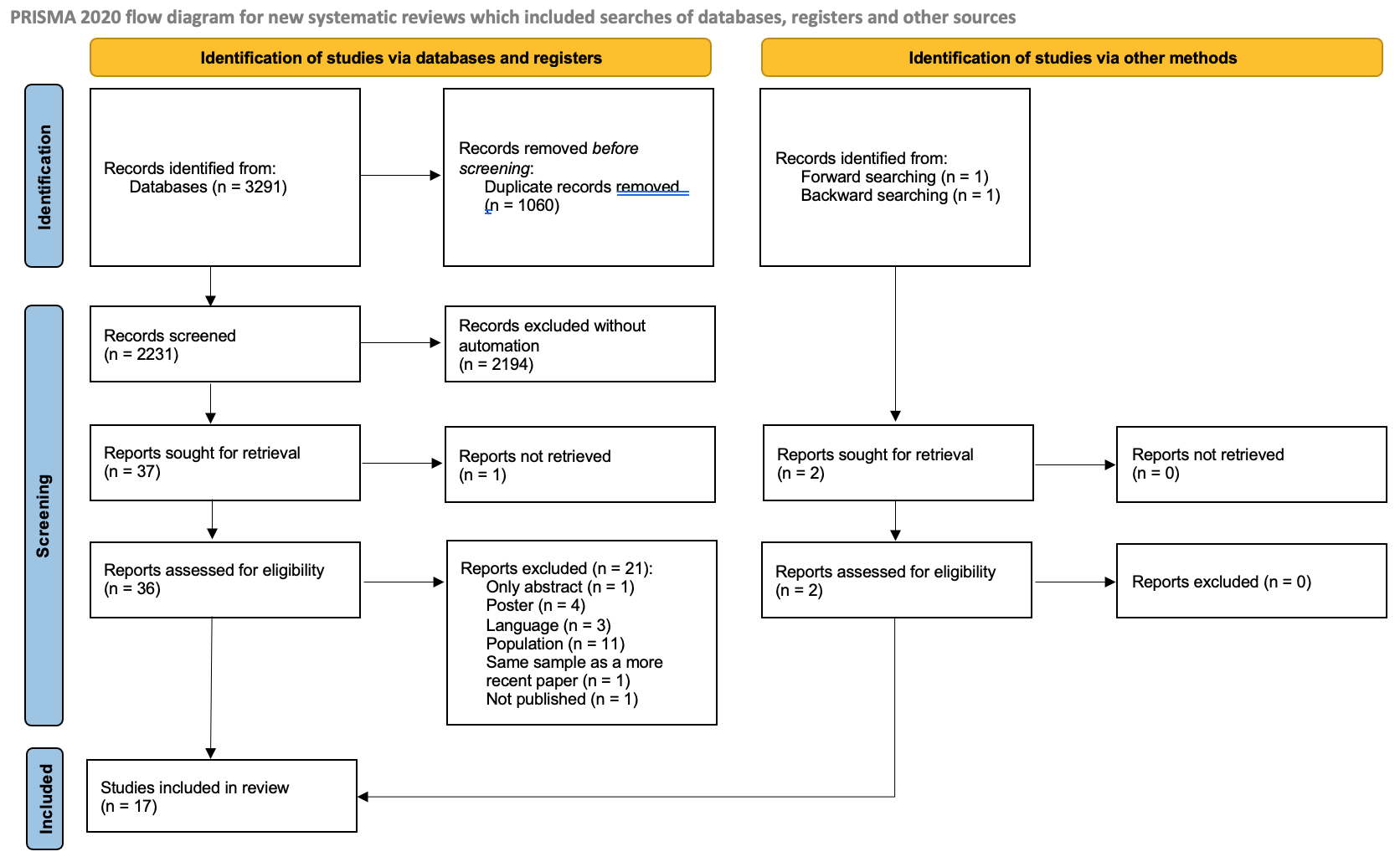
    The systematic review followed the PRISMA 2020 guidelines, with study selection based on a predefined protocol. The search was conducted through Medline, Embase, Cochrane, OvID, Scopus, ProQuest, PEDro and EBSCO. The study selection process, done by two blinded revisors utilizing a Microsoft Excel spreadsheet, included only prevalence studies that met the prespecified criteria. Data from selected studies were extracted and synthesized. The evidence was then assessed using the GRADE method and quality of reporting was assessed using the STROBE checklist.

    Results

    A total of 1585 articles were identified through database searches, with three added via reference screening. After duplicate removal and screening, 23 observational studies (cross-sectional or prospective) published between 2000 and 2024 were included. These studies investigated urinary incontinence (UI) prevalence in patients with chronic respiratory diseases, with considerable variability in demographics and disease characteristics. UI prevalence in patients with chronic cough ranged from 2.2% to 45% in pediatric patients, 30.4% to 74% in adult women, and 2.4% to 39% in adult men. 11 studies included only females, 3 only males and 9 mixed-gender populations. Most had small sample sizes (<250), while 3 were nationwide. Inclusion criteria were broad, particularly in cystic fibrosis, while exclusion criteria were more consistent. UI was primarly assessed via ICIQ-SF questionnaires. Risk factors included overweight (2) in chronic cough and underweight in cystic fibrosis. Lower FEV1% predicted correlated with increased UI in some cases, The quality of evidence was low, while reporting quality was acceptable.

    Conclusion

    This review met its objective of investigating the prevalence of urinary incontinence (UI) in patients with chronic cough-related diseases. Results show significantly higher UI rates in females, often double those in healthy individuals. Prevalence estimates for pediatric and male populations remain unclear, requiring further research. The underestimated nature of UI calls for enhanced clinical guidelines, patient education, and clinician engagement, as stigma and limited awareness may prevent proper diagnosis and treatment (3).

    REFERENCES

    (1) Cobb WS, Burns JM, Kercher KW, Matthews BD, James Norton H, Todd Heniford B. Normal Intraabdominal Pressure in Healthy Adults. J Surg Res. dicembre 2005;129(2):231–5.

    (2) Shang X, Fu Y, Jin X, Wang C, Wang P, Guo P, et al. Association of overweight, obesity and risk of urinary incontinence in middle-aged and older women: a meta epidemiology study. Front Endocrinol. 10 ottobre 2023;14:1220551.

    (3) Haukeland-Parker S, Frisk B, Spruit MA, Stafne SN, Johannessen HH. Treatment of urinary incontinence in women with chronic obstructive pulmonary disease—a randomised controlled study. Trials. dicembre 2021;22(1):900.

  • Proprietà psicometriche del Mini-Balance Evaluation System Test (Mini-BESTest) nei pazienti con ictus: una revisione sistematica

    Proprietà psicometriche del Mini-Balance Evaluation System Test (Mini-BESTest) nei pazienti con ictus: una revisione sistematica

    Psychometric properties of the Mini-Balance Evaluation Systems Test (Mini-BESTest) in stroke patients: a systematic review

    Autori

    Lazzaro Alberto [Aulss 6 Euganea, Padova, IT]

    Feller Daniel [Azienda Provinciale Servizi Sanitari di Trento, Trento, IT; Erasmus University Medical Center, Rotterdam, NL]

    Maffei Andrea [Azienda ospedaliera dell’Alto Adige Sabes, Bolzano, IT]

    Background and aims

    Stroke is one of the main neurological conditions that results in impaired postural and balance control, adversely affecting multiple physiological and body systems. Over 80% of individuals who experienced a first-time stroke exhibits balance impairments, leading to a reduced ability to maintain sitting, standing, or stepping balance. Lack of postural control in people with stroke is largely recognized as negatively impacting ambulatory stability, activity of daily living, social participation, quality of life, and risk of falling.

    A consensus-based paper suggests that the Mini-BESTest should be included in the minimum data set for measuring balance in adults with, and without, neurological conditions.

    No systematic review analyzing the properties Mini-BESTest in the specific stroke population have been found. It is important to evaluate the psychometric properties of an assessment tool before its administration in clinical practice. Thus, the aim of this systematic review is to synthesize the psychometric properties of the Mini-BESTest in stroke subjects.

    Methods

    The literature search was performed in six databases in September 2024. This review included all studies reporting at least one psychometric property of the Mini-BESTest as defined by COSMIN. The PRISMA-COSMIN for outcome measurement instruments were used for the reporting of the studies. COSMIN Risk of Bias checklist version 3.0 was used to assess the methodological quality of the studies.

    The protocol of the review has been registered in PROSPERO (ID: CRD42025637127).

    Results

    17 articles were included after the screening procedure, through a double-blind selection. Inter-rater, intra-rater and test-retest reliability were excellent. The Mini-BESTest showed good to very good internal consistency. MDC across the studies ranged from 2,01 to 4,25 and the SEM from 0,46 to 1,53. The Mini-BESTest showed an acceptable predictive validity for gait independence and risk of fall. The Mini-BESTest showed also good structural and convergent validity. Statistically significant differences in scores were found between healthy and stroke subjects and between fallers-and non-fallers, indicating a good discriminative validity. Mini-BESTest showed good to moderate responsiveness. Significant floor effect was reported in 2 studies at the baseline.

    Conclusion

    The Mini-BESTest represents an appropriate measurement instrument for assessing balance function in stroke patients. It has an excellent internal consistency, very good reliability, good convergent/divergent validity, high sensitivity in detecting change, no significant ceiling effect and a low to moderate floor effect.

    REFERENCES

    Elsman EBM, Mokkink LB, Terwee CB, Beaton D, Gagnier JJ, Tricco AC, Baba A, Butcher NJ, Smith M, Hofstetter C, Lee Aiyegbusi O, Berardi A, Farmer J, Haywood KL, Krause KR, Markham S, Mayo-Wilson E, Mehdipour A, Ricketts J, Szatmari P, Touma Z, Moher D, Offringa M. Guideline for reporting systematic reviews of outcome measurement instruments (OMIs): PRISMA-COSMIN for OMIs 2024. J Clin Epidemiol. 2024 Sep;173:111422. doi: 10.1016/j.jclinepi.2024.111422. Epub 2024 Jul 9. PMID: 38849061.

    Franchignoni F, Horak F, Godi M, Nardone A, Giordano A. Using psychometric techniques to improve the Balance Evaluation Systems Test: the mini-BESTest. J Rehabil Med. 2010 Apr;42(4):323-31. doi: 10.2340/16501977-0537. PMID: 20461334; PMCID: PMC3228839.

    King L, Horak F. On the mini-BESTest: scoring and the reporting of total scores. Phys Ther. 2013 Apr;93(4):571-5. doi: 10.2522/ptj.2013.93.4.571. PMID: 23547173.

    Mokkink LB, Elsman EBM, Terwee CB. COSMIN guideline for systematic reviews of patient-reported outcome measures version 2.0. Qual Life Res. 2024 Nov;33(11):2929-2939. doi: 10.1007/s11136-024-03761-6. Epub 2024 Aug 28. PMID: 39198348; PMCID: PMC11541334.

    Sibley KM, Howe T, Lamb SE, Lord SR, Maki BE, Rose DJ, Scott V, Stathokostas L, Straus SE, Jaglal SB. Recommendations for a core outcome set for measuring standing balance in adult populations: a consensus-based approach. PLoS One. 2015 Mar 13;10(3):e0120568. doi: 10.1371/journal.pone.0120568. PMID: 25768435; PMCID: PMC4358983.

  • L’importanza di identificare le red flags nei pazienti con dolore al gomito: una revisione sistematica

    L’importanza di identificare le red flags nei pazienti con dolore al gomito: una revisione sistematica

    The importance of identifying red flags in patients with elbow pain: a systematic review

    Autori

    Rossi Federico [Department of Medicine and Health Science “Vincenzo Tiberio”, University of Molise, Campobasso, Italy; Department of Biomedical and Neuromotor Sciences (DIBINEM), Alma Mater Studiorum, University of Bologna, Bologna, Italy]

    Cioeta Matteo [Department of Medicine and Health Science “Vincenzo Tiberio”, University of Molise, Campobasso, Italy]

    Palatini Alice [Department of Medicine and Health Science “Vincenzo Tiberio”, University of Molise, Campobasso, Italy]

    Maggialetti Giuseppe [Department of Medicine and Health Science “Vincenzo Tiberio”, University of Molise, Campobasso, Italy]

    Mancazzo Lidia [Department of Medicine and Health Science “Vincenzo Tiberio”, University of Molise, Campobasso, Italy]

    Giannotta Gabriele [Department of Medicine and Health Science “Vincenzo Tiberio”, University of Molise, Campobasso, Italy]

    Pellicciari Leonardo [IRCCS Istituto delle Scienze Neurologiche di Bologna, Bologna, Italy]

    Giovannico Giuseppe [Department of Medicine and Health Science “Vincenzo Tiberio”, University of Molise, Campobasso, Italy]

    Prato Ilaria [Department of Medicine and Health Science “Vincenzo Tiberio”, University of Molise, Campobasso, Italy]

    Background and aims

    Elbow pain, though uncommon, can herald serious pathology. Given the paucity of guideline‑based screening directives, this systematic review consolidates red‑flag findings to help hand therapists and other frontline clinicians recognise and promptly refer serious elbow disorders.

    Methods

    PROSPERO-registered systematic review (CRD42022336142) conducted according to the Cochrane Handbook and reported per PRISMA. Seven databases—PubMed, Web of Science, Cochrane Library, PEDro, CINAHL, EMBASE, Scopus—and Google Scholar were searched from inception to November 2024 using a PECO strategy without language or date limits. All study designs involving patients with elbow pain were eligible. Two reviewers independently screened, extracted data, and assessed risk of bias (RoB 2, Newcastle–Ottawa, Murad, AXIS), with arbitration by a third reviewer. Owing to study heterogeneity, findings were synthesized narratively and the prevalence of each red flag across studies was calculated.

    Results

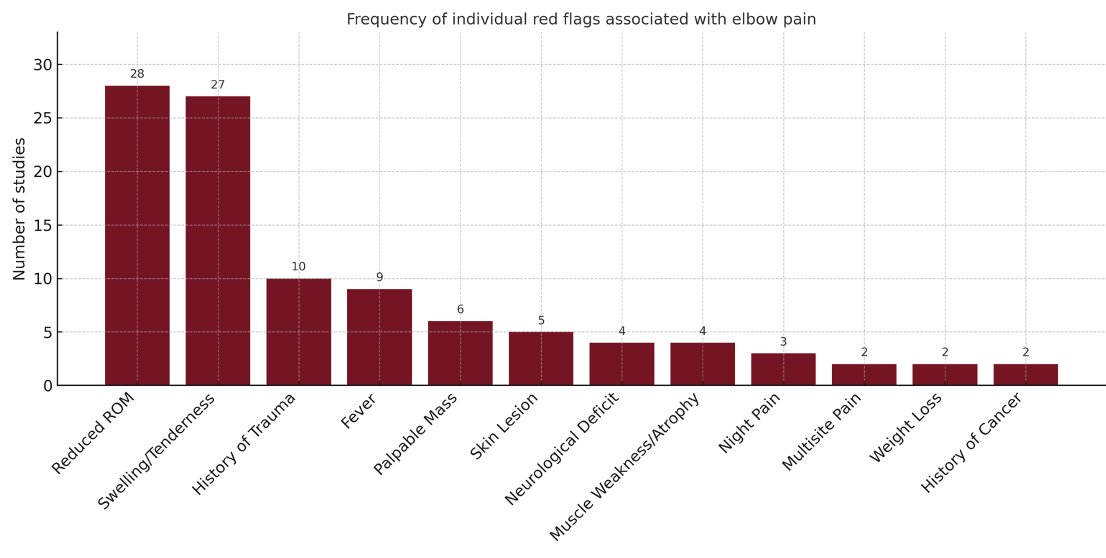
    Among 6 509 records screened, 52 studies (369 patients—4 retrospective and 1 prospective cohort, 8 case series, 39 case reports) met the inclusion criteria, most addressing oncologic (30 %) or orthopaedic (28 %) causes of elbow pain, with smaller proportions of infectious (17 %), vascular (11 %), systemic (11 %) and neurological (2 %) conditions. Across studies, reduced elbow range-of-motion and local swelling/tenderness were the most prevalent red flags, while palpable masses, night pain and trauma history selectively signalled oncologic or orthopaedic pathology; upper-limb hypertension, bruising or pallor pointed to vascular compromise, and fever or constitutional symptoms suggested infection or systemic disease. Radiography was universal for mechanical lesions, MRI or biopsy confirmed most tumours, and blood-pressure measurement or histology were crucial for vascular and infectious diagnoses, respectively. Although these patterns offer a pragmatic screening framework for first-contact clinicians, the evidence base is limited by a predominance of case reports/series and moderate-to-high risk of bias, underscoring the need for higher-quality prospective research to refine elbow red-flag algorithms.

    Conclusion

    Reduced elbow range of motion and local swelling are the most consistently reported red flags across oncologic, infectious, orthopaedic, vascular, systemic and neurological conditions. Incorporating systematic screening for these indicators—alongside targeted history, blood-pressure measurement and a brief neurological check—can sharpen clinicians’ differential diagnosis and accelerate referral. Prospective studies are now needed to quantify the diagnostic accuracy of these red flags and refine evidence-based guidelines for elbow pain management.

    REFERENCES

    1. Goodman and Marshall’s Recognizing and Reporting Red Flags for the Physical Therapist Assistant – Edition 2 – Edited by Charlene Marshall, BS, PTAElsevier Health Inspection Copies. Accessed May 5, 2025. https://www.inspectioncopy.elsevier.com/book/details/9780323878791
    2. Committee on Diagnostic Error in Health Care, Board on Health Care Services, Institute of Medicine, The National Academies of Sciences, Engineering, and Medicine. Improving Diagnosis in Health Care. (Balogh EP, Miller BT, Ball JR, eds.). National Academies Press (US); 2015. Accessed May 2, 2025. http://www.ncbi.nlm.nih.gov/books/NBK338596/

    3. Cochrane Handbook for Systematic Reviews of Interventions. Accessed February 14, 2024. https://training.cochrane.org/handbook
  • Creazione di uno Sportello Linfologico a Reggio Emilia: un modello organizzativo integrato nella Rete Linfologica territoriale

    Implementation of a Lymphedema Counseling Service in Reggio Emilia: An Integrated Organizational Model within the Territorial Lymphedema Network

    Autori

    Dimatteo Mariangela (FT) – Medicina fisica e riabilitazione ASMN, AUSL-IRCCS di Reggio Emilia – Italia; Studente del master in Riabilitazione in linfologia clinica Universitaria La Sapienza di Roma

    Alice Pecorari (FT) Servizio RRF di Correggio, AUSL-IRCCS di Reggio Emilia, Italia; Studente del master in Riabilitazione in linfologia clinica Universitaria La Sapienza di Roma

    Bassoli Agnese (FT) Servizio NPIA, AUSL-IRCCS di Reggio Emilia, Italia; Laureanda magistrale in scienze riabilitative delle professioni sanitarie presso Univr – Università degli studi di Verona

    Piccinelli Barbara (Medico Fisiatra) Medicina fisica e riabilitazione ASMN, AUSL-IRCCS di Reggio Emilia, Italia

    Manfredi Nicoletta (FT) Medicina fisica e riabilitazione ASMN, AUSL-IRCCS di Reggio Emilia, Italia

    Giberti Tiziana (FT) Servizio RRF CNM, AUSL-IRCCS di Reggio Emilia, Italia

    Isabella Campanini, PhD LAM (Dip. Neuromotorio Riabilitativo) AUSL-IRCCS di Reggio Emilia

    Rancati Jacopo Matteo (Dirigente Professioni Sanitarie della Riabilitazione) Direzione Assistenziale, AUSL-IRCCS di Reggio Emilia, Italia

    Background and aims

    Lymphedema is a chronic, progressive, and disabling condition caused by impaired lymphatic transport, often resulting in substantial functional limitations and reduced autonomy.
    As with many chronic conditions, its management entails considerable healthcare expenditures. Current literature advocates for organizational models that enhance patient participation in the continuum of care.
    Institutional monitoring data indicate that, following completion of the physiotherapy cycle, patients frequently initiate informal contact with physiotherapists—typically in response to symptom recurrence or to request advice on newly arising concerns.

    Methods

    Within the existing territorial lymphedema rehabilitation network, a structured rehabilitative counseling service has been designed. The service is accessible via a secure digital platform, with the objective of formalizing, tracking, and expanding access to such informal consultations.
    This direct-access model aims to offer timely and appropriate responses to low-complexity rehabilitation needs. Each patient may access the service for up to two consultations—either in person or via telemedicine—allowing the physiotherapist to assess the case and propose suitable interventions. In cases requiring more comprehensive care, the physiotherapist may directly initiate referral for physiatric evaluation.

    Results

    The launch of the rehabilitative counseling service is scheduled for Autumn 2025, with an initial pilot phase involving two healthcare districts.
    Service requests will be managed through a secure online form, serving as the user interface for access. The structure of this form will be informed by observational data collected from patients who currently engage the service informally.
    Preliminary data suggest that the most frequently reported needs include: counseling on compression garments and bandaging techniques, verification of appropriate use of assistive devices, symptom self-management support, and lifestyle education.
    During the first year of implementation, the service is expected to handle approximately 100 requests, with over 50% of cases likely to be managed autonomously by physiotherapists, without requiring referral for physiatric consultation.
    In the long term, this model aims to reduce both the number of physiatric referrals and physiotherapy sessions for this patient population by approximately 10%.
    Additional indicators will be monitored to evaluate the model’s effectiveness, including: case typology, nature of the interventions provided, response times, and user satisfaction, leveraging data generated through the digital request platform.

    Conclusion

    The activation of a lymphedema counselling service represents an innovative model of care, based on therapeutic education, self-management and proximity of the intervention, accordig with DM 77/2022. The project enhances the physiotherapist as a territorial reference point within the lymphological network, helping to reduce inappropriate access to physiatric visits and repeated treatments.

    REFERENCES

    • Gyawali B, Bowman M, Sharpe I, Jalink M, Srivastava S, Wijeratne DT. (2023) A systematic review of eHealth technologies for breast cancer supportive care. Cancer Treatment 2023; 114: 102519.
    • Henkin JS, Botton CE, Simon MS, et al. Telehealth multicomponent exercise and health education in breast cancer patients undergoing primary treatment: rationale and methodological protocol for a randomized clinical trial (ABRACE: Telehealth). Trials. 2023; 24: 42.
    • Hernandez Silva E, Lawler S, Langbecker D. The effectiveness of mHealth for self-management in improving pain, psychological distress, fatigue, and sleep in cancer survivors: a systematic review. Journal of Cancer Survivorship. 2019; 13: 97-107.
  • Costocondrite e dolore toracico: una scoping review

    Costocondrite e dolore toracico: una scoping review

    Costochondritis syndrome and thoracic-chest related pain: a scoping review

    Autori

    Bolandrini Andrea [Department of Human Neuroscience, “Sapienza” University of Rome, Roma, Italy]

    Barile Antonio [Department of Human Neuroscience, “Sapienza” University of Rome, Roma, Italy]

    Segat Marco [Department of Human Neuroscience, “Sapienza” University of Rome, Roma, Italy; Department of Neuroscience, University of Padova, Padova, Italy]

    Zaninetti Martina [Department of Human Neuroscience, “Sapienza” University of Rome, Roma, Italy]

    Fascia Matteo [Department of Human Neuroscience, “Sapienza” University of Rome, Roma, Italy; Department of Information Engineering, University of Brescia, Italy]; Segat Andrea [Department of Human Neuroscience, “Sapienza” University of Rome, Roma, Italy; Department of Neuroscience, University of Padova, Padova, Italy]

    Sebastiani Marta [Department of Human Neuroscience, “Sapienza” University of Rome, Roma, Italy]

    Minetti Federico [Department of Human Neuroscience, “Sapienza” University of Rome, Roma, Italy]

    Maselli Filippo [Department of Human Neuroscience, “Sapienza” University of Rome, Roma, Italy]

    Galeoto Giovanni [Department of Human Neuroscience, “Sapienza” University of Rome, Roma, Italy]

    Margelli Michele [Department of Human Neuroscience, “Sapienza” University of Rome, Roma, Italy; Department of Morphology Surgery and Experimental Medicine, Ferrara University, Ferrara, Italy]

    Background and aims

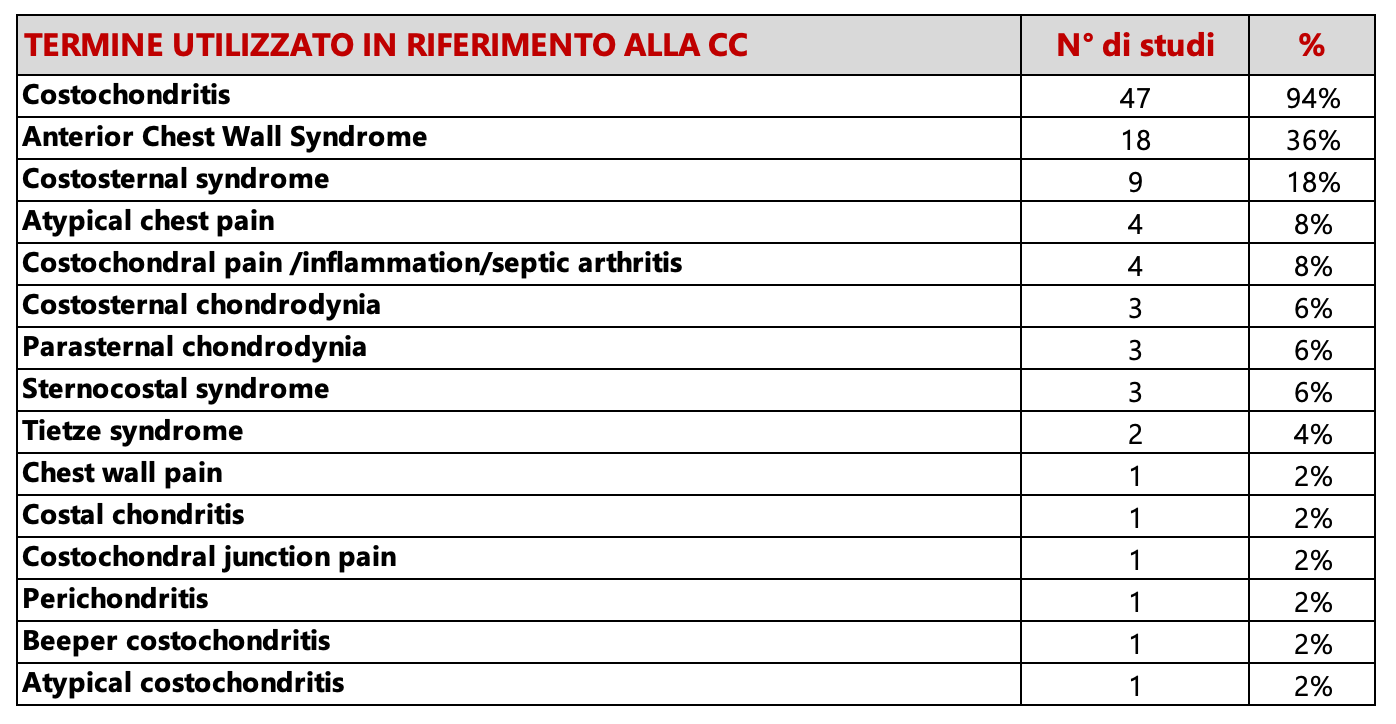
    Musculoskeletal chest pain is the most frequent type of chest pain encountered in primary care settings¹ and requires a comprehensive and often urgent clinical evaluation due to its heterogeneous etiology and the potential for life-threatening conditions.² Among these, costochondritis (CC) is commonly diagnosed and is also known as “costosternal syndrome”, “anterior chest wall syndrome”, and “costosternal chondrodynia”.³ This review aims to map the existing literature and provide a comprehensive overview of this condition.

    Methods

    This scoping review was conducted in accordance with the PRISMA-ScR checklist 4 and the Joanna Briggs Institute methodology for scoping reviews.5 The inclusion criteria were defined using the Population, Concept, and Context (PCC) framework. Studies of any type or design, published in English or Italian, were included without restrictions on publication date or geographical location.

    Results

    The term “costochondritis” was predominant, appearing in 94% of the studies reviewed. We identified 15 different terms used to refer to this condition, including “Tietze Syndrome”. Definitions of CC revealed discrepancies, particularly regarding the localization of pain and other features considered characteristic by some studies, such as localized tenderness and swelling.  A total of 10 etiologies were identified (inflammatory, unknown, traumatic, infectious, rheumatologic, neoplastic, metabolic, insidious, hormonal, and degenerative), with multiple potential causes simultaneously reported in 56% of the studies. The most frequently reported etiology was inflammation (64%); however, this scoping review did not identify any studies demostrating the presence of an inflammatory process in individuals affected by CC.

    Conclusion

    This scoping review is the first to highlight the heterogeneity in terminology and the inconsistencies in the definitions of this condition. The interchangeable use of “Tietze syndrome” and “costochondritis” increases the risk of confusing the two pathological entities. The findings also underscore the lack of consistent evidence supporting the presence of a clear inflammatory process in this condition.

    REFERENCES

    1. Stochkendahl MJ, Christensen HW. Chest pain in focal musculoskeletal disorders. Med Clin North Am. 2010 Mar;94(2):259-73. doi: 10.1016/j.mcna.2010.01.007. PMID: 20380955.
    2. Winzenberg T, Jones G, Callisaya M. Musculoskeletal chest wall pain. Aust Fam Physician. 2015 Aug;44(8):540-4. PMID: 26510139.
    3. Proulx AM, Zryd TW. Costochondritis: diagnosis and treatment. Am Fam Physician. 2009 Sep 15;80(6):617-20. PMID: 19817327.
    4. Tricco AC, Lillie E, Zarin W, O’Brien KK, Colquhoun H, Levac D, Moher D, Peters MDJ, Horsley T, Weeks L, Hempel S, Akl EA, Chang C, McGowan J, Stewart L, Hartling L, Aldcroft A, Wilson MG, Garritty C, Lewin S, Godfrey CM, Macdonald MT, Langlois EV, Soares-Weiser K, Moriarty J, Clifford T, Tunçalp Ö, Straus SE. PRISMA Extension for Scoping Reviews (PRISMA-ScR): Checklist and Explanation. Ann Intern Med. 2018 Oct 2;169(7):467-473. doi: 10.7326/M18-0850. Epub 2018 Sep 4. PMID: 30178033.
    5. Aromataris, E., Lockwood, C., Porritt, K., Pilla, B., & Jordan, Z. (Eds.).(2024). JBI Manual for Evidence Synthesis. JBI. https://doi.org/10.46658/JBIMES-24-01