Categoria: Congresso 2024

  • The impact of an Italian student-led physiotherapy clinic on physiotherapy student clinical reasoning and patients satisfaction

    The impact of an Italian student-led physiotherapy clinic on physiotherapy student clinical reasoning and patients satisfaction

    L’Impatto di una Student-led clinic italiana sul ragionamento clinico degli studenti di fisioterapia e sulla soddisfazione dei pazienti

    Autori

    Manuela Deodato (Department of Medical, Surgical and Health Sciences, University of Trieste, Trieste, Italy )

    Raffaele Sabot (Department of Medical, Surgical and Health Sciences, University of Trieste, Trieste, Italy )

    Francesca Zelesnich (Department of Medical, Surgical and Health Sciences, University of Trieste, Trieste, Italy )

    Giulia Sgubin (Department of Medical, Surgical and Health Sciences, University of Trieste, Trieste, Italy )

    Alex Buiote Stella (Department of Medical, Surgical and Health Sciences, University of Trieste, Trieste, Italy )

    Alessandra Galmonte (Department of Medical, Surgical and Health Sciences, University of Trieste, Trieste, Italy )

    Luigi Murena (Department of Medical, Surgical and Health Sciences, University of Trieste, Trieste, Italy )

    Introduction

    An optimal clinical environment represents an excellent place to develop clinical reasoning and clinical practice, which provide optimal decision making and, as a consequence, optimal patient management 1. Student led-clinics represent an innovative practical experience for physiotherapist students2. The aim of student-led-clinic is the development of clinical reasoning and professional skills through a teaching methodology by health care professional supervisors that could lead to an optimal patient management1–3. In fact, this model could provide benefits both in the student education and in health care systems2. Currently, there is few data on the impact of these models on the development of students clinical reasoning, nor on the patients satisfaction 2,4. Therefore, the aim of the present study is to evaluate the impact of an Italian Student-led clinic in the clinical reasoning of the physiotherapy students. The second aim is to evaluate the patients satisfaction in this model.

    Methods

    A quantitative cross-sectional survey was conducted on 102 university students and on 101 patients (Institutional review board of University of Trieste n. 70268; 8.05.2024) in accordance with the STrengthening the Reporting of OBservational Studies in Epidemiology. Concerning students, the questionnaire “Evaluation of Clinical reasoning during internship” was developed with the following domains: medical history, physiotherapy evaluation, the selection of rehabilitation goals, progression of treatment, patient education, discussion of clinical cases with the tutors/students. As regard to patients, the validated “Physical Therapy Satisfaction Survey (PTOPS)”5 was used and the questionnaire “Patients experience in Palestra Didattica” was developed that assess: Student–supervisor relationship, Quality of physiotherapy care, Style of supervision and Student qualities. The Guidelines for developing and validating questionnaire were respected 6 for the two developed questionnaires.

    Results

    The first interesting finding was that the impact of clinical reasoning of the physiotherapy students was statistically significantly improved in the PD student-led clinic with respect to other traditional models in 7 of 8 items take in to consideration. Another important finding was that the patients satisfaction assessed with the PTOPS survey was statistically significantly higher in the PD model compared with traditional models in 20 of 34 items: in 5 of 12 items of Depersonalization domain, in 4 of 6 items of Inaccessibility domain, in 7 of 10 items of Ambience domain and in 4 of 10 items of Cost domain. Finally, the “Patients experience in Palestra Didattica” questionnaire highlighted high rate of positive answers concerning, Student–supervisor relationship, Quality of physiotherapy care, Style of supervision and Student qualities.

    Discussion and Conclusion

    The student-led physiotherapy clinic Palestra Didattica represents an innovative clinical-learning environment that allow to meet both the health care systems and University needs, but also the student clinical education and patient care needs. Three main factors improve the patients and students experience in this model with respect to traditional models: 1) the collaborative interaction among students/patients/academic tutors that lead to patient-centered care and to student-centered learning experience; 2) the learning experience based on active learning methodology and on a real clinical experience with patients that promote clinical reasoning; 3) a dedicated environment in which education, service and research join together that enhance the relationship between health care systems and Universities, which, in turn, bridge the gap between theory and practice in order to promote both best practice for health service and an excellent quality of students learning experience.


    REFERENCES

    1. Furze JA, Black L, Mcdevitt AW, et al. Clinical Reasoning: The Missing Core Competency in Physical Therapist Education and Practice. Physical Therapy 2022.
    2. Wynne D, Cooper K. Student-led rehabilitation groups and clinics in entry-level health education: a scoping review. JBI Evidence Synthesis 2021.
    3. Kent F, Martin N, L. Keating J. Interprofessional student-led clinics: An innovative approach to the support of older people in the community. J Interprof Care 2016.
    4. Niwa L, MacLellan CL. Learning and satisfaction in a student-led clinic. Clinical Teacher 2021.
    5. Vanti C, Bonetti F, Ceron D, et al. Cross-cultural adaptation and validation of the Physical Therapy Outpatient Satisfaction Survey in an Italian musculoskeletal population. BMC Musculoskeletal Disorders 2013.
    6. Tsang S, Royse CF, Terkawi AS. Guidelines for developing, translating, and validating a questionnaire in perioperative and pain medicine. Saudi Journal of Anaesthesia 2017.
  • ESERCIZIO TERAPEUTICO E VISCOSUPPLEMENTAZIONE NELL’ARTROSI GLENO – OMERALE: STUDIO COMPARATIVO

    ESERCIZIO TERAPEUTICO E VISCOSUPPLEMENTAZIONE NELL’ARTROSI GLENO – OMERALE: STUDIO COMPARATIVO

    ESERCIZIO TERAPEUTICO E VISCOSUPPLEMENTAZIONE NELL’ARTROSI GLENO – OMERALE: STUDIO COMPARATIVO

    THERAPEUTIC EXERCISE AND VISCOSUPPLEMENTATION IN GLENO-HUMERAL OSTEOARTHRITIS: A COMPARED STUDY

    Autori

    Arone Basilio (Physiotherapist, Intensive Rehabilitation Clinic “Villa Elisa”, Cinquefrondi (RC) Italy)

    Napoli Vincenzo (Physiotherapist, Intensive Rehabilitation Clinic “Villa Elisa”, Cinquefrondi (RC) Italy)

    Surace Alessia (Physiotherapist, Intensive Rehabilitation Clinic “Villa Elisa”, Cinquefrondi (RC) Italy)

    Introduction

    The study was developed to compare short – term and mid – term efficacy between therapeutic exercise coupled with viscosupplementation and viscosupplementation only in patients with moderate to severe gleno – humeral osteoarthritis.

    Methods

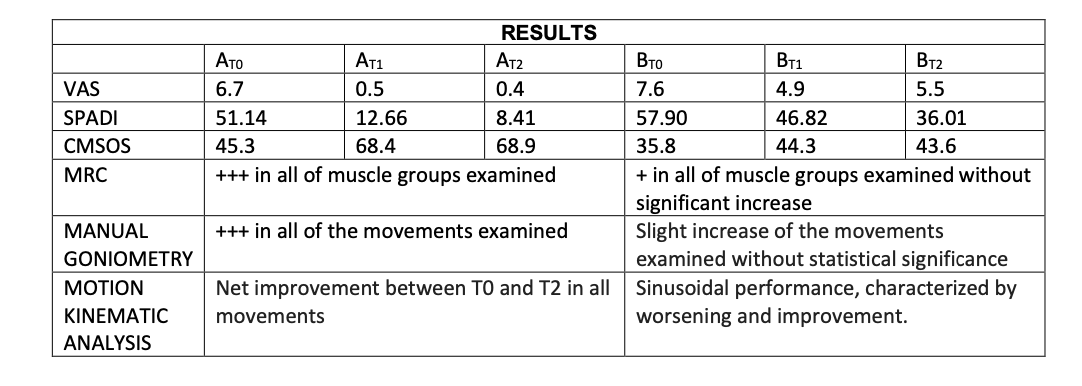
    20 patients over 45 years of age, pain over 6 months and less than 5 years, VAS> 4, and grade II-III Kellgreen – Lawrence were selected. They were subdivided randomly and assigned to group A (Hyaluronic Acid + Therapeutic Exercise) and Group B (Hyaluronic Acid). Exclusion criteria were adhesive capsulitis, extra – articular syndrome, complete rotator cuff injuries, Hyaluronic Acid allergy, IV class Kellgreen – Lawrence osteoarthritis, previous steroid infiltration and rheumatoid syndrome. Before starting the rehabilitation program, specific assessment scales (SPADI, CMSOS, MRC, VAS, Manual Goniometry and Motion Kinematic Analysis) were administered. B group patients were immediately administered intra – articular high molecular weight Hyaluronic Acid. To Group A patients, in addition to high molecular weight Hyaluronic Acid was administered a Therapeutic Exercise Protocol of 30 days, divided into 4 phases, including passive mobilizations, active – assisted exercises, isometric exercises, functional (isotonic and eccentric) and proprioceptive exercises.

    Results

    The results of the assessment scales of two groups were compared before to start rehabilitation program (T0), at short – term (T1 – 30 days) and at mid – term (T2 – 90 days). With good statistical significance (p <0.01 U p <0.05), Group A showed sensible improvements over Group B in all of investigated items. The most important improvements were shown in the time period between T0 and T1, where therapeutic exercise was performed.

    Discussion and Conclusion

    At 90 days, Group A patients have maintained gained performance and continued to improve, though statistically unimportant, while Group B patients began to get worse again.

    REFERENCES

    • DeGroot JH. – The variability of shoulder motions recorded by means of palpations – Clin Biomech – 1997 – 12:461-72
    • Van der Helm FC., Pronk GM. – Three-dimensional recording and description of motions of the shoulder mechanism – j. Biomech Eng – 1995;117:27-40
    • Balazs EA., Denlinger JL. – Viscosupplementation: a new concept in the treatment of osteoarthritis – J Rheumatol Suppl – 1993 Aug; 39:3-9
    • Henrotin Y., Raman R., Richette P., Bard H., Jerosch J., Conrozier T., Chevalier X., Migliore A. – Consensus statement on viscosupplementation with Hyaluronic Acid for the management of osteoarthritis. – Semin Arthritis Rheum 2015 Apr 30 – pii: >S0049-0172(15)00096-7
    • Constant CR – AHG Murley: A clinical method of functional assessment of the shoulder – Clin. Orthop. And Rel. Res. – 1987, 217:160 – 164
  • Come standardizzare i fattori di rischio per le cadute in ospedale? Un nuovo approccio multifase attraverso un proof-of-concept study

    Come standardizzare i fattori di rischio per le cadute in ospedale? Un nuovo approccio multifase attraverso un proof-of-concept study

    Come standardizzare i fattori di rischio per le cadute in ospedale? Un nuovo approccio multifase attraverso un proof-of-concept study

    How to standardize reported risk factors for falls in hospital? A new multi-phase approach using a proof-of-concept study

    Autori

    Caselli Serena [Unità Operativa Complessa di Medicina Riabilitativa, Azienda Ospedaliero-Universitaria di Modena, Modena, Italy]

    La Porta Fabio [IRCCS Istituto delle Scienze Neurologiche di Bologna, Bologna, Italy]

    Valpiani Giorgia [Research and Innovation Unit, Biostatistics and Clinical Trial Area, University Hospital of Ferrara, Ferrara, Italy]

    Lullini Giada [IRCCS Istituto delle Scienze Neurologiche di Bologna, Bologna, Italy]

    Negro Antonella [Innovation in Healthcare and Social Services, Emilia-Romagna Region, Bologna, Emilia-Romagna, Italy]

    Pellicciari Leonardo [IRCCS Istituto delle Scienze Neurologiche di Bologna, Bologna, Italy]

    Bassi Erika [Department of Translational Medicine, University of Eastern Piedmont, Novara, Italy]

    Pecoraro Valentina [Department of Laboratory Medicine and Pathology, AUSL Modena, Modena, Italy]

    Govoni Erika [[Innovation in Healthcare and Social Services, Emilia-Romagna Region, Bologna, Emilia-Romagna, Italy – Unità Organizzativa Riabilitazione Ospedaliera, Dipartimento Assistenziale Tecnico e Riabilitativo, Ausl Bologna, Bologna, Italy]

    Introduction

    In-hospital falls are a public health issue resulting in enormous individual, social and health costs. To prevent in-hospital falls, it is essential to know the risk factors (RFs) so that they can be recognized and prevented or modified through clinical interventions. The literature reports uncertainty and inconsistency in RF terminology for in-hospital falls that could be reduced by linking RFs to standardized health concepts, such as those provided by the conceptual categories of the WHO International Health Classifications. Therefore, this study, conducted by Innovation in Healthcare and Social Services of Emilia-Romagna Region, aims: 1) to perform a literature review to identify fall RFs among hospitalized adults; 2) to link the found RFs to the corresponding health classification categories to reduce the heterogeneity of their definitions; 3) to perform a meta-analysis on risk categories to identify significant RFs; and 4) to refine the definitive list of significant categories to avoid redundancies.

    Methods

    The review protocol was registered prospectively on the PROSPERO register (CRD42022328922). Four databases were queried. We included observational studies assessing patients who had experienced in-hospital falls, published in English or Italian until March 2022. Two independent reviewers performed the inclusion and extrapolation process. They evaluated the methodological quality (using National Institute of Health (NIH) quality assessment tools for case-control studies and observational cohort and cross-sectional studies) of the included studies. RF records were linked to the categories of three health classifications (International Classification of Functioning, Disability, and Health [ICF], International Classification of Diseases version 10 [ICD-10], Anatomical Therapeutic Chemical Classification [ATC]). Meta-analyses were performed to obtain an overall pooled odds ratio (OR) for each category, which aggregated single RFs, using a random effect model. Finally, significant RF categories were considered after the exclusion of redundant RFs across different classifications.

    Results

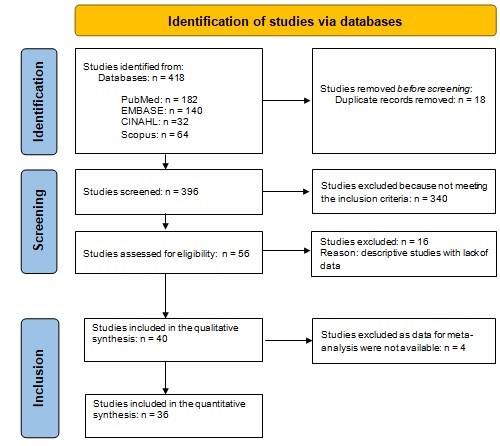
    Thirty-six articles were included in the meta-analysis. 1,111 RF records were identified; 616 were linked to ICF classification, 450 to ICD-10, and 260 to ATC. Considering the ICF, the meta-analysis identified 50 RF categories linked to 523 records as significant (52 RFs non-significant). Regarding ICD-10, the meta-analysis identified 51 RF categories for a total of 509 records as significant (101 RFs non-significant). Concerning ATC, the meta-analysis identified 26 RF categories linked to 294 records as significant (65 RFs non-significant). 18 RF categories were excluded as they were redundant or protective factors. After this process, the purified list included 53 significant RF categories linked to 328 records. The pooled OR values of the purified list ranged from 1.299 (N06A Antidepressants) to 8.633 (d420 Transferring oneself). Overall, the initial number of RFs was reduced by about 21 times compared to the initial number, i.e., from 1,111 identified RF records to 53 significant RF categories.

    Discussion and Conclusion

    This study aimed to provide a proof-of-concept that it may be feasible to reduce the reported heterogeneity in the description of fall RFs and, subsequently, their number by adopting the standard terminology provided by the International Health Classifications. We achieved this aim in four subsequent steps, and we identified 53 significant RF categories for in-hospital falls. We demonstrated that adopting a clear and consistent terminology derived from standardized international classifications may lead to a marked reduction and systematization of fall RFs among hospitalized adults. The list of significant RFs can be used as a template at the regional level to build more accurate measurement instruments to predict in-hospital falls.

    REFERENCES

    Deandrea, S, Bravi, F, Turati, F, Lucenteforte, E, La Vecchia, C, and Negri, E. Risk factors for falls in older people in nursing homes and hospitals. A systematic review and meta-analysis. Arch Gerontol Geriatr. (2013) 56:407–15. doi: 10.1016/j.archger.2012.12.006

    Cieza, A, Fayed, N, Bickenbach, J, and Prodinger, B. Refinements of the ICF linking rules to strengthen their potential for establishing comparability of health information. Disabil Rehabil. (2019) 41:574–83. doi: 10.3109/09638288.2016.1145258

  • La rilevazione e la predizione del rischio di caduta negli anziani residenti in comunità

    La rilevazione e la predizione del rischio di caduta negli anziani residenti in comunità

    La rilevazione e la predizione del rischio di caduta negli anziani residenti in comunità

    Fall risk detection and prediction in community-dwelling older adults

    Autori

    Caselli Serena [PhD program in Public Health, curriculum in Health Services Research and Technology Assessment, School of Medicine and Surgery, University of Milan Bicocca, Milano, Italy – Unità Operativa Complessa di Medicina Riabilitativa, Azienda Ospedaliero-Universitaria di Modena, Modena, Italy]

    La Porta Fabio [IRCCS Istituto delle Scienze Neurologiche di Bologna, Bologna, Italy]

    Cortesi Paolo A. [Research Center on Public Health, University of Milan Bicocca, Monza, Italy]

    Mantovani Lorenzo G. [Research Center on Public Health, University of Milan Bicocca, Monza, Italy]

    Introduction

    Falls represent a significant public health issue for the elderly, also with neurological diseases, for their human, health, and material costs. Epidemiological studies identified fall risk factors (RFs), and international guidelines recommend a multifactorial removal approach of the modifiable fall RFs and the implementation of evidence-based effective interventions for people at fall risk. Nevertheless, investigators did not use unique classifications for fall RFs, and despite the use of numerous fall risk tools, it is not possible to detect and predict fallers with optimal diagnostic accuracy. Thus, this thesis aims: 1) to validate a fall risk serial screening algorithm with a high level of diagnostic accuracy in community-dwelling older people, also with associated neurological diseases; 2a) assess the neurological disease effect on the screening tests; 2b) validate an International Classification of Diseases (ICD) & Functioning (ICF) core set for the fall risk in the same sample.

    Methods

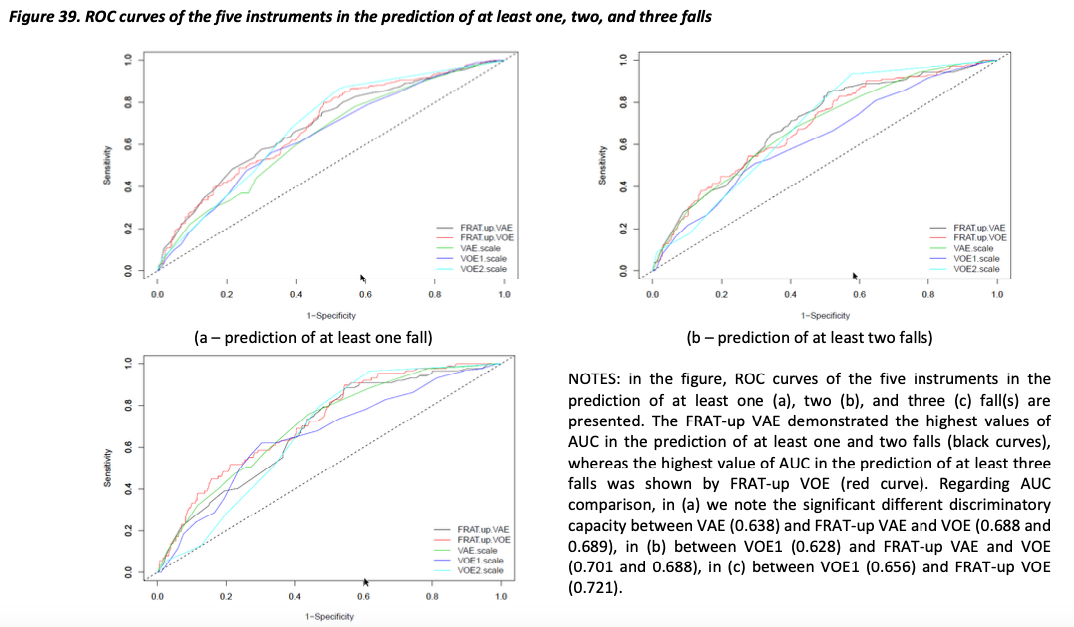
    Using data collected in the PRE.C.I.S.A. trial about the efficacy of a tailored intervention on fall risk, we performed the following analyses: 1) we calibrated VAE, VOE1 and VOE2 measurement scales with Rasch analysis (RA) and we calculated the two FRAT-up on the same variables; we studied the diagnostic accuracy of the single tools and the screening algorithms, obtained with serial combinations of the calibrated scales and the two FRAT-up tools, and with logistic regression models, in the prediction of at least one, two, and three (recurrent fallers) falls in the following twelve months; we compared their properties, with a purpose of external validation; 2a) we conducted a Differential Item Functioning (DIF) analysis for the calibrated scales and a t-test comparison for the two FRAT-up; 2b) we reviewed the fall RFs, and we linked them to the classification categories; we compared and integrated the core set with the existing Yen’s ICF core set for falls.

    Results

    The sample consisted of 768 older adults. We calibrated VAE, VOE1, and VOE scales, showing a satisfactory fit to the Rasch model (χ213=43.4; p=0.08; χ212=17.5, p=0.13; χ26=32.9, p=0.04) and adequate reliability for individual measurement. The serial combination with ‘AND’ rule of the calibrated scales generated serial screening algorithms predicting fall risk based on cutoffs defined using an ‘ad hoc’ clinical method, which considered a higher cost for false negatives (≥1 fall: SE=62.4%; SP=71.0%; ≥2 falls: SE=72.8%; SP=63.2%; ≥3 falls: SE=79.3%; SP=60.0%). We calculated cumulative post-test probabilities of the serial combination of the scales, performing more effectively than the single tools, and additional algorithms based on logistic regression models using a parallel combination. We realized an external validation through the comparison with FRAT-up algorithms. We demonstrated that the neurological disease effect on tools’ performance is minor and manageable with RA. We validated an ICD&ICF core set for the fall risk in community-dwelling older adults, also with associated neurological diseases (103 fall RFs linked to 74 categories).

    Discussion and Conclusion

    The described serial algorithms could constitute the first component of an effective fall prevention program in older adults, followed by the delivery of effective multifactorial and multicomponent interventions to people at risk in an outpatient ‘fall clinic’. Further projects are desirable to replicate all these findings in the context of larger, multicenter validation studies, improving the sample representativeness and then providing an economic evaluation of the proposed screening algorithms.

    REFERENCES

    Gillespie LD, Robertson MC, Gillespie WJ, et al. Interventions for preventing falls in older people living in the community. Cochrane Database Syst Rev 2012;9:CD007146.

    Allen NE, Schwarzel AK, Canning CG. Recurrent falls in Parkinson’s disease: a systematic review. Parkinson’s disease 2013;2013:906274.

    Weerdesteyn V, de Niet M, van Duijnhoven HJ, Geurts AC. Falls in individuals with stroke. J Rehabil Res Dev 2008;45:1195-1213.

    La Porta F, Lullini G, Caselli S, Valzania F, and the PRECISA Group (2022) Efficacy of a multiple-component and multifactorial personalized fall prevention program in a mixed population of community-dwelling older adults with stroke, Parkinson’s Disease, or frailty compared to usual care: The PRE.C.I.S.A. randomized controlled trial. Front.Neurol.13:943918.

    Cieza, A, Fayed, N, Bickenbach, J, and Prodinger, B. Refinements of the ICF linking rules to strengthen their potential for establishing comparability of health information. Disabil Rehabil. (2019) 41:574–83.

  • Benefici e rischi della Terapia Manipolativa Spinale nel trattamento del dolore cervicale aspecifico recente e persistente: una revisione sistematica con meta-analisi

    Benefici e rischi della Terapia Manipolativa Spinale nel trattamento del dolore cervicale aspecifico recente e persistente: una revisione sistematica con meta-analisi

    Benefici e rischi della Terapia Manipolativa Spinale nel trattamento del dolore cervicale aspecifico recente e persistente: una revisione sistematica con meta-analisi

    Benefits and harms of Spinal Manipulative Therapy for treating recent and persistent nonspecific neck pain: a systematic review with meta-analysis

    Autori

    Silvia Minnucci [Department of Clinical Science and Translational Medicine, University of Rome Tor Vergata, Rome, Italy]

    Tiziano Innocenti [Department of Health Sciences, Faculty of Science, Vrije Universiteit Amsterdam, Amsterdam Movement Sciences, The Netherlands]

    Stefano Salvioli [Department of Neuroscience, Rehabilitation, Ophthalmology, Genetics, Maternal and Child Health, University of Genova, Campus of Savona, Italy],

    Silvia Giagio [Department of Biomedical and Neuromotor Sciences (DIBINEM), Alma Mater Studiorum, University of Bologna, Bologna, Italy]

    Marzia Stella Yousif [Department of Clinical Science and Translational Medicine, University of Rome Tor Vergata, Rome, Italy]

    Daniel Feller [Provincial Agency for Health of the Autonomous Province of Trento, Trento, Italy]

    Fabrizio Brindisino [Department of Medicine and Health Science “Vincenzo Tiberio”, University of Molise c/o Cardarelli Hospital, C/da Tappino 86100 Campobasso, Italy]

    Agostino Faletra [Queen Elizabeth Hospital, Clinical Support & Screening Service, Gateshead, United Kingdom]

    Alessandro Chiarotto [Department of Health Sciences, Faculty of Science, Vrije Universiteit Amsterdam, Amsterdam Movement Sciences, The Netherlands]

    Firas Mourad [Department of Health, LUNEX University, 4671 Differdange, Luxembourg].

    Introduction

    Neck pain (NP) is one of the most common and disabling musculoskeletal conditions. Different clinical practice guidelines (CPGs) provide contradictory recommendations for how to manage NP, likely because of the low-quality evidence. Cervical spinal manipulative therapy (SMT), considered to represent both non-thrust mobilization and thrust manipulation, is a common intervention for NP within a multimodal care pathway. Overall, the effectiveness of cervical SMT for reducing pain and disability varies between studies and their results depend on symptoms staging, outcomes, comparators, and whether combined with other interventions. There is plenty of debate regarding manual therapy; some call for clinicians to abandon SMT. Therefore, clinicians need trustworthy information about the safety and effectiveness of the intervention.

    The objective of this systematic review with meta-analysis of randomized controlled trials is to estimate the benefits and harms of cervical SMT for treating NP.

    Methods

    This systematic review protocol was registered with the International Prospective Register of Systematic Reviews (PROSPERO) on 30 April 2021 (registration number CRD42021245671).

    We searched the MEDLINE, Cochrane CENTRAL, EMBASE, CINAHL, PEDro, Chiropractic Literature Index bibliographic databases, and grey literature sources, up to June 6, 2022.

    Randomized controlled trials (RCTs) evaluating SMT compared to guideline-recommended and non-recommended interventions, sham SMT, and no intervention for adults with neck pain were eligible for our systematic review.

    Pre-specified outcomes included pain, range of motion, disability, health-related quality of life. 

    Random-effects meta-analysis for clinically homogeneous RCTs at short-term and long-term outcomes.

    Risk of bias was assessed using the Cochrane Risk-of-Bias 2.0 Tool.

    We used the Grading of Recommendations Assessment Development and Evaluation approach to judge the certainty of evidence. 

    Results

    We included 28 RCTs with a total number of 2139 patients.

    Two trials were at an overall “low risk” of bias, four had “some concerns.” The remaining 22 trials were at “high risk” of bias for all the investigated outcomes.

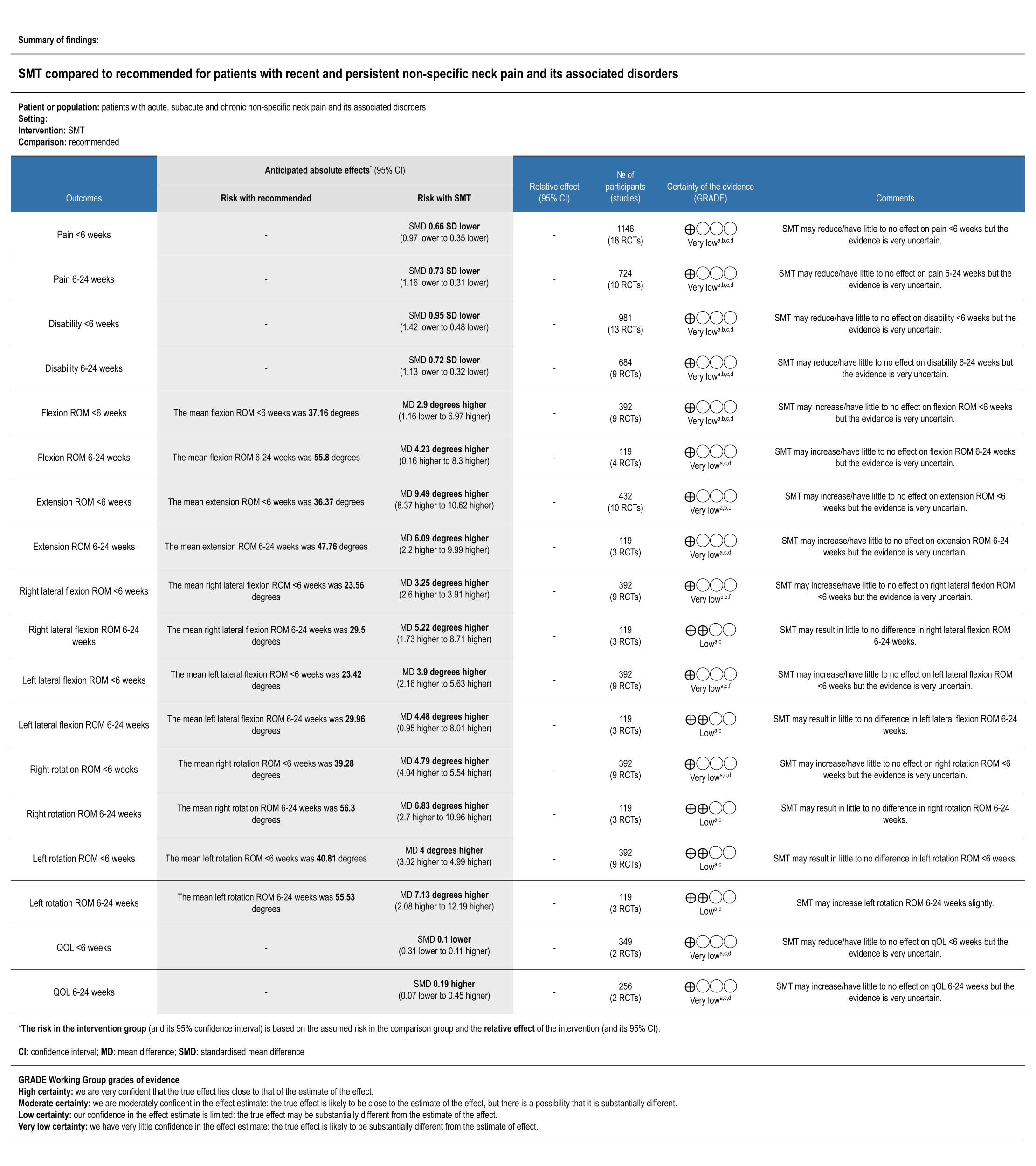
    There was very low to low certainty evidence that SMT was more effective than recommended interventions for improving pain at short-term (standardized mean difference [SMD] 0.66; confidence interval [CI] 0.35 to 0.97) and long-term (SMD 0.73; CI 0.31 to 1.16), and for reducing disability at short-term (SMD 0.95; CI 0.48 to 1.42) and long-term (SMD 0.65; CI 0.23 to 1.06). Transient side effects only were found (e.g., muscle soreness).

    Discussion and Conclusion

    Our results should be interpreted cautiously as the certainty of evidence varied from very low to low. We found that cervical SMT results in statistically significant and clinically relevant short- and long-term effects compared to recommended interventions for pain and disability. Non-statistically significant effects were found for pain and disability compared to non-recommended interventions, and statistically significant short-term effects were found on disability compared to sham and no interventions. Cervical SMT may provide ROM improvement, especially for extension, rotation, and lateral flexion movements. No differences were found between mobilization and thrust manipulation, except rotational ROM for thrust manipulation. Only a few trials reported minor AEs with the lowest proportion of side effects compared to exercise.

    In conclusion there was very low certainty evidence supporting cervical SMT as an intervention to reduce pain and improve disability in people with neck pain.

    REFERENCES

    Ferrari R, Russell AS. Regional musculoskeletal conditions: neck pain. Best Pract Res Clin Rheumatol. 2003;17:57-70.

    Gross A, Miller J, D’Sylva J, et al. Manipulation or mobilisation for neck pain. Cochrane Database Syst Rev. 2010;CD004249.

    Parikh P, Santaguida P, Macdermid J, Gross A, Eshtiaghi A. Comparison of CPG’s for the diagnosis, prognosis and management of non-specific neck pain: a systematic review. BMC Musculoskelet Disord. 2019;20:81

    Rubinstein SM, de Zoete A, van Middelkoop M, Assendelft WJJ, de Boer MR, van Tulder MW. Benefits and harms of spinal manipulative therapy for the treatment of chronic low back pain: systematic review and meta-analysis of RCTs. BMJ. 2019;364:l689.

    Sterne JAC, Savovic J, Page MJ, et al. RoB 2: a revised tool for assessing RoB in randomised trials. BMJ. 2019;366:l4898.

    Schünemann H, Brożek J, Guyatt G, Oxman A, editors. GRADE handbook for grading quality of evidence and strength of recommendations. Updated October 2021. The GRADE Working Group, 2013.

  • Implementazione di un protocollo di riabilitazione dell’arto superiore mediato da robot per un trattamento personalizzato dopo l’ictus. Un’analisi retrospettiva

    Implementazione di un protocollo di riabilitazione dell’arto superiore mediato da robot per un trattamento personalizzato dopo l’ictus. Un’analisi retrospettiva

    Implementation of a robot-mediated upper limb rehabilitation protocol for a customized treatment after stroke. A retrospective analysis

    Autori

    Pavan Arianna (IRCCS Fondazione Don Carlo Gnocchi, Florence, Italy)

    Fasano Alessio (IRCCS Fondazione Don Carlo Gnocchi, Florence, Italy)

    Cortellini Laura (IRCCS Fondazione Don Carlo Gnocchi, Florence, Italy)

    Lattanzi Stefania (IRCCS Fondazione Don Carlo Gnocchi, Florence, Italy)

    Papadopoulou Dionysia (IRCCS Fondazione Don Carlo Gnocchi, Florence, Italy)

    Insalaco Sabina (IRCCS Fondazione Don Carlo Gnocchi, Florence, Italy)

    Germanotta Marco (IRCCS Fondazione Don Carlo Gnocchi, Florence, Italy)

    Aprile Irene (IRCCS Fondazione Don Carlo Gnocchi, Florence, Italy)

    Introduction

    According to the World Health Organization (WHO), stroke is the leading cause of disability and the second leading cause of death worldwide, with a 30% increase expected between 2000 and 2025 [ 1 ]. Loss of upper limb dexterity represents one of the main factors of long-lasting disability in stroke patients, resulting in decreased autonomy and severe decline in quality of life [ 2 ]. In this context, rehabilitation brings benefits in terms of motor and functional recovery and cognitive and psychological improvement. In the past ten years, robotic equipment designed specifically for the neuromotor rehabilitation of the upper limb has gradually been introduced into clinical practice. [ 3 ]. The purpose of the study was to compare the effects of a robotic rehabilitation pathway, using a set of four robotic devices, before and after the implementation of a robotic treatment protocol defined on the basis of clinical outcome.

    Methods

    In this study, 81 patients with subacute stroke outcomes were recruited at the Don Carlo Gnocchi Foundation in Rome, including 32 patients for the Pilot Study Group (robotic treatment) and 49 for the Experimental Group (the robotic treatment protocol based on clinical outcome). Figure 1 represents the study design, included the protocol development phase. Subjects underwent a 30-session upper limb neurorehabilitation program using the following robotic devices (Figure 1): Diego, Amadeo, Pablo and Motore. Patients were assessed before (T0) and after (T1) the rehabilitation intervention using the following clinical scales: Fugl-Meyer Assessment for Upper Extremity (FMA-UE) to investigate upper extremity performance, Motricity Index (MI) to measure strength, Modified Barthel Index (mBI) for activities of daily living and the Numerical Rating Scale (NRS) for pain. In addition to the robotic treatment for upper limb recovery, patients performed daily conventional rehabilitation treatment aimed at trunk control, balance, and gait recovery. The following procedures were carried out: (a) an intragroup statistical analysis using the non-parametric Wilcoxon test to evaluate the data collected at T0 and T1 separately for the two groups; (b) an intergroup statistical analysis, using the non-parametric Mann-Whitney test, to compare the deltas of improvement (T1-T0) between the two groups.

    Results

    Intragroup analysis showed significant improvement in both groups in terms of upper limb motor function (FMA-UE Pilot Group: p<0.001; FMA-UE Experimental Group: p<0.001), strength (MI Pilot Group: p=0.002; MI Experimental Group: p<0.001) and autonomy in performing activities of daily living (mBI Pilot Group: p<0.001; mBI Experimental Group: p<0.001). There was no evidence of changes in pain (NRS Pilot Group: p=0.733; NRS Experimental Group: p=0.806). Intergroup analysis (Figure 2) on deltas of improvement showed a statistically significant difference in FMA-UE (p=0.002) and MI (p<0.001), indicative of greater recovery in motor function and upper limb strength in the Experimental Group, compared with the Pilot Group.

    Discussion and Conclusion

    The implementation of a customized robotic treatment protocol, using a set of 4 robotic devices, based on clinical outcome (thus allowing the type and mode of intervention to be defined) showed superiority over robotic treatment without a defined protocol. In detail, the results show an overall improvement in upper limb strength and function in subjects with acute phase stroke cerebri.

    REFERENCES

    [ 1 ] Truelsen, Thomas, et al. Eur J Neurol. 2006 Jun;13(6):581-98.

    [ 2 ] Nakayama, Hirofumi, et al. Arch Phys Med Rehabil. 1994 Apr; 75(4):394-398.

    [ 3 ] Mehrholz, Jan, et al. Cochrane Database Syst Rev. 2018 (9): CD006876.


  • Recupero a lungo termine delle abilita’ nei pazienti con ictus sottoposti a trattamento riabilitativo. Uno studio retrospettivo.

    Recupero a lungo termine delle abilita’ nei pazienti con ictus sottoposti a trattamento riabilitativo. Uno studio retrospettivo.

    Long-Term Recovery of Abilities in Stroke Patients undergoing Rehabilitation Treatment. A retrospective study.

    Autori

    Pavan Arianna (IRCCS Fondazione Don Carlo Gnocchi, Florence, Italy)

    Fasano Alessio (IRCCS Fondazione Don Carlo Gnocchi, Florence, Italy)

    Cortellini Laura (IRCCS Fondazione Don Carlo Gnocchi, Florence, Italy)

    Lattanzi Stefania (IRCCS Fondazione Don Carlo Gnocchi, Florence, Italy)

    Papadopoulou Dionysia (IRCCS Fondazione Don Carlo Gnocchi, Florence, Italy)

    Insalaco Sabina (IRCCS Fondazione Don Carlo Gnocchi, Florence, Italy)

    Germanotta Marco (IRCCS Fondazione Don Carlo Gnocchi, Florence, Italy)

    Aprile Irene (IRCCS Fondazione Don Carlo Gnocchi, Florence, Italy)

    Introduction

    According to published research, the incidence of clinical recovery in stroke victims increases during the initial weeks following the acute event and then decreases significantly in the months that follow (1). Previous research has demonstrated that, in the three to six months following a stroke, there is little to no improvement, particularly in terms of walking and motor function (2). Since then, this concept of functional recovery limited in the subacute phase has been abandoned. Current robotic rehabilitation approaches have shown efficacy even when applied beyond the first three months after the acute event; in particular, intensive robotic gait training has shown significant improvements in chronic stroke patients(3). The aim of this study is to retrospectively analyze the functional recovery profile of stroke patients in response to continuous rehabilitation treatment for more than six months after the acute event.

    Methods

    In this retrospective study, data were collected from 44 patients with stroke outcomes (20 females and 24 males, mean age 65±12) who were admitted to the Rome centre of the Don Carlo Gnocchi Foundation between May 2022 and May 2023. The latency range of the subjects taken into analysis varied from 1 to 48 months from the acute event. In particular, we recruired subjects who received consecutive rehabilitation cycles with a total duration of more than six months, in the different rehabilitation settings (inpatient 46%, partial inpatient 18% and outpatient 36%). The rehabilitation project included daily sessions of conventional and robotic neuromotor physiotherapy, speech therapy, occupational therapy and neuropsychological sessions. From the medical records, data were obtained from the following scales, relating to the beginning and end of each patient’s rehabilitation project: modified Barthel Index (mBI) for autonomy in activities of daily living, Numerical Rating Scale (NRS) for pain and Functional Ambulation Classification (FAC) to assess walking ability. In this study, only the mBI was considered. In particular, a statistical approach based on a linear mixed model was used to examine the relationship between the time elapsed since the acute event and the mBI index. In detail, the mBI was considered as a dependent variable, the months since the event as a fixed effect, and the subjects as a random effect. This analysis was conducted separately for data from four time intervals: within 6 months, between 6 months and 1 year, between 1 and 2 years, and between 2 and 3 years after the acute event.

    Results

    Only data from the first three years after the acute event for each patient were considered for the statistical analysis. The results showed a positive association between mBI and latency from the event in all four time intervals examined (Figure 1). Specifically, the fixed effect estimates were 5.9 (SE: 0.6) within 6 months (p<0.001), 2.9 (SE: 0.4) between 6 months and one year (p<0.001), 1.0 (SE: 0.3) between the first and second year (p<0.001) and 0.6 (SE: 0.2) between the second and third year (p<0.01).

    Discussion and Conclusion

    This study demonstrates the value of early intense therapy in the functional recovery of stroke patients. Furthermore,  long-term rehabilitation cycles that extend more than a year after the acute event are successful at preserving function and improving functional impairment recovery. These findings emphasize the need of giving therapy to chronic and late-stage patients.

    REFERENCES

    1. Duncan PW, Min Lai S. Stroke Recovery. Topics in Stroke Rehabilitation. 1 ottobre 1997;4(3):51–8.
    2. Jørgensen HS, Nakayama H, Raaschou HO, Vive-Larsen J, Støier M, Olsen TS. Outcome and time course of recovery in stroke. Part II: Time course of recovery. The Copenhagen Stroke Study. Arch Phys Med Rehabil. maggio 1995;76(5):406–12.
    3. Aprile I, Iacovelli C, Padua L, Galafate D, Criscuolo S, Gabbani D, et al. Efficacy of Robotic-Assisted Gait Training in chronic stroke patients: Preliminary results of an Italian bi-centre study. NeuroRehabilitation. 2017;41(4):775–82.
  • QUALITÀ DI VITA, ASPETTATIVE, PENSIERI E PAURE DEI PAZIENTI IN LISTA D’ATTESA PER ARTRODESI VERTEBRALE: UNO STUDIO QUALITATIVO

    QUALITÀ DI VITA, ASPETTATIVE, PENSIERI E PAURE DEI PAZIENTI IN LISTA D’ATTESA PER ARTRODESI VERTEBRALE: UNO STUDIO QUALITATIVO

    QUALITÀ DI VITA, ASPETTATIVE, PENSIERI E PAURE DEI PAZIENTI IN LISTA D’ATTESA PER ARTRODESI VERTEBRALE: UNO STUDIO QUALITATIVO

    QUALITY OF LIFE, EXPECTATIONS, THOUGHTS AND FEARS OF PATIENTS ON WAITLIST FOR SPINAL ARTHRODESIS: A QUALITATIVE STUDY

    Autori

    VANTI CARLA (Department of Biomedical and Neuromotor Sciences (DIBINEM), University of Bologna, Bologna 40138, Italy)

    FERRARI SILVANO (Department of Biomedical and Neuromotor Sciences (DIBINEM), University of Bologna, Bologna 40138, Italy)

    ALBANO ANGELA (Azienda Ospedaliero Universitaria IRCSS Sant’Orsola-Malpighi, Bologna 40138, Italy)

    BURBELLO ILARIA (Physiotherapy Private Practice, 35019 Tombolo (PD), Italy)

    DE CRISTOFARO LAURA (Department of Clinical Experimental Sciences, University of Brescia Brescia 25123, Italy)

    MATTAROZZI KATIA (Department of Medical and Surgical Sciences (DIMEC), University of Bologna, Bologna 40138, Italy)

    GASBARRINI ALESSANDRO (Department of Spine Surgery, IRCCS Istituto Ortopedico Rizzoli, Bologna 40136, Italy)

    PILLASTRINI PAOLO (Department of Biomedical and Neuromotor Sciences (DIBINEM), University of Bologna, Bologna 40138, Italy)

    Introduction

    Degenerative disorders of the spine are a widespread and disabling condition with significant clinical and socioeconomic impact (1) and spinal arthrodesis is a surgical option in the most severely affected patients (2). Although health-related quality of life (HRQoL) seems to improve after surgical treatment (3), patients candidates for lumbar surgery exhibit worse HRQoL compared to others with different orthopedic conditions (4). Although patient’s subjective experience following surgery has been investigated in several qualitative studies (5-6), no qualitative study has yet investigated the subjective perception of quality of life, expectations, emotional state, and fears of patients who are candidates for spinal surgery during the waiting period. Thus, the aim of this study is to understand cognition, emotional-behavioral state and quality of life of patients during time spent on the waitlist for lumbar spinal arthrodesis.

    Methods

    This qualitative study of semi-structured interviews was conducted at an orthopedic research institute in Italy. 15 patients participated in this study and were interviewed between May 2022 and February 2024. All patients signed a written informed consent to participate in the study. The interviews were transcribed and analyzed by a multiprofessional team (physiotherapists, orthopedic surgeon, psychologist) through thematic analysis. The study was approved by the Ethical Committee of Istituto Ortopedico Rizzoli on 24/03/2022, Prot. n. 0005021. The study protocol was registered on ClinicalTrials.gov database on 14/03/2022 with ID number NCT06323694. 

    Results

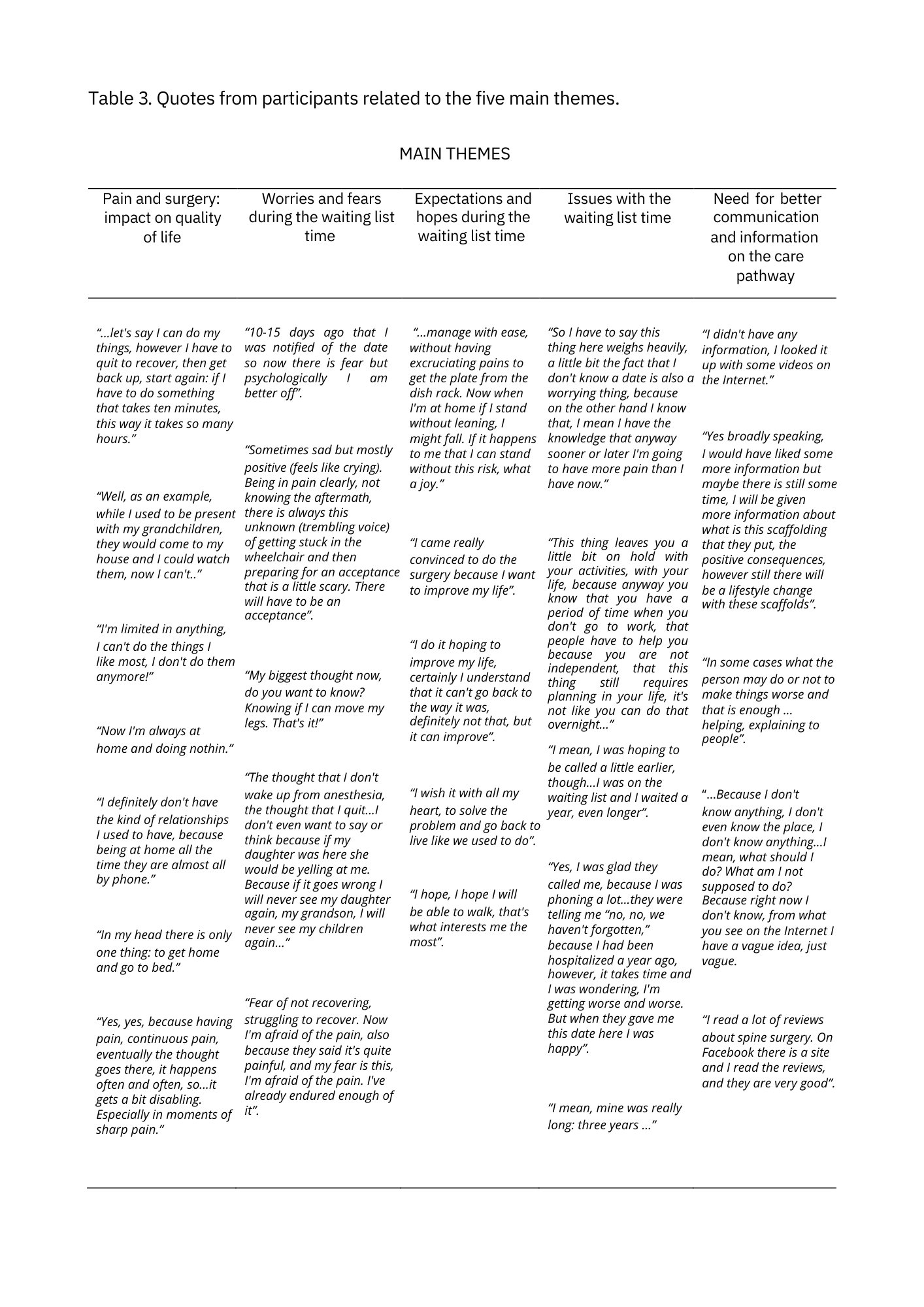
    Five main themes were found. (1) Pain and surgery: impact on quality of life, (2) Worries and fears during the waiting list time, (3) Expectations and hopes during the waiting list time, (4) Issues with the waiting list time, (5) Need for better communication and information on the care pathway. Three secondary themes were also produced: (6) social and family support during the course of treatment, (7) interpersonal relationships and social estrangement and (8) coping strategies.

    Discussion and Conclusion

    Overall the psycho-emotional condition described by the respondents is characterized by hope; however, it also shows feelings of uncertainty and insecurity.

    The findings of the study highlight that patients on the waiting list for spinal arthrodesis need more certainty about waiting times, better communication with hospital staff, more thorough information about their care pathway. This could help patients feel more confident and may lead to more adequate expectations before surgery.

    REFERENCES


    1. Kobayashi K, Ando K, Nishida Y, Ishiguro N, Imagama S. Epidemiological trends in spine surgery over 10 years in a multicenter database. Eur Spine J. 2018 Aug 1 [cited 2024 Feb 25];27(8):1698–703.
    2. Reisener MJ, Pumberger M, Shue J, Girardi FP, Hughes AP. Trends in lumbar spinal fusion—a literature review. Vol. 6, Journal of Spine Surgery. AME Publishing Company; 2020. p. 752–76.
    3. Nayak NR, Stephen JH, Piazza MA, Obayemi AA, Stein SC, Malhotra NR. Quality of Life in Patients Undergoing Spine Surgery: Systematic Review and Meta-Analysis.
    4. Becerra Fontal JA, Bagó Granell J, Garré Olmo J, Roig Busquets R, Peris Prats F, Villanueva Leal C. Evaluation of health-related quality of life in patients candidate for spine and other musculoskeletal surgery. European Spine Journal. 2013 May;22(5):1002–9.
    5. Davis RE, Vincent C, Henley A, McGregor A. Exploring the care experience of patients undergoing spinal surgery: A qualitative study. J Eval Clin Pract. 2013 Feb;19(1):132–8.
    6. Accardi-Ravid M, Eaton L, Meins A, Godfrey D, Gordon D, Lesnik I, et al. A Qualitative Descriptive Study of Patient Experiences of Pain before and after Spine Surgery. Pain Medicine (United States). 2020 Mar 1;21(3):604–12.


  • La tDCS monopolare potrebbe influenzare i riflessi del tronco encefalico: Uno studio computazionale e neurofisiologico

    La tDCS monopolare potrebbe influenzare i riflessi del tronco encefalico: Uno studio computazionale e neurofisiologico

    La tDCS monopolare potrebbe influenzare i riflessi del tronco encefalico: Uno studio computazionale e neurofisiologico

    Monopolar tDCS might affect brainstem reflexes: A computational and neurophysiological study

    Autori

    Guidetti Matteo [‘‘Aldo Ravelli” Center for Neurotechnology and Experimental Brain Therapeutics, Department of Health Sciences, University of Milan, Milan, Italy]

    Anna Maria Bianchi [Department of Electronics, Information and Bioengineering, Politecnico di Milano, Milan, Italy]

    Marta Parazzini [Institute of Electronics, Computer and Telecommunication Engineering, CNR, Milan, Italy]

    Natale Maiorana [‘‘Aldo Ravelli” Center for Neurotechnology and Experimental Brain Therapeutics, Department of Health Sciences, University of Milan, Milan, Italy]

    Marta Bonato [Institute of Electronics, Computer and Telecommunication Engineering, CNR, Milan, Italy]

    Rosanna Ferrara [‘‘Aldo Ravelli” Center for Neurotechnology and Experimental Brain Therapeutics, Department of Health Sciences, University of Milan, Milan, Italy]

    Giorgia Libelli [‘‘Aldo Ravelli” Center for Neurotechnology and Experimental Brain Therapeutics, Department of Health Sciences, University of Milan, Milan, Italy]

    Alberto Priori [‘‘Aldo Ravelli” Center for Neurotechnology and Experimental Brain Therapeutics, Department of Health Sciences, University of Milan, Milan, Italy]

    Tommaso Bocci [‘‘Aldo Ravelli” Center for Neurotechnology and Experimental Brain Therapeutics, Department of Health Sciences, University of Milan, Milan, Italy]

    Introduction

    Transcranial direct current stimulation (tDCS) has recently gained great interest due to its feasibility and available clinical evidences1. Several findings 2,3 suggest it can generate significant electric fields (EF) in subcortical regions, possibly modifying their activity. Several authors have tried to steer the EF to target deeper brain structures by setting number and position of scalp electrodes – a strategy called multi-electrode tDCS4,5. For example, monopolar montages (i.e., with reference over right deltoid) might induce greater concentration of currents6 and greater intensities of EF in thalamus and midbrain, compared to cephalic montages7. A way to evaluate the effect of the stimulation on brainstem is to assess trigeminal reflexes (e.g., blink reflex – BR, masseter inhibitory reflex – MIR), whose arcs relies on brainstem neural circuits (pons, medulla oblongata)8,9. In this study, we aimed to assess whether a monopolar multi-electrode tDCS (anodes over motor cortices, cathode over right deltoid) montage might selectively affect deep brain structures through computational predictions and neurophysiological assessment of BR and MIR.

    Methods

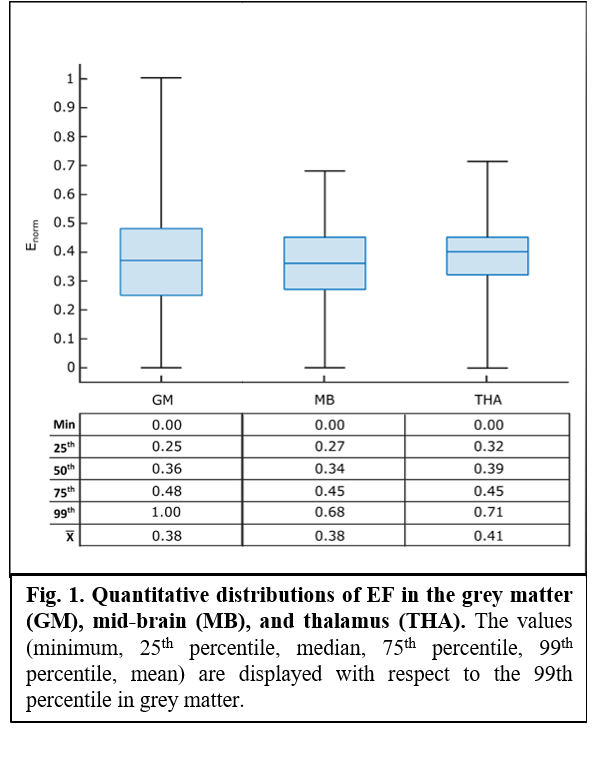
    A MRI-based human head model10 was used to model the EF induced by the experimental protocol of stimulation. Sponge electrodes were modelled, with a uniform electrical potential (± 1 V) over the surface. The peak (99th percentile), median, 25th and 75th percentile of the EF amplitude distribution in thalamus (THA) and mid-brain (MB), and the percentage of area where EF amplitude was greater than 25% (V25), 30% (V30), and 50% (V50) of the peak in the grey matter were considered. All values were normalized to the 99th percentile of EF in the grey matter. Then, the experimental protocol of stimulation (single session, 2 mA for 20 min, anode rubber pads: 25 cm2, reference pad: 35 cm2) was applied to 10 healthy subjects (mean ± SD age: 31.5 ± 9.7, 5 women). BR (reflex threshold, latencies of RI, RII ipsilateral and RII contralateral) and MIR (onset latencies and duration of SP1 and SP2) characteristics were recorded before (T0) and after (T1) the stimulation. Computational estimations were reported descriptively, while neurophysiological data were analysed through paired t-Test (T0 vs T1) to assess the effect of the treatment (p-value < 0.05 set as significant).

    Results

    Computational predictions suggest that the experimental protocol of stimulation might induce normalized medians (MB = 0.34; THA = 0.39), 25th (MB = 0.27; THA = 0.32) and 75th (MB, THA = 0.45) percentiles in deeper regions roughly comparable to those in the grey matter, with peak values always above ~70% of the peak in the grey matter (fig.1 and fig.2). Similarly, values of volume percentage suggest a concentration of EF for MB (V30 = 62.25%; V50 = 17.62%) and especially for THA (V30 = 81.02%; V50 = 17.18%) (fig.3). As for neurophysiological assessments, a significant reduction in latency (ms) of RI [right BR: t(9) = 5.24, p < 0.001; left BR: t(9) = 3.21, p = 0.01] and increase of SP1 duration (ms) of MIR [t(9) = -2.46, p = 0.03] was found (fig.4).

    Discussion and Conclusion

    In this study, we assessed the trends of EF distributions in MB and THA during a monopolar multi-electrode tDCS. Our results suggest that this montage might induce a deep and focal distribution of EF, as previously proposed11; however, none of previous studies were clinically confirmed, nor considered to use an extracephalic electrode. Since neurons in deep brain regions are directly sensitive to weak DC electric fields12, an effect similar to those induced by tDCS at cortical level might be expected. Indeed, we clinically tested computational predictions in healthy subjects. Clinical findings seem to confirm that monopolar multi-electrode tDCS induces changes in BR, suggesting a neuromodulatory effect on brainstem. We can hypothesize that tDCS may interfere with diencephalic nuclei (e.g., reticular formation, locus ceruleus) strictly connected to pontine and medullary areas from which BR originate13. The translation potentiality of these results is great, and the possibility to directly influence brainstem activity would be of great value for many clinical applications, e.g., rehabilitation of cranial nerves disfunctions or Parkinson’s disease.

    REFERENCES

    1 Lefaucheur, J.-P. et al. Clin Neurophysiol 128, 56–92 (2017)

    2 Parazzini, M. et al. Bioelectromagnetics 33, 476–487 (2012)

    3 Guidetti, M. et al. Biomedicines 10, 2333 (2022)

    4 Dmochowski, J. P. et al. J Neural Eng 8, 046011 (2011)

    5 Guler, S. et al. Journal of neural engineering 13, (2016)

    6 Noetscher, G. M. et al. IEEE Transactions on Biomedical Engineering 61, 2488–2498 (2014)

    7 Parazzini, M. et al. Clinical Neurophysiology 124, 1039–1040 (2013)

    8 Esteban, A. Neurophysiologie clinique = Clinical neurophysiology 29, 7–38 (1999)

    9 Ongerboer De Visser, B. W. et al. Brain : a journal of neurology 101, 285–294 (1978)

    10 Christ, A. et al. Physics in Medicine and Biology 55, 23 (2010)

    11 Khorrampanah, M. et al. Computers in Biology and Medicine 125, 103998 (2020)

    12 Reato, D. et al. The Journal of neuroscience : the official journal of the Society for Neuroscience 30, 15067–15079 (2010)

    13 Fearon, C. et al. Journal of Parkinson’s Disease 11, 261–269 (2021)

  • Atteggiamento dei fisioterapisti italiani verso i principi dell’EBP: uno studio trasversale attraverso l’Evidence Based Practice Questionnaire

    Atteggiamento dei fisioterapisti italiani verso i principi dell’EBP: uno studio trasversale attraverso l’Evidence Based Practice Questionnaire

    Attitude of Italian physiotherapists towards EBP principles: a cross-sectional study through the Evidence Based Practice Questionnaire

    Autori

    Deretti Lorenzo ((Bachelor’s Degree in Physiotherapy, Department of Clinical and Experimental Sciences, University of Brescia, Brescia, Italy))

    Negri Alessandro (Bachelor’s Degree in Physiotherapy, Department of Clinical and Experimental Sciences, University of Brescia, Brescia, Italy)

    Bertoni Gianluca (Department of Neurosciences, Rehabilitation, Ophthalmology, Genetics, Maternal and Child Health, University of Genoa, Genova, Italy; Department of Clinical and Experimental Sciences, University of Brescia, Brescia, Italy; Training Unit, Azienda Sociosanitaria Territoriale di Cremona, Cremona, Italy)

    Guidetti Matteo (“Aldo Ravelli” Center for Neurotechnology and Experimental Brain Therapeutics, Department of Health Sciences, University of Milan, Milan, Italy)

    Introduction

    ‘Evidence-based practice’ (EBP) refers to the conscientious, explicit, and judicious use of the best available evidence aimed at decision-making in patient care [1]. Pragmatically, it results in the integration of clinical expertise, the best evidence from the scientific literature, patient’s clinical condition and preferences [2]. Being physiotherapists (PTs) healthcare professionals, the Italian physiotherapist’s code of ethics mandates continuing professional education, beside the practice of good clinical practice according to research evidence – therefore, an EPB approach to professional practice (Art. 12 “Qualità ed appropriatezza delle cure e Art. 22 “Aggiornamento e formazione continua”) [3]. However, to date, there remain some critical issues in the fulfilment of this requirement [4], especially among Italian PTs [5]. Expanding previous knowledge [5], in this work we aim to investigate the attitude of Italian PTs towards EBP principles through a web questionnaire (Evidence Based Practice Questionnaire – EBPQ) [6].

    Methods

    In the present study, practice, opinions, skills, barriers, and facilitators of EBP in physiotherapy practice were investigated through the Italian EBPQ, consisting of 24 items with a Likert scale (scale from 1 to 7) [6]. The questionnaire was submitted to regularly registered Italian physiotherapists by Computer Assisted Web Interviewing (CAWI) method. In addition, demographic factors, such as gender (M, F), age (20-29, 30-39, 40-49, and > 50 years), region of work (northern Italy, other), years since graduation (<5; 6-10; >10 years), highest academic degree (bachelor’s, master’s and doctoral, master’s), field of activity (musculoskeletal, other), and time of actual activity (< 5, 6-20, > 20 years), were requested for analysis. After descriptive analysis, differences in EBPQ subscores between levels of demographic variables were considered. Since EBPQ subscores were found to be non-normally distributed (Kolmogorov-Smirnov test: p < 0.05), independent-samples Kruskal-Wallis (KW) analysis was used.

    Results

    139 PTs completed the survey with valid responses. Most of the participants were male (53.9%), young (45.3% < 29 yo) and working as freelancer (45.3%), in clinical care (100%), mostly with musculoskeletal diseases (72.6%). 64.6% of the responders have held the PT bachelor for <10 years (64.6%), which was the highest academic degree for the 62.5% of the sample (87, 62.5%). KW analysis to assess difference of EBPQ subitems scores across the levels of “years from the bachelor” showed significative differences for question on “how often I share new information with my colleagues” (χ2 [2] = 17.86, p < 0.001) and “ability to apply information to individuals” (χ2 [2] = 12.37, p = 0.002). Post hoc comparisons revealed that younger holders of PT bachelor (< 5yy) share new information significantly more often (for all comparisons, p < 0.005), and they can apply it significantly better to individuals (for all comparisons, p < 0.005) than older holders. KW analysis to assess difference of EBPQ subitems scores across the levels of “highest academic title” showed significative differences for question on “knowledge of how to retrieve evidence” (χ2 [2] = 20.76, p < 0.001), “ability to critically analyse evidence against defined standards” (χ2 [2] = 11.33, p = 0.003), “ability to determine the clinical applicability of the found material” (χ2 [2] = 7.34, p = 0.025). Post hoc comparisons revealed that PTs holding a level of education beyond bachelor’s degree show a greater knowledge on where to search for new information (for all comparisons, p < 0.005) and how to critically analyse it (for all comparisons, p < 0.005). Those holding the master’s degrees are statistically more able to determine the clinical validity of new research, compared to those holds a bachelor’s degree (p = 0.027).

    Discussion and Conclusion

    In this study, we assessed the practice, opinions and skills of EBP in physiotherapy clinical practice among PTs through a web version of the EBPQ. Our results suggest that “young PTs” (i.e., those holding a PT bachelor for <5 years) are more likely to share information found in the scientific databases, and to integrate them in the clinical practice. This could be explained by the short time since graduation, since university training lately is making the effort to focus on EBP concepts and practice, and by the short time to create a personal established clinical practice. Not surprisingly, PTs holding an academic grade higher than the bachelor’s degree (e.g., Master) reported a greater ability to search for and critically analyse new scientific information. This is in line with the greater research skills that higher academic courses are supposed to provide. Despite the limits of this study (e.g., little sample size and sample fairly representative of the general PT population), our results could serve as hint for further investigations and reflections on the use of EBP among Italian PTs – for example, how to bridge the generational gap.

    REFERENCES

    [1]        Sackett DL, Rosenberg WMC, Gray JAM, Haynes RB, Richardson WS. Evidence based medicine: what it is and what it isn’t. BMJ 1996;312:71–2. https://doi.org/10.1136/bmj.312.7023.71.

    [2]        Haynes RB, Devereaux PJ, Guyatt GH. Clinical expertise in the era of evidence-based medicine and patient choice. BMJ Evidence-Based Medicine 2002;7:36–8. https://doi.org/10.1136/ebm.7.2.36.

    [3]        Dalla A. CODICE DEONTOLOGICO DEI FISIOTERAPISTI n.d.

    [4]        Paci M, Faedda G, Ugolini A, Pellicciari L. Barriers to evidence-based practice implementation in physiotherapy: a systematic review and meta-analysis. Int J Qual Health Care 2021;33:mzab093. https://doi.org/10.1093/intqhc/mzab093.

    [5]        Castellini G, Corbetta D, Cecchetto S, Gianola S. Twenty-five years after the introduction of Evidence-based Medicine: knowledge, use, attitudes and barriers among physiotherapists in Italy – a cross-sectional study. BMJ Open 2020;10:e037133. https://doi.org/10.1136/bmjopen-2020-037133.

    [6]        Fernández-Domínguez JC, De Pedro-Gómez JE, Jiménez-López R, Romero-Franco N, Bays Moneo AB, Oliva-Pascual-Vaca Á, et al. Physiotherapists’ Evidence-Based Practice profiles by HS-EBP questionnaire in Spain: A cross-sectional normative study. PLoS One 2022;17:e0269460. https://doi.org/10.1371/journal.pone.0269460.