Categoria: Congresso 2024

  • L’esame neurologico per la radicolopatia cervicale: una scoping review

    L’esame neurologico per la radicolopatia cervicale: una scoping review

    neurological examination for cervical radiculopathy: a scoping review

    Autori

    Marzia Stella Yousif [Faculty of Medicine and Surgery, Department of Clinical Sciences and Translation Medicine, University of Rome Tor Vergata, Rome, Italy]

    Giuseppe Occhipinti [Freelance Physiotherapist at H.T. Clinic, Ragusa, Italy]

    Filippo Bianchini [Istituti Clinici Scientifici Maugeri IRCCS, Occupational Therapy and Ergonomics Unit, Montescano, 27040, Italy]

    Daniel Feller [Provincial Agency for Health of the Autonomous Province of Trento, Trento, Italy; Centre of Higher Education for Health Sciences of Trento, Trento, Italy]

    Annina Schmid [Nuffield Department of Clinical Neurosciences, Oxford University, Oxford, OX39DU, UK]

    Firas Mourad [Department of Physiotherapy, LUNEX International University of Health, Exercise and Sports, 4671 Differdange, Luxembourg; Luxembourg Health & Sport Sciences Research Institute A.s.b.l., 50, Avenue du Parc des Sports, 4671 Differdange, Luxembourg]

    Introduction

    Peripheral nerve compression and/or irritation within narrow anatomical spaces are known as entrapment neuropathies. Although aetiology remains largely unknown, cervical radiculopathy (CR) is one entrapment neuropathy CR prevalence variability (from 1.07 to 1.76 per 1,000 and 0.63 to 5.8 per 1,000 for males and females, respectively) is likely attributable to the differing diagnostic criteria, the geographical population location, and occupational features. Our understanding of CR is still limited and based on early studies, reporting a heterogeneity of pathomechanisms and various clinical presentations. Indeed, the definition of CR is not universally accepted among guidelines which commonly define CR by symptoms (e.g., pain or paraesthesia) radiating into the arm. However, according to the IASP definition, radiculopathies are not defined by pain/symptoms, but by action potential conduction slowing or block of a spinal nerve or its roots, leading to loss of sensory and/or motor function. Pain and paraesthesia are indicative of gain of nerve function  while neurological deficit is indicative of loss of nerve function and therefore a core sign of CR. This clinically manifests as dermatomal sensory loss, myotomal weakness, and/or deep tendon reflex (DTR) changes.

    Traditionally, clinicians and researchers diagnose CR performing a physical examination which include, neural mechanosensitive testing (e.g., upper limb neurodynamic tests) and provocative neck manoeuvres (e.g., spurling test). However, these commonly used have limited clinical use in identifying loss of nerve function but are designed to detect predominantly gain of nerve function. Diagnostic imaging (e.g., Magnetic Resonance Imaging (MRI)) and, neurophysiological testing (e.g., electromyography (EMG)) , were also suggested to optimize diagnostic accuracy. However, their clinical significance of findings remains contentious due to the high frequency of false positive and false negative results.

    Among the clinical tests routinely used to identify loss of nerve function, the bedside neurological examination (BNE) (i.e., sensory loss (light touch, pinprick, cold/worm), myotomal weakness, reduced DTR) for the assessment of peripheral sensory and motor responses has historically played a role in the differential diagnosis and in the prognostic profile of radiculopathy. Therefore, to diagnose CR in line with the IASP definition, signs of neurological deficits have to be examined with the BNE. However, it is unclear what is the evidence about the diagnostic accuracy of the BNE in diagnosing CR: one recent review didn’t find studies while other studies reported little literature. Also, no standardised guidance exists about the component and performance of the BNE for CR. This may lead to an increased risk of misdiagnosis and inappropriate treatment, resulting in delayed recovery and poor health outcomes. For these reasons, a scoping review was conducted to systematically map the research done in this area, to identify any existing gaps in knowledge, and to inform future studies. The following research questions was formulated: What is known from the literature about the diagnostic criteria, components, and performance of the BNE in diagnosing CR?

    Methods

    Our scoping review was performed following the 6-stage methodology suggested by Arksey and O’Malley. It was conducted following the extensions to the original framework recommended by the Joanna Briggs Institute methodology (JBI) for scoping reviews. The PRISMA extension for Scoping Reviews Checklist was used for reporting .

    Eligibility criteria 

    We followed the framework of Population, Concept and Context (PCC):

    • Population: patients with cervical radiculopathy
    • Concept: studies reporting the diagnostic accuracy and performance of at least one component of the BNE for CR.
    • Context: studies conducted in any context.
    • Type of evidence sources: cross–sectional studies, case–control studies, and randomized controlled trials (RCT) that aim to study the diagnostic accuracy of the BNE for CR. Also, in line with the characteristics of a scoping review, we have included narrative syntheses, systematic reviews, and scoping reviews. No restrictions regarding time, location, language, or setting were applied.

    Search strategy

    The research group developed a three-step approach.

    1. A preliminary search in PubMed was undertaken to identify articles on the topic and the shared terminology. We analysed all the terms reported to describe the three domains of PCC of interest (Appendix 1). Variations of the terms were refined to create a second search strategy with search phrases and Medical Subject Headings (MeSH) terms. The information gained from the initial search was used to develop a more comprehensive search strategy based on the PCC framework for PubMed. Appendix 1 details the initial search strategy.
    1. A final comprehensive search was conducted on PubMed, Embase, Scopus, Cinhal, DiTA from inception to January 23rd, 2024. The search strategy was adapted for each database.
    1. In addition, grey literature (e.g., Google Scholar) and the reference lists of included articles were searched manually through forward and backward citation tracking strategies (Web of Science) to identify any additional studies that may be relevant to this review.

    The PRISMA literature search extension was used to report the search strategies.


    Study selection and data extraction/synthesis

    Titles and abstracts to identify potentially eligible records were screened. Endnote (Clarivate Analytics, PA, USA) was used to remove duplicates. If a full-text could not be retrieved, we contacted authors with a maximum of two attempts on a weekly basis. Subsequently, full-texts were assessed for eligibility; any reasons for exclusions were recorded. We used the Rayyan platform for the selection process.

    Data extraction was conducted using an ad‐hoc data extraction form which was developed a priori, based on the JBI data extraction tool. A third researcher resolved unreconciled disputes. Extracted information included author(s), year of publication, study location, study population and size, aims of the study, study design, reference test to diagnose CR, details of the BNE including information on its performance, diagnostic accuracy, and relevant results and considerations. Any modifications to the data extraction strategy were reported in the results section. When diagnostic accuracy values were missing, we calculated them based on true positives, false positives, true negatives, and false negatives when reported. In case likelihood ratios (LR) were not provided, we calculated them using the sensitivity and specificity values when reported. Records selection and data extraction process were performed independently by 2 blinded reviewers. Discrepancies were discussed with another reviewer

    Descriptive analyses were performed, and the results were presented numerically. Included studies were reported as frequency and percentage. In addition, extracted data were summarized in tables. The performance and components of the BNE were reported qualitatively. Diagnostic accuracy were reported by sensitivity/specificity and +/- LRs according to the reference standard. Index test and nerve root were detailed when available. Missing data was gathered by contacting the corresponding author with a maximum of two attempts on a weekly basis.


    Results

    The initial literature search yielded 11,516 records, with 11,512 from the database and 4 from citation searching. After preliminary screening and duplicate removal, 11,456 records were excluded. Of the remaining 60 records, 6 could not be retrieved, and 46 were excluded after full-text review due to not meeting inclusion criteria, providing redundant information, or lacking sufficient details on NE diagnostic accuracy and procedures. Four more articles were excluded because the authors did not respond to requests for additional data.

    A second literature search identified 592 new articles, with 590 excluded after preliminary screening and duplicate removal. The remaining two articles were excluded after full-text review for not meeting inclusion criteria.

    Ultimately, 6 articles were included based on the inclusion criteria outlined in the PRISMA 2020 flow diagram. These articles are summarized in Table 2. All included studies were cross-sectional and in English, representing five countries, with the United States having the highest representation (n=2; 33%). Three studies (50%) were published between 2000-2010, two (33%) between 2011-2020, and one (17%) in 2021. One study (17%) was conducted in a primary care setting, two (33%) in a secondary care setting, and three (50%) in tertiary care settings.

    Examiners and NE Reporting

    Participants with cervical radiculopathy (CR) were recruited based on clinical suspicion in 4 studies (67%) and a diagnosis by a consultant using MRI and electromyography (EMG) in 2 studies (33%). NE was performed by physicians without reported specialties in 2 studies (33%), EMG specialists in 1 study (17%), and physiotherapists in 3 studies (50%).

    The reporting of NE procedures was generally poor and vague. Four studies (67%) did not report the procedures or any references to the NE used. One study conducted a bedside neurologic examination according to Butler (2000). Only one study described the NE procedure in detail, using the 3 components of NE (somatosensation, muscle function, and deep tendon reflexes).

    Diagnostic Accuracy

    The reference tests for diagnosing CR were heterogeneous. Most studies investigated the diagnostic accuracy of NE compared to electrodiagnostic tests (EDX) or MRI. Only three studies assessed the diagnostic accuracy of the entire bedside neurologic examination. One study reported sensitivity values alone.

    Somatosensation

    Somatosensation was typically assessed using soft brushes, soft balls, and pinpricks, following dermatomal maps. Sensitivity values ranged between 12% and 38%, with specificity values between 66% and 89%. The specificity was generally higher when compared with EDX than MRI, reflecting higher false positive rates with MRI.

    Reflexes

    Reduced deep tendon reflexes showed high specificity (93%-99%) but low sensitivity (3%-22%) when compared to EDX. The lowest specificity was found in studies comparing NE with MRI, showing a high sensitivity (up to 66.7%).


    Muscle Function

    Muscle weakness testing had sensitivity values ranging from 3% to 73%, and specificity values between 61% to 94% when compared to EMG. One study reported detailed diagnostic accuracy values for each muscle tested.

    Combined Testing

    Studies examining combined NE components found low sensitivity (9%-27%) but high specificity (74%-99%) for combinations of two components. Combining all three components resulted in high specificity (98%-99%) but low sensitivity (7%-14%).

    Summary

    Overall, the clinical presentation of acute CR is variable, with multiple-level distribution patterns of motor weakness, sensory changes, and diminished deep tendon reflexes. Motor changes were the most effective in detecting the damaged root, with sensory and reflex changes being less effective. The NE’s efficacy in predicting EDX test results was limited, with no significant relationship between NE and EDX outcomes. NE should guide EMG decisions, but a normal NE should not prejudice electrodiagnostic testing.


    Discussion and Conclusion

    The primary challenge in diagnosing cervical radiculopathy (CR) is the absence of universally accepted definitions and diagnostic criteria. Many guidelines define CR as spine-related arm pain, which complicates clarity on the topic. This, coupled with limited research on conservative management, affects the effectiveness and replicability of care. The Neuropathic Pain Special Interest Group of the International Association for the Study of Pain has recommended specific terminology and identification criteria for neuropathic pain, emphasizing that neurological deficits are core clinical signs of radiculopathy. However, our review found a scarcity of studies evaluating the diagnostic performance of the neurological examination (NE) for CR, partly due to the lack of a reliable gold standard for comparison.

    Most studies in our review used diagnostic imaging or electrodiagnostic tests (EDX) as reference standards. Routine imaging has a 30% false negative and false positive rate in detecting nerve root compromise when radiculopathy is suspected. Additionally, the patient’s position during imaging can influence the degree of nerve root compression observed, affecting interpretation. EDX examines only large myelinated fibers, representing about 20% of a peripheral nerve, and cannot detect small fiber damage. In our review, MRI showed higher sensitivity while EMG showed higher specificity compared to NE in identifying the relevant nerve root.

    Loss of function signs, such as dermatomal hypoesthesia, myotomal weakness, and reduced reflexes, are critical for diagnosing CR. When CR is suspected, NE is used to identify loss of action potential conductivity. Standard NE includes examining muscle function, deep tendon reflexes, and somatosensation of both large (light touch) and small (cold/warm and pin-prick) fibers. However, evidence on how to perform a valid and reliable NE is lacking. Our review found that descriptions of NE were often vague and poor in the included studies. Consistent assessments of key muscles, deep tendon reflexes, and key sensory points were used to determine nerve root compromise. Only one study included small fiber testing.

    Most included studies used spine-related arm pain as a diagnostic criterion for CR. However, radiculopathy should be defined by loss of function signs, not pain type, as it can occur with or without radicular pain. Radicular pain often has neuropathic characteristics (e.g., electric shocks, shooting pain, tingling, pins and needles), but a lack of history indicating a neural lesion does not meet the criteria for peripheral neuropathic pain and does not exclude somatic-referred pain. This inconsistency reflects the lack of a firm definition and diagnostic criteria for CR in guidelines.

    NE is crucial for diagnosing radiculopathy and influencing its management, yet few studies assess the diagnostic accuracy of NE for CR. MRI, commonly used as a reference diagnostic tool, has several limitations, including high false positive and negative rates and positional dependence. Our review found muscle weakness and reduced reflexes to be the most specific and sensitive indicators for CR, respectively, with their combination increasing the likelihood of CR ninefold. The association of heightened nerve mechanosensitivity, radicular pain, and numbness was found to have 99% specificity.

    Similarly, there is a paucity of studies on the diagnostic accuracy of NE for lumbar radiculopathy (LR), with similar limitations in reference standard testing (MRI, EDX, or intra-operative tests). Our results on NE’s diagnostic performance for CR align with those found for LR. A recent systematic review by Tawa et al. reported sensitivity of 0.61 and specificity of 0.63 for sensory testing, sensitivity ranging from 0.13 to 0.61 for muscle function testing, and reflex testing showing the highest specificity (0.60 to 0.93) and variable sensitivity (0.14 to 0.67). These results should be interpreted cautiously due to factors like verification bias and the lack of a gold standard in primary diagnostic accuracy studies.

    Diagnostic imaging accurately detects visually structural nerve root lesions but does not necessarily reflect loss of function signs. Variability among published dermatomal maps, due to significant overlap and individual variations, also affects sensory testing interpretation.

    A proposed grading system for neuropathic pain involves verifying criteria, including diagnostic tests confirming somatosensory nervous system lesions. This system, following routine patient consultation steps, may enhance CR diagnosis by increasing specificity and confidence.

    The validity of diagnostic tests like CT and MRI has been criticized due to high false positive and negative rates. Our review suggests diagnostic tests should follow specific criteria. EMG is useful for identifying the involved level when clear sensory loss signs are present, especially muscle weakness in single-level radiculopathies (C5, C7, or C8). However, EMG does not examine small fiber function. MRI and CT can be used when clinical signs are uncertain, but findings may not correlate with pathology.

    Future research should focus on the potential role of clinical neurological examination as a diagnostic reference standard. Standardizing NE procedures should be prioritized to enable its use as a screening tool and reliable outcome measure. Additionally, investigating signs and symptoms indicating gain of function and their association with NE findings in diagnosing cervical radiculopathy is necessary.

    REFERENCES

    Conradie M, Bester M, Crous L, Kidd M. Do clinical features and MRI suggest the same nerve root level in acute cervical radiculopathy? SA Journal of Industrial Psychology. 2006;62. doi:10.4102/sajp.v62i2.151

    Hassan A, Hameed B, Islam M, Khealani B, Khan M, Shafqat S. Clinical predictors of EMG-confirmed cervical and lumbosacral radiculopathy. Can J Neurol Sci. 2013;40(2):219-224. doi:10.1017/s0317167100013767

    Inal EE, Eser F, Aktekin LA, Öksüz E, Bodur H. Comparison of clinical and electrophysiological findings in patients with suspected radiculopathies. Journal of Back and Musculoskeletal Rehabilitation. 2013;26(2):169-173. doi:10.3233/BMR-2012-00364

    Lauder TD, Dillingham TR, Andary M, et al. Predicting electrodiagnostic outcome in patients with upper limb symptoms: Are the history and physical examination helpful? Archives of Physical Medicine and Rehabilitation. 2000;81(4):436-441. doi:10.1053/mr.2000.4426

    Sleijser-Koehorst MLS, Coppieters MW, Epping R, Rooker S, Verhagen AP, Scholten-Peeters GGM. Diagnostic accuracy of patient interview items and clinical tests for cervical radiculopathy. Physiotherapy. 2021;111:74-82. doi:10.1016/j.physio.2020.07.007

    Wainner RS, Fritz JM, Irrgang JJ, Boninger ML, Delitto A, Allison S. Reliability and diagnostic accuracy of the clinical examination and patient self-report measures for cervical radiculopathy. Spine (Phila Pa 1976). 2003;28(1):52-62. doi:10.1097/00007632-200301010-00014

    Bender C, Dove L, Schmid AB. Does Your Bedside Neurological Examination for Suspected Peripheral Neuropathies Measure Up? Journal of Orthopaedic & Sports Physical Therapy. 2023;53(3):107-112. doi:10.2519/jospt.2022.11281

    Arksey H, O’Malley L. Scoping studies: towards a methodological framework. Int J Soc Res Methodol. 2005;8:19-32. doi:10.1080/1364557032000119616

    Peters M, Godfrey C, McInerney P, Munn Z, Tricco AC, Khalil H. Chapter 11: Scoping Reviews (2020 version). In: Aromataris E, Munn Z, eds. JBI Manual for Evidence Synthesis. JBI; 2020. https://synthesismanual.jbi.global. https://doi.org/10.46658/JBIMES-20-12

    Tricco A, Lillie E, Zarin W, et al. PRISMA extension for scoping reviews (PRISMA-ScR): Checklist and explanation. Annals of Internal Medicine. 2018;169. doi:10.7326/M18-0850

    Rethlefsen ML, Kirtley S, Waffenschmidt S, et al. PRISMA-S: an extension to the PRISMA statement for reporting literature searches in systematic reviews. J Med Libr Assoc. 109(2):174-200. doi:10.5195/jmla.2021.962
     

  • Red flags per patologie gravi del rachide cervicale: una revisione sistematica di linee guida

    Red flags per patologie gravi del rachide cervicale: una revisione sistematica di linee guida

    Red flags per patologie gravi del rachide cervicale: una revisione sistematica di linee guida

    Red flags for potential serious pathologies in people with neck pain: a systematic review of clinical practice guidelines

    Autori

    Feller Daniel (Department of General Practice, Erasmus MC, University Medical Centre, Rotterdam, The Netherlands)

    Chiarotto Alessandro (Department of General Practice, Erasmus MC, University Medical Centre, Rotterdam, The Netherlands)

    Koes Bart (Department of General Practice, Erasmus MC, University Medical Centre, Rotterdam, The Netherlands)

    Maselli Filippo (Department of Human Neurosciences, Sapienza University of Rome, Rome, Italy)

    Mourad Firas (Department of Health, LUNEX 50, Avenue du Parc des Sports, 4671 Differdange, Luxembourg)

    Introduction

    Although benign in most patients, it is estimated that 1% of neck pain can be the early manifestation of severe pathologies, such as malignancy and cervical arterial pathology. As standard practice, red flags (i.e., items from a patient’s medical history and clinical examination potentially associated with a higher risk of serious conditions) have been used to guide clinicians in identifying serious cervical pathology. 1,2 To the best of the authors’ knowledge, no systematic review has been published investigating the recommended red flags for neck pain in clinical practice guidelines. Furthermore, knowledge of which study design the red flags recommendations were based on may help clinicians to value the recommendations’ strength. Therefore, we aimed to: 1) identify red flags to triage serious pathologies recommended in international clinical practice guidelines for neck pain, 2) evaluate the consistency in red flags recommendations across guidelines, and 3) investigate the strength of evidence, including on which study design the recommendations are based on.

    Methods

    The study protocol was registered a priori on MedRxiv. 3 Without time and languegae restriction, we searched for guidelines focusing on specific and non-specific neck pain in MEDLINE (via PubMed), EMBASE, and PEDro electronic databases on 09/06/2023. Guidelines were also searched through forward and backward citation tracking strategies (Web of Science on 12/07/2023), by consulting experts in the field (top 10 experts on neck pain according to ExpertScape.com on 15/07/2023), and by checking guideline organization databases (e.g., the “Canadian Medical Association Infobase of clinical practice guidelines” and the “Istituto Superiore Sanità – Sistema Nazionale Linee Guida”). Two reviewers performed independently the study selection and data extraction phases. We calculated Fleiss’ kappa to evaluate the consistency among guidelines recommendations. 4 Additionally, to summarize the recommendations to triage serious pathologies and the study designs to support recommendations, we computed descriptive statistics (absolute and relative frequencies) and reported the results narratively.

    Results

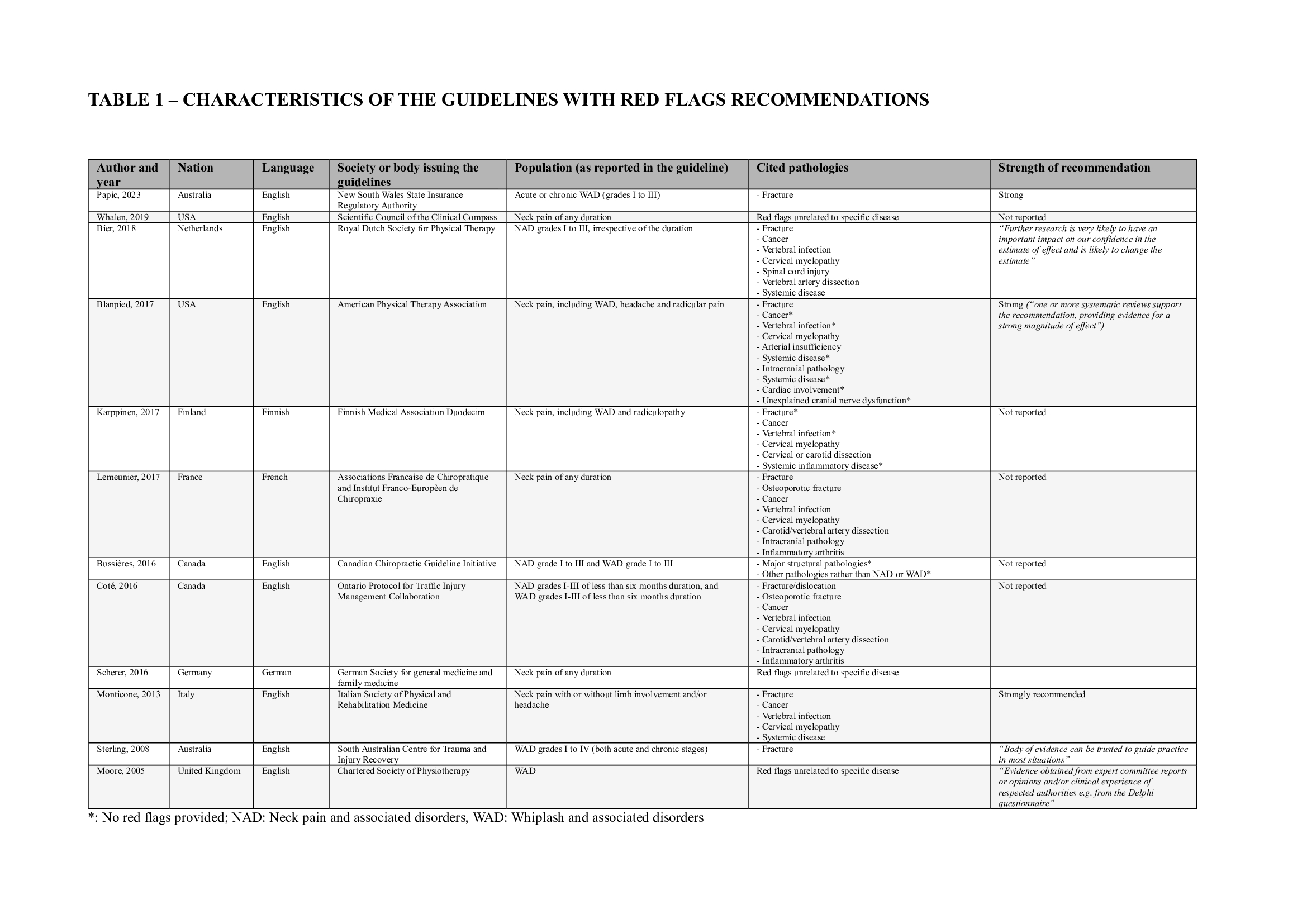
    We included 29 guidelines, 12 of which provided information on red flags to screen for serious pathologies (3 for whiplash-associated disorders, 5 for neck pain and associated disorders grade I to III, and 4 for mixed populations) (Table 1). We identified a total of 114 red flags in the guidelines related to fracture, cancer, vertebral infection, myelopathy, spinal cord injury, artery dissection, intracranial pathology, inflammatory arthritis, other systemic diseases, and conditions not related to a specific condition. Overall, there is limited consensus among guidelines regarding red flags for serious pathologies, except for cancer (slight agreement with a Fleiss Kappa of 0.15) and osteoporotic fractures (perfect agreement with a Fleiss’ Kappa of 1) (Table 2 and Table 3). Among all the red flags, only the Canadian C-spine rules for fractures were based on systematic reviews and supported by diagnostic test accuracy values (sensitivity ranging from 90% to 100%; specificity ranging from 42.5% to 45.1%). 10 The remaining red flags were mainly supported by case reports and case series that did not provide direct information on their diagnostic accuracy.

    Discussion and Conclusion

    We found that only a few red flags were consistently reported by all the included guidelines (Table 3). Among all the red flags, only the Canadian C-spine rule could be reliably used in clinical practice. All the other red flags have limitations in terms of applicability and diagnostic predictivity, indicating a gap in the literature that should be addressed in future research. This includes conducting secondary studies to systematically summarize the available red flags and primary studies to determine the diagnostic accuracy of signs and symptoms that may suggest a serious medical condition. According to the current limitations of the evidence, clinicians should use the red flags mentioned in the guidelines cautiously and integrate them into a sound clinical reasoning process. Accordingly, when combined within a broad clinical-reasoning framework to determine the level of suspicion about serious pathology, red flags may help clinicians make the best judgment on the appropriate clinical action in a continuous monitoring process. 2

    REFERENCES

    1. Rushton A, Carlesso LC, Flynn T, et al. International Framework for Examination of the Cervical Region for Potential of Vascular Pathologies of the Neck Prior to Musculoskeletal Intervention: International IFOMPT Cervical Framework. J Orthop Sports Phys Ther. 2023;53(1):7-22. doi:10.2519/jospt.2022.11147
    2. Heick J, Lazaro RT, eds. Goodman and Snyder’s Differential Diagnosis for Physical Therapists: Screening for Referral. 7th edition. Elsevier; 2022.
    3. Feller D, Chiarotto A, Koes B, Maselli F, Mourad F. Red flags for potential serious pathologies masquerading as musculoskeletal neck pain: a protocol for a systematic review of clinical practice guidelines. Published online June 22, 2023:2023.06.20.23291691. doi:10.1101/2023.06.20.23291691
    4. Fleiss JL. Measuring nominal scale agreement among many raters. Psychological Bulletin. 1971;76:378-382. doi:10.1037/h0031619
    5. Bier JD, Scholten-Peeters WGM, Staal JB, et al. Clinical Practice Guideline for Physical Therapy Assessment and Treatment in Patients With Nonspecific Neck Pain. Phys Ther. 2018;98(3):162-171. doi:10.1093/ptj/pzx118
    6. Whalen W, Farabaugh RJ, Hawk C, et al. Best-Practice Recommendations for Chiropractic Management of Patients With Neck Pain. J Manipulative Physiol Ther. 2019;42(9):635-650. doi:10.1016/j.jmpt.2019.08.001
    7. Label de la HAS – Évaluation du patient atteint de cervicalgie et prise de décision thérapeutique en chiropraxie. Haute Autorité de Santé. https://www.has-sante.fr/jcms/c_2803360/fr/label-de-la-has-evaluation-du-patient-atteint-de-cervicalgie-et-prise-de-decision-therapeutique-en-chiropraxie
    8. Scherer M, Chenot JF. Deutsche Gesellschaft für Allgemeinmedizin und Familienmedizin. Published online 2016.
    9. Monticone M, Iovine R, de Sena G, et al. The Italian Society of Physical and Rehabilitation Medicine (SIMFER) recommendations for neck pain. G Ital Med Lav Ergon. 2013;35(1):36-50.
    10. Stiell IG, Greenberg GH, McKnight RD, Nair RC, McDowell I, Worthington JR. A study to develop clinical decision rules for the use of radiography in acute ankle injuries. Annals of Emergency Medicine. 1992;21(4):384-390. doi:10.1016/S0196-0644(05)82656-3
    11. Saragiotto BT, Maher CG, Lin CC, Verhagen AP, Goergen S, Michaleff ZA. Canadian C‐spine rule and the National Emergency X‐Radiography Utilization Study (NEXUS) for detecting clinically important cervical spine injury following blunt trauma. Cochrane Database Syst Rev. 2018;2018(4):CD012989. doi:10.1002/14651858.CD012989
  • Sono necessari miglioramenti nell’aderenza al TRIPOD statement dei modelli predittivi per pazienti con dolore del rachide o artrosi: uno studio di meta – ricerca

    Sono necessari miglioramenti nell’aderenza al TRIPOD statement dei modelli predittivi per pazienti con dolore del rachide o artrosi: uno studio di meta – ricerca

    Sono necessari miglioramenti nell’aderenza al TRIPOD statement dei modelli predittivi per pazienti con dolore del rachide o artrosi: uno studio di meta – ricerca

    Improvements are needed in the adherence to the TRIPOD statement for clinical prediction models for patients with spinal pain or osteoarthritis: a meta-research study

    Autori

    Feller Daniel (Department of General Practice, Erasmus MC, University Medical Centre, Rotterdam, The Netherlands)

    Wingbermuhle Roel (Department of General Practice, Erasmus MC, University Medical Centre, Rotterdam, The Netherlands)

    Berg Bjørnar (Centre for Intelligent Musculoskeletal Health, Faculty of Health Sciences, Oslo Metropolitan University, Oslo, Norway)

    Nesse Vigdal Ørjan (Centre for Intelligent Musculoskeletal Health, Faculty of Health Sciences, Oslo Metropolitan University, Oslo, Norway)

    Innocenti Tiziano (Department of Health Sciences, Faculty of Science, Vrije Universiteit Amsterdam, Amsterdam Movement Sciences, The Netherlands)

    Grotle Margreth (Centre for Intelligent Musculoskeletal Health, Faculty of Health Sciences, Oslo Metropolitan University, Oslo, Norway)

    Ostelo Raymond (Department of Health Sciences, Faculty of Science, Vrije Universiteit Amsterdam, Amsterdam Movement Sciences, The Netherlands)

    Chiarotto Alessandro (Department of General Practice, Erasmus MC, University Medical Centre, Rotterdam, The Netherlands)

    Introduction

    Clinicians can use prediction models to inform decision-making, such as determining the best course of treatment for a patient based on their prognosis. 1 However, this can be achieved only if the development or validation study is described in sufficient detail to enable the clinician to use the model. 1 Also, accurate reporting of the models’ development or validation is crucial to allowing other researchers to assess their validity and reliability, reproduce or replicate the study, or build upon the findings in future research. 1 Currently, no studies have assessed the completeness of the reporting in studies that develop or validate a (prognostic or diagnostic) prediction model for patients with spinal pain or osteoarthritis (OA). Therefore, the objective of this study was to evaluate the completeness of reporting of prediction model studies in patients with spinal pain or OA in terms of adherence to the “Transparent Reporting of a Multivariable Prediction Model for Individual Prognosis or Diagnosis” (TRIPOD). 1

    Methods

    We searched for prognostic and diagnostic prediction models in patients with spinal pain or OA in MEDLINE, Embase, Web of Science, and CINHAL. We limited our search from January 2016 to the 17th of March 2023. We used this time framework because the TRIPOD checklist was published in 2015, and we assumed some delay from publication and potential widespread use. Reference lists of the included studies and bibliographic information of relevant systematic reviews were also checked. Using a standardized adherence assessment form published by Heus et al. 2, we assessed the adherence to the TRIPOD statement of the included studies. Two pairs of independent reviewers performed the study selection and data extraction phases.

    Results

    We included 66 studies. The majority of the studies (56.1%) focused on back pain. Most studies (80.3%) developed a model without external validation and 87.9% focused on prognostic models. Of all the studies, 87.9% used regression-based models, while the remaining 12.1% employed machine learning techniques. Most of the studies (65.2%) did not declare to have used the TRIPOD statement (Table 1).

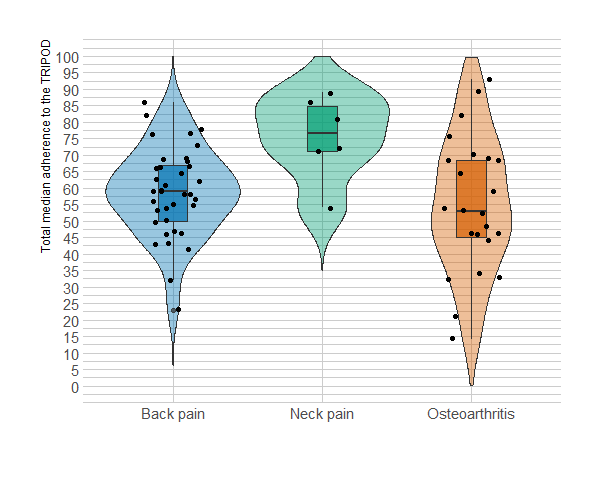
    The median adherence to the TRIPOD was 59% overall (IQR: 21.8) (Figure 1). The difference in the median adherence between studies that declared the use of the TRIPOD and those that did not was 4%. Furthermore, we did not observe any improvement in adherence over the years. The items in the methods and results sections were the ones with the worst reporting, while the items in the discussion and background were the ones with the best reporting. Notably, only 42.2% of the studies fully described participant characteristics, just 10% reported model-building procedures and internal validation methods, and less than half of the studies reported performance measures (i.e., discrimination and calibration).

    Discussion and Conclusion

    The adherence to the TRIPOD of prediction models in the spinal pain and OA field is limited. Due to the reporting below desirable standards, clinicians may encounter difficulties in effectively applying a model in clinical practice, and researchers cannot judge the model’s validity or build on research findings.  Thus, future studies on prediction models in spinal pain and OA should follow the TRIPOD statement for their reporting. The use of the TRIPOD should be encouraged by peer reviewers and journal editors, for example, by mentioning the TRIPOD as the mandatory reporting guideline for prediction model studies in the “instruction for authors” section of the journal. 2 Journals and editors should also adopt stricter strategies to check for reporting completeness 3, and the biomedical literature, in general, should increase authors’ awareness about the importance of complete reporting, as it is probably one of the barriers to fully implementing the reporting guidelines and why there has been no improvement in adherence over the years. 4

    REFERENCES

    1. Moons KGM, Altman DG, Reitsma JB, et al. Transparent Reporting of a multivariable prediction model for Individual Prognosis Or Diagnosis (TRIPOD): Explanation and Elaboration. Ann Intern Med. 2015;162(1):W1-W73. doi:10.7326/M14-0698
    2. Heus P, Damen JAAG, Pajouheshnia R, et al. Uniformity in measuring adherence to reporting guidelines: the example of TRIPOD for assessing completeness of reporting of prediction model studies. BMJ Open. 2019;9(4):e025611. doi:10.1136/bmjopen-2018-025611
    3. Innocenti T, Ostelo R, Verhagen A, et al. Rehabilitation journal editors recognize the need for interventions targeted to improve the completeness of reporting, but there is heterogeneity in terms of strategies actually adopted: A cross-sectional web-based survey. J Evid Based Med. 2023;16(2):111-115. doi:10.1111/jebm.12527
    4. Schlussel MM, Sharp MK, de Beyer JA, et al. Reporting guidelines used varying methodology to develop recommendations. Journal of Clinical Epidemiology. 2023;159:246-256. doi:10.1016/j.jclinepi.2023.03.018
  • Prevalenza del dolore neuropatico tra pazienti in accordo con il grading system aggiornato e nuovi cut-off dei questionari.

    Prevalenza del dolore neuropatico tra pazienti in accordo con il grading system aggiornato e nuovi cut-off dei questionari.

    Prevalence of neuropathic pain among patients according to the updated grading system and new questionnaires’ cut-offs.

    Autori

    Cavicchi Tommaso [Department of Clinical Sciences and Translation Medicine, University of Rome “Tor Vergata”, 00133 Rome, Italy]

    Esposto Massimo [Department of Medicine and Health Science “Vincenzo Tiberio”, University of Molise, c/o Cardarelli Hospital, C/da Tappino, 86100 Campobasso, Italy]

    Zanoli Gustavo [Orthopaedic Unit, Santa Maria Maddalena Hospital.Via Gorizia 2, 45030 Occhiobello (Ro), Italy]

    Sindaco Gianfranco [Interdisciplinary Pain Unit,Santa Maria Maddalena Hospital.Via Gorizia 2, 45030 Occhiobello (Ro), Italy; Advanced Algology Research, Via Monttefeltro 66, Rimini, Italy]

    Polli Andrea [Pain in Motion (PiM) international research group, Department of Physiotherapy, Human Physiology and Anatomy, Faculty of Rehabilitation Sciences & Physiotherapy, Vrije Universiteit Brussel, Brussels, Belgium; www.paininmotion.be; Department of Public Health and Primary Care, Centre for Environment & Health, KU Leuven, Leuven, Belgium; Flanders Research Foundation – FWO]

    Introduction

    Neuropathic pain (NP) is characterized by intense symptoms, a longer prognosis, and different management strategies when compared to other pain presentations. Early diagnosis of NP is crucial to improve clinical outcomes and follows the International Association for the Study of Pain (IASP) grading system, which classifies NP likelihood as “possible”, “probable”, and “definite”. Several tools have been developed and described in the literature to aid the process of diagnosing NP, such as the Leeds Assessment of Neuropathic Symptoms and Signs (LANSS), and painDETECT. However, it is still unclear to what extent these tools could help clinicians to assess patients presenting with features of NP. Therefore, this work aimed to determine the prevalence of NP pain among patients who present to a private clinic, assess the accuracy of LANSS and painDETECT compared to the updated IASP grading system, and explore correlations between questionnaires’ scores and clinical variables.

    Methods

    Consecutive patients presenting to two private clinics from July 2018 to December 2019 were assessed by a medical doctor according to the updated IASP grading system for NP. Two blinded physiotherapists collected demographic data, questionnaires’ scores (i.e., LANSS, painDETECT), and clinical variables (e.g., quality of life). The non-parametric Bonferroni-corrected Kruskal-Wallis test was run to check for intergroup differences. Received Operating Characteristics (ROC) and Areas Under the Curve (AUC) were used to compare the performance of questionnaires and the IASP grading system, and to suggest new cut-off scores. Correlations were tested by calculating the Spearman-Rho correlation index. Statistical analyses were performed using Statistical Package for Social Sciences (SPSS-IBM) version 28.0.

    Results

    Of 204 patients 50.5% was classified as unlikely, 40.2% as probable, and 9.3% as definite NP. Comparisons among possible, probable, and definite NP groups showed significant (p<.001) differences in pain intensity, questionnaires’ scores, and the Mental Component Scale (MCS) of the Short-Form 12. Both questionnaires showed a higher agreement with the updated IASP grading system for unlikely (LANSS: 84.5%; painDETECT: 86.4%) than for probable and definite NP (LANSS: 41.6%; painDETECT: 22.8%). Area Under the Curve was 0.81 (0.7; 0.92) and 0.88 (0.8; 0.97) for LANSS and painDETECT, respectively. New suggested cut-off scores were 5 (sensitivity = 0.95) and 21 (specificity = 0.99) for LANSS, and 5 (sensitivity = 0.95) and 19 (specificity = 0.95) for painDETECT. Both questionnaires correlated significantly (p<.05) with pain intensity (LANSS: r = 0.364; painDETECT: r = 0.423), and MCS (LANSS: r = -0.278; painDETECT: r = -0.261).

    Discussion and Conclusion

    The prevalence of definite NP according to the updated IASP grading system resulted in line with existing evidence. However, a large group of patients still lacked any form of certainty about their pain phenotype. While old questionnaires’ cut-offs performed poorly when compared to the clinical diagnosis, both questionnaires’ scores (considered regardless of their cut-offs) performed well for patients diagnosed as unlikely and definite NP. Therefore, patients in doubt could be addressed by using painDETECT new cut-off scores of 16 or higher to confirm NP (specificity = 0.95), and 10 or lower to exclude NP (sensitivity = 0.89). LANSS new cut-off scores could be 16 or higher (specificity = 0.90), and 7 or lower (sensitivity = 0.89). Overall, painDETECT performed slightly better than LANSS.

    REFERENCES

    • Colloca L, Ludman T, Bouhassira D, et al. Neuropathic pain. Nat Rev Dis Prim. 2017;3(1):1-19.
    • Haanpää M, Attal N, Backonja M, et al. NeuPSIG guidelines on neuropathic pain assessment. PAIN®. 2011;152(1):14-27.
    • Finnerup NB, Haroutounian S, Kamerman P, et al. Neuropathic pain: an updated grading system for research and clinical practice. Pain. 2016;157(8):1599.
    • Truini A, Aleksovska K, Anderson CC, et al. Joint European Academy of Neurology–European Pain Federation–Neuropathic Pain Special Interest Group of the International Association for the Study of Pain guidelines on neuropathic pain assessment. Eur J Neurol. Published online 2023.
    • Attal N, Martinez V, Bouhassira D. Potential for increased prevalence of neuropathic pain after the COVID-19 pandemic. Pain reports. 2021;6(1).
    • Migliore A, Gigliucci G, Moretti A, et al. Cross cultural adaptation and validation of Italian version of the leeds assessment of neuropathic symptoms and signs scale and pain DETECT questionnaire for the distinction between nociceptive and neuropathic pain. Pain Res Manag. 2021;2021.
    • Vaegter HB, Andersen PG, Madsen MF, Handberg G, Enggaard TP. Prevalence of neuropathic pain according to the IASP grading system in patients with chronic non-malignant pain. Pain Med. 2014;15(1):120-127.
  • I pazienti con sindrome fibromialgica ricevono strategie di gestione aggiornate? Una survey a metodi misti tra i fisioterapisti italiani

    I pazienti con sindrome fibromialgica ricevono strategie di gestione aggiornate? Una survey a metodi misti tra i fisioterapisti italiani

    I pazienti con sindrome fibromialgica ricevono strategie di gestione aggiornate? Una survey a metodi misti tra i fisioterapisti italiani

    Do patients with fibromyalgia syndrome receive updated management strategies? A mixed-methods web survey among Italian physiotherapists

    Autori

    Massimo Esposto [Department of Medicine and Health Science “Vincenzo Tiberio”, University of Molise, c/o Cardarelli Hospital, C/da Tappino, 86100 Campobasso, Italy]

    Gabriele Anella [Department of Medicine and Health Science “Vincenzo Tiberio”, University of Molise, c/o Cardarelli Hospital, C/da Tappino, 86100 Campobasso, Italy]

    Leonardo Pellicciari [IRCCS Istituto delle Scienze Neurologiche di Bologna, Bologna, Italy]

    Mattia Bisconti [Department of Medicine and Health Science “Vincenzo Tiberio”, University of Molise, c/o Cardarelli Hospital, C/da Tappino, 86100 Campobasso, Italy]

    Giuseppe Giovannico [Department of Medicine and Health Science “Vincenzo Tiberio”, University of Molise, c/o Cardarelli Hospital, C/da Tappino, 86100 Campobasso, Italy]

    Andrea Polli [Pain in Motion Research group, Department of Rehabilitation Sciences and Physiotherapy, Vrije Universiteit Brussel (VUB), Centre for Environment & Health, Department of Public Health and Primary Care, Katholieke Universiteit Leuven (KUL), Research foundation – Flanders (FWO)]

    Matteo Cioeta [Department of Neuroscience, IRCCS San Raffaele Roma, Rome, Italy]

    Introduction

    Fibromyalgia syndrome (FMS) is the most common form of chronic widespread pain, according to the International Classification of Disease-11. Its diagnostic criteria were described by the American College of Rheumatology in 1990 and lastly updated in 2016. FMS patients are characterized by poor quality of life and high healthcare costs. Furthermore, the present historical moment could justify a future increase in FMS prevalence due to recent associations shown between FMS and long-COVID symptoms. For these reasons, healthcare professionals must have a solid and updated understanding of FMS characteristics and its evidence-based management strategies. Therefore, we developed a survey to assess the level of knowledge, adherence to the Clinical Practice Guidelines (CPGs), and confidence of Italian physiotherapists in managing FMS patients. The survey also explored possible difficulties in following the guidelines’ recommendations.

    Methods

    All authors contributed to the development of the mixed-methods survey, which received additional comments from 10 expert physiotherapists in chronic pain. Its final version consisted of 6 sections: introduction to the study; demographics; 15 items exploring guidelines’ adherence (10-point Likert scale); perceived knowledge of guidelines (4-point Likert scale); participants’ difficulties (1 open question); and 20 items determining the understanding of FMS (True or False). The questionnaire was administered to Italian practicing physiotherapists via social media (e.g., Facebook, Instagram) and newsletter (i.e., Italian Association of Physiotherapists). It was open to replies from January 15th, 2024, to April 15th, 2024. The a-priori estimated sample size was 383 participants. The reporting of this study is in line with the CHERRIES and STROBE guidelines. The protocol was prospectively registered in Open Science Framework.

    Results

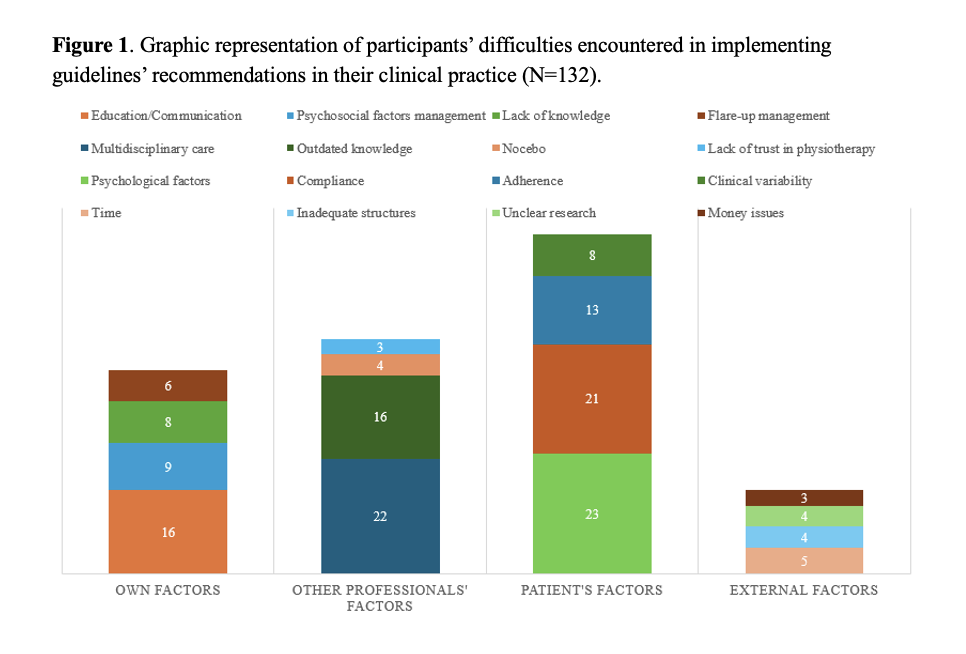
    We obtained 398 replies: 42% reported low or absent confidence, 49% reported medium, and 9% high or extremely high level of confidence in treating FMS patients. Similarly, 67% declared to have a poor or worse knowledge of CPGs. Among those (33%) who reported a good or very good knowledge, four major themes emerged to describe the difficulties encountered in their clinical practice: own factors (28%), other professionals’ factors (26%), patient’s factors (49%), and external factors (12%). Overall adherence to the CGPs recommendations was good. However, specific items showed too much reliance on posture, education techniques used in isolation, and focus on painful symptoms. Italian physiotherapists showed a good to very good knowledge of FMS theory and characteristics, with a median score of 17.0 points (interquartile range: 16.0-19.0).

    Discussion and Conclusion

    The results of this study showed that, on average, Italian physiotherapists have a good knowledge of CPGs and FMS theory. Despite this, only a small percentage reported having high or extreme confidence in managing these patients. Among the most commonly reported difficulties, were the lack of training in education and communicative strategies, multidisciplinary relationships, and factors related to the patient such as psychosocial aspects, compliance, and clinical variability of each clinical case. This could indicate that knowledge of CPGS and FMS theory alone may not be sufficient and that clinicians might need to develop transversal skills for the optimal management of these patients. Notably, this survey was probably subjected to a selection bias, and items used to measure the knowledge of participants on FMS theory were not previously validated. For these reasons further research is necessary.

    REFERENCES

    • Sarzi-Puttini P, Giorgi V, Marotto D, Atzeni F. Fibromyalgia: an update on clinical characteristics, aetiopathogenesis and treatment. Nat Rev Rheumatol. 2020;16(11):645-660.
    • Treede RD, Rief W, Barke A, et al. Chronic pain as a symptom or a disease: The IASP Classification of Chronic Pain for the International Classification of Diseases (ICD-11). Pain. 2019;160(1):19-27. doi:10.1097/j.pain.0000000000001384
    • Wolfe F, Clauw DJ, Fitzcharles M, et al. The American College of Rheumatology preliminary diagnostic criteria for fibromyalgia and measurement of symptom severity. Arthritis Care Res (Hoboken). 2010;62(5):600-610
    • Esposto M, Anella G, Pellicciari L, Bisconti M, Polli A, Cioeta M. Investigation of Italian physiotherapists’ management of Fibromyalgia Syndrome patients: a web-based survey. Open Sci Framew. Published online 2024. doi:10.17605/OSF.IO/NW9J2
  • Discectomia lombare: valutazione e comparazione degli effetti acuti degli esercizi del core, con stabilometria e sensore inerziale o specchio, sull’allineamento spinale e l’equilibrio. Studio Pilota

    Discectomia lombare: valutazione e comparazione degli effetti acuti degli esercizi del core, con stabilometria e sensore inerziale o specchio, sull’allineamento spinale e l’equilibrio. Studio Pilota

    Lumbar discectomy: evaluation and comparison of the acute effects of core exercises, done using stabilometric platform and inertial sensor or mirror, on spine alignment and balance. Pilot study.

    Autori

    Marin Luca (Laboratory of Adapted Motor Activity (LAMA), University of Pavia, Pavia, Italy), (Department of Rehabilitation, Healthcare Institute “Città di Pavia”, Gruppo San Donato, Pavia, Italy), (Department of Rehabilitation, Faculty of Medicine, University of Ostrava, Ostrava, Czech Republic)

    Chiodaroli Matteo (Department of Rehabilitation, Healthcare Institute “Città di Pavia”, Gruppo San Donato, Pavia, Italy), (Laboratory for Rehabilitation, Medicine and Sport (LARMS), Rome, Italy)

    Gatti Alessandro (Laboratory of Adapted Motor Activity (LAMA), University of Pavia, Pavia, Italy)

    Carlone Nicolò (Degree Course in Physiotherapy, University of Pavia, Pavia, Italy), (Department of Rehabilitation, Healthcare Institute “Città di Pavia”, Gruppo San Donato, Pavia, Italy)

    Manzoni Federica (S.C. Epidemiology, Health Protection Agency of Pavia, Pavia, Italy)

    Re Fabio (Laboratory for Rehabilitation, Medicine and Sport (LARMS), Rome, Italy)

    Patanè Pamela (Laboratory of Adapted Motor Activity (LAMA), University of Pavia, Pavia, Italy), (Laboratory for Rehabilitation, Medicine and Sport (LARMS), Rome, Italy), (Department of Industrial Engineering, University of Tor Vergata, Rome, Italy)

    Abbiati Fabrizio (Department of Rehabilitation, Healthcare Institute “Città di Pavia”, Gruppo San Donato, Pavia, Italy), (Laboratory for Rehabilitation, Medicine and Sport (LARMS), Rome, Italy)

    Febbi Massimiliano (Department of Rehabilitation, Faculty of Medicine, University of Ostrava, Ostrava, Czech Republic), (Laboratory for Rehabilitation, Medicine and Sport (LARMS), Rome, Italy)

    Introduction

    Conservative therapy is usually the first choice for spine disc herniation and most of patients benefit from this treatment. Microscopic lumbar discectomy (MLD) is often the best alternative when conservative therapy fails. However, in the early days post-MLD many patients show functional impairments and kinesiophobia that are associated with worse clinical outcomes.

    Spinal proprioception is crucial but patients tend to use more signals coming from the ankle. Lower levels of spinal proprioception and balance lead to sensorimotor alterations and impaired motor control which are both risk factors for postural alterations, trauma and pain.

    Therefore, immediately encouraging patients to be active and do core activation exercises is essential. Aim of the study is to evaluate the acute effects of two different physiotherapic methods, both involving core perception and activation, on balance and spine alignment in patients that underwent MLD.

    Methods

    From 20th June to 28th July 2023, 12 patients (6 female) candidates for MLD, were recruited. After signing an informed consent they were randomly assigned to one of the two Core activation exercises study group: Visual biofeedback, with stabilometric platform and inertial sensor (BF) (Riablo, Euleria, Rovereto, Italy) or squared up mirror (ES).

    Both interventions lasted 10 minutes and included the same exercises, supervised by Physiotherapist. Before (T0) and after (T1) the intervention an assessment was made. Spine alignment (RMS) was evaluated with Spine 3D (Sensormedica, Guidonia, Rome), a non-invasive, three-dimensional optoelectronic detection system that uses Light Detection and Ranging technology, while balance with a stabilometric platform (FreeMed, sensormedica). In T0, participants were asked to assume the most comfortable position. In T1, they were asked to assume the most correct posture possible, using the sensorimotor information learned with the intervention.

    Results

    The Bruschen-Pagan test was used to determine whether the model was parametric or not. To compare improvement between groups, while controlling for baseline levels, we used analysis of covariance (ANCOVA). Quantitative variables are expressed as mean and standard deviation. The significance was set at p<0.05. All analyses were performed using R Statistical Software (v4.1.2; R Core Team 2021).

    In T1, compared to T0, all balance parameters improve slightly in BF and worsen in ES; all values aren’t significant.

    Ellipse Area: BF (133.61±76.66; 216.16±229.78), ES (157.39±93.91; 143.72±67.63) p 0.091. Ellipse Eccentricity: BF (0.32±0.22; 0.25±0.24), ES (0.50±0.39; 0.59±0.18) p 0.53. Delta X: BF (12.90±4.92; 13.41±6.19), ES (16.47±9.00; 13.75±5.08) p 0.342. Delta Y: BF (11.33±3.72; 13.76±6.30), ES (13.42±2.42; 12.31±4.88) p 0.083. RMS improves in BF (5.17±3.31; 6.00±3.31) while it worsens in ES (3.50±1.38; 3.31±2.04); both values aren’t significant.

    Discussion and Conclusion

    It is known that immediately after spine surgery the perceptual-motor adaptation mechanisms are reduced or absent. In addition a postural correction, greater than the usual one causes difficulties to somato-sensory system to adapt to the new position. A previous study, done on the same population and with the same methodology but without the biofeedback provided by stabilometry, had shown a worsening of balance in both groups, greater in the group that had an improvement in RMS. The acute improvements of balance and spine alignment in BF compared to ES seem to indicate that the biofeedback given by the technology is useful to improve posture and balance of patients undergoing MLD. Limitations of the study are the small number of the sample and the single session of exercises, justified by the reduced post-MLD hospitalization time. Further studies, with a significant sample size and more sessions, are needed.

    REFERENCES

    1) Chen B-L, Guo J-B, Zhang H-W, et al. Surgical versus non-operative treatment for lumbar disc herniation: a systematic review and meta-analysis. Clinical Rehabilitation. 2018;32(2):146-160.

    2) Gilmore, S. J., Hahne, A. J., Davidson, M., McClelland, J. A. (2020). Physical activity patterns of patients immediately after lumbar surgery. Disability and rehabilitation, 42(26), 3793–3799.

    3) Hebert, J. J., Fritz, J. M., Thackeray, A., Koppenhaver, S. L., & Teyhen, D. (2015). Early multimodal rehabilitation following lumbar disc surgery: a randomised clinical trial comparing the effects of two exercise programmes on clinical outcome and lumbar multifidus muscle function. British journal of sports medicine, 49(2), 100–106.