Categoria: Congresso 2024

  • La qualità delle revisioni sistematiche in fisioterapia muscoloscheletrica è criticamente bassa: uno studio meta-epidemiologico

    La qualità delle revisioni sistematiche in fisioterapia muscoloscheletrica è criticamente bassa: uno studio meta-epidemiologico

    Quality of systematic reviews on musculoskeletal physiotherapy is critically low: a meta-epidemiological study

    Autori

    Ferri Nicola [Department of Biomedical and Neuromotor Sciences (DIBINEM), Alma Mater Studiorum University of Bologna, Bologna, Italy]

    Ravizzotti Elisa [Department of Neuroscience, Rehabilitation, Ophthalmology, Genetics and Maternal Child Health (DINOGMI), University of Genoa, Genoa, Italy]

    Bracci Alessandro [Department for Life Quality Studies (QUVI), University of Bologna, Rimini, Italy]

    Carreras Giulia [Oncologic Network, Prevention and Research Institute (ISPRO), Florence, Italy]

    Pillastrini Paolo [Department of Biomedical and Neuromotor Sciences (DIBINEM), Alma Mater Studiorum University of Bologna, Bologna, Italy]

    Di Bari Mauro [Department of Experimental and Clinical Medicine, University of Florence, Florence, Italy]

    Introduction

    Clinicians implement the best scientific evidence to support decision-making, according to the Evidence-Based Practice paradigm. Systematic reviews with meta-analysis of RCTs (SRs) represent the best evidence for questions of intervention effectiveness. These studies have been growing exponentially for decades now, with the paradox that in recent years, the secondary literature has overcome the primary literature in relative growth. This resulted in the emergence of overlapping SRs on the same question, with sometimes conflicting results or conclusions. A recent survey reported that most decision-makers find it difficult to choose the best evidence out of many. This study aims to investigate musculoskeletal physiotherapy literature assessing the methodological quality of SRs over the past 10 years and to analyze possible quality predictors.

    Methods

    This is an observational study in the meta-research field. We searched four scientific databases (MEDLINE, CDSR, CINAHL, PEDro) using both free text and MeSH terms. Two independent assessors selected only the SRs concerning treatment effectiveness on musculoskeletal conditions, published between 2012 and 2022. A random list of included full texts was generated, and the first 100 SRs were included. The study outcomes included the SRs type (Cochrane or non-Cochrane), the Journal Impact Factor (JIF), the Journal Quartile, the h-index of the first and last author, the publication policy, the total number of studies, and the direction of results and conclusions. Each SR was then qualitatively assessed using the AMSTAR-2 tool by two independent assessors, leading to a four-level score (critically low, low, moderate, and high). Descriptive analyses were performed, followed by multivariable ordinal logistic regression. The STROBE checklist for conference abstracts was followed.

    Results

    A total of 2078 records were retrieved, and 395 full texts were included, from which the random sample of 100 SRs was obtained. Ninety SRs (90%) are of critically low quality, 4 of low quality (4%), 2 of moderate quality (2%) and 4 of high quality (4%). The overall methodological quality has not increased over the past 10 years, and the high-quality SRs are all Cochrane SRs. Quality seemed to differ according to the JIF; however, after performing a sensitivity analysis, Cochrane SRs proved to be a confounding factor. Thus, in our sample, JIF is not associated with SR quality. The h-index of the first and last authors are significantly different across SR quality, and the last author’s h-index is the only weak predictor (OR 1.04; 95% CI: 1.01, 1.06) among all the variables considered.

    Discussion and Conclusion

    This study confirms previous research on different topics and highlights how the quality of current literature is extremely low while there is a staggering increase in publications. The physiotherapy profession has ethical and legal responsibilities through an obligation of means. But what if the best evidence is of low methodological quality? How should it be used to support clinical practice? In the first instance, the recommendation for the clinician is to always assess the quality of SRs carefully and not to trust the prestige of the journal, the most recent publication, or the one that included the more primary studies. The study design alone (i.e., SRs) is not enough to support a clinical choice. We suggest that researchers strictly follow the existing methodological recommendations for conducting a SR and that editors implement a thorough quality assessment during peer-review processes; this could improve the quality of the scientific literature and, finally, patient care.

    REFERENCES

    Ferri N, Ravizzotti E, Bracci A, Carreras G, Pillastrini P, Di Bari M. The confidence in the results of physiotherapy systematic reviews in the musculoskeletal field is not increasing over time: a meta-epidemiological study using AMSTAR 2 tool. J Clin Epidemiol. 2024 Feb 24;169:111303. doi: 10.1016/j.jclinepi.2024.111303. Epub ahead of print. PMID: 38402999.

  • Valutazione della funzione vestibolare in persone con ictus tramite l’utilizzo del video Head Impulse Test: uno studio cross-sectional

    Valutazione della funzione vestibolare in persone con ictus tramite l’utilizzo del video Head Impulse Test: uno studio cross-sectional

    Vestibular function assessment in people with stroke using the video Head Impulse Test: a cross-sectional study

    Autori

    Ferri Nicola [Department of Biomedical and Neuromotor Sciences, University of Bologna, Bologna, Italy]

    Casagrande Conti Laura [Santa Lucia Foundation, Scientific Institute for Research and Health Care, Rome, Italy]

    Turolla Andrea [Department of Biomedical and Neuromotor Sciences, University of Bologna, Bologna, Italy]

    Orejel Bustos Amaranta Soledad [Santa Lucia Foundation, Scientific Institute for Research and Health Care, Rome, Italy]

    Sorge Chiara [Santa Lucia Foundation, Scientific Institute for Research and Health Care, Rome, Italy]

    Pillastrini Paolo [Department of Biomedical and Neuromotor Sciences, University of Bologna, Bologna, Italy]

    Manzari Leonardo [MSA ENT Academy Center, Cassino, Italy]

    Tramontano Marco [Department of Biomedical and Neuromotor Sciences, University of Bologna, Bologna, Italy]

    Introduction

    Rehabilitation of persons with stroke (PwS) involves multidisciplinary care as defined in the most recent guidelines. Posture and balance disturbance are prevalent aspects that impact function and autonomy and are a primary focus of physiotherapy treatment in PwS. Indeed, the vestibular system plays a central role in balance disorders, and some studies assessed the peripheral semicircular canal’s function in CNS pathologies using the video Head Impulse Test (vHIT). The vHIT is a safe, valid and reliable tool, but current literature reported heterogeneous findings in the CNS population, leading to uncertainty in clinical implications. In this context, an objective assessment of peripheral vestibular function in a neurorehabilitation setting has never been published. The aim of the present study is to fill this gap by providing some preliminary data on semicircular canal function among PwS.

    Methods

    This is a cross-sectional study, conducted at the neurorehabilitation service of the Santa Lucia Foundation in Rome from January 2023 to September 2023. PwS were consecutively recruited based on the following inclusion criteria: first-time strokes with hemiparesis and Functional Ambulation Classification score > 3. PwS were excluded if they had severe cognitive impairment, unilateral spatial neglect, or aphasia. The peripheral vestibular function was the primary outcome, objectively assessed using the vHIT through both HIMP (Head Impulse Paradigm) and SHIMP (Suppression Head Impulse Paradigm) paradigms. Then, the participants were assessed for balance function using the Berg Balance Scale and Mini-BESTest. STATA 17 was used for statistical analyses; the Shapiro-Wilk test was performed to test data normality, and Spearman’s rank correlation tests were used to investigate correlations between outcomes. The STROBE checklist for conference abstracts was followed.

    Results

    A total of 36 PwS were recruited (11 women; age range: 18-78 years); twenty-two were in the subacute stage (< 6 months from stroke), and 14 were in the chronic stage. Overall, 288 semicircular canals were assessed using the vHIT, of which 216 through HIMP, and 72 through the SHIMP paradigm. The mean VOR (vestibulo-ocular reflex) gain showed confidence intervals lower than the expected functional value of 1 in the overall analyses for almost every canal and paradigm. Applying the normative cut-offs for canal function, the left anterior and the right posterior were the canals with the highest prevalence of dysfunctional VOR gain in the analyzed sample, affecting 38.9% and 33.3% of the participants, respectively. No differences were found according to the disease stage (subacute vs chronic) or functional balance outcomes (Berg Balance Scale and Mini-BESTest).

    Discussion and Conclusion

    This study is the first to objectively analyze the vestibular canal function in PwS in a neurorehabilitation setting. Isolated canal dysfunction was very prevalent in our sample, involving 75% of participants; this indicates that patients with central lesions may present peripheral vestibular dysfunction that does not necessarily involve the entire vestibular system and does not follow a clearly defined pattern. Furthermore, the VOR gain confidence intervals lower than the expected value imply a general peripheral vestibular hypofunction in our sample. Our findings suggest that routinely assessing vestibular function in PwS could give valuable information about a crucial sensory input for the balance system and thus provide new insights for neurosensory integration modalities.

    REFERENCES

    Tramontano M, Ferri N, Turolla A, Orejel Bustos AS, Casagrande Conti L, Sorge C, Pillastrini P, Manzari L. Video head impulse test in subacute and chronic stroke survivors: new perspectives for implementation of assessment in rehabilitation. Eur Arch Otorhinolaryngol. 2024 May 17. doi: 10.1007/s00405-024-08721-x. Epub ahead of print. PMID: 38758244.

  • EFFETTO DI UN INTERVENTO EDUCATIVO PRECOCE DEL FISIOTERAPISTA IN PAZIENTI CON ACUTE LOW BACK PAIN CHE ACCEDONO AL PRONTO SOCCORSO: PROTOCOLLO PER UNO STUDIO RANDOMIZZATO CONTROLLATO

    EFFETTO DI UN INTERVENTO EDUCATIVO PRECOCE DEL FISIOTERAPISTA IN PAZIENTI CON ACUTE LOW BACK PAIN CHE ACCEDONO AL PRONTO SOCCORSO: PROTOCOLLO PER UNO STUDIO RANDOMIZZATO CONTROLLATO

    Effect of an early educational intervention by Physiotherapist in patients with Acute Low Back Pain accessing the Emergency Department: protocol for a randomized controlled trial

    Autori

    Ragazzo Filippo (Università degli Studi di Padova, Padova, Italia)

    Ferrari Silvano (Università degli Studi di Padova, Padova, Italia)

    Introduction

    Acute back pain is a common condition that constitutes a significant global public health issue. It has a high incidence among the population and impacts quality of life, work capacity, and socio-economic costs. Guidelines for the treatment of Acute Low Back Pain recommend the use of non-pharmacological treatments as the first-line approach, emphasizing the use of manual therapy, therapeutic exercise, patient education, and information as primary treatment modalities. However, these guidelines do not specify how early the treatment should commence. Individuals presenting at the Emergency Department (ED) for this type of back pain might help us understand whether early physiotherapy could be beneficial in reducing pain and disability.

    From this framework, the authors have decided to develop a protocol for a Randomized Controlled Trial of superiority with two parallel groups with the aim of verifying the effectiveness of an early physiotherapy intervention in patients with Acute Nonspecific Low Back Pain in the Emergency Department.

    Methods

    Participants with acute back pain presenting at the ED will be consecutively recruited and assigned to two intervention arms via simple randomization, based on inclusion and exclusion criteria. The experimental group will meet with a physiotherapist within 4 days of ED admission to receive information about their condition, education on biopsychosocial factors, and a simple spinal muscle activation exercise, supported by a video for home practice. A follow-up phone call will occur one week later. The control group will receive standard ED physician recommendations and an initial physiotherapist assessment. The primary outcome is pain measured by the NPRS scale. Secondary outcomes include disability (Roland-Morris Disability Questionnaire), general health (EuroQuol 5D-5L questionnaire), Global Perceived Effect, and return-to-work date. Both groups will be assessed at 1, 3, and 6 months from the initial visit.

    Results

    Currently, 30 participants have been recruited, 23 of whom have completed the first scheduled follow-up, and 9 have finished the entire study. Participant recruitment is expected to be completed by the end of June 2024, and the study, including data analysis, is anticipated to be completed by the end of this year

    Discussion and Conclusion

    We need to wait until the end of the study to conduct a thorough analysis of the obtained data. However, some significant elements can already be observed: participants have shown engagement and felt reassured by the prospect of being followed up by the physiotherapist. The experimental group appreciated the supportive phone call one week after the first appointment, as it provided further clarification and strategies to manage their pain in the initial period. This confirms the importance of offering explanations and practical solutions for carrying out daily activities, as emphasized in all current guidelines.

    The main limitations of this study are:

    -the heterogeneity of the sample characteristics does not allow for a detailed evaluation of subgroups of patients with back pain who might benefit more or less from this type of intervention;

    -intervention and assessments are conducted by a single physiotherapist, who is also responsible for data collection during the follow-ups.

    REFERENCES

    Zaina F et al. A Systematic Review of Clinical Practice Guidelines for Persons With Non-specific Low Back Pain With and Without Radiculopathy: Identification of Best Evidence for Rehabilitation to Develop the WHO’s Package of Interventions for Rehabilitation. Arch Phys Med Rehabil. 2023

    Fritz JM et al. Early Physical Therapy vs Usual Care in Patients With Recent-Onset Low Back Pain: A Randomized Clinical Trial. JAMA. 2015

    Arnold E et al. The Effect of Timing of Physical Therapy for Acute Low Back Pain on Health Services Utilization: A Systematic Review. Arch Phys Med Rehabil. 2019

    Ferrari S, Vanti C, Pillastrini P. Riabilitazione Integrata Delle Lombalgie. Elsevier; 2002

    Boutron I, Altman DG, Moher D, Schulz KF, Ravaud P. CONSORT Statement for Randomized Trials of Nonpharmacologic Treatments: A 2017 Update and a CONSORT Extension for Nonpharmacologic Trial Abstracts. Ann Intern Med. 2017

  • Frammentazione dell’identità: un’analogia tra “Uno, nessuno e centomila” di Pirandello e la condizione clinica dell’uomo bionico.

    Frammentazione dell’identità: un’analogia tra “Uno, nessuno e centomila” di Pirandello e la condizione clinica dell’uomo bionico.

    An identity fragmentation: analogy between Pirandello’s “Uno, Nessuno e Centomila” and the clinical condition of bionic man.

    Autori

    Di Dio Antonio (Università degli studi di Messina)

    Bonanno Francesco (Università degli studi di Messina)

    Pintaudi Teresa (Università degli studi di Messina)

    Ceccio Mariachiara (Università degli studi di Messina)

    Cavallaro Filippo (Università degli studi di Messina)

    Introduction

    Human identity can be compared to the fragmentation of the “self” in Pirandello’s novel. This concept is also applicable to the condition of bionic man, who faces a “fracture” between the “biological self” and the “technology-enhanced self”. In both situations, there is an identity crisis that challenges self-perception and how others perceive men. This analysis discusses the analogy between Pirandello’s novel ” Uno, Nessuno e Centomila” and the clinical condition of a patient with a prosthesis, that transforms him into a bionic man. The body does not immediately recognize the implant, in fact we want to highlight the dynamics related to self-perception and identity in fragmented and complex contexts.

    Methods

    The analysis focus on critical interpretation of the identity themes featured in the novel and their transposition to the clinical condition of the bionic man. A comparative approach is taken to investigate the similarities between the two situations, examining how physical alterations and external perception affect personal identity.

    Results

    In Pirandello’s novel, the main character Vitangelo Moscarda discovers a physical “defect” of which he had never been aware. This leads him to a profound reflection on his identity: “I did not know well even my own body, the things of mine that belonged most intimately to me: my nose, my ears, my hands, my legs. And I would go back to look at them to reexamine them” (Chapter One). This discovery arouses in him a feeling of alienation and fragmentation of the self, in which Moscarda realizes that he has never been to others what he thought he was to himself. His identity is fragmented, multiple and it changes according to each different perception that others have of him. He begins to realize that there is not one “I” but many, depending on who is observing him. This identity crisis leads him into a deep reflection on who he really is, whether there is an authentic “one” or whether he is always “none” because his identity is defined by others and never completely by himself. Similarly, the bionic man who is implanted with a prosthesis may experience a similar identity crisis. His clinical condition represents a “fracture” between his original biological self and the new self-enhanced by technology. The body that does not immediately recognize the implant might represent the rejection or difficulty of integrating this new physical identity with the previous one. The physical change requires a new self-perception and can affect how others see and treat him, causing a “rift” between the perceived self and the real self. His identity is now defined not only by his natural body but also by his artificial parts, leading him to an inner conflict about who he really is. The prosthesis could be seen as one of the “hundred thousand” identities that the person has to integrate: “Again, I still believed that he was one this stranger: one to all, as one I believed I was to me. But soon my atrocious drama became complicated. With the discovery of the hundred thousand Moscarda who I was not only for others but also for me” (chapter four).

    Discussion and Conclusion

    This analogy emphasizes how identity is a universal theme, applicable in both literary and clinical contexts, and how the interaction between the perceived self and the real self can be a source of reflection and inner conflict. Both situations show how physical alterations, whether natural or technological, can have a decisive impact on self-perception and personal identity.

    REFERENCES

    • Da L. Pirandello, Uno, nessuno e centomila, Libro primo, capp. I-IV, Torino, Einaudi, 1994.
  • Strutture temporanee, soluzioni durature: ponteggi e fissatori ortopedici a confronto

    Strutture temporanee, soluzioni durature: ponteggi e fissatori ortopedici a confronto

    Temporary Structures, Durable Solutions: a comparison between scaffolding and Orthopedic Fixators

    Autori

    Di Dio Antonio (Università degli studi di Messina)

    Bonanno Francesco (Università degli studi di Messina)

    Pintaudi Teresa (Università degli studi di Messina)

    Ceccio Mariachiara (Università degli studi di Messina)

    Cavallaro Filippo (Università degli studi di Messina)

    Introduction

    An interesting analogy between two seemingly distant worlds is that of building construction and the clinic. The aim of this work is to make a comparison between the structure of a construction scaffold and an external orthopedic fixator. Although they operate in different contexts, both systems share fundamental principles of support, stability, and adaptability. We want to highlight the importance of temporary structures that provide an important support during the repair process.

    Methods

    A comparative method was used for the analysis, comparing the structures and functions of the construction scaffold with those of the orthopedic external fixator. This comparison has made it possible to highlight the similarities in the design principles and use of both systems.

    Results

    The analysis revealed several similarities between the construction scaffold and the orthopedic external fixator. Both systems are based on an interconnected structure: in scaffolding, frames interlock to support the building structure while, in the external fixator, the metal components keep the bone stump aligned. Both systems are designed to be modular and adaptable. A scaffold can be built in various ways to accommodate different building shapes and sizes while an external fixator can be fixed to fit the patient’s anatomy and healing needs. In addition, the scaffold provides temporary support during the construction phase, allowing workers to work safely, while the external fixator provides temporary support during all the healing bone process. In both cases, the support is removed once their task is completed. Finally, a scaffold must be safe for workers, ensuring that they can work without risks. Similarly, an external fixator must ensure that bone fragments remain in place ensuring their healing.

    Discussion and Conclusion

    This analysis makes clear how the principles of interconnectedness, adaptability, temporary support and stability are fundamental in both contexts. These principles help health care professionals to manage the complexity of bone fractures and ensure effective healing (such as a well-designed scaffold ensures the safe and stable construction of a building). It becomes clear how the interactions between the various structures are critical to achieving favorable outcomes.

    REFERENCES

    • Hadeed, A., Werntz, R. L., Varacallo, M. (2023). External Fixation Principles and Overview. PubMedwith DeepL.com (free version)
  • Passato, presente e futuro della teleriabilitazione in ambito cardiologico: revisione sistematica della letteratura

    Passato, presente e futuro della teleriabilitazione in ambito cardiologico: revisione sistematica della letteratura

    Past, present and future of Cardiac Telerehabilitation: a sistematic review

    Autori

    Garofano Marina [University of Cagliari and Department of Medicine, Surgery and Dentistry, University of Salerno, Italy]

    Vecchione Carmine [Department of Medicine, Surgery and Dentistry, University of Salerno, Italy]

    Calabrese Mariaconsiglia [Department of Medicine, Surgery and Dentistry, University of Salerno, Italy]

    Rusciano Maria Rosaria [Department of Medicine, Surgery and Dentistry, University of Salerno, Italy]

    Carrizzo Albino [Department of Medicine, Surgery and Dentistry, University of Salerno, Italy]

    Galasso Gennaro [Department of Medicine, Surgery and Dentistry, University of Salerno, Italy]

    Bramanti Placido [University eCampus, Novedrate, Italy]

    Corallo Francesco [Centro Neurolesi Bonino Pulejo, Messina, Italy,]

    Ciccarelli Michele [Department of Medicine, Surgery and Dentistry, University of Salerno, Italy]

    Bramanti Alessia [Department of Medicine, Surgery and Dentistry, University of Salerno, Italy]

    Introduction

    Among chronic diseases, Cardiovascular Diseases (CVD) are associated with very high rates of re-hospitalization and mortality worldwide. The complexity of these pathologies requires frequent access at hospital facilities in order to allow multidisciplinary assessments and for the execution of diagnostic tests. The guidelines, also, emphasize the importance of Cardiac Rehabilitation (CR) programs, which have demonstrated a favourable effect on outcomes, so Cardiac Telerehabilitation (CTR) could represent an innovative health care delivery model that support more patient-centered care in order to meet health needs more effectively. The aim of our review is studying how technologies used in rehabilitation have changed over time and also understanding what type of rehabilitation program have been used in telerehabilitation to answer the complex health needs of people with cardiovascular disease.

    Methods

    We searched randomized controlled trials (RCTs) in 3 electronic databases: PubMed, Web of Science and Scopus, from January 2015 to January 2024, using relevant keywords. Initially, 502 articles were found, 79 duplicates were identified and eliminated with End Note. All the studies included are evaluated using the Cochrane risk-of-bias tool to assess the risk of all types of bias (selection bias, performance bias, attrition bias, reporting bias, and overall). After that, all the studies were also checked for the Physiotherapy Evidence Database (PEDro) score to perform a quality assessment.

    Results

    In total, 16 RCTs fulfilled the predefined criteria, which were analysed in our systematic review. Regarding the diseases assessed, 12 studies are about coronary artery diseases (CAD), 1 concerned patients with coexisting chronic obstructive pulmonary disease (COPD) and chronic heart failure (CHF), 1 concerned patients who underwent ablation for atrial fibrillation, 2 concerned patients with Heart Failure (HF).

    The technological solutions adopted are the most varied and provide for the detection of vital parameters which are transmitted in real-time by the device which detects them (1-5) or uploaded later by the patients using applications (6-8) in order to allow the safety of the patients during training and the monitoring of the correctness of the rehabilitation programme. Some studies involve only the correct execution of movement by sensor or with the use of virtual reality in CR (9-11) aimed at anxiety and depression management (12, 13) or lung function in post- Coronary Artery Bypass Graft (CABG) patients (14). Finally, in the 2015 study by Maddison et al (16), there is no monitoring system; all outcome measures are based on patient’s self-reported data. In a 2020 study, on the other hand, the same authors use a very comprehensive system that can directly detect and transmit vital and movement parameters (17).

    As regards CR programmes, the studies included in our review show a wide range of interventions, based mainly on exercise, sometimes accompanied by patient education on the management of risk factors (dietary interventions, cessation of smoking habits, maintenance of an active lifestyle) and counselling interventions for the management of anxiety and depression. These studies also show a wide range of rehabilitation programme, in terms of types, intensity and duration of exercise training. The rehabilitation programmes mostly focus on exercise and range from a minimum of 6 weeks with a frequency of 3 times per week (27), to a maximum of 24 weeks (34, 35, 39, 40) with a frequency ranging from 3 to 5 times per week. In these studies the exercise type is a moderate-intensity aerobic training (39, 40) alone or combined with strength training and stretching (34, 35). With regard to the studies including the use of virtual reality (36-38) associated with exercise training, there are generally only a few sessions, ranging from 5 to 8, aimed to improve symptoms such as anxiety and depression (36, 37), which are often present in people with CVD, or to enhance the respiratory pattern in post-CABG patients (38). Despite the wide variety of rehabilitation programmes proposed, we report the lack of studies involving exercises to improve flexibility and coordination and only a few studies including respiratory exercises.

    As primary outcame, most of the included studies consider Cardiorespiratory fitness (CRF) assessed with Cardiopulmonary exercise testing (CPET), expressed as peak oxygen consumption (VO2 peak) (30-32, 39, 40), maximal oxygen consumption (VO2 max) (41) or as Metabolic Equivalent of Task (MET) (26). Only 2 studies performed a 6-Minute Walking Test (6MWT) to evaluate the possible effects of CTR on the exercise capacity (25, 27). As secondary outcomes in the studies analysed we mostly find assessments of physical activity, Quality of Life (QoL), training adherence, cardiovascular risk factors/laboratory parameters, anxiety and depression level. Physical activity is assessed in different ways, i.e. with the Physical Activity Scale for elderly (PASE) (25), with the International Physical Activity Questionnaire (IPAQ) for the self-reported PA assessment (31, 39, 40) and finally with the use of accelerometry data (33, 41).

    Discussion and Conclusion

    The aim of this review is to highlight how much telerehabilitation has changed since its beginnings. The technologies used in the included studies show a considerable evolution over time from simpler systems, such as text messages sent via telephone, to more sophisticated platforms, also equipped with virtual reality. Another aim of this review is show what type of rehabilitation program have been mainly used in telerehabilitation and to highlight the effectiveness of telerehabilitation in the treatment of CVD. The rehabilitation treatments used in the included studies are heterogeneous in terms of programme duration, single treatment duration, intensity and type of exercise. In conclusion in this systematic review, we have shown, overall, that CTR can be an advantageous alternative in improving the functional outcome of patients with CVD, especially due to the technological advances we have been assisting in recent years, which allow real-time monitoring and transmission of vital and movement parameters, offering a care experience comparable to traditional center-based rehabilitation. Compared to center-based rehabilitation, moreover, CTR can offer further advantages, with better cost-effectiveness, the breaking down of geographical barriers, and the improvement of access to treatment for the female population, traditionally more socially committed (18). Furthermore, CTR treatment is safe, can lead to increased levels of participation and can improve long-term cardiovascular risk management (19).

    REFERENCES

    1. Bernocchi P, Vitacca M, La Rovere MT, Volterrani M, Galli T, Baratti D, et al. Home-based telerehabilitation in older patients with chronic obstructive pulmonary disease and heart failure: a randomised controlled trial. Age Ageing. 2018;47(1):82-8.
    2. Bravo-Escobar R, González-Represas A, Gómez-González AM, Montiel-Trujillo A, Aguilar-Jimenez R, Carrasco-Ruíz R, et al. Effectiveness and safety of a home-based cardiac rehabilitation programme of mixed surveillance in patients with ischemic heart disease at moderate cardiovascular risk: A randomised, controlled clinical trial. BMC Cardiovasc Disord. 2017;17(1):66.
    3. Fang J, Huang B, Xu D, Li J, Au WW. Innovative Application of a Home-Based and Remote Sensing Cardiac Rehabilitation Protocol in Chinese Patients After Percutaneous Coronary Intervention. Telemed J E Health. 2019;25(4):288-93.
    4. Maddison R, Rawstorn JC, Stewart RAH, Benatar J, Whittaker R, Rolleston A, et al. Effects and costs of real-time cardiac telerehabilitation: randomised controlled non-inferiority trial. Heart. 2019;105(2):122-9.
    5. Piotrowicz E, Pencina MJ, Opolski G, Zareba W, Banach M, Kowalik I, et al. Effects of a 9-Week Hybrid Comprehensive Telerehabilitation Program on Long-term Outcomes in Patients With Heart Failure: The Telerehabilitation in Heart Failure Patients (TELEREH-HF) Randomized Clinical Trial. JAMA Cardiol. 2020;5(3):300-8.
    6. Batalik L, Dosbaba F, Hartman M, Batalikova K, Spinar J. Benefits and effectiveness of using a wrist heart rate monitor as a telerehabilitation device in cardiac patients: A randomized controlled trial. Medicine (Baltimore). 2020;99(11):e19556.
    7. Cai C, Bao ZP, Wu N, Wu FM, Sun GZ, Yang G, et al. A novel model of home-based, patient-tailored and mobile application-guided cardiac telerehabilitation in patients with atrial fibrillation: A randomised controlled trial. CLINICAL REHABILITATION. 2022;36(1):40-50.
    8. Piotrowicz E, Zieliński T, Bodalski R, Rywik T, Dobraszkiewicz-Wasilewska B, Sobieszczańska-Małek M, et al. Home-based telemonitored Nordic walking training is well accepted, safe, effective and has high adherence among heart failure patients, including those with cardiovascular implantable electronic devices: a randomised controlled study. Eur J Prev Cardiol. 2015;22(11):1368-77.
    9. Frederix I, Hansen D, Coninx K, Vandervoort P, Vandijck D, Hens N, et al. Effect of comprehensive cardiac telerehabilitation on one-year cardiovascular rehospitalization rate, medical costs and quality of life: A cost-effectiveness analysis. Eur J Prev Cardiol. 2016;23(7):674-82.
    10. Vieira ASD, de Melo M, Pinho A, Machado JP, Mendes JGM. The effect of virtual reality on a home-based cardiac rehabilitation program on body composition, lipid profile and eating patterns: A randomized controlled trial.
    11. Vieira A, Melo C, Machado J, Gabriel J. Virtual reality exercise on a home-based phase III cardiac rehabilitation program, effect on executive function, quality of life and depression, anxiety and stress: a randomized controlled trial. DISABILITY AND REHABILITATION-ASSISTIVE TECHNOLOGY. 2018;13(2):112-23.
    12. Józwik S, Cieslik B, Gajda R, Szczepanska-Gieracha J. Evaluation of the Impact of Virtual Reality-Enhanced Cardiac Rehabilitation on Depressive and Anxiety Symptoms in Patients with Coronary Artery Disease: A Randomised Controlled Trial. JOURNAL OF CLINICAL MEDICINE. 2021;10(10).
    13. Józwik S, Cieslik B, Gajda R, Szczepanska-Gieracha J. The Use of Virtual Therapy in Cardiac Rehabilitation of Female Patients with Heart Disease. MEDICINA-LITHUANIA. 2021;57(8).
    14. Lima HD, Souza RDP, Santos A, Borges DL, Guimaraes ARF, Ferreira G, et al. Virtual reality on pulmonary function and functional independence after coronary artery bypass grafting: clinical trial. AMERICAN JOURNAL OF CARDIOVASCULAR DISEASE. 2020;10(4):499-505.
    15. Maddison R, Pfaeffli L, Whittaker R, Stewart R, Kerr A, Jiang Y, et al. A mobile phone intervention increases physical activity in people with cardiovascular disease: Results from the HEART randomized controlled trial. Eur J Prev Cardiol. 2015;22(6):701-9.
    16. Maddison R, Rawstorn JC, Stewart RAH, Benatar J, Whittaker R, Rolleston A, et al. Effects and costs of real-time cardiac telerehabilitation: randomised controlled non-inferiority trial. HEART. 2019;105(2):122-9.
    17. Snoek JA, Meindersma EP, Prins LF, van’t hof AWJ, de Boer MJ, Hopman MT, et al. The sustained effects of extending cardiac rehabilitation with a six-month telemonitoring and telecoaching programme on fitness, quality of life, cardiovascular risk factors and care utilisation in CAD patients: The TeleCaRe study. JOURNAL OF TELEMEDICINE AND TELECARE. 2021;27(8):473-83.
    18. Brouwers RWM, van Exel HJ, van Hal JMC, Jorstad HT, de Kluiver EP, Kraaijenhagen RA, et al. Cardiac telerehabilitation as an alternative to centre-based cardiac rehabilitation. Neth Heart J. 2020;28(9):443-51.
    19. Zhong W, Liu R, Cheng H, Xu L, Wang L, He C, et al. Longer-Term Effects of Cardiac Telerehabilitation on Patients With Coronary Artery Disease: Systematic Review and Meta-Analysis. JMIR Mhealth Uhealth. 2023;11:e46359.
  • IMPATTO DELLA FATICA SUL CAMMINO E L’EQUILIBRIO IN SOGGETTI CON SCLEROSI MULTIPLA

    IMPATTO DELLA FATICA SUL CAMMINO E L’EQUILIBRIO IN SOGGETTI CON SCLEROSI MULTIPLA

    IMPATTO DELLA FATICA SUL CAMMINO E L’EQUILIBRIO IN SOGGETTI CON SCLEROSI MULTIPLA

    EFFECTS OF FATIGUE ON WALKING PERFORMANCE AND DYNAMIC BALANCE IN SUBJECTS WITH MULTIPLE SCLEROSIS

    Autori

    Anastasi Denise (Università degli studi di Sassari)

    Introduction

    Fatigability is a critical impairment in multiple sclerosis (MS) directly impacting activities of daily living [1]. Identification of the stability changes during a fatiguing task using an objective assessment, might result in early prediction of falls during activities of daily living, tailored rehabilitation programs, and better management of the pathology during daily activities for people with MS (PwMS). Several studies demonstrated the effectiveness of circuit training for improving walking and balance [2,3], but to date there are no studies focused on the effect of fatigue on motor skills.

    Thus, the aims of this  study are: 1) to assess the effect of experimentally induced exertion on walking and balance, and 2) to assess the effect of a “circuit training” intervention compared to a standard rehabilitation treatment on walking, dynamic balance and the impact of fatigue in PwMS.

    Methods

    Thirty-one PwMS (age: 51.52±11.28 years, EDSS 4(3.5-6)points) and 8 Healthy Subjects (HS, age: 46.25±6.27years) were recruited. Kinematic data were collected using a 9-camera SMART-D motion capture system. PwMS and HS were asked to walk over ground at a steady cadence (subjective spontaneous cadence augmented of the 15%). Subjects were asked to rate their physical exertion every minute on the Borg scale, and the test ended when PwMS referred a fatigue of 17 (very hard), while the HS test lasted 30 minutes. We computed the following gait parameters: speed, stride length, single stance time (SS), cadence, and stance time. While, for dynamic stability we considered: step width trunk range of motion on frontal (TRUNK _ML), and horizontal plane (TRUNK _AP), Center of Mass displacement on frontal plane (CoM_ML), and head range of movement on frontal plane (HEAD _ML). Finally, we calculated the percentage of mechanical energy recovery.

    A subgroup of 28 PwMS was included in a randomized controlled pilot study, in which there was an experimental group that performed a circuit rehabilitation program (CG) and a usual care control group (UG). The experimental intervention concerned an initial part of walking on a treadmill with alternating intense and recovery phases, followed by balance and functional strengthening exercises without breaks. Both treatments lasted 45 minutes, twice a week for 6 weeks. Clinical and instrumental assessment were repeat at the end of the rehabilitation intervention. A Linear Mixed model with random intercepts was used to analyse the between-group differences in gait and dynamic balance parameters before and after the intervention.

    Results

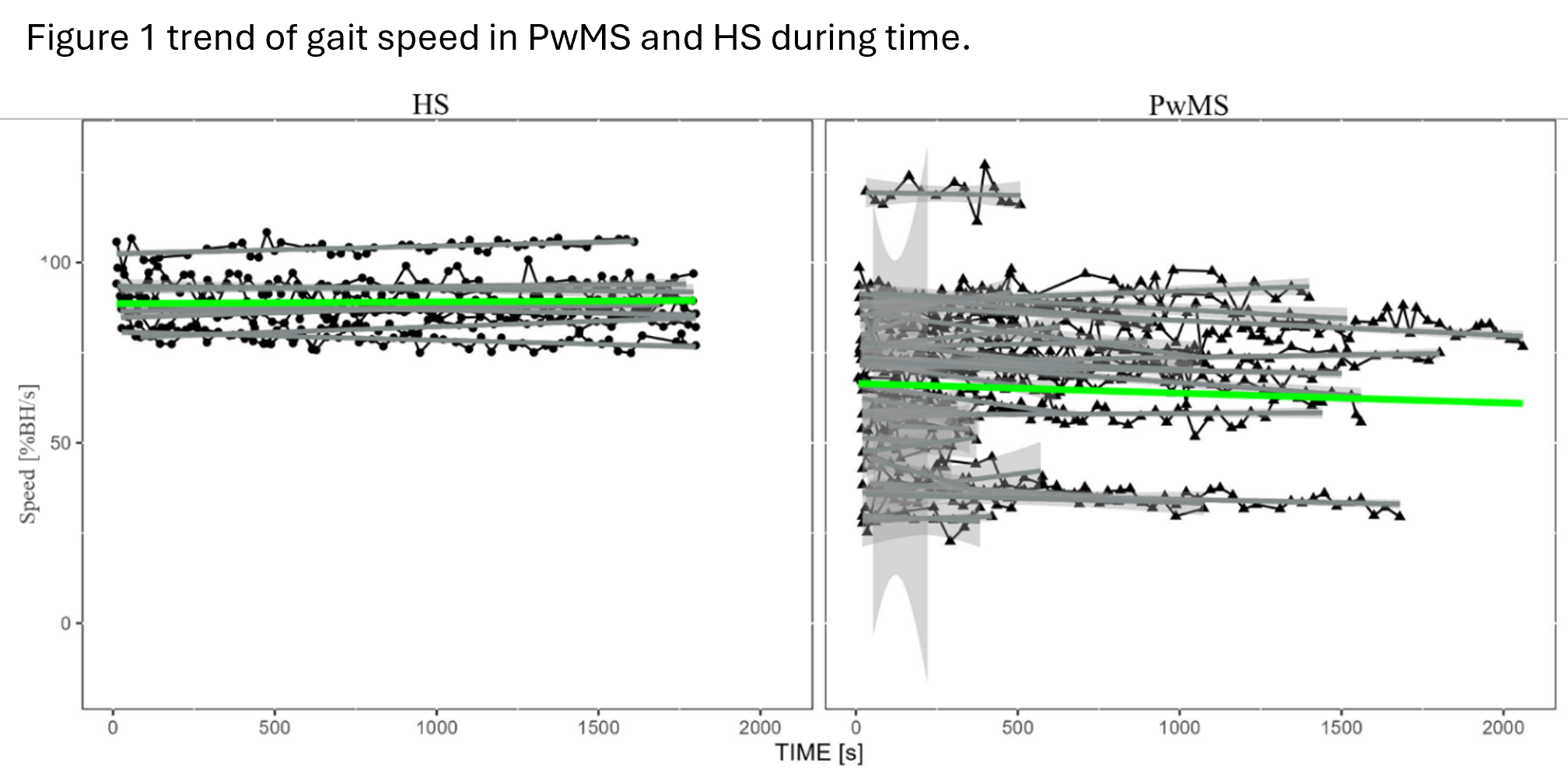
    PwMS reached a perceived fatigue “very hard” walking for15.6±11.3minutes) while HS walked for 30 minutes without exertion (RPE<11points). PwMS showed an increase in speed of 0.008%BH/s per minute, with respect HS who showed an increase of 0.0006%BH/s per minute (p <0.001, Figure 1) and a small reduction of cadence of 0.05 step/min per minute, while HS slight increase it of 012 step/min per minute. p <0.001), indicating a gait deterioration over time in PwMS. We also found changes in dynamic stability with a statistically significant between-group increase of HEAD _ML (PwMS: 0.59mm per minute, HS: 0.20mm per minute p <0.001) and TRUNK _ML (PwMS: 0.03 deg per minute, HS: 0.00744 deg per minute, p <0.001, Figure 2). No between group different were found in the other indexes.

    With respect the RCT study, the analysis of the primary outcome, the MFIS_PH, a greater reduction in perceived fatigue was observed in the EG than in the CG (CG: T0 = 15.6±9.0 pt, T1 = 11.6±7.7 pt, UG: T0 = 16.3±8.1 pt, T1 = 13.6±8.7 pt, F = 3.82, p=0.05). No statistically differences were found in the trends of the variables between CG and UG.

    Discussion and Conclusion


    The use of the fatiguing test can highlight motor changes due to fatigue, which vary in different subjects. It seems to have the potential to better guide rehabilitation treatment, highlighting characteristics not evident in normal assessments performed in a non-fatiguing condition. In future studies it could be used to better tailor the rehabilitation intervention and obtain greater effectiveness in managing fatigue in PwMS. The experimental intervention seems to improve the management of fatigue in ADL, it remains to be understood how to better direct the intervention based on the proposed assessment in a state of fatigue.

    REFERENCES

    [1] Mills, R. J., and Young, C. A. (2008). A medical definition of fatigue in multiple sclerosis. QJM 101, 49–60.

    [2] Sethy, D., Bajpai, P., and Kujur, E. S. (2010). Effect of task related circuit training on walking ability in a Multiple Sclerosis subject. A single case study. NeuroRehabilitation 26, 331–337.

    [3] Tramonti, C., Di Martino, S., and Chisari, C. (2020). An intensive task-oriented circuit training positively impacts gait biomechanics in MS patients. NeuroRehabilitation 46, 321–331.

  • Lesioni cerebrali acquisite in età pediatrica: scoping review dell’intervento neuromotorio in area critica.

    Lesioni cerebrali acquisite in età pediatrica: scoping review dell’intervento neuromotorio in area critica.

    Pediatric Acquired Brain Injuries: a scoping review of the neuromotor intervention in critical care setting.

    Autori

    Roberta Giustetto [Physical Therapy and Rehabilitation, Giannina Gaslini Children’s Hospital IRCCS, Genoa, Italy]

    Matteo Pirinu [Rehabilitation Professional Unit, Meyer Children’s University Hospital IRCCS, Florence, Italy]

    Introduction

    Pediatric Acquired Brain Injury (ABI) occurs in infants, children and adolescents, with a traumatic (TBI) or non-traumatic (n-TBI) origin (1). ABI is a long-life condition that affects many aspects of a child’s life and can profoundly influence physical and cognitive development skills (2). Early rehabilitation is crucial to managing the multidimensionality of the problem and preventing complications due to prolonged immobilization in intensive care (3). However, there are still no specific guidelines in the literature for the implementation and characterization of neuromotor interventions in critical care for pediatric ABI. This review aims to explore the types of neuromotor interventions, with reference to the domains of the “International Classification of Functioning, Disability and Health: Children and Youth” (ICF-CY), and their characteristics based on the “Frequency, Intensity, Time, and Type” (FITT) criteria, that can be applied in critical care for children and adolescents with ABI.

    Methods

    Scoping Review conducted according to the Preferred Reporting Items for Systematic reviews and Meta-Analyses extension for Scoping Reviews’ (PRISMA-ScR) Checklist. Two pediatric physiotherapists independently conducted comprehensive research on Pubmed, Embase, and PEDro databases.
    Articles were initially screened by title and abstract, and those considered potentially eligible were examined by full-text review. Data from the included studies were analyzed and synthesized concerning the types and characteristics of neuromotor interventions reported.

    Results

    Five studies met the inclusion criteria, out of a total of 1900 articles reviewed. In the included studies, physiotherapy or occupational therapy interventions started between 72 and 96 hours post-injury. All articles reported interventions focused on Body Functions and Structures (e.g. postural hygiene, joint ROM and muscle strength maintenance) and Activities (e.g. training for postural transitions or walking), while only two studies addressed interventions to enhance independence in activities of daily living (ADL). Concerning the intervention characteristics, all studies specified the type of intervention, most provided details on frequency, but only one study detailed the duration and intensity of the interventions.

    Discussion and Conclusion

    The studies included in this Scoping Review align with existing literature proposed in the acute phase of ABI for adults in relation to timing and types of interventions. Despite the benefits of early mobilization in critical care, several barriers exist to the implementation of such interventions, especially in traumatic brain injuries, where neuroprotection plays a critical role. Factors such as the patient’s stability, resource availability and the training of health professionals play key roles in the early implementation of neuromotor interventions in critical care settings (4). There is a need for further research to validate and refine early intervention protocols for pediatric neurocritical patients. Future studies should focus on determining the optimal timing of initiation, feasibility, and effectiveness of rehabilitative interventions in critical care, ideally using the ICF-CY classification and FITT criteria to describe the types and characteristics of the interventions (5).

    REFERENCES

    1. A. e. a. Linden MA, «Further recommendations of the International Paediatric Brain Injury Society (IPBIS) for the post-acute rehabilitation of children with acquired brain injury.,» Brain Injury, vol. 38, n. 3, pp. 151-159, 2024.
    2. C. e. a. Anderson V, «Functional plasticity or vulnerability after early brain injury?,» Pediatrics, vol. 116, n. 6, pp. 1374-82, 2005 .
    3. C. e. a. Forsyth RJ, «Modelling early recovery patterns after paediatric traumatic brain injury,» Archives of Disease in Childhood, vol. 95, n. 4, pp. 266-70, 2010.
    4. J. Thompson JY, «Early mobilisation and rehabilitation in the PICU: a UK survey,» BMJ Paediatrics Open, vol. 6, 2022.
    5. V. O. e. a. Gmelig Meyling C., «Physical rehabilitation interventions in children with acquired brain injury: a scoping review,» Developmental Medicine & Child Neurology, vol. 64, pp. 40-48, 2022.
  • Il Dolore Muscoloscheletrico nei Bambini e negli Adolescenti: Indagine Conoscitiva sull’uso della Classificazione Proposta dalla IASP tra i Fisioterapisti Italiani che Lavorano in Area Pediatrica

    Il Dolore Muscoloscheletrico nei Bambini e negli Adolescenti: Indagine Conoscitiva sull’uso della Classificazione Proposta dalla IASP tra i Fisioterapisti Italiani che Lavorano in Area Pediatrica

    Musculoskeletal Pain in Children and Adolescents: Survey on the Use of the Classification Proposed by IASP Among Italian Physiotherapists Working in Paediatrics

    Autori

    Giorgia Meneguzzo [ UOC Hospice Pediatrico – Azienda ospedaliera di Padova, Padova, Italy]

    Matteo Pirinu [Rehabilitation Professional Unit, Meyer Children’s University Hospital IRRCS, Florence, Italy]

    Francesco Cantarelli [Ass. Casa del Sole Onlus, Mantova, Italy; Clinical and Experimental Sciences Department, University of Brescia, Italy]

    Giulio Valagussa [ ]

    Introduction

    Pain is a complex multidimensional phenomenon (1) and pain management is a challenge for physiotherapists (PTs). About 30% of children and adolescents present nociplastic pain at least once in their lifetime (1). In 2020, the International Association for the Study of Pain (IASP) proposed an update of pain definition enriched by a new classification of the pain mechanisms underlying it (2,3). Preliminary data obtained through a pilot survey of a small group of colleagues from various European countries during the European Paediatric Physiotherapy Congress (EUPPT 2022) showed that the IASP terminology was known by about 60% of the participants. This study aims to investigate the knowledge and use in clinical practice of the most recent definition of pain and classification of pain mechanisms proposed by the IASP among PTs working in paediatrics in Italy.

    Methods

    The study is a Nationwide Questionnaire Survey, with 15 multiple-choice questions, and 1 non-compulsory open-ended question, addressed to Italian paediatric PTs, recruited among the members of the Specialist Interest Group (GIS) in Paediatric Physiotherapy of the Italian Association of Physiotherapy (AIFI) and the former students of the Master’s Degree Course in Paediatric Physiotherapy of the University of Florence. The results obtained were analysed through descriptive statistics.

    Results

    Eighty-nine questionnaires were collected out of 400 sent. 77.5% of PTs work mainly with children, 6.5% with adults, the remainder with both. Only 44% of the PTs working primarily in paediatrics are familiar both with the IASP pain definition and classification. Moreover, 10% of those who know the classification do not use it in their clinical practice. Amongst the PTs working with the children, no significant differences were found in the use of the classification and the work context (i.e. hospital, community service) or work field (i.e. musculoskeletal, neurological, cardio-respiratory).

    Finally, there was a significant difference in the use of the classification among PTs who had worked at least once with a child or adolescent with nociplastic pain and those who had never done so (p=0.03), and a further significant difference between those who worked with these children regularly and those who worked sporadically (p=0.007).

    Discussion and Conclusion

    This study confirms the need to disseminate more knowledge on the classification of the pathophysiological mechanisms of pain among Italian physiotherapists working in paediatrics, especially considering that approximately 50% of the colleagues who participated in the survey have treated at least one child with nociplastic pain in their career.

    REFERENCES

    1. King S, Chambers CT, Huguet A, MacNevin RC, McGrath PJ, Parker L, MacDonald AJ. The epidemiology of chronic pain in children and adolescents revisited: a systematic review. Pain. 2011 Dec;152(12):2729-2738.
    2. Raja, S. N., Carr, D. B., Cohen, M., Finnerup, N. B., Flor, H., Gibson, S., Keefe, F. J., Mogil, J. S., Ringkamp, M., Sluka, K. A., Song, X. J., Stevens, B., Sullivan, M. D., Tutelman, P. R., Ushida, T., & Vader, K. (2020). The revised International Association for the Study of Pain definition of pain: concepts, challenges, and compromises. Pain, 161(9), 1976–1982.
    3. International Association for the Study of Pain. IASP Council adopts task force recommendation for third mechanistic descriptor of pain [Internet]. Washington (DC): The Association; 2018 [cited 2020 Oct 21]. Available from: https://www.iasp-pain.org/PublicationsNews/NewsDetail.aspx?ItemNumber=6862.
  • Programma riabilitativo in paziente con disfunzioni vescicali, intestinali e sessuali dopo intervento chirurgico di rimozione di ependimoma endomidollare C1 -C3 mediante laminectomia: caso clinico

    Programma riabilitativo in paziente con disfunzioni vescicali, intestinali e sessuali dopo intervento chirurgico di rimozione di ependimoma endomidollare C1 -C3 mediante laminectomia: caso clinico

    Programma riabilitativo in paziente con disfunzioni vescicali, intestinali e sessuali dopo intervento chirurgico di rimozione di ependimoma endomidollare C1 -C3 mediante laminectomia: caso clinico

    Pelvic rehabilitation program in a woman with bladder, bowel and sexual dysfunction after C1 -C3 endomidullary ependymoma removal surgery by laminectomy: a case report

    Autori

    Malaspina Vissia [Ast Fermo, Italia]

    Bragagnolo Matteo [Ast Fermo, Italia]

    Grasso Anna Maria [Ast Fermo, Italia]

    Introduction

    Ependymomas are rare glial tumors with clinical and biological heterogeneity, categorized into supratentorial ependymoma, posterior fossa ependymoma, and spinal cord ependymoma, depending on anatomical localization.(1).
    Treatment involves primarily surgical resection, aiming at maximal safe resection: the extent of resection is the most important prognostic factor.(2)
    The main symptoms are sensory and motor deficit, hyposthenia, coordination and balance deficit, and Bladder or bowel dysfunction. (3)
    Post-surgical rehabilitation can improve the consequences of surgery and maintain a good quality of life, especially in young patients with long life expectancy. (4)
    With this case report, we describe the results obtained from rehabilitation treatment aimed at improving sphincters control and sexual dysfunctions after C1 -C3 intramedullary ependymoma removal surgery by laminectomy.

    Methods

    The patient is a 45-year-old nulliparous woman who underwent laminectomy surgery for removal of cervical ependymoma. She takes Lirica 150 mg 1×2/day and pregabalin 350 mg/day.
    At T0 the patient had left hemilateral paresthesia, also involving the saddle area, vulvar, intra vulvar and anal areas; severe hypo-pallesthesia at AAIIs going back to SIAS. She left AI sthenic deficits (F3).
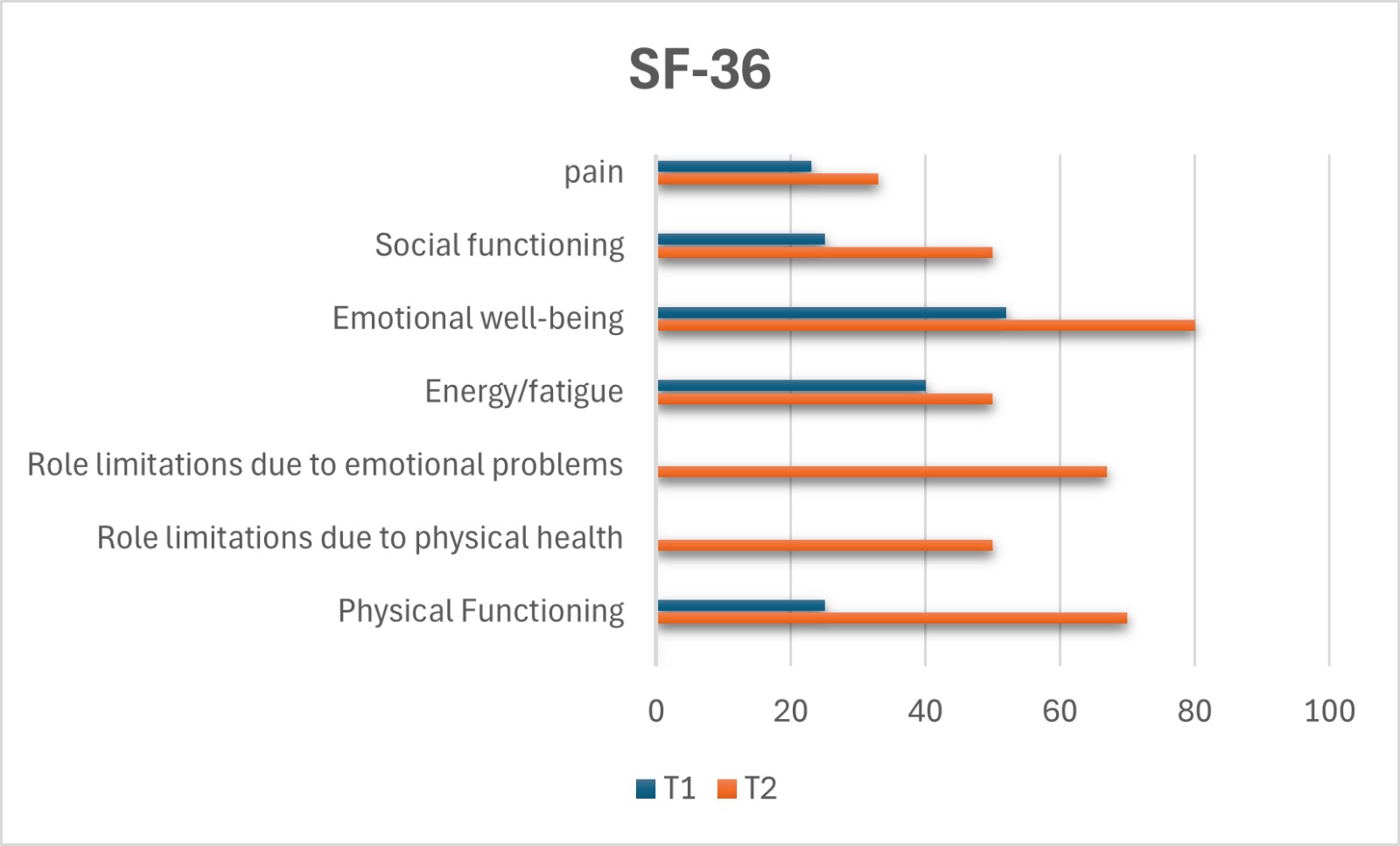
    Perineal sensitivity, pelvic floor muscle (PC test), urinary and fecal leakage (ICIQ-SF and WEXNER-CCS), quality of daily living (SF-36 and EQ-5D-3L), and sexual function (FSFI) were assessed at first and last session.
    The treatment lasted 4 months (two days a week for 2 months and once a week for another 2 months, not during menstruation).
    Manual techniques were adopted to release trigger points, in association with pelvic floor muscle exercises, also through the use of BFB, and sensory discrimination (tactile, pressure and thermal) and proprioceptive exercises in the perineal area.

    Results

    All parameters assessed at evaluation (T0) improved at the end of treatment (T1).
    Sensitivity and proprioception in the perineal area improved. There was an increase in pelvic floor muscle function (PC Test T0: F2, E1-2, E2-2; T1; F3, E1-3, E2-3) with a reduction in urinary incontinence (ICIQ-SF T0: 12/21; T1 3/21) and fecal incontinence (WEXNER-CCS T0: 6/20; T1: 3/20), leading to an improvement in quality of life [SF 36 T0: physical functioning 25/100, role limitations due to physical health 0/100, role limitations due to emotional problems 0/100, energy 40/100, emotional well-being 52/100, social functioning 25/100, pain 23/100, general health 45/100; T1: physical functioning 70/100, role limitations due to physical health 50/100, role limitations due to emotional problems 67/100, energy 50/100, emotional well-being 80/100, social functioning 50/100, pain 33/100, general health 50/100. EQ-5D-3L T0: 21222 (0.377), T1 11221 (0.679)] and sexual functions (FSFI T0: 26.4; T1; 17.5).

    Discussion and Conclusion

    Physiotherapy treatment through functional exercise of the pelvic muscles, also with the support of biofeedback, and proprioceptive exercises with devices of different surfaces and consistencies, has led to an increase in sensitivity in the pelvic area, an increase in pelvic motor control and to a reduction in urinary and fecal incontinence. The main factor to focus on was improving quality of life and sexual function. There are still few studies in the literature that evaluate the effectiveness of the rehabilitation treatment of perineal dysfunction on patients with incomplete spinal cord injury. Future work could investigate this further and include follow-ups to verify the maintenance of the results obtained.

    REFERENCES

    (1) Cerretti, G., Pessina, F., Franceschi, E., Barresi, V., Salvalaggio, A., Padovan, M., Manara, R., di Nunno, V., Bono, B. C., Librizzi, G., Caccese, M., Scorsetti, M., Maccari, M., Minniti, G., Navarria, P., & Lombardi, G. (2023). Spinal ependymoma in adults: from molecular advances to new treatment perspectives. In Frontiers in Oncology (Vol. 13). Frontiers Media SA. https://doi.org/10.3389/fonc.2023.1301179

    (2) Weber DC, Wang Y, Miller R, et al. Long-term outcome of patients with spinal myxopapillary ependymoma: treatment results from the MD Anderson Cancer Center and institutions from the Rare Cancer Network. Neuro Oncol. 2015;17(4):588–95.

    (3) Abdulaziz M, Mallory GW, Bydon M, et al. Outcomes following myxopapillary ependymoma resection: the importance of capsule integrity. Neurosurg Focus. 2015;39(2):E8.

    (4)Suzuki, T., Tsuji, O., Ichikawa, M., Ishii, R., Nagoshi, N., Kawakami, M., Watanabe, K., Matsumoto, M., Tsuji, T., Fujiwara, T., & Nakamura, M. (2023). Early Phase Functional Recovery after Spinal Intramedullary Tumor Resection Could Predict Ambulatory Capacity at 1 Year after Surgery. Asian Spine Journal, 17(2), 355–364. https://doi.org/10.31616/asj.2022.0068