Categoria: Congresso 2024

  • MINDFULNESS & ACCEPTANCE AND COMMITMENT THERAPY NEL LBP ASPECIFICO PERSISTENTE – CAMBIAMENTO DEL MINDSET E DELL’ADERENZA AL TRATTAMENTO DEI PAZIENTI: A CASE SERIES

    MINDFULNESS & ACCEPTANCE AND COMMITMENT THERAPY NEL LBP ASPECIFICO PERSISTENTE – CAMBIAMENTO DEL MINDSET E DELL’ADERENZA AL TRATTAMENTO DEI PAZIENTI: A CASE SERIES

    MINDFULNESS & ACCEPTANCE AND COMMITMENT THERAPY NEL LBP ASPECIFICO PERSISTENTE – CAMBIAMENTO DEL MINDSET E DELL’ADERENZA AL TRATTAMENTO DEI PAZIENTI: A CASE SERIES

    MINDFULNESS & ACCEPTANCE AND COMMITMENT THERAPY (ACT) APPROACH IN PERSISTENT NON-SPECIFIC LOW BACK PAIN – ASSESSING PATIENTS’ MINDSET CHANGE AND TREATMENT ENGAGEMENT: A CASE SERIES

    Autori

    Dr. Celso Andrea [Azienda sanitaria Friuli Occidentale – AsFO, Distretto delle Dolomiti Friulane, Maniago (PN), Italy]

    Dr.ssa Canderan Monica [Azienda sanitaria Friuli Occidentale – AsFO, Distretto delle Dolomiti Friulane, Maniago (PN), Italy]

    Introduction

    Persistent Non-specific Low Back Pain (NsLBP) constitutes a major global challenge1-3 and a source of significant suffering, disability and healthcare costs4. In this case-series, we present the results of a combined physiotherapy treatment merging Mindfulness-based Therapy5 with Acceptance and Commitment Therapy (ACT)6-7. ACT has been shown to have positive effects in chronic pain8, and meta-analyses showed improvements in pain intensity, physical functioning, depression and anxiety, and quality of life (QoL)9.

    Methods

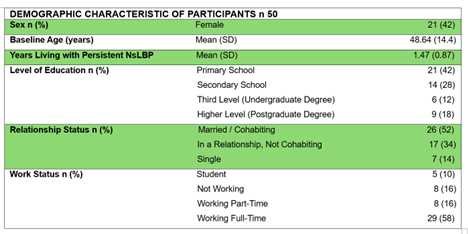
    n 50 with Non-specific Low Back Pain (NsLBP) patients (29 M, 21 F) was consecutively enrolled in one-year period and evaluated with initial, post-intervention (six months) evaluation and one-year follow-up, with administration of Patient-Related Outcome Measures (PROMs) such as Örebro Musculoskeletal Pain Screening Questionnaire (OMPSQ) and consequent further functional and psychosocial assessment with Roland Morris Disability Questionnaire (RMDQ), Fear Avoidance Beliefs Questionnaire (FABQ), Tampa Scale of Kinesiophobia (TSK), Pain Catastrophizing Scale (PCS), Coping Strategies Questionnaire (CSQ) and Pain Self-Efficacy Questionnaire (PSEQ), as measures to evaluate patients’ mindset change and treatment engagement. Physiotherapy treatment was based on Mindfulness sessions with body scan audio record and meditation walks merged with ACT principles to teach simple psychological skills, to promote psychological flexibility, and to address facilitators and barriers to self-management.

    Results

    Under a dispositionalist patient-centred approach10-11, the therapeutic process was multidimensional in nature, encompassing biomedical, psychological, social, and experiential components, and enables the construction of an intersubjective12 space between the clinician and the patient, where the characteristics of both can find a space headed towards a narrative shared sense-making process13 and an appropriate engagement to foster the therapeutic alliance14-16. Psychologically informed practice17-19 guided the therapeutical journey, where Motivational Interviewing (MI)20 framework, Mindfulness and ACT principles enabled to improve psychological flexibility and enhance personal engagement and self-management activation, as shown at the end of therapeutic program (six month) and at one-year follow-up, at outcomes re-evaluation comparing to baseline.

    Discussion and Conclusion

    A multidimensional patient-centred approach21 under a dispositionalist causal framework of reference, with the aim of whole person scrutiny22, may representing a good viaticum that prompt patients’ recovery and thrive. The recovery of functional levels and implementation of self-management programs23 consent to cope successfully with LBP complaint, under a shared clinical decision-making and personal empowerment lens. Further, be acquainted in Mindfulness and ACT’s core principles, directly reduces avoidance and promotes openness, bringing the possibility to build present-focused awareness, and coordinate greater engagement in goal-oriented and values-based activities.

    REFERENCES

    1. Hartvigsen J, et al. Lancet 2018.
    2. Buchbinder R, et al. Lancet 2018.
    3. Foster NE, et al. Lancet 2018.
    4. Murray CJL, et al. Lancet 2012.
    5. Cherkin DC, et al. JAMA 2016.
    6. Hayes, SC. Behav Ther 2004.
    7. Tatta J, et al. Phys Ther 2022.
    8. Hann KEJ et al.  J Context Behav Sci 2014.
    9. Veehof MM, et al. Cogn Behav Ther 2016.
    10. Anjum RL, et al. Springer 2020.
    11. Low M. J Eval Clin Pract 2017.
    12. Low M. In Touch. 2018.
    13. Launer J. Routledge, London 2018.
    14. Testa M, et al. Man Ther 2016.
    15. Rossettini G, et al. BMC Musculoskelet Disord 2018.
    16. McParlin Z, et al. Front Behav Neurosci 2022.
    17. Nicholas MK, George SZ. Phys Ther 2011.
    18. Main CJ, George SZ. Phys Ther 2011.
    19. Ballengee LA, et al. J Pain Res 2021.
    20. Nijs J, et al. Phys Ther 2020.
    21. Hutting N, et al. Musculoskelet Sci Pract 2022.
    22. Belton J, et al. Chiropr Man Ther 2022.
    23. Hutting N, et al. J Orthop Sports Phys Ther 2019.
  • Uni&PoliToPrevent: analisi dell’associazione tra disturbi muscoloscheletrici, livelli di attività fisica e stress nei dipendenti universitari. Uno studio trasversale.

    Uni&PoliToPrevent: analisi dell’associazione tra disturbi muscoloscheletrici, livelli di attività fisica e stress nei dipendenti universitari. Uno studio trasversale.

    Uni&PoliToPrevent: analysis of the association between musculoskeletal disorders, levels of physical activity and stress in university employees. A cross-sectional study.

    Autori

    Martina Ballesio [School of Physiotherapy, University of Turin School of Medicine, Turin, Italy]

    Beatrice Occhetto [School of Physiotherapy, University of Turin School of Medicine, Turin, Italy]

    Marco Trucco [School of Physiotherapy, University of Turin School of Medicine, Turin, Italy]

    Anna Mulasso [Department of Medical Sciences, University of Turin, 10126 Turin, Italy]

    Maja Popovic [Department of Medical Sciences, University of Turin, 10126 Turin, Italy]

    Paolo Riccardo Brustio [Department of Clinical and Biological Sciences, University of Turin, 10126 Turin, Italy]

    Alberto Rainoldi [Department of Medical Sciences, University of Turin, 10126 Turin, Italy]

    Introduction

    Musculoskeletal disorders encompass various inflammatory and degenerative conditions affecting muscles, tendons, ligaments, joints, peripheral nerves, and blood vessels. They are highly prevalent within the population and result not only in significant economic and social costs but also a reduced quality of life for individuals1. Work-related musculoskeletal disorders are subset of musculoskeletal disorders, caused and/or aggravated by occupational risk factors. Work-related musculoskeletal disorders represent the leading cause of disability, absenteeism, and lost productivity in industrially developed and developing countries, making them one of the most widespread health issues in the workforce2. Musculoskeletal disorders among workers have a multifactorial origin, including not only individual and biomechanical factors but also biopsychosocial and organizational aspects3. Currently, there is a lack of Italian studies that quantify the prevalence of these disorders in occupational office settings and their association with specific psychophysical risk factors4. Therefore, the objective of this study is to examine the relationships between musculoskeletal disorders, levels of physical activity, and stress among employees of the University of Turin and the Polytechnic University of Turin.

    Methods

    The recruited sample consisted of 446 employees from two universities. Participants completed an online questionnaire consisting of four sections:

    1. socio-demographic and work-related informations;
    2. the NMQ (Nordic Musculoskeletal Questionnaire)5;
    3. the GPAQ (Global Physical Activity Questionnaire)6;
    4. the PSS (Perceived Stress Scale)7.

    Variables were compared between the two universities using the independent samples t-test and the Wilcoxon-Mann-Whitney test when the distribution was non-normal. Negative binomial regression model was used to present the prevalence ratio (PR) and corresponding 95% Confidence Intervals (CIs).

    Results

    The prevalence of at least one musculoskeletal disorder in the last twelve months was found to be 85.2%. The most common disorders in the sample were neck disorders (57.9%), lumbar disorders (47.8%), and shoulder disorders (39.7%), with a similar distribution between the two universities. We found statistically significant associations between moderate (PR=1.44; IC95%: 1.01-2.05) and high (PR=1.71; IC95%: 1.04-2.81) stress levels and neck disorders, as well as moderate (PR=1.54; IC95%: 1.03-2.31) stress levels and shoulder disorders. Upper back disorders were found to be associated with the levels of stress in both the crude (moderate: PR=2.43; IC95%: 1.39-4.23; high: PR=3.61; IC95%:1.82-7.17) and adjusted models (moderate: PR=2.34; IC95%:1.17-4.69; high: PR=3.06; IC95%:1.27-7.34).

    After adjustment for confounding factors (i.e., sex, age, educational attainment, job role, weekly working hours, remote work, hours in front of video display terminals, BMI, health perception, chronic diseases, smoking, alcohol consumption) there was no association between levels of physical activity, sedentary behavior, and musculoskeletal disorders.

    Discussion and Conclusion

    The results of this study highlight the association between musculoskeletal disorders and stress, reinforcing the well-known multifactorial origin of these disorders; therefore, it is essential to address physical, psychosocial, and organizational risk factors.

    Despite the lack of a clear association between musculoskeletal disorders and levels of physical activity or sedentary behavior found in this research, it is important to emphasize that prevention interventions that include physical activity in the workplace can still be an effective opportunity8. Considering the wide impact of physical activity and stress on health, a multidisciplinary approach that combines interventions for mental and physical health and organizational well-being can help reduce the incidence of musculoskeletal disorders among workers.

    REFERENCES

    1. Cieza A, Causey K, Kamenov K, Hanson SW, Chatterji S, Vos T. Global estimates of the need for rehabilitation based on the Global Burden of Disease study 2019: a systematic analysis for the Global Burden of Disease Study 2019. Lancet Lond Engl. 19 dicembre 2021;396(10267):2006–17.
    2. EU-OSHA. Preventıon of musculoskeletal dısorders and psychosocıal rısks ın the workplace: EU strategıes and future challenges | Safety and health at work EU-OSHA. 2022.
    3. Roquelaure Y. Musculoskeletal Disorders and Psychosocial Factors at Work. SSRN Electron J. 2018;
    4. Seconda indagine nazionale sulla salute e sicurezza nei luoghi di lavoro (Insula2). 2021.
    5. Kuorinka I, Jonsson B, Kilbom A, Vinterberg H, Biering-Sørensen F, Andersson G, et al. Standardised Nordic questionnaires for the analysis of musculoskeletal symptoms. Appl Ergon. 1 settembre 1987;18(3):233–7.
    6. Keating XD, Zhou K, Liu X, Hodges M, Liu J, Guan J, et al. Reliability and Concurrent Validity of Global Physical Activity Questionnaire (GPAQ): A Systematic Review. Int J Environ Res Public Health. novembre 2019;16(21):4128.
    7. Lee EH. Review of the Psychometric Evidence of the Perceived Stress Scale. Asian Nurs Res. 1 dicembre 2012;6(4):121–7.
    8. Global action plan on physical activity 2018–2030: more active people for a healthier world. World Health Organization; 2018.
  • Prestazioni di sei chatbots di intelligenza artificiale rispetto alle linee guida di pratica clinica nel prendere decisioni informate per il dolore radicolare lombosacrale: uno studio trasversale

    Prestazioni di sei chatbots di intelligenza artificiale rispetto alle linee guida di pratica clinica nel prendere decisioni informate per il dolore radicolare lombosacrale: uno studio trasversale

    Prestazioni di sei chatbots di intelligenza artificiale rispetto alle linee guida di pratica clinica nel prendere decisioni informate per il dolore radicolare lombosacrale: uno studio trasversale

    Comparative performance of six artificial intelligence chatbots in providing health advice for radicular lumbosacral pain against clinical practice guidelines: a cross-sectional study

    Autori

    Bargeri Silvia [IRCCS Istituto Ortopedico Galeazzi, Unit of Clinical Epidemiology, Milan, Italy]

    Guida Stefania [IRCCS Istituto Ortopedico Galeazzi, Unit of Clinical Epidemiology, Milan, Italy]

    Turolla Andrea [Department of Biomedical and Neuromotor Sciences (DIBINEM), Alma Mater University of Bologna, Bologna, Italy] [Unit of Occupational Medicine, IRCCS Azienda Ospedaliero-Universitaria di Bologna, Bologna, Italy]

    Castellini Greta [IRCCS Istituto Ortopedico Galeazzi, Unit of Clinical Epidemiology, Milan, Italy]

    Pillastrini Paolo [Department of Biomedical and Neuromotor Sciences (DIBINEM), Alma Mater University of Bologna, Bologna, Italy] [Unit of Occupational Medicine, IRCCS Azienda Ospedaliero-Universitaria di Bologna, Bologna, Italy]

    Palese Alvisa [Department of Medical Sciences, University of Udine, Udine, Italy]

    Cook Chad [Department of Orthopaedics, Duke University, Durham, NC] [Duke Clinical Research Institute, Duke University, Durham, NC] [Department of Population Health Sciences, Duke University, Durham, NC]

    Rossettini Giacomo [School of Physiotherapy, University of Verona, Verona, Italy] [Department of Human Neurosciences, University of Rome ‘Sapienza Roma’, Rome, Italy] [Musculoskeletal Pain and Motor Control Research Group, Faculty of Sport Sciences, Universidad Europea de Madrid, 28670 Madrid, Spain] [Musculoskeletal Pain and Motor Control Research Group, Faculty of Health Sciences, Universidad Europea de Canarias, Tenerife, 38300 Canary Islands, Spain]

    Gianola Silvia [IRCCS Istituto Ortopedico Galeazzi, Unit of Clinical Epidemiology, Milan, Italy]

    Introduction

    Large Language Models (LLMs) are advanced deep learning systems designed to understand, generate, and interact with human language. In the field of LLMs, artificial intelligence (AI) chatbots represent emerging tools that are trained to generate human-like text based on large amounts of data. This technological advancement is particularly significant in healthcare, where patients increasingly rely on AI chatbots for information on health conditions, treatment options, and preventive measures, essentially serving as virtual assistants. Specifically, for musculoskeletal pain conditions of the lumbar spine, the performance of AI chatbots in aligning with clinical practice guidelines (CPGs) for providing answers to complex clinical questions on lumbosacral radicular pain is still unclear.

    Methods

    We conducted a cross-sectional study evaluating AI chatbots’ responses against CPGs recommendations for diagnosing and treating lumbosacral radicular pain. Eligible recommendations were extracted from a previous systematic review of CPGs and were categorized into ‘should do’, ‘could do’, ‘do not do’, or ‘uncertain’. Clinical questions derived from these CPGs were posed to the latest versions (updated in April 2024) of the following six AI chatbots: ChatGPT-3.5, ChatGPT-4, Microsoft Copilot, Google Gemini, Claude, and Perplexity. We assessed the AI chatbots performance by (i) measuring the internal consistency of their answers through the percentage of text similarity when a question was re-asked for three times, (ii) evaluating the reliability between two independent reviewers in grading chatbots responses using Fleiss’ kappa coefficients and (iii) comparing the accuracy of AI chatbots answers to CPG recommendations, determined by the frequency of agreement among all judgments.

    Results

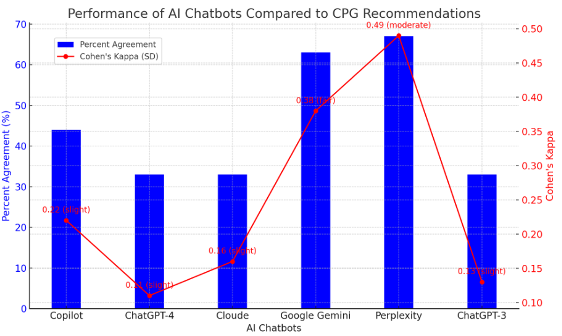
    Nine clinical questions were tested. Overall, we found highly variable internal consistency in the responses from chatbots for each question (median range 26% to 68%). The intra-rater reliability was “almost perfect” for both reviewers in Copilot, Perplexity, and ChatGPT-3.5, and “substantial” in ChatGPT-4, Claude, and Gemini. Inter-rater reliability was “almost perfect” in Perplexity (0.84, SE: 0.16) and ChatGPT-3.5 (0.85, SE: 0.15), “substantial” in Copilot (0.69, SE: 0.20), Claude (0.66, SE: 0.21), and Google Gemini (0.80, SE: 0.18), and “moderate” for ChatGPT-4 (0.54, SE: 0.23). Compared to CPGs recommendations, Perplexity had the highest accuracy (67%), followed by Google Gemini (63%) and Copilot (44%). Conversely, Claude, ChatGPT-3.5, and ChatGPT-4 showed the lowest, each scoring 33% (Figure 1 and 2).

    Discussion and Conclusion

    Despite the variability in internal consistency and good intra- and inter-rater reliability, the AI chatbots’ responses often did not align with CPGs recommendations for diagnosing and treating lumbosacral radicular pain. Clinicians and patients should pay attention when using these AI models, since one-third to two-thirds of the recommendations provided may be inappropriate or misleading according to specific chatbots.

    REFERENCES

    Clusmann J, Kolbinger FR, Muti HS, et al. The future landscape of large language models in medicine. Commun Med. 2023;3(1):141. doi:10.1038/s43856-023-00370-1

    Park YJ, Pillai A, Deng J, et al. Assessing the research landscape and clinical utility of large language models: a scoping review. BMC Med Inform Decis Mak. 2024;24(1):72. doi:10.1186/s12911-024-02459-6

    Khorami AK, Oliveira CB, Maher CG, et al. Recommendations for Diagnosis and Treatment of Lumbosacral Radicular Pain: A Systematic Review of Clinical Practice Guidelines. J Clin Med 2021; 10(11).

    Norman GR, Streiner DL. Biostatistics: The Bare Essentials. People’s Medical Publishing House; 2014.

  • Responsività alla riabilitazione della stabilità dinamica locale del tronco in soggetti con atassia cerebellare degenerativa primaria.

    Responsività alla riabilitazione della stabilità dinamica locale del tronco in soggetti con atassia cerebellare degenerativa primaria.

    Responsività alla riabilitazione della stabilità dinamica locale del tronco in soggetti con atassia cerebellare degenerativa primaria.

    Responsiveness to rehabilitation of local dynamic stability of the trunk in subjects with primary degenerative cerebellar ataxia.

    Autori

    Castiglia Stefano Filippo [Department of Medico-Surgical Sciences and Biotechnologies, “Sapienza” University of Rome-Polo Pontino, Latina, Italy; Department of Brain and Behavioral Sciences, University of Pavia, Pavia, Italy]]

    Trabassi Dante [Department of Medico-Surgical Sciences and Biotechnologies, “Sapienza” University of Rome-Polo Pontino, Latina, Italy]

    Conte Carmela [Department of Medico-Surgical Sciences and Biotechnologies, “Sapienza” University of Rome-Polo Pontino, Latina, Italy]

    Varrecchia Tiwana [Department of Occupational and Environmental Medicine, Epidemiology and Hygiene, INAIL, Monteporzio Catone, Italy]

    Chini Giorgia [Department of Occupational and Environmental Medicine, Epidemiology and Hygiene, INAIL, Monteporzio Catone, Italy]

    Ranavolo Alberto [Department of Occupational and Environmental Medicine, Epidemiology and Hygiene, INAIL, Monteporzio Catone, Italy]

    Casali Carlo [Department of Medico-Surgical Sciences and Biotechnologies, “Sapienza” University of Rome-Polo Pontino, Latina, Italy]

    Serrao Mariano [Department of Medico-Surgical Sciences and Biotechnologies, “Sapienza” University of Rome-Polo Pontino, Latina, Italy; Movement Analysis Lab, Policlinico Italia, Roma]

    Introduction

    Ataxic gait is characterized by incoordination between the upper and lower bodies, which results in increased upper body oscillations with a lack of local trunk stability, transforming the trunk into a generator of perturbations during walking [1]. Recently three trunk acceleration – derived gait indexes, namely the harmonic ratios (HRs), short-time longest Lyapunov’s exponent (sLLE), and step-to-step coefficient of variation (CV), showed the best ability to characterize the trunk behavior during gait of swCA[2,3]. This study aimed to assess the responsiveness to the rehabilitation of HR, sLLE, CV in a sample of subjects with primary degenerative cerebellar ataxia (swCA), and investigate the correlations between their improvements (∆), clinical characteristics, and spatio-temporal and kinematic gait features.

    Methods

    The trunk acceleration patterns in the antero-posterior (AP), medio-lateral (ML), and vertical (V) directions during gait of 21 swCA were recorded using a magneto-inertial measurement unit placed at the lower back before (T0) and after (T1) a period of inpatient rehabilitation. For comparison, a sample of 21 age- and gait speed-matched healthy subjects (HSmatched) was also included. Cohen’s d with Hedge’s correction was used to calculate internal responsiveness. To identify significant differences between swCA and HS at T0 and T1, the unpaired t-test or Mann–Whitney test was used. The external responsiveness was assessed using an anchor-based method using the smallest detectable change of the SARA scale (3.5 points) criterion for clinical improvement[4].

    Results

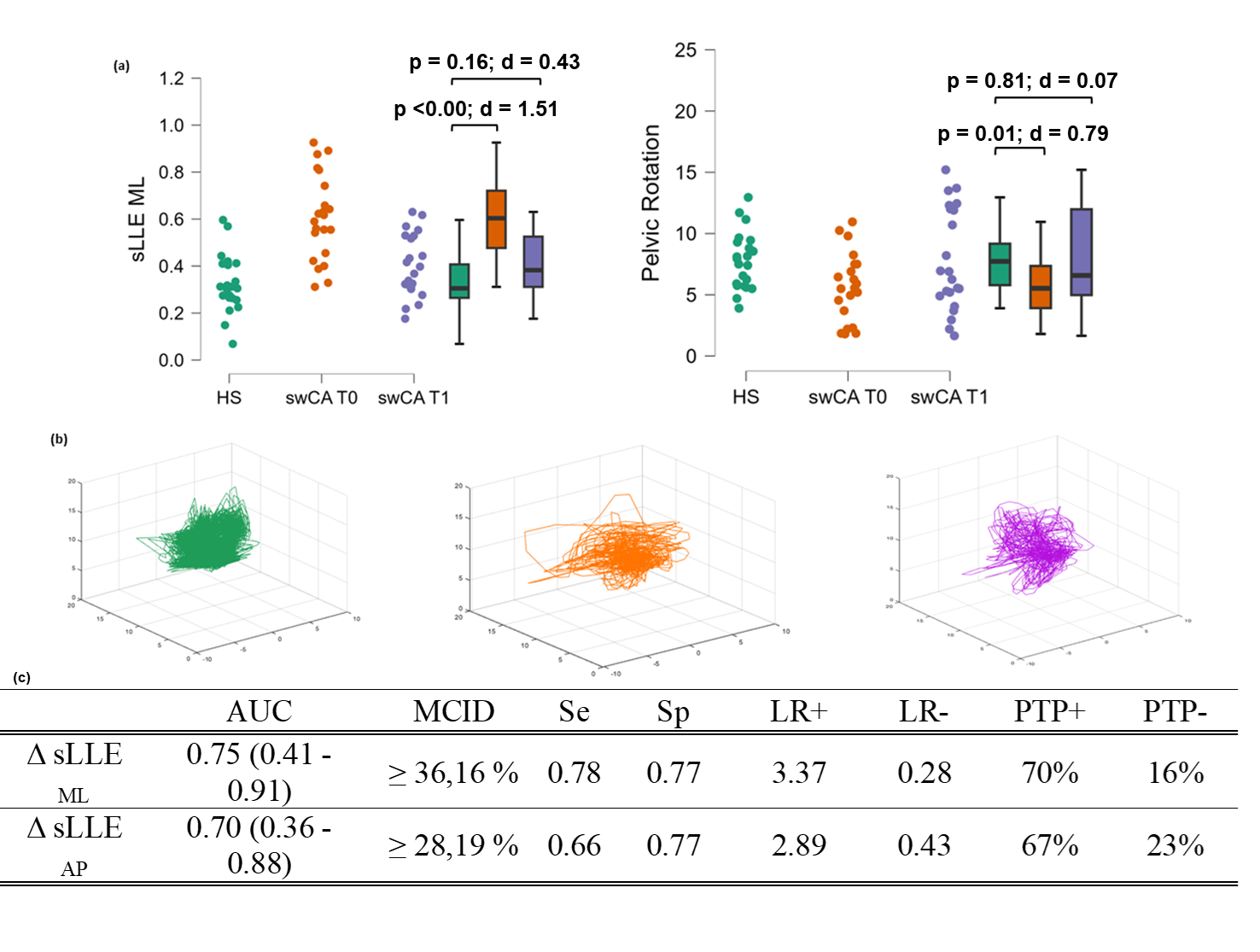
    At T1, sLLE in the AP (sLLEAP) and ML (sLLEML) directions significantly improved with moderate to large effect sizes (sLLEAP: p = 0.03; d= 0.75; sLLEML: p=0.00; d = 0.86), as well as SARA scores (p = 0.00; d = 0.73), stride length (p = 0.04; d = 0.46), and pelvic rotation (p = 0.03; d = 0.49). sLLEML and pelvic rotation also approached the HSmatched values at T1 (Fig. 1, a), suggesting a normalization of the parameter. HRs and CV did not significantly modify after rehabilitation. ∆sLLEML correlated with ∆ of the gait subscore of the SARA scale (∆SARAGAIT) (ρ = 0.41; p = 0.03) and ∆stride length (ρ = 0.51; p = 0.01). ∆sLLEAP correlated with ∆pelvic rotation (ρ = 0.41; p = 0.03) and ∆SARAGAIT (ρ = 0.43; p = 0.03). The minimal clinically important differences (MCID) for sLLEML and sLLEAP were ≥ 36.16% and ≥ 28.19%, respectively, as the minimal score reflecting a clinical improvement in SARA scores (Fig. 1, c).

    Discussion and Conclusion

    sLLE in the ML and AP directions revealed good internal and external responsiveness, and moderately correlated with the improvements in SARAGAIT subscore, stride length, and pelvic rotation [5]. The findings of this study suggest that trunk stability can be effectively quantified using sLLE and improve after rehabilitation. Because of the usability and affordability of magneto-inertial measurement units, sLLE can be considered a useful additional outcome measure for assessing the effectiveness of intensive rehabilitation treatments, particularly when focusing on improvements in trunk stability during gait. Further studies including larger populations are needed to confirm these results and investigate long-term responsiveness.

    REFERENCES

    [1]Manto M, Serrao M, Filippo Castiglia S, Timmann D, et al. Neurophysiology of cerebellar ataxias and gait disorders. Clin Neurophysiol Pract. 2023 Jul 20;8:143-160.

    [2]Castiglia SF, Trabassi D, Tatarelli A, et al. Identification of Gait Unbalance and Fallers Among Subjects with Cerebellar Ataxia by a Set of Trunk Acceleration-Derived Indices of Gait. Cerebellum. 2023 Feb;22(1):46-58.

    [3]Caliandro P, Conte C, Iacovelli C, et al. Exploring Risk of Falls and Dynamic Unbalance in Cerebellar Ataxia by Inertial Sensor Assessment. Sensors (Basel). 2019 Dec 17;19(24):5571

    [4]Schmitz-Hübsch T, Fimmers R, Rakowicz M, et al.Responsiveness of different rating instruments in spinocerebellar ataxia patients. Neurology. 2010 Feb 23;74(8):678-84

    [5]Castiglia SF, Trabassi D, Conte C, et al. Local Dynamic Stability of Trunk During Gait is Responsive to Rehabilitation in Subjects with Primary Degenerative Cerebellar Ataxia. Cerebellum. 2024 Jan 27. doi: 10.1007/s12311-024-01663-4. Epub ahead of print.

  • L’influenza della lombalgia non specifica sulla cinematica del cammino: una revisione sistematica con meta-analisi

    L’influenza della lombalgia non specifica sulla cinematica del cammino: una revisione sistematica con meta-analisi

    How non-specific low back pain affects gait kinematics: a systematic review and meta-analysis

    Autori

    Fulvio Dal Farra (Dept. of Information Engineering, University of Brescia, Brescia, Italy)

    Nicola Francesco Lopomo (Dept. of Design, Politecnico of Milan, Milano Italy)

    Matteo Fascia (Dept. of Information Engineering, University of Brescia, Brescia, Italy)

    Emilia Scalona (Dept. of Medical and Surgical Specialties, Radiological Sciences and Public Health, University of Brescia, Brescia, Italy)

    Veronica Cimolin (Dept. of Electronics, Information and Bioengineering, Politecnico of Milan, Milano, Italy

    Introduction

    Non-specific low back pain (NS-LBP) is a frequent musculoskeletal condition affecting up to 80% of the population in their lifetime. Perturbations in spinal and lower limb dynamics have been considered as potential factors directly involved in NS-LBP, including joint rigidity, muscle weakness and poor neuromuscular function. All these factors could lead to asymmetrical or abnormal mechanical loading of the lumbar spine.

    Since walking represents one of the activities that is routinely repeated throughout the whole day, it can be affected and contribute to pain, activity limitations, and disability in subjects presenting NS-LBP. Despite the large number of studies carried out over the years, to the best of our knowledge, no systematic review exists on this topic.

    Therefore, we carried out a systematic review focused to provide a structured synthesis of the actual evidence on this topic, specifically addressing the use of quantitative and instrumental assessing methods.

    Methods

    The conceptualization of this review followed the “2020 Preferred Reporting Items for Systematic Reviews and Meta-Analysis” (PRISMA 2020 checklist) and the protocol was preliminary registered in PROSPERO (ID: CRD42023431380). A search strategy was implemented in Medline, Embase, Scopus, Web of Science, and IEEE Xplore databases, up to March 2024.

    Inclusion criteria were: any analytical observational research instrumentally assessing the trunk and lower limbs kinematics of spontaneous walking in NS-LBP, in a comparison with healthy people. As for the exclusion criteria, studies where walking was assessed on the treadmill, or studies dealing with subjects affected by other conditions affecting the walking performance were excluded.

    Study selection and data extraction were performed by two blinded reviewers, the methodological quality was evaluated by the Joanna Briggs Institute (JBI) Critical Appraisal Checklist for Analytical Cross-Sectional Studies, and the quality of the evidence was rated through GRADE framework.

    Results

    Overall, a total of 19 cross-sectional studies were included in this review and none of those was found without any methodological issues. A meta-analysis was only possible for some of the examined spatial-temporal parameters, all the outcomes related to joint motion were summarized through a qualitative synthesis.

    The meta-analysis showed a lower gait velocity [-15.42 (-22.78, -8.06) cm/s; p≤ 0.0001], a lower cadence [-9.85 (-18.72, -0.99) steps/min; p= 0.03] and a lower step length [-6.30 (-11.83; -0.77) cm; p= 0.03] in NS-LBP compared to healthy people. Regarding motion analysis, a few authors observed a less and asymmetrical motion of the lower spine in the frontal and in the transverse plane. Changes in lower limbs kinematics were reported sporadically and resulted inconsistent. The quality of the evidence was rated as very-low due to the presence of study design issues, inconsistency, indirectness and imprecision.

    Discussion and Conclusion

    There is very-low quality evidence that gait speed, cadence and step length are reduced in patients with NS-LBP, and that stride length does not differ compared to healthy people. There is proof of a movement reduction in the lower lumbar spine and in the pelvis, both in the transverse and in the frontal plane. No differences in the lower limb kinematics appeared to be consistent over the studies. The importance of instrumental motion assessment in NS-LBP should be well taken into consideration by the healthcare policies, so that the applicability of such procedures may be guaranteed.

    High-quality observational studies are needed to improve the quality of the evidence and to determine if the kinematic modifications in NS-LBP people are related to physical or psycho-behavioral factors, and if they are caused by the presence of pain or by physical re-adaptations.

    REFERENCES

    1.Andersson G. B. (1999). Epidemiological features of chronic low-back pain. Lancet (London, England), 354(9178), 581–585. https://doi.org/10.1016/S0140-6736(99)01312-4

    2. Karayannis NV, Jull GA, Hodges PW. Physiotherapy movement based classification approaches to low back pain: comparison of subgroups through review and developer/expert survey. BMC Musculoskelet Disord 2012;13:24.

    3. Müller, R., Ertelt, T., & Blickhan, R. (2015). Low back pain affects trunk as well as lower limb movements during walking and running. Journal of biomechanics, 48(6), 1009–1014. https://doi.org/10.1016/j.jbiomech.2015.01.042

    4. Guyatt, G. H., Oxman, A. D., Vist, G. E., Kunz, R., Falck-Ytter, Y., Alonso-Coello, P., Schünemann, H. J., & GRADE Working Group (2008). GRADE: an emerging consensus on rating quality of evidence and strength of recommendations. BMJ (Clinical research ed.)336(7650), 924–926. https://doi.org/10.1136/bmj.39489.470347.AD


  • Quando per la semplificazione il fisioterapista tornò ad essere massaggiatore. Scenari letterari nella divulgazione

    Quando per la semplificazione il fisioterapista tornò ad essere massaggiatore. Scenari letterari nella divulgazione

    Literary scenarios in popularization: when the physiotherapist went back to being a massage therapist.

    Autori

    Francesco Bonanno (Università degli studi di Messina)

    Mariachiara Ceccio (Università degli studi di Messina)

    Teresa Pintaudi (Università degli studi di Messina)

    Filippo Cavallaro (Università degli studi di Messina)

    Introduction

    The space for disclosure and professional testimony, thanks to the plot defined by the authors in the novels, takes us to unexpected dimensions and fascinating adventures. Then it happens that one quotes The Radical Chick Census written by Giacomo Papi and is surprised at how it is current and close.

    Doing science popularization is an activity of communicating addressed to the general public, consisting in specialized notions and research of a discipline in a form that is easy to understand. The space that has been available in the online journal Messina Medica 2.0,  like so many spaces for discussion, are opportunities to grow as a profession and to improve as professionals.

    It is a chance to learn to present ourselves clearly and to relate with other professionals. In this way we can be recognizable for specific expertise and our own disciplinary field.

    Writing and discussing leads to being recognized individually, while these activities need to be done by all physiotherapist in order to proclaim our own identity.

    Methods

    Since 2019, every 15 days a space has been open for discussion and presentation, focusing on novels and essays analyzed by physiotherapist’s point of view (often relating them to clinical episodes).

    We analyzed the contents of more than one hundred articles published, to note the aspects correlated with concern or denunciation, evoked by simplification or reductionism.

    Results

    At the time when the discipline of physiotherapy also entered in our country’s academic sphere with the establishment of university courses, we had the awareness that we would have to know the body of knowledge of the specific profession, the techniques and how the basic sciences served as the foundation of that knowledge. This was a new thing for the world of medicine and for the whole encyclopedic field of knowledge.

    In the health knowledge sphere there were those who had studied ways and times that allowed serious and/or incurable diseases not to be survivable (even it was discovered that certain interventions of physiotherapy limited disease outcomes). Early undergraduate students were suggested to write a glossary of terminology in physiotherapy. For some areas it was easier to relate in others not.

    In the text and content analysis of the articles published by Messina Medica 2.0 in the bookseller’s “Noterelle riabilitative del padre del libraio” there are some signs that should act as a spur for the profession.

    Two problems are most obvious: firstly the simplification which is a specific risk of popularization, then that of reductionism which is a specific risk of the scientific thinking.

    Due problemi sono più evidenti in primis quello della semplificazione che è un rischio specifico della divulgazione, poi quello del riduzionismo che è rischio specifico del pensiero scientifico.

    Discussion and Conclusion

    In the illness filed, the body alone faces in autonomy with suffering with the tools at its disposal. Today, with scientific knowledge, we know the complexity that underlies our lives, so we cannot relegate all to simple word, commonly used, with an etymology and a history.

    Alessandro Baricco argues that “whenever we make certain buzzwords of brutal simplicity enough for us, we burn years of collective growth spent not getting screwed by the apparent simplicity of things.”

    Culture is not a “smoky thing”. Culture is the streets on which we walk, the houses where we live, the words in our mouths that some other human, time ago, who knows why, invented. With the ”Rehabilitation Noterella” point of view, we can rewrite it this way,: “Physiotherapy is not a smoky or magical thing. Physiotherapy is the roads on which the reasoning of the physiotherapist walks, the spaces where it is practiced, the words that run in our mouths and that some other human, in practicing and describing his interventions has found and used. Culture is a bet that we can eventually understand each other. That is why it sometimes bothers”.

    REFERENCES

    • Cavallaro F., Fiolo R., Giordano G. Lo Statuto Epistemologico della Fisioterapia, Fisioterapisti 55/2014
    • a cura di Ferrari MG., Il Codice Deontologico dei Fisioterapisti, Ed Libreria Cortina 2014
    • AA.VV., Linee guida per la formazione del fisioterapista – core competence, Masson 2003
    • AA.VV., La formazione “core” del Fisioterapista, Scienza Riabilitativa 13(3) 2011
    • https://www.messinamedica.it/
    • Papi G., Il censimento dei radical chic, Feltrinelli 2019
    • Baricco A., The Game, Einaudi 2018
  • Tentammo di stimare il settimo: uno studio meta-analitico

    Tentammo di stimare il settimo: uno studio meta-analitico

    We tried testing the seventh cranial nerve: a meta-analysis study

    Autori

    Francesco Bonanno (Università degli studi di Messina)

    Mariachiara Ceccio (Università degli studi di Messina)

    Teresa Pintaudi (Università degli studi di Messina)

    Filippo Cavallaro (Università degli studi di Messina)

    Introduction

    Facial nerve palsy is a clinical diagnosis di­fferentiating between central upper motor neuron lesions (e.g., stroke) and peripheral lower motor neuron lesions (e.g., idiopathic or caused by infection or trauma or surgery). Peripheral facial nerve palsy has various causes; the most common is Bell’s palsy (approximately 75% of all cases)1, which has a better prognosis than secondary causes. Secondary causes include neoplasms, such as acoustic neuroma and facial nerve schwannoma, and/or surgical adverse. It has been reported that after removal of an acoustic nerve schwannoma or neuroma, facial nerve palsy might occur in up to 70 percent of cases1. Rehabilitation is an important issue in peripheral facial nerve palsy management. Di­fferent approaches have been applied, such as exercise therapy, electrotherapy, massage, lymph drainage, and biofeedback therapy2, but there is no evidence that any particular technique is better than others.

    Our aim is to conduct a meta-analysis in order to understand and to investigate the therapies, the management and the complexity of pathology.

    Methods

    A meta-analysis of the literature was conduct on the rehabilitation methods used in facial palsy. We searched English articles published from 2004 to 2024, according to the Preferred Reporting Items for Systematic Reviews and Meta-Analyses (PRISMA) principles. The electronic databases PubMed, Scopus, Cochrane Library were investigated, using the following key words, which were combined to achieve maximum search strategy sensitivity: (“facial palsy”) AND (“physiotherapy”) AND (“rehabilitation”).

    First, articles were screened by title and abstract, using the following inclusion criteria for selection: (1) randomized controlled trials (RCTs); (2) written in English language; (3) published on indexed journals from 2004 to 2024.

    The exclusion criteria were: (1) non-randomized trials; (2) reviews; (3) papers written in other languages than English. Second, the full texts of the selected articles were screened with further exclusions according to the previously described criteria. A PRISMA flowchart of the selection and screening method is provided in Figure 1.

    Results

    Table 1 summaries the principal key point of each article analyzed. All the author proposed different type of therapeutic protocols (Kabat, laser therapy, neuro-mobilisation), showing improvements in all validated score scale (such as House-Brackmann scale and Facial Disability Index) and in somatic and proprioceptive sensitivity, facial symmetry and electrophysiological responses.

    These results highlight the central role of the physiotherapist in the management of facial palsy.

    Discussion and Conclusion

    Little clinical literature is still available on physiotherapy field about the treatment of 7nc injuries. Minimal is that in which the specific physiotherapy techniques of intervention are described.

    The work of colleagues who have indicated therapeutic conducts is very important. An interdisciplinary contribution that can give comfort to the active participation of the subject and enhancement to the physiotherapist’s knowledge and skills can be very useful.

    REFERENCES

    1 Finsterer J. Management of peripheral facial nerve palsy. Eur Arch Otorhinolaryngol. 2008;265(7):743–752

    2 Peitersen E. Bell’s palsy: the spontaneous course of 2,500 peripheral facial nerve palsies of different etiologies. Acta Otolaryngol Suppl. 2002;(549):4–30.

    3 Cavallaro F, Portaro S, Pintaudi T, Ceccio M, Alito A. Remote Cognitive Therapeutic Exercise in Facial Nerve Palsy Rehabilitation: Pandemic Tips and Tricks. Innov Clin Neurosci. 2023 Jan-Mar;20(1-3):10-12. PMID: 37122569; PMCID: PMC10132273.

  • Confronto tra due modalità di passaggio posturale supino-seduto in pazienti con sternotomia: valutazione clinica ed ecografica

    Confronto tra due modalità di passaggio posturale supino-seduto in pazienti con sternotomia: valutazione clinica ed ecografica

    Comparison between two supine-to-sitting postural change methods in patients with sternotomy: clinical and ultrasonographic evaluation

    Autori

    Giardini Marica (Istituti Clinici Scientifici Maugeri IRRCS, Department of Physical and Rehabilitation Medicine Unit, Institute of Veruno, Italy)

    Libiani Gianluca (Istituti Clinici Scientifici Maugeri IRRCS, Department of Physical and Rehabilitation Medicine Unit, Institute of Veruno, Italy)

    Guenzi Marco (Istituti Clinici Scientifici Maugeri IRRCS, Department of Cardiac Rehabilitation, Institute of Veruno, Italy)

    Arcolin Ilaria (Istituti Clinici Scientifici Maugeri IRRCS, Department of Physical and Rehabilitation Medicine Unit, Institute of Veruno, Italy)

    Godi Marco (Istituti Clinici Scientifici Maugeri IRRCS, Department of Physical and Rehabilitation Medicine Unit, Institute of Veruno, Italy)

    Introduction

    In patients with median sternotomy, during post-operative period, the supine to sitting postural change is a movement in which the sternal wound is placed under stress, despite is essential for patient’s autonomy. The current sternal precautions are considered overly restrictive, potentially limiting patients’ recovery (1,2). Pain has emerged as a reliable indicator of movement safety (3). A device known as “IDSS” (Individual Device for Supine-to-Sitting), which utilizes a rope attached to the bed to facilitate the supine-to-sitting transition, has demonstrated lower pain and effort levels compared to traditional rotational techniques (4). Despite these benefits, sternal displacement during these movements has not been thoroughly investigated.

    This study aims to analyse two techniques for performing the supine-to-sitting postural change in patients who have undergone median sternotomy. The goal is to compare these techniques in terms of pain and sternal edge motion, ultimately identifying the safest and least painful method for patient use.

    Methods

    This research is a prospective, observational, monocentric study approved by the relevant ethical committees. Patients who had undergone median sternotomy and met the inclusion criteria were recruited between the 20th and 25th postoperative days. The Sternal Instability Scale (SIS) was used to record clinically detectable sternal instability. Patients were required to perform movements such as coughing and supine-to-sitting postural changes using two techniques: the rotational and the ‘IDSS.’ In each movement and in a static starting position, patients were asked about their pain using the Numerical Rating Scale (NRS), and ultrasound measurements were employed to determine the distance between sternal edges in both antero-posterior and latero-lateral displacements.

    Results

    The study included 17 subjects, 24% of whom were women, with an average age of 64 ±15 years. 12 patients had a score of 0 on the SIS and were declared stable. Pain levels increased during movements compared to static conditions (at least, p<0.05), with higher pain reported during the rotational technique compared to the ‘IDSS’ (p<0.05). During the required movements, some sternal micromotions less than 2 mm in the antero-posterior direction and about 1 mm in the medio-lateral direction were measured. However, sternal displacement did not present statistically significant differences between measurements (p=0.57) neither on the latero-lateral plane, nor on the antero-posterior plane (p=0.12). In the subgroup of unstable patients (n=5), displacement differed between coughing and rotational movements in the latero-lateral direction (p<0.05), with the rotational movement causing greater displacement.

    Discussion and Conclusion

    Restricting the use of the upper limbs and trunk following cardiac surgery via median sternotomy is not justified for all patients. A small amount of multiplanar motion is normal and part of the healing process. Pain should guide the choice of postural transition technique, with “IDSS” being preferred due to its association with less pain (4). Further studies are needed to tailor postural transitions for patients with sternal instability. Both techniques for supine-to-sitting transitions were found to be similar in terms of the risk of sternal mobilization, but “IDSS” is recommended due to its lower associated pain. Further research is necessary to develop personalized approaches for these patients.

    REFERENCES

    1. Cahalin L.P., Lapier T.K., Shaw D.K.:Sternal Precautions: Is It Time for Change? Precautions versus Restrictions -A Review of Literature and Recommendations for Revision. Phys.Ther.J.,2011Mar;22(1):5–15.
    2. Brocki B.C., Thorup C.B., Andreasen J.J.:Precautions related to midline sternotomy in cardiac surgery: a review of mechanical stress factors leading to sternal complications. J. Cardiovasc. Nurs., 2010Jun;9(2):77–84.
    3. Katijjahbe M.A., Granger C.L., Denehy L., Royse A., Royse C., Bates R., Logie S., Ayub M.A.N., Clarke S., El-Ansary D.:Standard restrictive sternal precautions and modified sternal precautions had similar effects in people after cardiac surgery via median sternotomy (‘SMART’ Trial): a randomised trial. J. Physiother., 2018Apr;64(2):97–106.
    4. Giardini M., Guenzi M., Arcolin I., Godi M., Pistono M., Caligari M.:Comparison of Two Techniques Performing the Supine-to-Sitting Postural Change in Patients with Sternotomy. Clin. Med., 2023Jul;12(14):4665.
  • Valutazione dell’affidabilità dell’Instrumented Timed Up and Go (iTUG) test in pazienti con frattura di femore

    Valutazione dell’affidabilità dell’Instrumented Timed Up and Go (iTUG) test in pazienti con frattura di femore

    Valutazione dell’affidabilità dell’Instrumented Timed Up and Go (iTUG) test in pazienti con frattura di femore

    Assessing Instrumented Timed Up and Go (iTUG) test Reliability Among Patients with Femur Fracture

    Autori

    Arcolin Ilaria (Istituti Clinici Scientifici Maugeri IRRCS, Department of Physical and Rehabilitation Medicine Unit, Institute of Veruno, Italy)

    Giardini Marica (Istituti Clinici Scientifici Maugeri IRRCS, Department of Physical and Rehabilitation Medicine Unit, Institute of Veruno, Italy)

    Libiani Gianluca (Istituti Clinici Scientifici Maugeri IRRCS, Department of Physical and Rehabilitation Medicine Unit, Institute of Veruno, Italy)

    Corna Stefano (Istituti Clinici Scientifici Maugeri IRRCS, Department of Physical and Rehabilitation Medicine Unit, Institute of Veruno, Italy)

    Godi Marco (Istituti Clinici Scientifici Maugeri IRRCS, Department of Physical and Rehabilitation Medicine Unit, Institute of Veruno, Italy)

    Introduction

    The Timed Up and Go (TUG) test, renowned for its simplicity and wide clinical applicability, is a primary tool for assessing mobility, balance, walking ability, and fall risk in older adults [1,2,3]. This test helps identify individuals at greater risk of falls, making it a cornerstone in fall prevention guidelines [4]. Recently, the TUG test has been enhanced with inertial measurement units (IMUs), creating the instrumented Timed Up and Go (iTUG) test. The iTUG provides detailed insights into functional deficits, specific mobility issues, and improves fall detection sensitivity. It also facilitates the comparison of results across different time intervals and predicts future outcomes [5,6].

    Despite its potential, the reliability of the iTUG has only been evaluated in a few studies, primarily involving neurological and heterogeneous orthopedic populations. The present study aims to assess the intra-rater, inter-rater, and test-retest reliability of the iTUG in orthopedic inpatients, particularly those with femur fractures. Additionally, this study seeks to develop an interpretative model of the iTUG to better assess patient performance.

    Methods

    The reliability of 100 variables detected with the iTUG was evaluated using data from 48 inpatients, underwent surgery for femur fracture (38 female, mean age 88.1±5.6 years), prior to their discharge from our rehabilitation ward. Each subject performed the iTUG test five times over two consecutive days, with the tests administered separately by two different physiotherapists. During the trials, patients wore an inertial sensor (EXLs3-m, mHealth Technologies, Italy) on their lower back and were allowed to use their usual walking aid. Test-retest, intra-rater, and inter-rater reliability were assessed through Intra-class Correlation Coefficients (ICCs) [7]. The iTUG variables that demonstrated excellent reliability in all three types of assessments were then used to create a correlation matrix. After removing the highly correlated variables (r>0.90), an exploratory factor analysis was conducted [8].

    Results

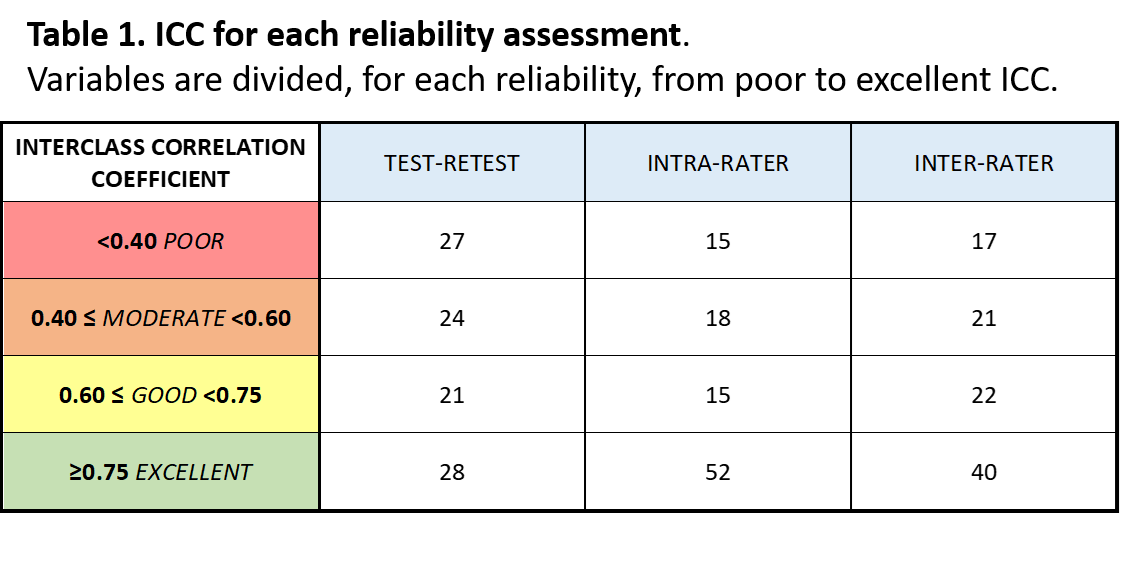
    Table 1 shows the ICC for each reliability assessment. Overall, the ICCs revealed that 11 out of the 100 variables obtained with the iTUG had “poor” reliability, while 27 variables demonstrated “excellent” reliability in all three types of assessments. Of these 27 variables, 6 were highly correlated (r>0.90) and were removed from subsequent analysis. The remaining 21 variables showed a good Kaiser-Meyer-Olkin measure (>0.70) and were distributed across 4 factors, with a cumulative variance of approximately 75%. These factors captured the essential components of the iTUG performance, including measures of acceleration, angular velocity, step duration, gait speed, and other key metrics, providing a comprehensive assessment framework (see table 2).

    Discussion and Conclusion

    The iTUG test is not only a practical and easily applicable assessment tool but also a reliable instrument for evaluating people with femur fractures. However, not all the extracted variables provide useful information; by reducing the number to reliable and non-redundant ones, it is possible to define an interpretative model for the assessment of physical performance in people with femur fractures. This model provides more detailed information on specific domains than just the total time of the TUG test measured with a stopwatch. Further research is needed to customize postural transitions for patients with sternal instability, enhancing their rehabilitation and safety.

    REFERENCES

    [1] Podsiadlo D, Richardson S. J Am Geriatr Soc. 1991;39(2):142-8.

    [2] Nightingale CJ, et al. JAPA 2019;27(2):230-233.

    [3] Herman T, et al. Gerontol. 2011;57(3):203-210.

    [4] NICE: The assessment and prevention of falls in older people. 2013, http://www.nice.org.uk/CG161.

    [5] van Lummel RC, et al. PLoS One. 2016;11(3):e0151881.

    [6] Tan D, et al. MBEC 2019;57:369-377.

    [7] McDowell I. Oxford University Press; 2006.

    [8] Norman GR, et al. House-USA, Ltd; 2014.

  • La Riabilitazione su Base Comunitaria: modelli dalla Salute Globale per la presa in carico sul territorio

    La Riabilitazione su Base Comunitaria: modelli dalla Salute Globale per la presa in carico sul territorio

    La Riabilitazione su Base Comunitaria: modelli dalla Salute Globale per la presa in carico sul territorio

    Autori

    Costanza Rosini, Università degli Studi di Siena

    Introduction

    “La sesta Missione riguarda la Salute, un settore critico, che ha affrontato sfide di portata storica nell’ultimo anno. L’impatto della crisi del Covid-19 sui sistemi sanitari ha dimostrato l’importanza di una garanzia piena, equa e uniforme del diritto alla salute su tutto il territorio nazionale; la pandemia, poi, ha posto il benessere della persona nuovamente al centro dell’agenda politica.
    Le riforme e gli investimenti proposti con il Piano in quest’area hanno due obiettivi principali: potenziare la capacità di prevenzione e cura del sistema sanitario nazionale a beneficio di tutti i cittadini, garantendo un accesso equo e capillare alle cure e promuovere l’utilizzo di tecnologie innovative nella medicina.” 
    Il Piano Nazionale di Ripresa e Resilienza, il programma straordinario di finanziamenti approvato dal governo italiano nel 2022, ha individuato nella riforma della Sanità la sesta delle sue Missioni, pensate per migliorare la condizione della popolazione italiana a seguito di due anni estremamente duri dal punto di vista sanitario ed economico. Come riporta il testo, il biennio 2020-2022 ha visto il nostro Paese a combattere contro l’emergenza sanitaria legata al Covid-19 ed è stato un periodo che ha messo sotto grande pressione il Sistema Sanitario Nazionale, mettendo in luce problematiche che hanno reso difficoltosa l’erogazione omogenea dei servizi. Una larga parte dei fondi destinati alla Missione 6 (un un totale di 25,40 milioni) verranno destinati alla creazione di “reti di prossimità, strutture e telemedicina per l’assistenza sanitaria territoriale”: la necessità di creare delle reti di sostegno all’interno del territorio è stata estremamente chiara durante l’emergenza sanitaria. In un momento in cui l’accentramento delle cure non era infatti possibile, è stato osservato come risultasse difficoltoso mantenere il contatto con tutti coloro i quali cercassero di accedere ai servizi sul territorio: la mancanza di protocolli
    redatti, la dispersione delle risorse, le difficoltà geografiche legate alla disposizione degli abitanti sul territorio sono state solo alcune delle cause che hanno portato il personale sanitario a dover gestire momenti di grande difficoltà.

    L’accesso alle cure è “diritto costituzionale dell’individuo e della collettività” secondo l’articolo 32 della Costituzione ma non sempre è possibile garantire il servizio a tutti seguendo i principi di equità e di inclusione: se l’alta specializzazione all’interno degli ospedali ha permesso di raggiungere altissimi risultati dal punto di vista della cura, sul territorio è facile trovarsi davanti a difficoltà di natura molto pratica ma non per questo meno importanti: la
    distanza tra i luoghi di domicilio e il presidi ospedalieri, ad esempio, che impedisce al paziente di muoversi autonomamente ma che ruba eccessivo tempo all’operatore che cerca di sopperire tramite accessi domiciliari. La dispersione delle risorse rende estremamente difficoltoso creare una rete di professionisti che sia in grado di prendere in carico situazioni complesse, talvolta rende agli utenti inaccessibili percorsi, in quanto non tutti i passaggi burocratici sono chiari e ben comprensibili: in un contesto ampio e ricco di sfumature come una comunità(un comune, una provincia considerando i più piccoli fino alla regione o all’intero Stato) è molto facile che le risorse impiegate non riescano a raggiungere in maniera immediata l’obiettivo di salute del paziente. All’interno di questa revisione della letteratura verrà analizzata la Riabilitazione su Base Comunitaria, un modello di programmazione multidimensionale che approfondisce tra i vari settori anche la gestione sanitaria, e nello specifico della riabilitazione, con il fine di apportare modifiche positive sulla qualità della vita della popolazione dove opera.
    Questo modello è stato analizzato e regolamentato dall’OMS sotto forma di linea guida nel 2010, nasce e si sviluppa per i paesi a basso-medio reddito, dove ha riscontrato buoni risultati dimostrando di ridurre l’esclusione sociale e lo stigma legato alla disabilità.
    L’obiettivo di questa analisi è approfondire i processi produttivi indicati dall’OMS, analizzare gli indicatori della qualità presenti, sottolineare punti di forza e di debolezza che ne possono limitare l’applicazione e infine tracciare una linea di congiunzione tra questo modello e le caratteristiche e le necessità del territorio dei paesi ad alto reddito come l’Italia,in quei casi in cui le caratteristiche geografiche, demografiche e istituzionali possano far pensare a delle analogie dei bisogni per l’assistenza sul territorio.

    Methods

    Questa revisione della letteratura è stata effettuata analizzando le fonti disponibili: Cochrane, Pubmed, Google Scholar e le pagine istituzionali dell’OMS. La raccolta degli articoli ha permesso di accedere a 35 fonti, di cui 9 linee guida, 5 report istituzionali, 7 articoli di natura compilativa, 7 revisioni e 7 studi, divisi tra trial clinici e studi osservazionali. Gli articoli sono stati selezionati a fronte di un numero di partenza di 52 articoli, di cui 17 sono stati scartati per
    scarsa rilevanza scientifica. Gli articoli sono stati analizzati a partire dallo studio delle linee guida OMS in merito alla Riabilitazione e alla Riabilitazione su Base Comunitaria affiancate ai report dei convegni che hanno segnato la storia della promozione della salute.
    In seguito sono stati analizzati tutti gli studi posteriori alla pubblicazione delle linee guida per approfondire alcuni aspetti e rilevare criticità e vantaggi nell’applicazione pratica.

    Results

    Dopo l’analisi approfondita della strutturazione della Riabilitazione su Base Comunitaria, dei suoi destinatari, dei suoi punti di forza e di debolezza e dopo aver contestualizzato i cambiamenti che l’Italia si sta apprestando ad affrontare dopo due anni cruciali per la Sanità, è possibile tirare le fila per regalare un quadro esaustivo.
    La Riabilitazione su Base Comunitaria si pone come un approccio multisettoriale e multidimensionale che ha come fine ultimo il benessere del cittadino e che si articola in cinque macroaree di intervento: Salute, Istruzione, Mezzi di sostentamento, Sociale, Empowerment.
    Questo è possibile, allocando le risorse in maniera tale da intervenire sia sul singolo individuo, sia sull’ambiente in cui vive tramite azioni volte al benessere della comunità. Nei progetti di salute, specificatamente nell’ambito della Riabilitazione, questo è possibile tramite interventi di prevenzione e screening a livello comunitario, tramite la presa in carico del paziente insieme a tutto il suo nucleo familiare, educando e formando chi si occupa di lui a gestire le complicanze, a prevenire le complicanze secondarie e ad aiutarlo ad effettuare scelte consapevoli. Il modello della riabilitazione comunitaria non deve e non vuole andare a sovrapporsi ai modelli di Assistenza Primaria ma serve ad incrementare il lavoro dei presidi già esistenti intervenendo su quelle variabili che possano determinare l’efficacia del trattamento. Il coinvolgimento del professionista sanitario avviene su due livelli: quello manageriale in cui partecipa e mette a disposizione le sue competenze per l’organizzazione e la distribuzione delle cure, e quello professionale in cui si occupa del trattamento riabilitativo del paziente, dell’educazione sanitaria, della gestione ambientale del contesto domiciliare e della scelta degli ausili. Questo modello ha portato risultati pari ai modelli tradizionali dal punto di vista dell’outcome clinico ma soprattutto ha migliorato in maniera sensibile la qualità della salute percepita, contrastando l’esclusione sociale e lo stigma delle PCD.
    Il modello di programmazione sanitaria su Base Comunitaria ha moltissimi punti a suo favore: la gestione e condivisione delle risorse, il coinvolgimento diretto della comunità e delle persone con disabilità, la possibilità di collaborazione tra i vari stakeholder in un’ottica che mira a rafforzare l’assistenza sul territorio e garantire percorsi semplici e accessibili al cittadino, così da poter usufruire dei servizi primari e di avere in caso di bisogno possibilità di accedere ai servizi specialistici in maniera veloce.
    Le criticità di questo modello che ancora frenano la sua applicazione in molti territori in cui risulterebbe vantaggioso (ad esempio i contesti a bassa densità di popolazione) sono legate alla difficoltà di creare dei processi a maglia stretta che siano al tempo stesso validati e individualizzabili a seconda delle caratteristiche della comunità e del paziente. Le linee guida infatti presentano solamente indicazioni molto generiche, e un’esecuzione lasciata all’interpretazione degli operatori non è sempre foriera di successo. Inoltre questa enorme varietà di soluzioni possibili rende difficile individuare gli indicatori di outcome che servono a valutare l’intervento e poterlo modificare prima di implementarlo.
    Negli anni sono stati svolti molti studi per poter ovviare a questi problemi, in quanto comunque il modello comunitario si mostra il più completo per sopperire alle lacune presenti sul territorio, che in Italia si è organizzato tramite l’istituzione di reti di welfare che vadano a colmare eventuali difficoltà nel reperire i servizi pubblici.
    Un modello come la Riabilitazione su Base Comunitaria, se analizzato in chiave critica e rimodellato grazie anche agli strumenti che il settore medico ha a disposizione vent’anni dopo la pubblicazione del Position Paper dell’OMS, ha delle ottime potenzialità per essere ricalcato e utilizzato come modello di programmazione sanitaria dei servizi pubblici e privati, anche in regime di collaborazione, in quanto si pone come punto di vista olistico, garantisce la presa in carico multisettoriale e porta al professionista l’opportunità di collaborare stabilmente in equipe. Il professionista sanitario che si approccia con il modello RBC può inoltre accrescere le sue competenze dal punto di vista della partecipazione ed affiancarle alle competenze
    specifiche ambulatoriali, definirsi come profilo professionale nell’ottica della promozione della salute e della pianificazione.
    In un momento storico in cui la necessità di elaborare e aggiornare le risorse presenti nell’ottica di adattarsi a nuovi bisogni è così evidente, le nuove sfide di presa in carico centrata sul paziente e di comunità inclusiva, sostenibile e consapevole non sono mai state così chiare e stimolanti.

    Discussion and Conclusion

    Dopo l’analisi approfondita della strutturazione della Riabilitazione su Base Comunitaria, dei suoi destinatari, dei suoi punti di forza e di debolezza e dopo aver contestualizzato i cambiamenti che l’Italia si sta apprestando ad affrontare dopo due anni cruciali per la Sanità, è possibile tirare le fila per regalare un quadro esaustivo.
    La Riabilitazione su Base Comunitaria si pone come un approccio multisettoriale e multidimensionale che ha come fine ultimo il benessere del cittadino e che si articola in cinque macroaree di intervento: Salute, Istruzione, Mezzi di sostentamento, Sociale, Empowerment. Questo è possibile, allocando le risorse in maniera tale da intervenire sia sul singolo individuo, sia sull’ambiente in cui vive tramite azioni volte al benessere della comunità. Nei progetti di
    salute, specificatamente nell’ambito della Riabilitazione, questo è possibile tramite interventi di prevenzione e screening a livello comunitario, tramite la presa in carico del paziente insieme a tutto il suo nucleo familiare, educando e formando chi si occupa di lui a gestire le complicanze, a prevenire le complicanze secondarie e ad aiutarlo ad effettuare scelte consapevoli. Il modello della riabilitazione comunitaria non deve e non vuole andare a sovrapporsi ai modelli di Assistenza Primaria ma serve ad incrementare il lavoro dei presidi già esistenti intervenendo su quelle variabili che possano determinare l’efficacia del trattamento. Il coinvolgimento del professionista sanitario avviene su due livelli: quello manageriale in cui partecipa e mette a disposizione le sue competenze per l’organizzazione e la distribuzione delle cure, e quello professionale in cui si occupa del trattamento riabilitativo
    del paziente, dell’educazione sanitaria, della gestione ambientale del contesto domiciliare e della scelta degli ausili. Questo modello ha portato risultati pari ai modelli tradizionali dal punto di vista dell’outcome clinico ma soprattutto ha migliorato in maniera sensibile la qualità della salute percepita,
    contrastando l’esclusione sociale e lo stigma delle PCD.
    Il modello di programmazione sanitaria su Base Comunitaria ha moltissimi punti a suo favore: la gestione e condivisione delle risorse, il coinvolgimento diretto della comunità e delle persone con disabilità, la possibilità di collaborazione tra i vari stakeholder in un’ottica che mira a rafforzare l’assistenza sul territorio e garantire percorsi semplici e accessibili al cittadino, così da poter usufruire dei servizi primari e di avere in caso di bisogno possibilità di accedere ai servizi specialistici in maniera veloce.
    Le criticità di questo modello che ancora frenano la sua applicazione in molti territori in cui risulterebbe vantaggioso (ad esempio i contesti a bassa densità di popolazione) sono legate alla difficoltà di creare dei processi a maglia stretta che siano al tempo stesso validati e individualizzabili a seconda delle caratteristiche della comunità e del paziente. Le linee guida infatti presentano solamente indicazioni molto generiche, e un’esecuzione lasciata
    all’interpretazione degli operatori non è sempre foriera di successo. Inoltre questa enorme varietà di soluzioni possibili rende difficile individuare gli indicatori di outcome che servono a valutare l’intervento e poterlo modificare prima di implementarlo.
    Negli anni sono stati svolti molti studi per poter ovviare a questi problemi, in quanto comunque il modello comunitario si mostra il più completo per sopperire alle lacune presenti sul territorio, che in Italia si è organizzato tramite l’istituzione di reti di welfare che vadano a colmare eventuali difficoltà nel reperire i servizi pubblici.
    Un modello come la Riabilitazione su Base Comunitaria, se analizzato in chiave critica e rimodellato grazie anche agli strumenti che il settore medico ha a disposizione vent’anni dopo la pubblicazione del Position Paper dell’OMS, ha delle ottime potenzialità per essere ricalcato e utilizzato come modello di programmazione sanitaria dei servizi pubblici e privati, anche in regime di collaborazione, in quanto si pone come punto di vista olistico, garantisce la presa in carico multisettoriale e porta al professionista l’opportunità di collaborare stabilmente in equipe. Il professionista sanitario che si approccia con il modello RBC può inoltre accrescere le sue competenze dal punto di vista della partecipazione ed affiancarle alle competenze specifiche ambulatoriali, definirsi come profilo professionale nell’ottica della promozione della salute e della pianificazione. In un momento storico in cui la necessità di elaborare e aggiornare le risorse presenti nell’ottica di adattarsi a nuovi bisogni è così evidente, le nuove sfide di presa in carico centrata sul paziente e di comunità inclusiva, sostenibile e consapevole non sono mai state così chiare e stimolanti.

    REFERENCES

    1. PNRR: salute [ Internet ]. www.governo.it. 2021. Disponibile su: https://www.governo.it/it/approfondimento/pnrr-salute/16707
    2. La Costituzione – Articolo 32 | Senato della Repubblica [ Internet ]. Disponibile su: https://www.senato.it/istituzione/la-costituzione/parte-i/titolo-ii/articolo-32
    3. Scelfo P, Sapuppo C. Storia e campi di applicazione della Classificazione Internazionale del Funzionamento della Disabilità e della Salute. Pratica Medica & Aspetti Legali. 15 marzo 2012;6(1):21–9.
    4. World Health Organization, Unesco, International Labour Office. CBR: a strategy for rehabilitation, equalization of opportunities, poverty reduction and social inclusion of people with disabilities. Switzerland: World Health Organization; 2004.
    5. Salute M della. La convenzione delle Nazioni Unite sui diritti delle persone con disabilità [ Internet ]. Disponibile su: https://www.salute.gov.it/portale/documentazione/p6_2_2_1.jsp?lingua=italiano&id=1 361
    6. Indagine conoscitiva sulla condizione delle persone con disabilità [ Internet ]. 2021. Disponibile su: https://www.istat.it/it/archivio/255699
    7. Rehabilitation 2030 meeting report [ Internet ]. Disponibile su: https://www.who.int/publications/m/item/WHO-NMH-NVI-19.10
    8. Ata A. Dichiarazione Universale di Alma Ata sull’Assistenza Sanitaria Primaria. :3.
    9. World Health Organization. Rehabilitation Unit. Community-based rehabilitation and health care referral services : a guide for programme managers [ Internet ]. World Health Organization; 1994. Report No.: WHO/RHB/94.1. Unpublished. Disponibile su: https://apps.who.int/iris/handle/10665/60710
    10. Guidelines for conducting, monitoring and self-assessment of community based rehabilitation programmes: using evaluation information to improve programmes [ Internet ]. Source. 2014. Disponibile su: https://asksource.info/resources/guidelinesconducting- monitoring-and-self-assessment-community-based-rehabilitation
    11. UNESCO, ILO, Organization W. CBR: A Strategy for Rehabilitation, Equalization of Opportunities, Poverty Reduction and Social Inclusion of People with Disabilities. Joint Position Paper. http://lst-iiep.iiep-unesco.org/cgibin/wwwi32.exe/[in=epidoc1.in]/?t2000=020572/(100). 1 gennaio 2004;
    12. Linee guida RBC – anno 2010 [ Internet ]. Disponibile su: https://ovci.it/index.php/it/cosa-facciamo/italia/educazione-alla-globalita/101-seztec/888-linee-guida-rbc-anno-2010
    13. UN Enable – Text of the Convention on the Rights of Persons with Disabilities [ Internet ]. Disponibile su:https://www.un.org/esa/socdev/enable/rights/convtexte.htm
    14. Sostenibilità nell’Enciclopedia Treccani [ Internet ]. Disponibile su: https://www.treccani.it/enciclopedia/sostenibilita
    15. ASIA PACIFIC DISABILITY REHABILITATION JOURNAL [ Internet ]. Disponibile su:
    https://www.dinf.ne.jp/doc/english/asia/resource/apdrj/v182007/developmental_articles 02.html
    16. Doig E, Fleming J, Kuipers P, Cornwell PL. Comparison of rehabilitation outcomes in day hospital and home settings for people with acquired brain injury – a systematic review. Disabil Rehabil. 2010;32(25):2061–77.
    17. Trani J, Escallon J, Bakshi P, The impact of a community based rehabilitation program in Afghanistan: a longitudinal analysis using propensity score matching and difference in difference analysis – PubMed [ Internet ]. Disponibile su: https://pubmed.ncbi.nlm.nih.gov/34419118/
    18. Chung EYH, Packer T, Yau M. When East meets Wests: community-based rehabilitation in Chinese communities. Disability and Rehabilitation. 1 gennaio 2011;33(8):697–705.
    19. Kendall E, Buys N, Larner J. Community-based Service Delivery in Rehabilitation: The Promise and the Paradox. Disability and Rehabilitation. gennaio 2000;22(10):435– 45.
    20. empowerment – Dizionario inglese-italiano WordReference [ Internet ]. Disponibile su: https://www.wordreference.com/enit/empowerment
    21. Seijas VA, Lugo LH, Cano B, Escobar LM, Quintero C, Nugraha B, et al. Understanding community-based rehabilitation and the role of physical and
    rehabilitation medicine. Eur J Phys Rehabil Med [ Internet ]. febbraio 201854(1). Disponibile su: https://www.minervamedica.it/index2.php?show=R33Y2018N01A0090

    22. Community Rehabilitation: Live Well for Longer | The Chartered Society of Physiotherapy [ Internet ]. Disponibile su: https://www.csp.org.uk/publications/community-rehabilitation-live-well-longer
    23. Barnes M, Radermacher H. Neurological rehabilitation in the community. Journal of rehabilitation medicine : official journal of the UEMS European Board of Physical and Rehabilitation Medicine. 1 dicembre 2001;33:244–8.
    24. Systematic overview of economic evaluations of health-related rehabilitation -ScienceDirect [ Internet ]. [citato 15 aprile 2022]. Disponibile su:
    https://www.sciencedirect.com/science/article/pii/S1936657415001508?via%3Dihub
    25. NUGRAHA B, RUSLINA DEFI I, PRIMA YOLANDA R, WARLIANI M, BIBENV, JENNIE J, et al. DESCRIBING COMMUNITY-BASED REHABILITATION SERVICES IN INDONESIA BY USING THE INTERNATIONAL CLASSIFICATION OF SERVICE ORGANIZATION IN REHABILITATION 2.0. J Rehabil Med. 24 febbraio 2021;53(3):2763
    26. Post E, Cornielje H, Andrae K, Maarse A, Wickenden M. Participatory inclusion evaluation: a flexible approach to building the evidence base on the impact of community-based rehabilitation and inclusive development programmes. Knowledge Management for Development Journal. :20.
    27. Goryakin Y, Aldea A, Lerouge A. Promoting sport and physical activity in Italy: a cost-effectiveness analysis of seven innovative public health policies. annali di igiene medicina preventiva e di comunità. 8 novembre 2019;(6):614–25.
    28. Grandisson M, Hébert M, Thibeault R. A systematic review on how to conduct evaluations in community-based rehabilitation. Disability and Rehabilitation. febbraio 2014;36(4):265–75.
    29. Kim MT, Kim KB, Ko J, Murry N, Xie B, Radhakrishnan K, et al. Health Literacy and Outcomes of a Community-Based Self-Help Intervention. Nurs Res. 2020;69(3):210–8.
    30. Huys N, Van Stappen V, Shadid S, De Craemer M, Androutsos O, Wikström K, et al. Effectiveness of a family-, school- and community-based intervention on physical activity and its correlates in Belgian families with an increased risk for type 2 diabetes mellitus: the Feel4Diabetes-study. BMC Public Health. 12 agosto 2020;20(1):1231.
    31. Maeshima S, Osawa A. Community-Based Rehabilitation After Brain Infarction in Japan: From the Acute Phase to Home. In: Pluta R, curatore. Cerebral Ischemia [ Internet ]. Brisbane (AU): Exon Publications; 2021.Disponibile su: http://www.ncbi.nlm.nih.gov/books/NBK575733/
    32. Can Digitization of Health Care Help Low-Resourced Countries Provide Better Community-Based Rehabilitation Services? | Physical Therapy | Oxford Academic [ Internet ]. [citato 13 aprile 2022]. Disponibile su: https://academic.oup.com/ptj/articleabstract/ 100/2/217/5610821
    33. Spasova S, Baeten R, Vanhercke B. CHALLENGES IN LONG-TERM CARE IN EUROPE. 2018;6.
    34. Welfare comunitario: dinamiche ed esperienze su cui riflettere • Secondo Welfare [ Internet ]. Secondo Welfare. 2019 [citato 5 maggio 2022]. Disponibile su: https://www.secondowelfare.it/editoriale/welfare-comunitario-dinamiche-edesperienze-su-cui-riflettere/
    35. PNRR: una prima analisi dell’impatto sul welfare sociale e sociosanitario [ Internet ]. welforum.it. [citato 5 maggio 2022]. Disponibile su: https://welforum.it/il-punto/versoun- welfare-piu-forte-ma-davvero-coeso-e-comunitario/pnrr-una-prima-analisidellimpatto- sul-welfare-sociale-e-sociosanitario/