Categoria: Congresso 2024

  • Prevalenza delle disfunzioni del pavimento pelvico nelle atlete che praticano discipline aeree: una survey on-line

    Prevalenza delle disfunzioni del pavimento pelvico nelle atlete che praticano discipline aeree: una survey on-line

    Prevalence of the pelvic floor dysfunctions in aerial athletes: a on-line survey

    Autori

    URBINATI GIULIA, (UNIVERSITA DEGLI STUDI DI TOR VERGA ROMA, ITALY)

    PELLICCIARI LEONARDO, (IRCCS Istituto delle Scienze Neurologiche di Bologna, Bologna, Italy)

    BASSINI ELIA, (UNIVERSITA DEGLI STUDI DI ROMA TOR VERGATA ROMA, ITALY)

    VICECONTI ANTONELLO, (PRIVATE PRACTICE, SAVONA)

    Introduction

    This study is the first to investigate the prevalence of pelvic floor dysfunctions in female athletes who practice aerial disciplines. Aerial disciplines, originating from the circus, encompass a range of acrobatic elements such as aerial fabric, hoop, trapeze, net, and pole. While traditionally limited to acrobats and circus performers, there has been a surge in interest from individuals engaging in these athletic pursuits, leading to their widespread popularity. Pole and aerial dance, renowned within aerial disciplines, are distinguished by their airborne practice and demand rigorous training emphasizing physical strength, agility, and joint flexibility. Despite extensive research on pelvic floor dysfunction in high-impact sports such as volleyball, basketball,gymnastic and CrossFit, there remains a gap in the literature pertaining to female athletes participating in aerial disciplines. Therefore, this study aims to provide estimates of the prevalence of pelvic floor dysfunctions in pole dance and aerial fabric. Strength training has been found to be a risk factor for stress urinary incontinence in studies evaluating women in CrossFit (73%)1, powerlifting (43.9%)2, and weightlifting (41.7%)3.

    Considering that aerial disciplines are strength sports, we expect to find prevalence similar to that of studies on other sports investigated.

    Methods

    A web-based questionnaire incorporating three sections from the International Consultation on Incontinence Questionnaire (ICIQ) (i.e., ICIQ-UI-SF for urinary incontinence, ICIQ-OAB for urgency/frequency syndrome, and ICIQ-FLUTSsex for sexual symptoms) was administered to adult female subjects affiliated to sports clubs, pole dance establishments, and aerial dance federations nationwide. The prevalence was calculated, and descriptive statistics was used to present the data.

    Results

    Four hundred and ninety-nine females were included in this study. One hundred and sixty-eight (34.1%) participants frequented aerial fabric, 270 (54.9%) practiced pole dancing, and 54 (11.3%) performed both disciplines. Regarding the total sample, 106 (21.5%) of the participants reported urine leakage at least once a week; of these, most (96.2%) were small in quantity. For the sample practicing aerial fabric, 27 out of 168 subjects (16.1%) reported a small amount of urine loss at least once a week. Finally, regarding the sample that practiced pole dancing, 68 subjects out of 270 (25.2%) reported urine loss at least once a week.

    Discussion and Conclusion

    Approximately one-fifth of participants who practiced pole dancing and/or aerial fabric reported leakage of urine at least once a week, even if was of minor entity. Considering the two different samples, the prevalence was higher in pole dance practitioners than in aerial fabric practitioners, probably our hypothesis is that in pole dance the impact on the ground and the resulting ground reaction forces are more frequent than in aerial dance.
    Although there is no data in the literature relating to pelvic floor dysfunctions in these disciplines, the study showed a significant prevalence of iu, greater in pole dance athletes. our hypothesis is that in pole dance there is greater contact with the ground and greater load forces from the ground. the present observational study deserves further investigation through incidence studies and possible clinical studies to verify whether any changes in training methods, as well as evaluation and education by pelvic floor professionals, can improve the condition of athletes suffering from incontinence urinary and promote prevention

    REFERENCES

    1. Elks W, Jaramillo-Huff A, Barnes KL, Petersen TR, Komesu YM. The Stress Urinary Incontinence in CrossFit (SUCCeSS) study. Female Pelvic Med Reconstr Surg 26: 101–106, 2020.

    2. Wikander L, Kirshbaum MN, Waheed N, Gahreman DE. Urinary incontinence in competitive women powerlifters: A cross-sectional survey. Sports Med Open 7: 89–11, 2021.

    3. Skaug KL, Engh ME, Frawley H, Bø K. Prevalence of pelvic floor dysfunction, bother and risk factors and knowledge of the pelvic floor muscles in Norwegian male and female powerlifters and Olympic weightlifters. J Strength Cond Res 36: 2800–2807, 2022
  • Alterazioni nella gait initiation dopo frattura di arto inferiore: la fisioterapia può prevenire l’apprendimento al non uso?

    Alterazioni nella gait initiation dopo frattura di arto inferiore: la fisioterapia può prevenire l’apprendimento al non uso?

    Alterazioni nella gait initiation dopo frattura di arto inferiore: la fisioterapia può prevenire l’apprendimento al non uso?

    Changes in gait initiation after lower limb immobilization: can physiotherapy prevent “learning non-use”?

    Autori

    Sgubin Giulia (Department of Life Science, University of Trieste, Trieste, Italy; ASUGI, Trieste, Italy; Department of Medicine, Surgery and Health Sciences, University of Trieste, Trieste, Italy)

    Trobec Belinda (Department of Medicine, Surgery and Health Sciences, University of Trieste, Trieste, Italy; ASUGI, Trieste, Italy)

    Canton Gianluca (Department of Medicine, Surgery and Health Sciences, University of Trieste, Trieste, Italy; ASUGI, Trieste, Italy)

    Zelesnich Francesca (Department of Medicine, Surgery and Health Sciences, University of Trieste, Trieste, Italy; ASUGI, Trieste, Italy)

    Sabot Raffaele (Department of Medicine, Surgery and Health Sciences, University of Trieste, Trieste, Italy; ASUFC, Udine, Italy)

    Deodato Manuela (Department of Medicine, Surgery and Health Sciences, University of Trieste, Trieste, Italy; ASUGI, Trieste, Italy)

    Murena Luigi (Department of Medicine, Surgery and Health Sciences, University of Trieste, Trieste, Italy; ASUGI, Trieste, Italy)

    Introduction

    The effects of inactivity and lack of load following a lower limb fracture on motor behavior are well known [1]. Walking and transitional movements such as gait initiation are bipedal activities in which load is progressively transferred between the two lower limbs within a variable base of support depending on the action [2].

    The lack of load after a fracture or lower limb surgery results in impaired load management, leading to reduced smoothness in body progression during walking.

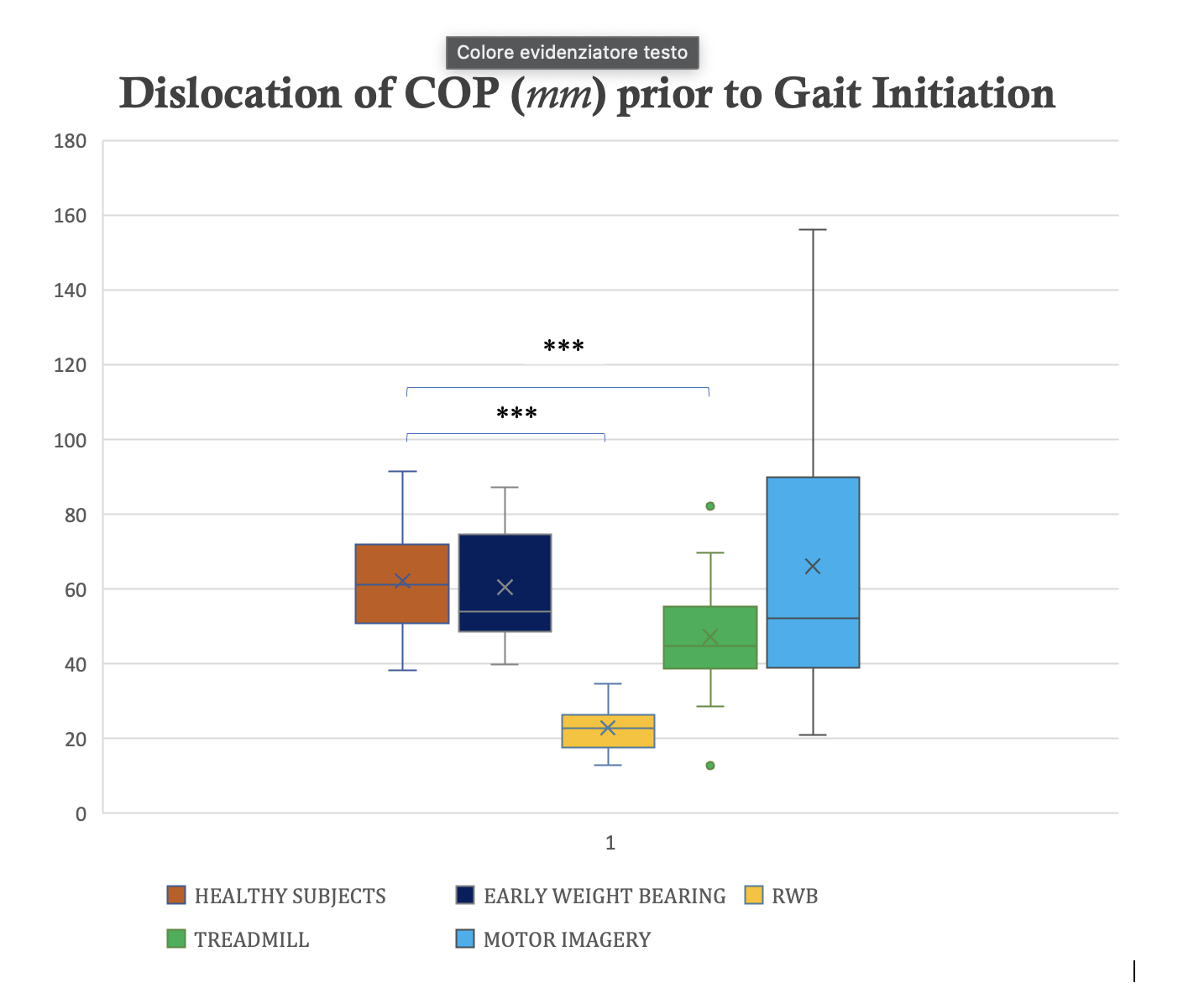
    This study analyzed the center of pressure (COP) lateral displacement prior to self-generated gait initiation.

    Methods

    Four groups of individuals with lower limb fractures were compared to a group of healthy.

    RWB group comprised patients who, according to healthcare system, did not access physiotherapy until weight-bearing was permitted.

    EWB group included patients who were operated on and immediately ready for weight-bearing on the operated limb.

    MOTOR IMAGERY group consisted of non-weight-bearing patients who were offered motor imagery exercises in combination with early rehabilitation.

    TREADMILL group included non-weight-bearing patients who received early rehabilitation and antigravity treadmill simulating walking without gravity.

    Subjects underwent clinical and functional evalutation and gait analysis at 3 months post-fracture; all subjects fully bear weight on both lower limbs.

    Data related to the COP lateral displacement preceding the heel-off were recorded in motion analysis laboratory using an optoelectronic system. Subjects were instructed to initiate walking with the limb that had the fracture.

    Results

    The analysis of the collected data identified a significant reduction in COP displacement during medio-lateral phase of anticipatory postural adjustments (APAs) after the period of inactivity in RWB and TREADMILL groups compared to the group of healthy subjects and the group of patients with early weight-bearing (P<.00001).

    EWB and MOTOR IMAGERY groups demonstrated a behavior similar to that of healthy subjects as early as 3 months post-operation (P=.92828 and P=.71138).

    Discussion and Conclusion

    The study highlighted the impaired load management in the groups of patients with lower limb fracture after cast immobilization during the task of gait initiation. Considering that the anticipatory postural adjustment (APA) occurred on the contralateral lower limb, these data support the line of studies [3] suggesting that motor behavior alterations, even in the presence of a fracture or “peripheral damage”, affect central movement control mechanisms.

    Furthermore, the study has allowed for the identification and quantification of movement strategies that are not otherwise measurable but are only observable in a clinical setting and persist in these patients despite the progressive recovery of weight-bearing.

    REFERENCES

    [1] Moisello C, et al. J Mot Behav. 2008;(40):165–176.

    [2] Winter DA. Gait Posture. 1995;(3):193–214.

    [3] Ebrahimabadi Z et al. Journal of Bodywork and Movement Therapies 2018;22(1):40–5.

  • Quali tipologie di esercizio di controllo motorio sono maggiormente utilizzate per modificare il dolore nel breve termine nei pazienti con pelvic girdle pain: una revisione narrativa

    Quali tipologie di esercizio di controllo motorio sono maggiormente utilizzate per modificare il dolore nel breve termine nei pazienti con pelvic girdle pain: una revisione narrativa

    Types of Motor Control Exercises Most Effective for Short-Term Pain Relief in Patients with Pelvic Girdle Pain: A Narrative Review

    Autori

    Alessandro Mantia, University of Rome La Sapienza Department of Human Neuroscience, Rome,Italy

    Mirko Zitti, University of Rome La Sapienza Department of Human Neuroscience, Rome,Italy

    Lorenzo Storari, University of Rome La Sapienza Department of Human Neuroscience, Rome,Italy

    Fabiola Garzonio, University of Rome La Sapienza Department of Human Neuroscience, Rome,Italy

    Graziano Raffaele, University of Rome La Sapienza Department of Human Neuroscience, Rome,Italy

    Fabio Fiorentino, University of Rome La Sapienza Department of Human Neuroscience, Rome,Italy

    Rebecca Andreutto, University of Rome La Sapienza Department of Human Neuroscience, Rome,Italy

    Filippo Maselli, University of Rome La Sapienza Department of Human Neuroscience, Rome,Italy

    Introduction

    Pelvic girdle pain (PGP) is described in the literature as a subset of low back pain (LBP) characterized by pain perceived between the posterior iliac crest and the gluteal fold, particularly near the sacroiliac joints. This condition can present in a nonspecific form: during pregnancy or postpartum (pregnancy-related PGP), which is also the most prevalent form; as a result of mechanical alterations due to trauma or microtrauma (non-pregnancy-related PGP); or in a specific form following fractures, infections, or arthritis. There are different intervention modalities available in the literature and for years, researchers have been investigating and studying the best approach for managing this condition and the associated biopsychosocial impairments.The aim of this study focused on the effectiveness of motor control (MC) exercises in reducing pain in the short term, and whether these really have the characteristics to stimulate MC.

    Methods

    The narrative review was carried out by searching various medical-rehabilitation databases (Pubmed, Cochrane, PEDro database, Scopus, EMBASE, Web Of Science) and was done following the methodology described by Gasparyan et al. The research was carried out taking into consideration different study designs (i.e. systematic reviews and RCTs) published between 2013 and 2023 only in english language. The research included all studies that considered patients with PGP or sacroiliac dysfunctions and involved interventions consisting of MC exercises or lumbopelvic stabilization exercises. Excluded from the review were articles that lacked an experimental or control group or did not exclusively involve motor control exercise interventions, pediactric population and papers not in english language.

    Results

    A total of 3151 studies were identified, from these five studies were included (including 4 RCTs and 1 systematic review).The primary outcome investigated was pain reduction. It was observed that these exercises were ineffective in reducing pain in the short term when implemented alone. The qualitative analysis underscored that the exercises utilized to date lack specificity and structure, not following the dictates proposed by the various motor control theories

    Discussion and Conclusion

    From the analysis conducted, it has been highlighted that the exercises currently utilized are generally lacking in specificity and structure, not adhering to the principles proposed by various motor control theories. Based on the available data and the structure of these exercises, it is therefore not possible to definitively state whether MC exercises are more or less effective in reducing short-term pain in patients with both pregnancy-related and non-pregnancy-related PGP.Future studies are warranted to enhance understanding, within the rehabilitation field ,regarding the structuring of MC exercises. This will enable better programming and evaluation of the effects of a alone motor control exercise approach in managing PGP and its short-term pain reduction.

    REFERENCES

    Stuge B. Evidence of stabilizing exercises for low back- and pelvic girdle pain – a critical review. Brazilian J Phys Ther [Internet]. 2019;23(2):181–6. Available from: https://doi.org/10.1016/j.bjpt.2018.11.006

    Weis CA, Pohlman K, Draper C, Stuber K, Hawk C. Chiropractic Care for Adults With Pregnancy-Related Low Back , Pelvic Girdle Pain , or Combination Pain : A Systematic Review. :15–8.

    Pousette S, Gutke A, Betten C, Ar KD. Treatments for pregnancy-related lumbopelvic pain : a systematic review of physiotherapy modalities. 2015;94:1156–67.

    Kennedy DJ, Engel A, Kreiner DS, Nampiaparampil D. Review Article Fluoroscopically Guided Diagnostic and Therapeutic Intra-Articular Sacroiliac Joint Injections : A Systematic Review. 2015;1500–18.

    O’Sullivan PB, Beales DJ. Diagnosis and classification of pelvic girdle pain disorders-Part 1: A mechanism based approach within a biopsychosocial framework. Man Ther. 2007;12(2):86–97.

    Mapinduzi J, Ndacayisaba G, Mahaudens P, Hidalgo B. Effectiveness of motor control exercises versus other musculoskeletal therapies in patients with pelvic girdle pain of sacroiliac joint origin: A systematic review with meta-analysis of randomized controlled trials. J Back Musculoskelet Rehabil. 2022;35(4):713–28.

    Motor Control Translating Research Into Clinical Practice 5th 2017.

    Yuri A, Lilit G, Blackmore H, Kitas GD. Writing a narrative biomedical review : considerations for authors , peer reviewers , and editors. 2011;1409–17.

  • Efficacia della realtà virtuale sulla riduzione del dolore nei differenti distretti anatomici in ambito muscoloscheletrico: Una revisione sistematica della letteratura con metanalisi

    Efficacia della realtà virtuale sulla riduzione del dolore nei differenti distretti anatomici in ambito muscoloscheletrico: Una revisione sistematica della letteratura con metanalisi

    Efficacia della realtà virtuale sulla riduzione del dolore nei differenti distretti anatomici in ambito muscoloscheletrico: Una revisione sistematica della letteratura con metanalisi

    Effectiveness of virtual reality on pain in different anatomical regions in the musculoskeletal field: a systematic review with metanalysis.

    Autori

    Mirko Zitti, University of Rome La Sapienza Department of Human Neuroscience, Rome,Italy

    Martina Regazzetti, IRCCS San Camillo Hospital, Lido of Venice,Italy

    Giorgia Pregnolato, IRCCS San Camillo Hospital, Lido of Venice,Italy

    Sara Federico, IRCSS San Camillo Hospital, Lido of Venice,Italy

    Luisa Cacciante, IRCSS San Camillo Hospital, Lido of Venice,Italy

    Blazej Cieslik, IRCSS San Camillo Hospital, Lido of Venice,Italy

    Andrea Ricci, Alma Mater Europea, Maribor, Slovenia

    Filippo Maselli, University of Rome La Sapienza Department of Human Neuroscience, Rome,Italy

    Lorenzo Storari, University of Rome La Sapienza Department of Human Neuroscience, Rome,Italy

    Pawel Kiper, IRCSS San Camillo Hospital, Lido of Venice,Italy

    Introduction

    Musculoskeletal pain is one of the primary symptoms that prompt patients to seek physiotherapy consultations. The use of virtual reality in physiotherapy is rapidly expanding across various areas. While it is already well-studied in the neurological field, there is a notable lack of research in the musculoskeletal domain. This review aims to investigate the effectiveness of virtual reality in pain relief in different anatomical regions.

    Methods

    The research, conducted on MEDLINE (via PubMed), Cochrane Library, Scopus, Web of Science and Embase, included randomized controlled trials that evaluate the effectiveness of virtual reality interventions, whether immersive, specialized non-immersive and through gaming platforms. The treatment was compared to conventional rehabilitation. Primary outcomes focused on pain, with secondary outcomes assessing quality of life. Search was carried out up to October 31, 2023. All patients 18+ with  musculoskeletal disorders in various anatomical regions, both treated conservatively and post-surgery, were included. However, central and peripheral neurological disorders, as well as rheumatic diseases, were excluded. All those treatments included under telerehabilitation, teleconsultation methods, robotic interventions and exoskeletons were excluded. The selection of studies was performed by four independent reviewers. Two of them have experience in musculoskeletal physiotherapy, and the other two have experience in virtual reality . Pairs were formed consisting of a reviewer expert in virtual reality and one in musculoskeletal physiotherapy. The meta-analysis was performed using RevMan 5.4 and a subgroup analysis was also done between immersive virtual reality, specialized non-immersive virtual reality and exergaming. The quality of the evidence was assessed with the Cochrane risk of bias tool(RoB2).This study is registered on PROSPERO, number CRD42023466977.

    Results

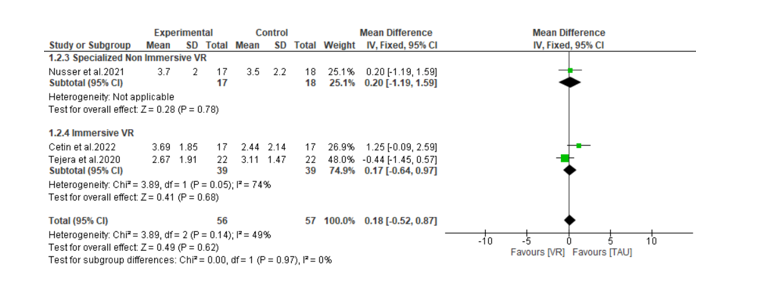
    Out of 1265, twenty-seven articles met the eligibility criteria, with 1191 participants overall. Twenty articles contributed to the meta-analyses. Significant results were found regarding pain relief in knee district (SMD=-0.33; CI -0.55; -0.10; I21 13%, P < 0.004), especially for the subgroup specialized non-immersive virtual reality (SMD=-0.32; CI -0.62; -0.03; P <0,003; I2 = 10%,). For the other districts, the heterogeneity found was too high to draw strong recommendations.


    Discussion and Conclusion

    Virtual reality demonstrates potential in treating pain associated with musculoskeletal disorders; however, interventions must be tailored to individual patients and their specific conditions. Given the moderate to low methodological quality of the studies included, along with the heterogeneity in VR modalities, dosages, and exercise programs, further research is required to determine its true efficacy in alleviating pain across various musculoskeletal disorders. Larger, more comprehensive studies, designed to address specific conditions and employing distinct virtual reality interventions, are necessary to provide deeper insights into the effectiveness of virtual reality in pain management within the musculoskeletal domain.

    REFERENCES

    Chaplin E, Karatzios C, Benaim C. Clinical Applications of Virtual Reality in Musculoskeletal Rehabilitation: A Scoping Review. Healthcare [Internet]. 2023 Dec 15 [cited 2024 Apr 26];11(24):3178. Available from: https://www.mdpi.com/2227-9032/11/24/3178

    Rutkowski S, Kiper P, Cacciante L, Cieślik B, Mazurek J, Turolla A, et al. Use of virtual reality-based training in different fields of rehabilitation: A systematic review and meta-analysis. J Rehabil Med [Internet]. 2020 [cited 2024 Apr 26];52(11):jrm00121. Available from: https://medicaljournalssweden.se/jrm/article/view/3752

    Gumaa M, Rehan Youssef A. Is Virtual Reality Effective in Orthopedic Rehabilitation? A Systematic Review and Meta-Analysis. Physical Therapy [Internet]. 2019 Oct 28 [cited 2024 Apr 26];99(10):1304–25. Available from: https://academic.oup.com/ptj/article/99/10/1304/5537309

    Brady N, McVeigh J, McCreesh K, Rio E, Dekkers T, Lewis J. Exploring the effectiveness of immersive Virtual Reality interventions in the management of musculoskeletal pain: a state-of-the-art review. Vol. 26. 2021.

    Collado-Mateo D, Merellano-Navarro E, Olivares P, Garcia-Rubio J, Gusi N. Effect of exergames on musculoskeletal pain: A systematic review and meta-analysis. Vol. 28. 2018.

    Padilla-Castañeda MA, Sotgiu E, Barsotti M, Frisoli A, Orsini P, Martiradonna A, et al. An Orthopaedic Robotic-Assisted Rehabilitation Method of the Forearm in Virtual Reality Physiotherapy. Journal of Healthcare Engineering [Internet]. 2018 Aug 1 [cited 2024 Apr 26];2018:1–20. Available from: https://www.hindawi.com/journals/jhe/2018/7438609/

    Nagpal AS, Raghunandan A, Tata F, Kibler D, McGeary D. Virtual Reality in the Management of Chronic Low Back Pain: A Scoping Review. Front Pain Res [Internet]. 2022 Mar 7 [cited 2024 Apr 26];3:856935. Available from: https://www.frontiersin.org/articles/10.3389/fpain.2022.856935/full


  • Analisi costo-efficacia di un programma di teleriabilitazione rispetto alla fisioterapia convenzionale nella Sclerosi Multipla Progressiva

    Analisi costo-efficacia di un programma di teleriabilitazione rispetto alla fisioterapia convenzionale nella Sclerosi Multipla Progressiva

    A cost-effectiveness analysis of a home-based telerehabilitation program compared with conventional physiotherapy in Progressive Multiple Sclerosis

    Autori

    Da Ros Alessandra [Dipartimento di Management – Università degli Studi di Verona, Verona, Italia]

    Landi Stefano [Dipartimento di Management – Università degli Studi di Verona, Verona, Italia]

    Leardini Chiara [Dipartimento di Management – Università degli Studi di Verona, Verona, Italia]

    Maistri Gianluca [Dipartimento di Management – Università degli Studi di Verona, Verona, Italia]

    Francesca Salaorni [Dipartimento di Neuroscienze, Biomedicina e Movimento – Università degli studi di Verona, Verona, Italia]

    Giovanni Morone [Dipartimento di Medicina clinica, sanità pubblica, scienze della vita e dell’ambiente – Università degli Studi dell’Aquila, L’Aquila, Italia]

    Sofia Straudi [Dipartimento di Neuroscienze e Riabilitazione – Università degli Studi di Ferrara, Ferrara, Italia]

    Gabriele Perachiotti [Dipartimento di Neuroscienze e Riabilitazione – Università degli Studi di Ferrara, Ferrara, Italia]

    Crestani Mauro [Università degli Studi di Verona, Verona, Italia]

    Gandolfi Marialuisa [Università degli Studi di Verona, Verona, Italia]

    Introduction

    Physiotherapy is essential to Multiple Sclerosis (MS) management and can be costly, especially if it involves frequent visits to a healthcare facility or the patient’s home. A recent study showed an increase in costs with a good increase in QoL, leading to a cost-effective Incremental Cost-Effectiveness Ratio (ICER) of around 14,000 €/QALYs of a home-based standing frame program1. Digital Telerehabilitation (DT) has the potential to improve patient outcomes while reducing costs by eliminating the need for frequent visits to a healthcare facility, reducing travel costs, and allowing patients to receive care from the comfort of their own homes.

    Moreover, many people with MS might prefer DT combined with traditional rehabilitation programs due to its convenience and flexibility. DT allows patients to receive care at a time and place that suits them best, increasing their engagement with physiotherapy programs and improving adherence.

    An economic assessment will establish the resources required to provide the new program, estimate intervention costs, and estimate cost-effectiveness. The economic evaluation will be carried out within the health technology assessment (HTA) framework, considering the perspective of the Italian National Healthcare System (NHS) and society as a whole.

    This study aims to contribute to developing evidence-based physiotherapy programs for people with progressive MS that look at managerial aspects.

    Methods

    An economic evaluation of the introduction of a telemedicine program will be carried out within the HTA framework, considering the perspective of the healthcare system and society as a whole. It is “the comparative analysis of alternative courses of action in terms of both their costs and consequences”2 to provide robust information for informed choices and allocate resources for the greatest possible utility for the health systems and society.

    The project proposes a single-blind RCT with two parallel arms to compare the effects between the experimental group (EG) and the control group (CG). Consecutive patients with primary (PPMS) and secondary progressive (SPMS) MS diagnoses referred to the participating units will be assessed for eligibility.

    The volumes of health services will be collected at baseline encompassing the resources use 6 months prior to the start of the study and a T3 estimating the resource use during the entire trial duration3.

    The DT program’s economic impact will be assessed by measuring different types of costs (i.e. program costs, direct healthcare costs, direct non-healthcare costs, and indirect costs)4.

    Results

    The items used for the cost-effectiveness analysis will be the program costs (time of health professionals, materials used, etc.), the direct healthcare costs (as healthcare service uses, costs of outpatient health services, hospitalization and purchase of medications), direct non-healthcare costs (the costs of transportation and caregiving or informal care), indirect costs (as productivity loss due to treatments or disease setbacks)4. Regarding the implementation and management activities fixed and variable costs will be identified to understand the volume of patients involved to reach economic convenience for the fully operational DT program.

    Direct healthcare costs will be assessed using the Multiple Sclerosis Health Resource Utilization Survey Multiple Sclerosis Health Resource Utilization Survey (MS-HRS) adapted for the Italian context5. The MS-HRS is validated instrument for resource use of MS’s patient.

    The direct non healthcare cost collection will be based on the social part on iMTA Medical Consumption Questionnaire.

    Indirect costs will be measured using validated log as the iMTA Productivity Cost Questionnaire for productivity loss6. This questionnaire is validated on a shorter time period and will be administered at T0, T2 and T3.

    Discussion and Conclusion

    An economic evaluation of introducing the new technology will be carried out. In detail, cost and health outcomes will be synthesized in a cost-effectiveness model highlighting the DT program’s value for money (or not) vs. usual care. Two types of analyzes will be performed: 1) Analysis of the break-even point or Break-even analysis and 2) Cost-effectiveness (CEA) and cost-utility analysis (CUA). The final outcome measure will be the ICER.

    The first outcome will be economically valorized from the point of view of the structure (e.g. the hospital) implementing DT programs, while the CEA will analyze also the societal perspective to estimate the costs for both the national health system and patients.

    The results of this project will be relevant for advancing dedicated physiotherapy pathways for PPMS and SPMS patients through DT. Next to clinical outcomes, our results will support clinical guidelines on managing patients with PPMS and SPMS toward a more sustainable multiple sclerosis physical rehabilitation and provide preliminary data on cost-effectiveness to inform policymakers in the Italian NHS.

    REFERENCES

    1. Freeman, J., Hendrie, W., Jarrett, L., Hawton, A., Barton, A., Dennett, R., … & Creanor, S. (2019). Assessment of a home-based standing frame programme in people with progressive multiple sclerosis (SUMS): a pragmatic, multi-centre, randomised, controlled trial and cost-effectiveness analysis. The Lancet Neurology18(8), 736-747.
    2. Valè, N., Gandolfi, M., Mazzoleni, S., Battini, E., Dimitrova, E. K., Gajofatto, A., … & Smania, N. (2020). Characterization of upper limb impairments at body function, activity, and participation in persons with multiple sclerosis by behavioral and EMG assessment: a cross-sectional study. Frontiers in neurology10, 1395.
    3. Lassmann, H., Brück, W., & Lucchinetti, C. F. (2007). The immunopathology of multiple sclerosis: an overview. Brain pathology17(2), 210-218.
    4. Choi, H. J., & Lee, E. W. (2019). Methodology of estimating socioeconomic burden of disease using national health insurance (NHI) data. Eval Heal Serv.
    5. Ness, N. H., Haase, R., Kern, R., Schriefer, D., Ettle, B., Cornelissen, C., … & Ziemssen, T. (2020). The multiple sclerosis health resource utilization survey (MS-HRS): development and validation study. Journal of medical Internet research, 22(3), e17921.
    6. Bouwmans, C., Krol, M., Severens, H., Koopmanschap, M., Brouwer, W., & Hakkaart-van Roijen, L. (2015). The iMTA productivity cost questionnaire: a standardized instrument for measuring and valuing health-related productivity losses. Value in health, 18(6), 753-758.
  • Complessità delle comunità: nuove opportunità per la fisioterapia, tra educazione e interventi terapeutici nel territorio

    Complessità delle comunità: nuove opportunità per la fisioterapia, tra educazione e interventi terapeutici nel territorio

    Complexity of communities: new opportunities for physiotherapy, between education and therapeutic interventions in the territory

    Autori

    Mariachiara Ceccio (Università degli studi di Messina)

    Teresa Pintaudi (Università degli studi di Messina)

    Francesco Bonanno (Università degli studi di Messina)

    Filippo Cavallaro (Università degli studi di Messina)

    Introduction

    The distance between what people need and the ability of the SSN to meet those needs, corresponds to a continuous pursuit, because the organization needs legislative time and this leads people to turn to inappropriate facilities or to look to the private sector.

    In addition, technological innovation and scientific research ensure new opportunities to deal with diseases that lead to new outcomes on people’s health. We can speak about a “new generation of patients”.

    The health needs of the people of 2024 have demands that were unthinkable even ten years ago.

    The recent experience of Covid 19 led to an acceleration concerning all the themes directly related with the infection, prioritizing vaccine research over the treatment of the patient, the use of new technologies in health activities (telemedicine), the autonomous adaptation dealing with all diseases whose attention was, in that period, deemed deferrable.

    The lengthening of the average life span, the possibility of survival with chronic and overlapping diseases, technological innovation that much has changed the way surgeons intervene, new types of drugs that face diseases that were incurable, are all vectors that lead physiotherapy to new problems.

    Methods

    To find a way to solve these problems we have to rely on:

    – the analysis of the skills and the interventions that the physiotherapist has in his toolbox

    – the analysis of the spaces the physiotherapist is asked to occupy

    – the evaluation of the institutional administrative role of OFIs

    – the criteria of the continuous update about the analysis on the stratification of the risk profile of social and health care fragility

    Results

    New health needs already involved physiotherapists who adapted, during the pandemic period, therapeutic interventions to the conditioning filters of DPI, the management of patients/clients/users at a distance with telemedicine, the delayed caregiving dictated by isolation and the acquisition of the skills needed to guide the functional recovery of those affected by SARS-COV-2. At the same time, the SSN moved away from guaranteeing the Essential Levels of Care, demonstrating an inability to manage RSA, helping to lengthen the waiting lists.

    Meanwhile, chronic non-communicable diseases and oncological diseases required preventive attention, along with aging, sedentary lifestyle, poor diet, and population stress, in order to adapt one’s lifestyle and/or expectations to the health condition.

    From the experience gained during the pandemic period, new challenges arise:

    – How to adapt care in PNRR-funded Community Homes with PNNR funds

    – Which spaces in the Operations Center can be used for non-emergency medical care

    – What activities in the Territorial Operations Centers can be implemented for the coordination of the patient care

    – How to collaborate in the territory with the family and community nurse in addition to the general practitioner or pediatrician

    – What roles need to be defined  in the Continuity of Care Unit for taking care of the complex cases in the district mobile team

    – What kind of presence should be provided in the Community Hospital , the Palliative Care Network (from the early phase of chronic-degenerative diseases to the terminal phase), and the Family Consultatory (service for the health of minors, women, couples, and families).

    Discussion and Conclusion

    The complexity of new prevention, treatment and rehabilitation needs dictated by the changing conditions of life and health as well as the innovation of proposed treatments, will respond to a new generation of patients with a new generation of physical therapists.

    REFERENCES

    • a cura di Ferrari MG., Il Codice Deontologico dei Fisioterapisti, Ed Libreria Cortina 2014
    • https://www.quotidianosanita.it/stampa_articolo.php?articolo_id=10038, quotidianosanità.it Venerdì 26 NOVEMBRE 2021 Il Pnrr e la necessità della stratificazione dei bisogni delle popolazioni osservate
    • Costa G., Vannoni F. I DETERMINANTI DEL FABBISOGNO DI SALUTE E DI ASSISTENZA IN ITALIA NELL’INDAGINE MULTISCOPO ISTAT
  • Il linguaggio del cammino: interpretare gli stati emotivi attraverso le caratteristiche del passo

    Il linguaggio del cammino: interpretare gli stati emotivi attraverso le caratteristiche del passo

    The language of gait: interpreting emotional states through gait features

    Autori

    Elisabetta Sarasso (Neuroimaging Research Unit, Division of Neuroscience, IRCCS San Raffaele Scientific Institute, Milan, Italy; Vita-Salute San Raffaele University, Milan, Italy; Department of Neuroscience, Rehabilitation, Ophthalmology, Genetics and Maternal Child Health, University of Genoa, Genoa, Italy)

    Martina Putzolu (Department of Experimental Medicine, Section of Human Physiology, University of Genoa, Genoa, Italy)

    Elisa Canu (Neuroimaging Research Unit, Division of Neuroscience, IRCCS San Raffaele Scientific Institute, Milan, Italy)

    Andrea Gardoni (Neuroimaging Research Unit, Division of Neuroscience, IRCCS San Raffaele Scientific Institute, Milan, Italy)

    Elisa Ravizzotti (Department of Neuroscience, Rehabilitation, Ophthalmology, Genetics and Maternal Child Health, University of Genoa, Genoa, Italy)

    Lucia Zenere (Neuroimaging Research Unit, Division of Neuroscience, IRCCS San Raffaele Scientific Institute, Milan, Italy)

    Susanna Mezzarobba (Department of Neuroscience, Rehabilitation, Ophthalmology, Genetics and Maternal Child Health, University of Genoa, Genoa, Italy)

    Silvia Basaia (Neuroimaging Research Unit, Division of Neuroscience, IRCCS San Raffaele Scientific Institute, Milan, Italy)

    Federica Agosta (Neuroimaging Research Unit, Division of Neuroscience, IRCCS San Raffaele Scientific Institute, Milan, Italy; Neurology Unit, IRCCS San Raffaele Scientific Institute, Milan, Italy; Vita-Salute San Raffaele University, Milan, Italy) – Laura Avanzino (IRCCS Ospedale Policlinico San Martino, Genoa, Italy; Department of Experimental Medicine, Section of Human Physiology, University of Genoa, Genoa, Italy)

    Massimo Filippi (Neuroimaging Research Unit, Division of Neuroscience, IRCCS San Raffaele Scientific Institute, Milan, Italy; Neurology Unit, IRCCS San Raffaele Scientific Institute, Milan, Italy; Neurorehabilitation Unit, IRCCS San Raffaele Scientific Institute, Milan, Italy; Neurophysiology Service, IRCCS San Raffaele Scientific Institute, Milan, Italy; Vita-Salute San Raffaele University, Milan, Italy) – Elisa Pelosin (Department of Neuroscience, Rehabilitation, Ophthalmology, Genetics and Maternal Child Health, University of Genoa, Genoa, Italy; IRCCS Ospedale Policlinico San Martino, Genoa, Italy)

    Introduction

    Evidence suggests that action observation training can enhance spatio-temporal gait parameters in Parkinson’s disease (PD). Given the complex interplay between emotion and gait, gait videos with emotional contents might be useful in studying the interaction between gait and emotion in PD. The overall aim of the study was to investigate whether the observation of emotional gait conditions can modulate spatio-temporal gait parameters and gait-related functional brain correlates in healthy subjects and PD patients by evoking those emotions. To reach this overall objective, we first aimed at developing and testing gait videos evoking specific emotions in a large population of healthy subjects and then in a preliminary sample of PD.

    Methods

    We developed a questionnaire containing videos of an actress walking with different gait patterns according to specific emotions (happiness, sadness, fear, anxiety, anger, disgust, surprise and neutral). The actress was instructed to walk while embodying these emotions, and her facial expressions were intentionally blurred to promote emotion recognition through body movements. Participants were asked to select the emotion they believe the actress is experiencing from a list of emotions and to rate the valence and the intensity of the emotion perceived. To identify the most effective video for each emotion the percentage of correct answers and the mean value of valence and intensity were calculated. This step allows for the selection of videos based on data from a healthy population. The selected videos have been subsequently tested in a small sample of PD that were also asked to mimic the observed emotional gait. Gait parameters changes were assessed using wearable motion sensors.

    Results

    110 healthy subjects answered the questionnaire. Sadness, anger, neutral and happiness emotions were the most frequently recognized, with between 90 and 100% of subjects providing the correct answer. Participants attributed negative valence to sadness and anger, while positive valence to happiness. Fear and anxiety tend to be confused by healthy subjects, thus we decided to consider them as a unique feeling and to select a single video representing fear/anxiety. Regarding intensity, all emotions, except for the neutral video, were rated around 7 or 8 on a scale ranging from 0 to 10. The selected emotional gait videos (neutral, happiness, sadness and fear/anxiety) were administered to 10 PD patients that demonstrated 100% emotion recognition. During emotional gait imitation, PD subjects importantly modified spatio-temporal gait parameters, with positive emotions increasing step, arm and trunk movement amplitude and negative emotions altering gait speed, clearance and trunk kinematics.

    Discussion and Conclusion

    Effective videos for sadness, anger, fear/anxiety, neutral and happiness were identified. Probably surprise and disgust cannot be unequivocally detected from body movements as they are emotions transmitted though facial expression. Therefore, we excluded these emotions from our experiment. The selected emotional gait videos were easily recognized by a sample of 10 PD patients. Preliminary findings from wearable sensors suggested the possibility to modulate spatio-temporal gait parameters of PD patients through imitation of emotional gait patterns. To conclude, we developed effective emotional gait videos in healthy subjects and PD, which will help studying the interaction between gait and emotion in PD.

    REFERENCES

    1. Sarasso E, Filippi M, Agosta F. Clinical and MRI features of gait and balance disorders in neurodegenerative diseases. J Neurol. 2023 Mar;270(3):1798-1807. doi: 10.1007/s00415-022-11544-7. Epub 2022 Dec 28.
    2. Sarasso E, Agosta F, Piramide N, Gardoni A, Canu E, Leocadi M, Castelnovo V, Basaia S, Tettamanti A, Volontè MA, Filippi M. Action Observation and Motor Imagery Improve Dual Task in Parkinson’s Disease: A Clinical/fMRI Study. Mov Disord. 2021 Nov;36(11):2569-2582. doi: 10.1002/mds.28717. Epub 2021 Jul 19.
    3. Avanzino L, Lagravinese G, Abbruzzese G, Pelosin E. Relationships between gait and emotion in Parkinson’s disease: A narrative review. Gait Posture. 2018 Sep;65:57-64. doi: 10.1016/j.gaitpost.2018.06.171. Epub 2018 Jun 28.
    4. Gross MM, Crane EA, Fredrickson BL. Effort-Shape and kinematic assessment of bodily expression of emotion during gait. Hum Mov Sci. 2012 Feb;31(1):202-21. doi: 10.1016/j.humov.2011.05.001. Epub 2011 Aug 10.
  • Relazioni tra misure del distretto caviglia rilevate a lettino e misure di deambulazione in pazienti con esiti di ictus cronico. Studio di correlazione.

    Relazioni tra misure del distretto caviglia rilevate a lettino e misure di deambulazione in pazienti con esiti di ictus cronico. Studio di correlazione.

    Relazioni tra misure del distretto caviglia rilevate a lettino e misure di deambulazione in pazienti con esiti di ictus cronico. Studio di correlazione.

    Relationships between ankle-related outcome measures acquired at the bedside and ambulation outcome measures in patients with chronic stroke. A correlation study.

    Autori

    Bò Maria Chiara [LAM – Motion Analysis Laboratory, Neuromotor and Rehabilitation Department, San Sebastiano Hospital, Azienda USL-IRCCS di Reggio Emilia, Correggio (Reggio Emilia), Italy]

    Cavazzuti Lorenzo [LAM – Motion Analysis Laboratory, Neuromotor and Rehabilitation Department, San Sebastiano Hospital, Azienda USL-IRCCS di Reggio Emilia, Correggio (Reggio Emilia), Italy]

    Lusuardi Mirco [Neuromotor and Rehabilitation Department, Azienda USL-IRCCS Reggio Emilia, Correggio (Reggio Emilia), Italy]

    Damiano Benedetta [LAM – Motion Analysis Laboratory, Neuromotor and Rehabilitation Department, San Sebastiano Hospital, Azienda USL-IRCCS di Reggio Emilia, Correggio (Reggio Emilia), Italy]

    Scaltriti Sara [LAM – Motion Analysis Laboratory, Neuromotor and Rehabilitation Department, San Sebastiano Hospital, Azienda USL-IRCCS di Reggio Emilia, Correggio (Reggio Emilia), Italy]

    Guglielmini Francesco [Adjunct Professor, Department of Neurosciences, Biomedicine and Movement, University of Verona]

    Merlo Andrea [LAM – Motion Analysis Laboratory, Neuromotor and Rehabilitation Department, San Sebastiano Hospital, Azienda USL-IRCCS di Reggio Emilia, Correggio (Reggio Emilia), Italy]

    Campanini Isabella [LAM – Motion Analysis Laboratory, Neuromotor and Rehabilitation Department, San Sebastiano Hospital, Azienda USL-IRCCS di Reggio Emilia, Correggio (Reggio Emilia), Italy]

    Introduction

    Equinus foot is one of the main lower limb deformities after a stroke. It results from a combination of altered motor control (e.g., triceps surae overactivity, dorsiflexor muscle paresis) and peripheral soft tissue changes (e.g., increased stiffness and viscosity, contractures) [1]. These phenomena are usually assessed at the bedside, with passive and active ankle movements [2,3]. Patients often suffer from limited walking ability both at home and in social settings, which can be assessed with specific questionnaires or functional tests [4]. It is still unclear whether and which measurements from the clinical assessment correspond to patients’ dynamic abilities. This study aims to understand the relationships between bedside ankle assessment and ambulation skills. This may help clinicians to categorise the patients within “standard” behaviour or as outliers, and refer them for further examinations, such as instrumental gait analysis with surface electromyography, if necessary.

    Methods

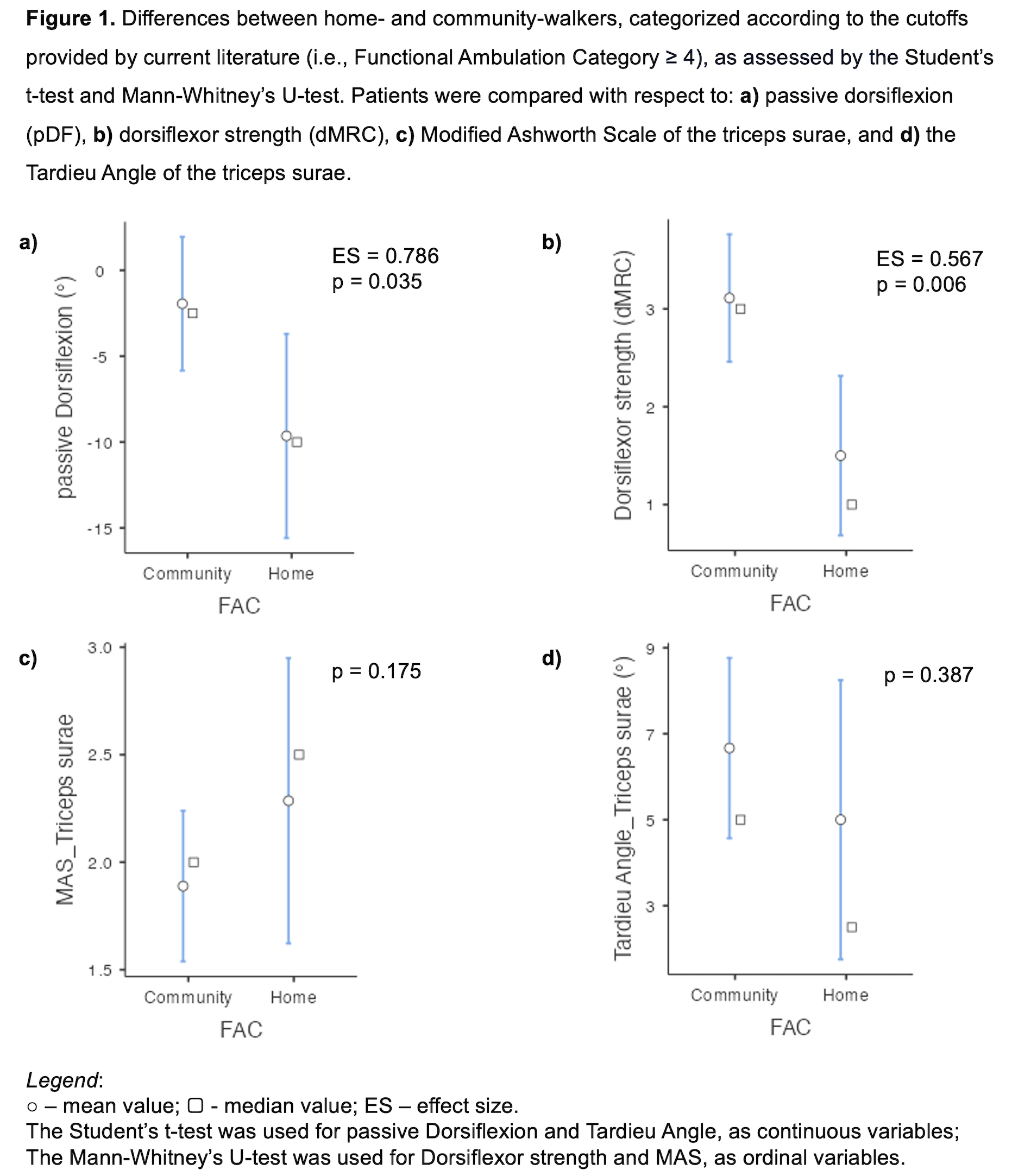
    This is a cross-sectional study. We included patients with hemiparesis due to stroke who underwent comprehensive clinical and instrumental assessment at our institution. Ankle-related measures were: passive and active dorsiflexion (aDF, pDF), dorsiflexor and plantarflexor muscle strength (dMRC, pMRC), and triceps surae spasticity, as assessed with the Modified Ashworth Scale (MAS) and the Tardieu angle. Ambulation-related measures were: Functional Ambulation Category (FAC), Walking Handicap Scale (WHS), Rivermead Mobility Index (RMI), and gait speed derived from gait analysis trials. Spearman’s rho and Kendall’s tau were used to describe correlation relationships between variables. Student’s t-test and Mann-Whitney’s U-test, along with related effect size (ES), were used to show significant differences between community and home-based walkers, as classified according to the cut-off thresholds provided by the literature. Statistical significance was set at 5%.

    Results

    Thirty-three patients (27/6 M/F) aged 58.2 (12.8) and 28.2 (29.7) months post-stroke were included. Weak to strong relationships were shown between pDF, aDF, dMRC, pMRC, and the different assessments of walking ability (0.375 ≤ rho ≤ 0.705, p<0.05). MAS inversely correlated with gait speed only (rho = -0.378, p<0.05). Neither ankle- nor ambulation-related outcome measures were associated with triceps surae spasticity when measured with the Tardieu angle (rho < 0.299, p>0.05). Moreover, MAS and the Tardieu angle did not correlate (p>0.05). In general, a value of one variable could correspond to values across the entire range of the other variable, given the heterogeneity of the observations. Community walkers were significantly different from home-based walkers in terms of pDF, aDF, dMRC, pMRC (0.41 ≤ |ES| ≤ 1.61, p<0.05) (see Figure 1a, 1b) but did not differ in terms of MAS and Tardieu angle (p > 0.175) (see Figure 1c, 1d).

    Discussion and Conclusion

    Associations between pDF, aDF, dMRC, pMRC and walking abilities suggest that patients with chronic stroke who maintained a fair range of motion and muscle strength are more likely to have walking abilities suitable for both safe and outdoor settings. Spasticity assessed with Tardieu Angle never correlated with walking abilities. Likely, spasticity did not occur during walking, even though it had been previously observed with passive manoeuvres at the bedside. This is probably because the patients with chronic stroke walked at very low speeds, which did not elicit a velocity-dependent phenomenon such as spasticity. Finally, MAS obtained conflicting results probably because it measures both stretch reflex activity and muscle contractures without distinguishing them [3]. Future studies should further explore the associations between these variables, highlighting possible cause-and-effect relationships that may guide tailored interventions.

    REFERENCES

    [1] Gracies JM. Pathophysiology of spastic paresis. II: Emergence of muscle overactivity. Muscle Nerve. 2005;31(5):552-571. doi:10.1002/mus.20285

    [2] de l’Escalopier N, Voisard C, Michaud M, et al. Evaluation methods to assess the efficacy of equinovarus foot surgery on the gait of post-stroke hemiplegic patients: A literature review. Front Neurol. 2022;13:1042667. Published 2022 Nov 9. doi:10.3389/fneur.2022.1042667

    [3] Campanini I, Bò MC, Bassi MC, et al. Outcome measures for assessing the effectiveness of physiotherapy interventions on equinus foot deformity in post-stroke patients with triceps surae spasticity: A scoping review. PLoS One. 2023;18(10):e0287220. Published 2023 Oct 12. doi:10.1371/journal.pone.0287220

    [4] Mudge S, Stott S. Outcome measures to assess walking ability following stroke: a systematic review of the literature. Physiotherapy. 2007;93(3):189–200. Published 2007 Sept. doi: 10.1016/j.physio.2006.12.010

  • Applicazioni cliniche della valutazione strumentale dell’equilibrio statico in pazienti con malattia di Parkinson e parkinsonismi: una revisione sistematica.

    Applicazioni cliniche della valutazione strumentale dell’equilibrio statico in pazienti con malattia di Parkinson e parkinsonismi: una revisione sistematica.

    Applicazioni cliniche della valutazione strumentale dell’equilibrio statico in pazienti con malattia di Parkinson e parkinsonismi: una revisione sistematica.

    Instrumental static balance assessment of patients with Parkinson’s disease and Parkinsonism for clinical applications: a systematic review.

    Autori

    Bò Maria Chiara [LAM – Motion Analysis Laboratory, Neuromotor and Rehabilitation Department, San Sebastiano Hospital, Azienda USL-IRCCS di Reggio Emilia, Correggio (Reggio Emilia), Italy]; Cavazzuti Lorenzo [LAM – Motion Analysis Laboratory, Neuromotor and Rehabilitation Department, San Sebastiano Hospital, Azienda USL-IRCCS di Reggio Emilia, Correggio (Reggio Emilia), Italy]

    Bassi Maria Chiara [Medical Library, Azienda USL-IRCCS di Reggio Emilia, Correggio (Reggio Emilia), Italy]

    Lusuardi Mirco [Neuromotor and Rehabilitation Department, Azienda USL-IRCCS Reggio Emilia, Correggio (Reggio Emilia), Italy]

    Cavallieri Francesco [Neurology Unit, Neuromotor & Rehabilitation Department, Azienda USL-IRCCS di Reggio Emilia, Viale Risorgimento 80, 42123, Reggio Emilia, Italy]

    Di Rauso Giulia [Neurology Unit, Neuromotor & Rehabilitation Department, Azienda USL-IRCCS di Reggio Emilia, Viale Risorgimento 80, 42123, Reggio Emilia, Italy]

    Valzania Franco [Neurology Unit, Neuromotor & Rehabilitation Department, Azienda USL-IRCCS di Reggio Emilia, Viale Risorgimento 80, 42123, Reggio Emilia, Italy]

    Damiano Benedetta [LAM – Motion Analysis Laboratory, Neuromotor and Rehabilitation Department, San Sebastiano Hospital, Azienda USL-IRCCS di Reggio Emilia, Correggio (Reggio Emilia), Italy]

    Scaltriti Sara [LAM – Motion Analysis Laboratory, Neuromotor and Rehabilitation Department, San Sebastiano Hospital, Azienda USL-IRCCS di Reggio Emilia, Correggio (Reggio Emilia), Italy]

    Merlo Andrea [LAM – Motion Analysis Laboratory, Neuromotor and Rehabilitation Department, San Sebastiano Hospital, Azienda USL-IRCCS di Reggio Emilia, Correggio (Reggio Emilia), Italy]

    Campanini Isabella [LAM – Motion Analysis Laboratory, Neuromotor and Rehabilitation Department, San Sebastiano Hospital, Azienda USL-IRCCS di Reggio Emilia, Correggio (Reggio Emilia), Italy]

    Introduction

    Patients with Parkinson’s disease (pwPD) or Parkinsonism usually complain of impaired balance and are two to three times more likely to fall than healthy adults [1]. This reduces patient autonomy from caregivers and negatively affects their quality of life [2]. Instrumental posturography has been suggested in the literature as a valuable technique to quantitively assess static balance in pwPD [3], being used in nearly 500 papers over the last 24 years. However, it suffers from some limitations, such as the absence of a defined “normal pattern”, the lack of protocol standardization, and the large number of parameters that can be computed [4]. This systematic review aims to critically appraise the use of static posturography in pwPD, including the clinical, technical, and methodological aspects, and identify gaps hindering its translation into the clinical routine.

    Methods

    Four databases were searched for relevant articles by two blinded assessors. Primary studies on pwPD or Parkinsonism assessing the “baseline” condition (i.e., static posturography performed barefoot, in a bipedal upright stance, acquired with eyes open, on a firm surface) were included. A tailored set of 19 quality questions for the critical appraisal process was designed de novo, encompassing five different domains: study methodology, clinical aspects, assessment protocol, technical aspects, and transferability to clinical practice. Each question was scored on a three-level basis (i.e., 1 for “yes”, 0.5 for “limited details”, and 0 for “no”), plus a “not applicable” score. This allowed for the computation of domain-related and total percentage scores and the classification of studies as high-quality, medium-quality, and low-quality [5].

    Results

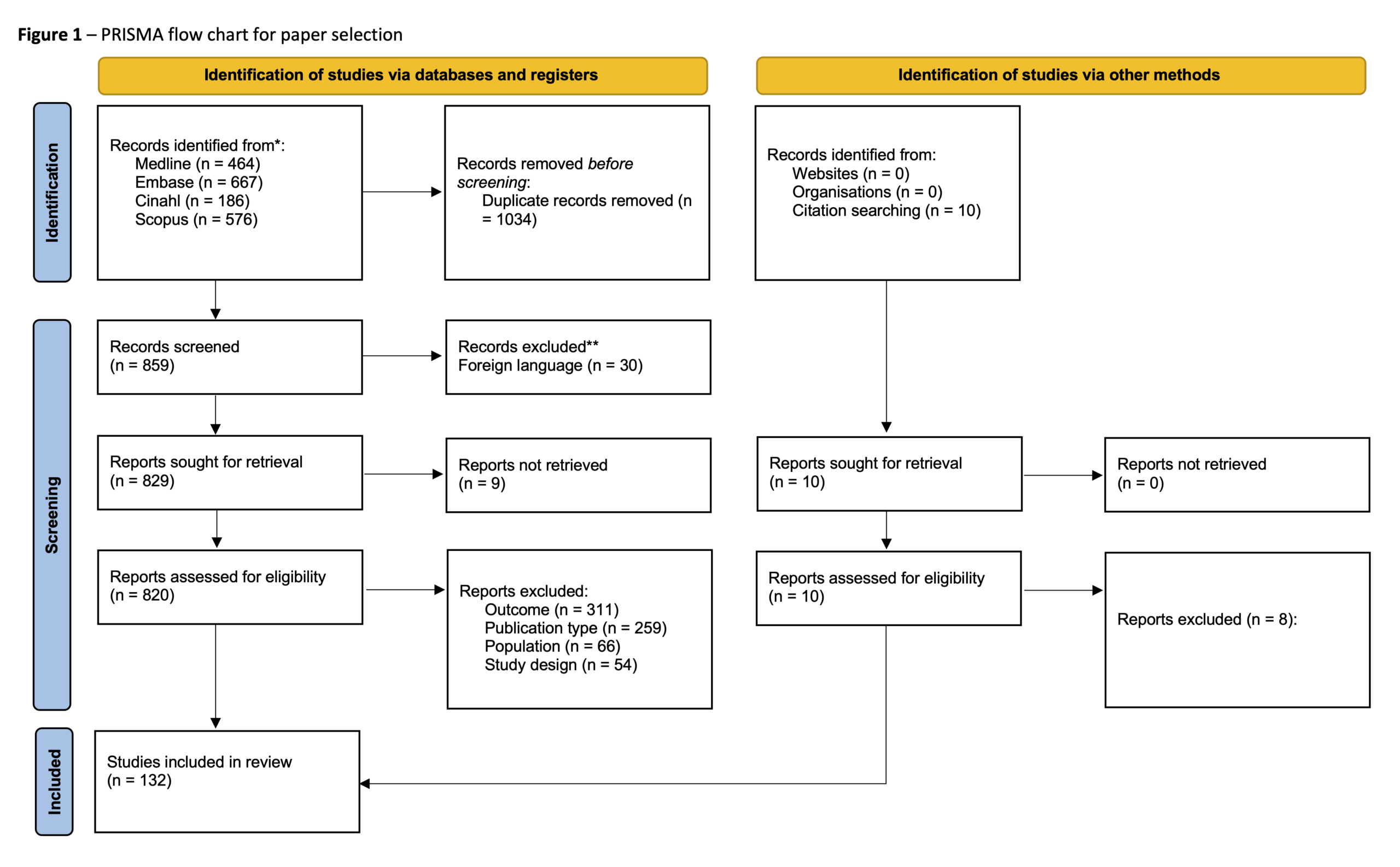
    132 studies were included (Fig 1), involving 4262 pwPD. Most papers (105/132) were rated as medium-quality (Fig 2a). The domains with the lowest scores were “transferability to clinical practice” and “assessment protocol” (Fig 2b). The main flaw hindering translatability was the lack of a stated rationale behind the selection of specific protocols and posturographic parameters. From a clinical point of view, study samples lacked descriptive details and included patients with heterogeneous disease severity. Treatment techniques and dosages, when applicable, were overall well-detailed. From a methodological point of view, the lack of: 1) a-priori sample size design, 2) description of both the set-up and instructions given to the patients (e.g., foot and arm positioning, visual target), 3) relevant technical information (i.e., sampling frequency and filters), and 4) clarity on the formulas used to obtain parameters further limited the power of study results and protocol replicability.

    Discussion and Conclusion

    Our customized critical appraisal highlighted several opportunities for enhancing the quality of studies on static posturography in the assessment of pwPD. In future studies, authors should: 1) discuss the rationale for choosing the assessment protocols and posturographic parameters to describe postural abilities of pwPD, 2) detail the inclusion criteria and select appropriate samples according to the aim of the study, and 3) report all the technical information to replicate the procedures and computations. Addressing these areas can significantly improve the external validity and clinical transferability of scientific literature to daily practice, which is key in biomedical research. This review provides useful references for each of the domains considered, supporting the rapid portability of findings to clinical settings.

    REFERENCES

    [1]      R.M. Pickering, Y.A.M. Grimbergen, U. Rigney, A. Ashburn, G. Mazibrada, B. Wood, P. Gray, G. Kerr, B.R. Bloem, A meta-analysis of six prospective studies of falling in Parkinson’s disease, Movement Disorders 22 (2007) 1892–1900. https://doi.org/10.1002/mds.21598.

    [2]      M. Michałowska, U. Fiszer, A. Krygowska-Wajs, K. Owczarek, Falls in Parkinson’s disease. Causes and impact on patients’ quality of life., Funct Neurol 20 (2005) 163–8. http://www.ncbi.nlm.nih.gov/pubmed/16483454.

    [3]      A. Kamieniarz, J. Michalska, A. Brachman, M. Pawłowski, K.J. Słomka, G. Juras, A posturographic procedure assessing balance disorders in parkinson’s disease: A systematic review, Clin Interv Aging 13 (2018) 2301–2316. https://doi.org/10.2147/CIA.S180894.

    [4]      L. Chiari, Stabilometry, in: Encyclopedia of Neuroscience, Springer Berlin Heidelberg, Berlin, Heidelberg, 2009: pp. 3830–3833. https://doi.org/10.1007/978-3-540-29678-2_5623.

    [5]      F. Samadi Kohnehshahri, A. Merlo, D. Mazzoli, M.C. Bò, R. Stagni, Machine learning applied to gait analysis data in cerebral palsy and stroke: A systematic review, Gait Posture 111 (2024) 105–121. https://doi.org/10.1016/j.gaitpost.2024.04.007.

  • L’integrazione dei concetti di “cure” e “care” per migliorare il benessere dei bambini con disturbi neurologici ricoverati dopo la chirurgia neuro-ortopedica: il progetto Inclusive Care

    L’integrazione dei concetti di “cure” e “care” per migliorare il benessere dei bambini con disturbi neurologici ricoverati dopo la chirurgia neuro-ortopedica: il progetto Inclusive Care

    Integrating cure and care to improve the well-being of inpatient children with neurological disorders undergoing neuro-orthopedic surgery: the Inclusive Care project

    Autori

    Giacobbi Meris [OPA Sol et Salus, Torre Pedrera Di Rimini, Rimini]; Bò Maria Chiara [OPA Sol et Salus, Torre Pedrera Di Rimini, Rimini]

    Gengotti Francesca [OPA Sol et Salus, Torre Pedrera Di Rimini, Rimini]; Dellamotta Daniela [OPA Sol et Salus, Torre Pedrera Di Rimini, Rimini]

    Fortunato Nunzia [OPA Sol et Salus, Torre Pedrera Di Rimini, Rimini]; Foschi Mattia [OPA Sol et Salus, Torre Pedrera Di Rimini, Rimini]

    Retini Noemi [OPA Sol et Salus, Torre Pedrera Di Rimini, Rimini]; Caronia Letizia [Dipartimento di Scienze dell’Educazione, Università degli studi di Bologna]

    Ranzani Federica [Dipartimento di Scienze dell’Educazione, Università degli studi di Bologna]; Aulizio Vincenzo [Centro di Iniziativa Democratica degli Insegnanti (CIDI), Rimini]

    Serafini Martina [Cooperativa Millepiedi, Rimini]; Bertini Simona [OPA Sol et Salus, Torre Pedrera Di Rimini, Rimini]

    Taddei Mia [OPA Sol et Salus, Torre Pedrera Di Rimini, Rimini]; Bertozzi Monia [OPA Sol et Salus, Torre Pedrera Di Rimini, Rimini]

    Prati Paolo [OPA Sol et Salus, Torre Pedrera Di Rimini, Rimini]; Bemporad Jonathan [OPA Sol et Salus, Torre Pedrera Di Rimini, Rimini]

    Zerbinati Paolo [OPA Sol et Salus, Torre Pedrera Di Rimini, Rimini]; Mariotti Paolo [OPA Sol et Salus, Torre Pedrera Di Rimini, Rimini]

    Montesi Massimo [OPA Sol et Salus, Torre Pedrera Di Rimini, Rimini]; Merlo Andrea [OPA Sol et Salus, Torre Pedrera Di Rimini, Rimini]

    Introduction

    In pediatric healthcare, the balance between cure and care is essential, especially during prolonged periods of hospitalization [1]. At our institution, more than 300 underage children per year undergo neuro-orthopedic surgery (NOS), aimed at correcting limb deformities caused by neurological conditions. Patients remain hospitalized for about a month to begin rehabilitation. While cure aims to improve function and minimize the impact of a pathological condition, care focuses on socio-emotional well-being, the implementation of sensorimotor and cognitive skills, and attempts to reduce the impact of medicalization on quality of life [2]. The Inclusive Care (IC) project was designed to integrate these two key aspects into inpatient children’s stay at our institution.

    This study explores the several steps followed in designing the IC project and describes its aims and the preliminary results obtained.

    Methods

    The design of IC involved the hospital management and the professionals responsible for several clinical (rehabilitation ward, physiotherapist – PT and nurse coordinators, psychologist, educator) and support services (engineering, quality, training, research).

    Setting (S): We screened for suitable spaces, specific pathways to access them, and planned renovation work.

    Management (M): We defined the professionals to be involved, detailing their activities and responsibilities. We set the frequency of the IC activities 3 times/week and drafted the process for collecting patients’ anamnestic, cognitive, and functional information before admission to support organization. Necessary documentation (e.g., privacy policy and informed consent) was prepared.

    Research (R): We drafted the inclusion criteria for children eligible for IC-related studies and reviewed the current literature to identify outcome measures suitable for evaluating the IC effectiveness on children’s well-being and behaviors.

    Results

    S: We renovated and furnished an outbuilding specifically for children with disabilities. To enhance accessibility, we marked the path to access it with colored road signs such as footsteps and wheelchairs.

    M: The hospital signed a memorandum with the municipality of our city, the reference university in our region – Department of Education, and two volunteering associations. The IC includes educators, teachers, a pedagogical supervisor, and a psychologist. The presence of a nurse and PT during activities ensures safety and integration with ongoing rehabilitation. A list of pedagogical activities was drafted, including the necessary materials, tailored to the children’s needs.

    R: From November 2023, the IC involved 125 children recovering from NOS. We used the Strengths & Difficulties Questionnaires to assess the impact of IC on a pilot sample of 10 patients. Parents were highly satisfied, and PTs reported overall increased compliance to the traditional rehabilitation program.

    Discussion and Conclusion

    The IC project represents an innovative patient & family -centered paradigm in the rehabilitation field, where cure and care integrate each other, emphasizing the patient’s agency as well as family members’ core role, engagement and needs. Advanced surgical and rehabilitation procedures pair with structured playful moments with peer activities, supporting the relational and psychological needs of the children. Approaching children as such before treating them as patients may help them develop coping strategies and engage more actively in physiotherapy, potentially increasing its effectiveness. Moreover, the IC offers a privileged setting in which rehabilitation professionals can observe children and understand their needs, therefore designing tailored exercises. The IC also provides extensive support to caregivers, alleviating the stress and emotional burden they may experience by seizing the opportunity for a brief daily relief during playtime activities.

    REFERENCES

    [1]      G. Perasso, G. Camurati, E. Morrin, C. Dill, K. Dolidze, T. Clegg, I. Simonelli, H.Y.C. Lo, A. Magione-Standish, B. Pansier, S.C. Gulyurtlu, A. Garone, H. Rippen, Five Reasons Why Pediatric Settings Should Integrate the Play Specialist and Five Issues in Practice, Front Psychol 12 (2021). https://doi.org/10.3389/fpsyg.2021.687292.

    [2]      K. Koukourikos, L. Tzeha, P. Pantelidou, A. Tsaloglidou, The Importance of Play During Hospitalization of Children, Materia Socio Medica 27 (2015) 438. https://doi.org/10.5455/msm.2015.27.438-441.