Entry-level physical therapist curricula in geriatric care: an Italian national survey study
Autori
Dal Ben Sara (Istituto AltaVita-IRA, Padua – Italy; School of Physiotherapy, University of Padua, Padua – Italy; Geriatric Physiotherapy Specialist Interest)
Bucchi Francesco (CIDAS Social Cooperative, Ferrara – Italy; Geriatric Physiotherapy Specialist Interest Group, Italian Physiotherapy Association)
Culcasi Antonio (Nursing, Technical and Rehabilitative Assistance Service, IRCCS Istituto Ortopedico Rizzoli, Bologna – Italy; School of Physiotherapy, Alma Mater Studiorum, University of Bologna, Bologna – Italy; Geriatric Physiotherapy Specialist Interest Group, Italian Physiotherapy Association)
Lecora Stefano (Private Practitioner, Naples – Italy; Geriatric Physiotherapy Specialist Interest Group, Italian Physiotherapy Association)
Tedeschi Roberto (Independent Researcher, Bologna – Italy)
Da Roit Marco (Quality Service, AULSS1 Dolomiti, Belluno – Italy, AULSS1, Dolomiti – Italy; Geriatric Physiotherapy Specialist Interest Group, Italian Physiotherapy Association)
Background and aims
To address the health needs of the aging population, it is necessary to map entry-level curricula for health professionals.
This survey investigated geriatric-related content in entry-level physical therapist (PT) curricula offered by Italian universities.
Methods
A cross-sectional observational study was conducted using the CROSS checklist. A 66 questions survey was developed and sent via e-mail to all entry-level PT program directors of the Italian universities.
Results
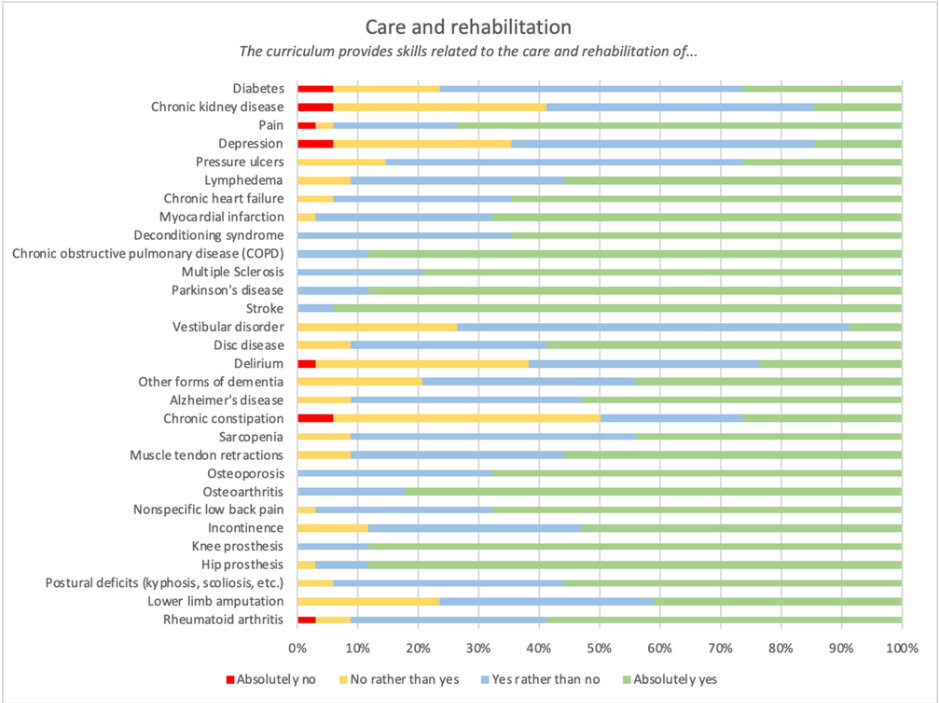
A total of 34 physical therapist undergraduate course directors out of 62 completed the survey, yielding a 54.8% response rate. These results highlight the need for greater emphasis on health promotion and prevention. Although essential competencies such as the promotion of an active lifestyle and fall prevention appear to be well covered, other aspects remain underrepresented. Relevant gaps were also noted in the care and rehabilitation of some common chronic conditions (e.g., constipation, depression, and diabetes), as well as in therapeutic education. Greater attention to these topics could help align training with the emerging needs of the healthcare system. However, 11.76% of Italian PT programs do not include specific modules or courses dedicated to geriatric rehabilitation. Overall, there is considerable variability in teaching hours, topic coverage, and depth.
Conclusion
This study provides meaningful insights for updating the current PT curricula in geriatric care. This survey could represent a tool for future longitudinal research on mapping curricula over time in response to the aging population.
REFERENCES
The International Association for Physiotherapists Working with Older People (IPTOP). 2021. Standards of Clinical Practice: Revised Edition. 2021.
Geriatrics Section APTA. Essential Competencies in the Careof Older Adults at the Completion of the Entry-level Physical Therapist Professional Program of Study. 2017.
Perez CDA. Integration of geriatric content in entry-level physical therapy education in the Philippines: a pilot study. The Philippine Journal of Physical Therapy. 2022;1(2). Accessed October 28, 2024.
Sharma A, Minh Duc NT, Luu Lam Thang T, et al. A Consensus- Based Checklist for Reporting of Survey Studies (CROSS). J Gen Intern Med. 2021;36(10):3179-3187.
Almarwani M. Does ageism exist among multidisciplinary rehabilitation students? Predictors of attitudes toward older adults. J Multidiscip Healthc. 2023;16:181-189.