Physiotherapy management of nociplastic pain: A Delphi study of Italian specialists.
Introduction
Pain is a significant health problem for people with musculoskeletal disorders, particularly when it lasts over 3 months1. In many cases, the transition from acute to chronic pain seems to be related to neuroplastic changes occurring in the Central Nervous System (CNS), a process called Central Sensitization (CS)2. Although CS is not the only cause, mechanisms of sensitizations of the CNS play an essential role in nociplastic pain3. Early identification of people with suspected CS mechanisms is necessary due to higher severity of pain, reduced quality of life and poor prognosis4. Despite this, no clinical practice guidelines are available to manage people with suspected CS in rehabilitative settings5. For this reason, this Delphi study aims to reach a consensus on the physiotherapy management of people with pain and suspected CS mechanisms in the Italian scenario.
Methods
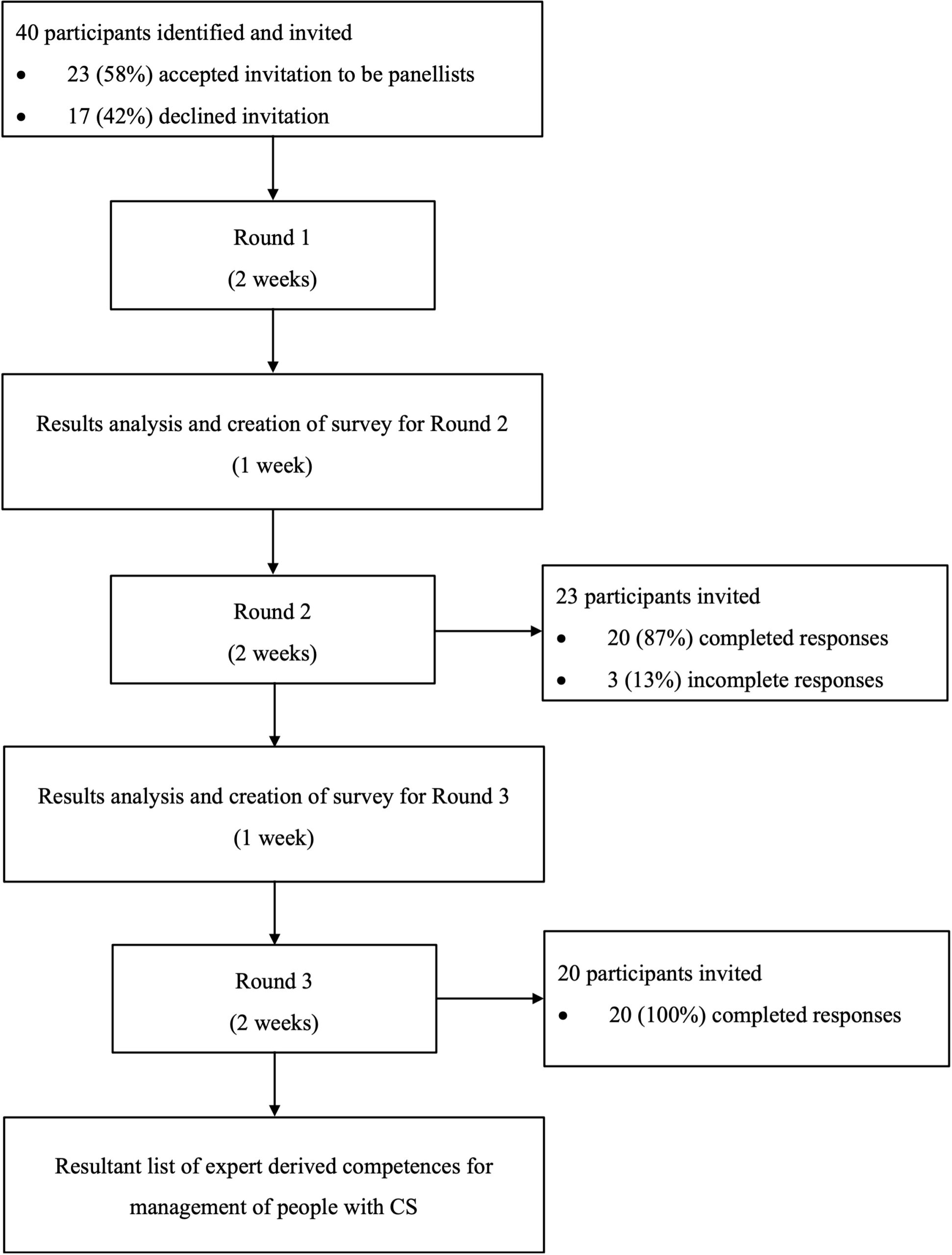
A web-based Delphi process was employed. Experts in the rehabilitation field were recruited following pre-defined eligibility criteria. Consensus criteria were defined for each round to establish the agreement between participants. Panellists evaluated the usefulness of physical therapist competences in managing people with signs of CS through closed-ended questions. For every competence included, panellists have to explain how they act in their clinical practice every time they approach people where a CS mechanism is suspected. Following completion of three Delphi rounds the final list of competencies was generated.
Results
23 participants were recruited for the web-based Delphi process. They all completed Round 1 (23/23, 100%), twenty Round 2 and Round 3 (20/23, 87%). Following Round 1, seven areas were identified by the panel as crucial for CS physiotherapy management; 19 competencies out of 40 reached the consensus between experts, and nine additional competencies were added to Round 2 following literary review. Round 2 identified the agreement for all the 29 competencies. During Round 3, all the experts confirmed the final list generated through the consensus process.
Discussion and Conclusion
An agreement between experts was found for the final list of competencies that a physiotherapist should implement every time it approaches people with suspected CS mechanisms. A detailed list of steps was defined to better characterize the physiotherapy process applicable in clinical practice. These steps derived from existing procedures described in the literature and were integrated with additional behaviors identified by the participants in this web-based Delphi process. Our results can open the door to a new way to decline the physiotherapy approach to specific health conditions where theory and practice struggle to find a meeting point. Further research is needed to support the clinical utility of the final list of physiotherapy behaviors and its applicability in daily practice.
REFERENCES
- Treede RD, Rief W, Barke A, et al. Chronic pain as a symptom or a disease: the IASP Classification of Chronic Pain for the International Classification of Diseases (ICD-11). Pain. 2019;160(1):19-27.
- Camfferman D, Moseley GL, Gertz K, Pettet MW, Jensen MP. Waking EEG Cortical Markers of Chronic Pain and Sleepiness. Pain Med. 2017;18(10):1921-1931.
- Shraim MA, Massé-Alarie H, Hall LM, Hodges PW. Systematic Review and Synthesis of Mechanism-based Classification Systems for Pain Experienced in the Musculoskeletal System. The Clinical Journal of Pain. 2020;36(10):793-812.
- Breivik H, Collett B, Ventafridda V, Cohen R, Gallacher D. Survey of chronic pain in Europe: prevalence, impact on daily life, and treatment. Eur J Pain. 2006;10(4):287-333.
- Nijs J, Goubert D, Ickmans K. Recognition and Treatment of Central Sensitization in Chronic Pain Patients: Not Limited to Specialized Care. J Orthop Sports Phys Ther. 2016;46(12):1024-1028.