From assessment to participation: appropriateness of the rehabilitation pathway in Pallister-Killian Syndrome.
Autori
Moscato Francesca [Life s.r.l. Centro di riabilitazione Estensiva, Isola di Capo Rizzuto KR, Italia]
Castiglione Chiara [SCDO Medicina Fisica – Neuroriabilitazione, Azienda Ospedaliero-Universitaria San Luigi Gonzaga, Torino, Italia]
Inzitari Maria Teresa [Medicina Fisica e Riabilitativa, Azienda Ospedaliero-Universitaria “Renato Dulbecco”, Catanzaro, Italia][Medicina Fisica e Riabilitativa, Dipartimento di Scienze Mediche e Chirurgiche, Università degli Studi “Magna Graecia”, Catanzaro, Italia]
Background and aims
Pallister-Killian syndrome (PKS) is a rare genetic disorder caused by tetrasomy of chromosome 12p, characterised by intellectual disability, hypotonia, and various craniofacial and multisystem anomalies [1]. It requires an individualised, multidisciplinary rehabilitation approach. This study aimed to assess adaptive functioning in PKS patients using the Vineland Adaptive Behaviour Scales, Second Edition (Vineland-II).
Methods
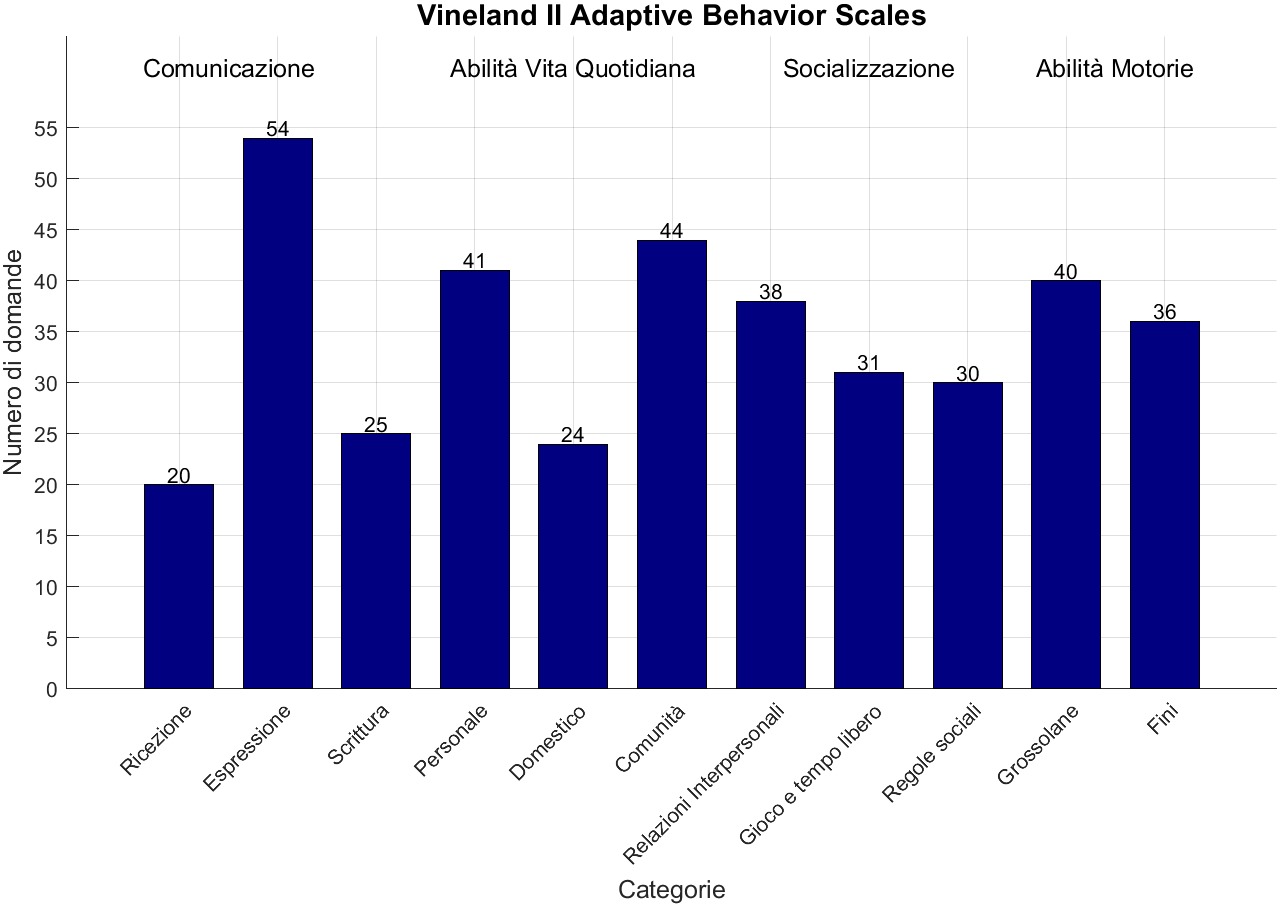
The project was approved by the Ethics Committee of the Calabria Region. It was included paediatric subjects aged 3 to 16 years diagnosed with Pallister-Killian Syndrome. Adaptive functioning was evaluated using the Vineland Adaptive Behaviour Scales, Second Edition (Vineland-II), which assesses four domains: Communication, Daily Living Skills, Socialisation, and Motor Skills, each with specific subscales [2]. Items are scored from 0 to 2 based on independence and activity frequency [3]. Raw scores for each subscale were calculated, and the total score allowed comparison of functional abilities across domains at a single time point.
Results
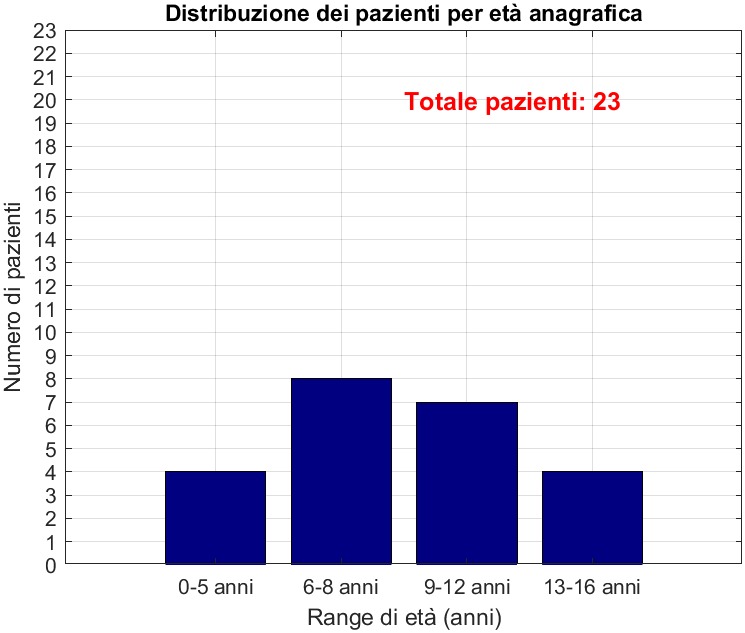
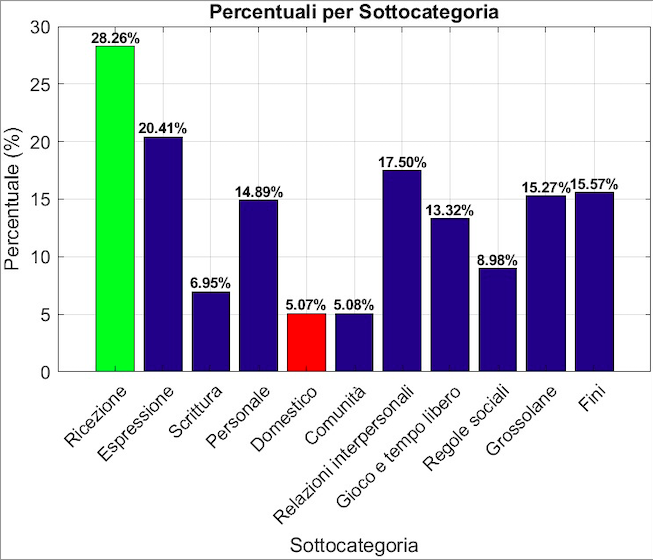
A total of 23 patients were recruited. Analysis of the raw scores indicated that the most developed skills were communication (C–Receptive: 28.26%) and socialisation (S–Interpersonal Relationships: 17.5%). The most critical areas included writing (C–Written: 6.95%), and domestic and community living skills (DLS–Domestic: 5.07%; DLS–Community: 5.08%). Motor skill (MS), both fine (FineMS: 15.57%) and gross (GrossMS: 15.27%), showed balanced development, but with considerable potential for improvement.
Conclusion
The results indicate a heterogeneous functional profile in subjects with Pallister-Killian Syndrome. The Vineland-II is valid tool for tailoring therapy and determining the level of support needed in home, school, and social settings. Further research is needed to guide and design tailored rehabilitation interventions for this population and to ensure continuity of care, and enhance support systems for families.
REFERENCES
[1] Izumi, Kosuke, and Ian D Krantz. “Pallister-Killian syndrome.” American journal of medical genetics. Part C, Seminars in medical genetics vol. 166C,4 (2014).
[2] Sparrow, S.S., Balla, D.A., Cicchetti, D.V. Vineland Adaptive Behavior Scales, Second Edition. Pearson Assessments.
[3] Balboni, G., Belacchi, C., Bonichini, S., Coscarelli, A. Vineland-II. Vineland Adaptive Behavior Scale Second Edition. Survey forms. Firenze: Giunti O.S., (2016).