Virtual Reality as a Therapeutic Approach for Entrapment Neuropathies: A Scoping Review
Autori
Giacomello Matteo [University of Padova, Padova, Italy]
Lando Alex [Department of Biomedical and Neuromotor Sciences (DIBINEM), Alma Mater Studiorum University of Bologna, Bologna, Italy]
Lazzaretti Eleonora [Department of Rehabilitation, Ulss 7 Pedemontana, Bassano del Grappa, Italy]
Background and aims
Over the past decade, advanced digital technologies have reshaped rehabilitation by enabling highly customisable, immersive interventions that engage both motor and sensory pathways. Virtual reality (VR) systems, ranging from fully immersive headsets to motion-tracking gamified platforms, have shown efficacy in enhancing motor control and reducing pain in both neurological and musculoskeletal conditions. VR also supports brain plasticity and activates the mirror neuron system. Entrapment neuropathies (EN), such as carpal tunnel syndrome (CTS), continue to impose chronic pain, sensory disturbances, and functional impairments, which are not always resolved by conservative or surgical treatments. Despite the success of VR in related domains, its specific application in EN rehabilitation remains unclear. This scoping review therefore aims to comprehensively map the current landscape of VR-based interventions for EN, detailing intervention types, dosing protocols, and clinical as well as engagement outcomes, to guide future research and clinical integration.
Methods
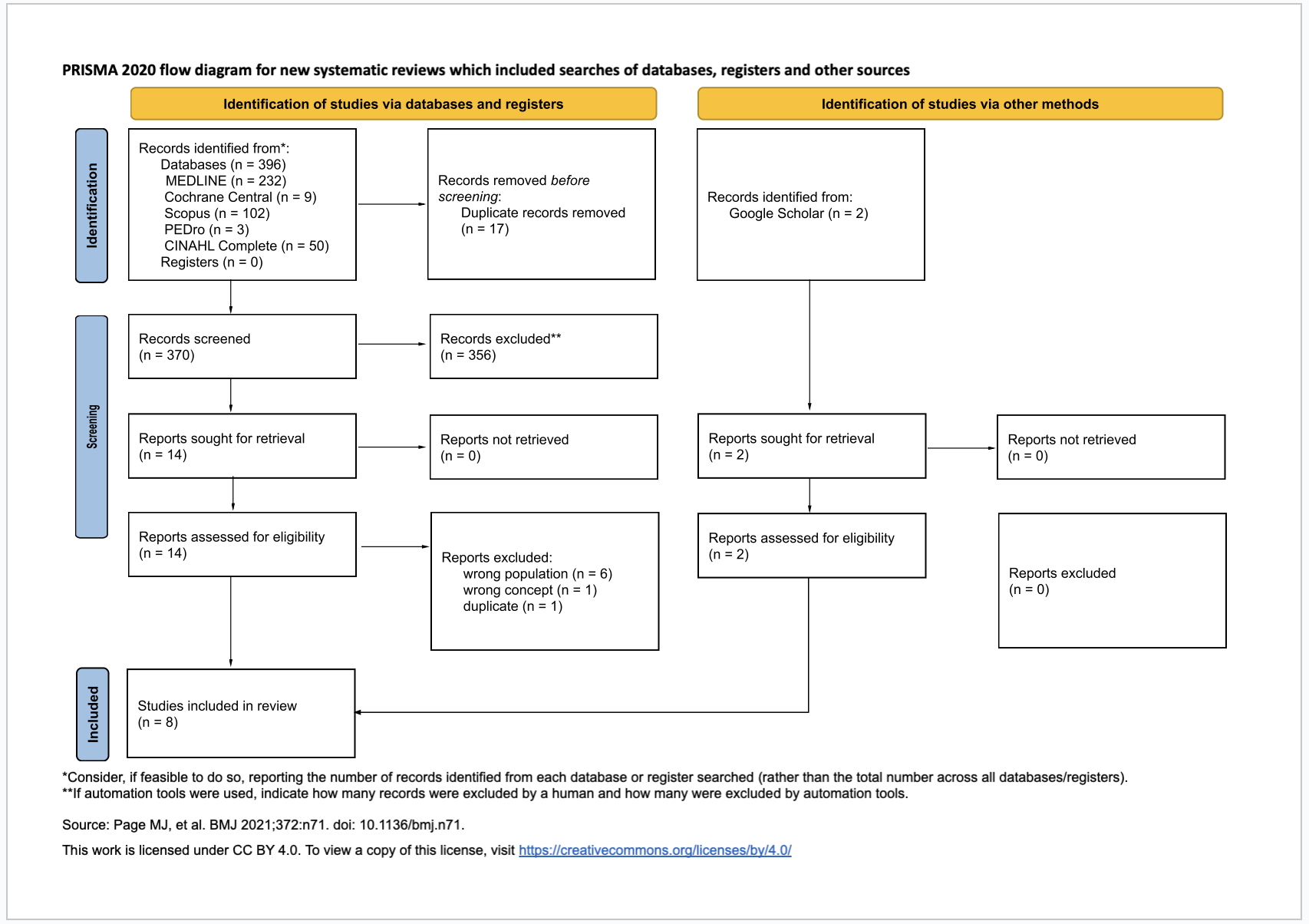
Following the Joanna Briggs Institute methodology and PRISMA-ScR guidelines, we registered our protocol a priori on Figshare (DOI: 10.6084/m9.figshare.28009196.v1). MEDLINE, Cochrane Central, CINAHLComplete, Scopus, and PEDro were searched from inception to January 2025, without restrictions on study design or publication status. Only English-language records were included. Grey literature sources (i.e., Google Scholar) and reference lists were also screened. Two reviewers independently screened title/abstract and full-text using Ryann QRCI software, with conflicts resolved by a third reviewer. Data were extracted into a standardised form, including study design, VR modality, intervention dose, and outcome measures. Results were synthesised in tabular and narrative formats.
Results
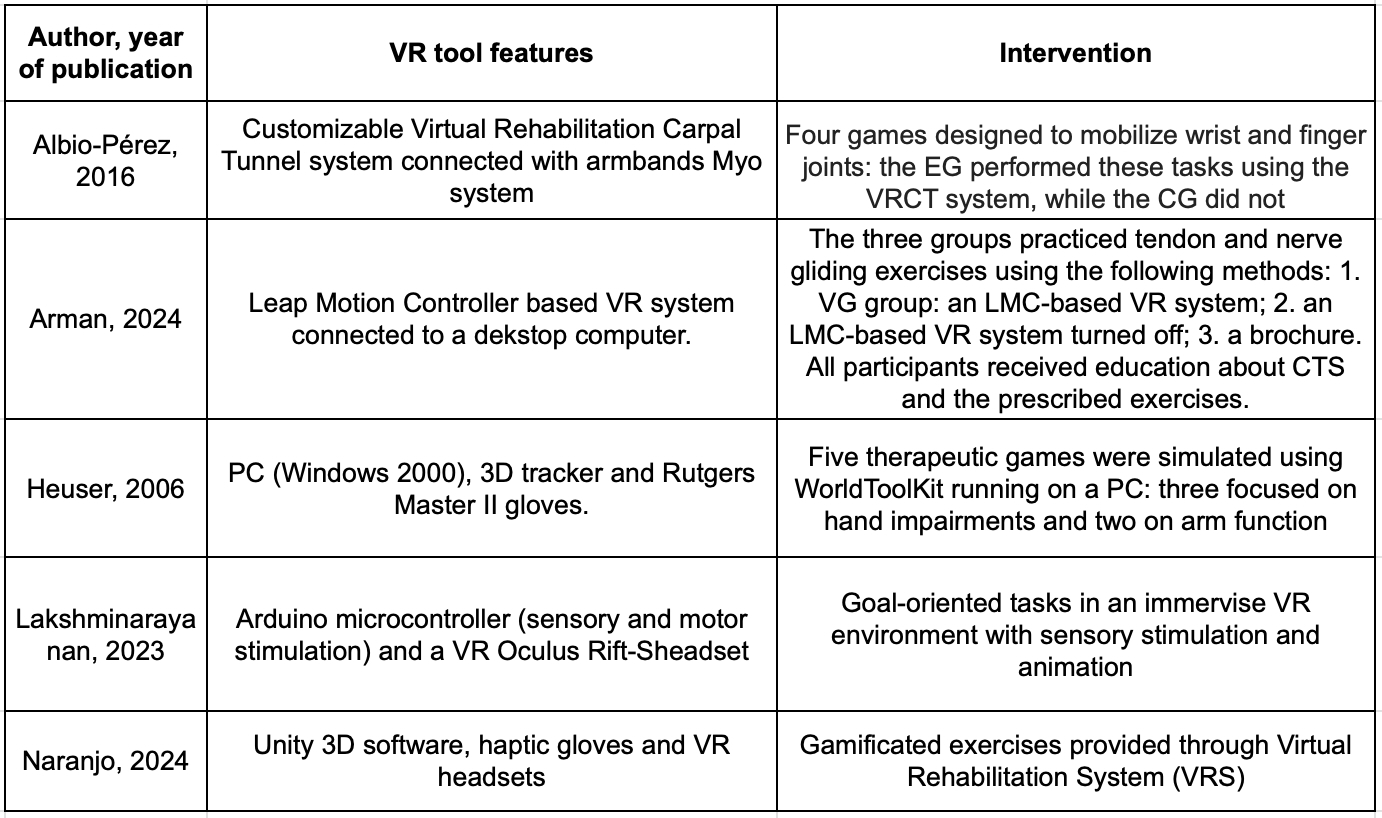
Of 372 records retrieved, 7 studies met inclusion criteria, all targeting VR-based rehabilitation for CTS. Publication years spanned 2006-2025. Study designs included two randomized controlled trials, one pilot study, one qualitative study, one narrative review, one book chapter, and one conference proceeding. VR interventions ranged from immersive headsets to semi-immersive gamified tasks and motion-capture exercises. Intervention doses varied from single sessions to multi-week protocols. Primary outcomes assessed included symptom severity (pain intensity, paresthesia), functional status (grip strength, dexterity, range of motion), and patient engagement (usability, motivation scales). Across studies, VR interventions were associated with clinically meaningful reductions in pain, improvements in sensory and motor function, and high levels of adherence and user satisfaction.
Conclusion
Preliminary evidence suggests that VR is a feasible, engaging, and beneficial adjunct to standard care for individuals with EN. Future large-scale, methodologically rigorous trials should refine dosing, assess long-term outcomes, and expand to other EN types.
REFERENCES
- Girach A, Julian TH, Varrassi G, Paladini A, Vadalouka A, Zis P. Quality of Life in Painful Peripheral Neuropathies: A Systematic Review. Pain Res Manag. 2019 May 23;2019:2091960. doi: 10.1155/2019/2091960. PMID: 31249636; PMCID: PMC6556282.
- Padua L, Cuccagna C, Giovannini S, Coraci D, Pelosi L, Loreti C, Bernabei R, Hobson-Webb LD. Carpal tunnel syndrome: updated evidence and new questions. Lancet Neurol. 2023 Mar;22(3):255-267. doi: 10.1016/S1474-4422(22)00432-X. Epub 2022 Dec 13. PMID: 36525982.
- Rutkowski S, Kiper P, Cacciante L, Cieślik B, Mazurek J, Turolla A, Szczepańska-Gieracha J. Use of virtual reality-based training in different fields of rehabilitation: A systematic review and meta-analysis. J Rehabil Med. 2020 Nov 19;52(11):jrm00121. doi: 10.2340/16501977-2755. PMID: 33073855.
- Ahmadpour N, Randall H, Choksi H, Gao A, Vaughan C, Poronnik P. Virtual Reality interventions for acute and chronic pain management. The International Journal of Biochemistry & Cell Biology. 2019 Sep;114:105568.
- Tricco AC, Lillie E, Zarin W et al. (2018) PRISMA Extension for Scoping Reviews (PRISMA-ScR): Checklist and Explanation. Ann Intern Med, 169(7): 467-473. doi: 10.7326/M18-0850.