Revisiting Normative Data for the CKCUEST: A Comparative Study of Amateur and Professional Volleyball Players
Autori
Baldasarre Francesco
Background and aims
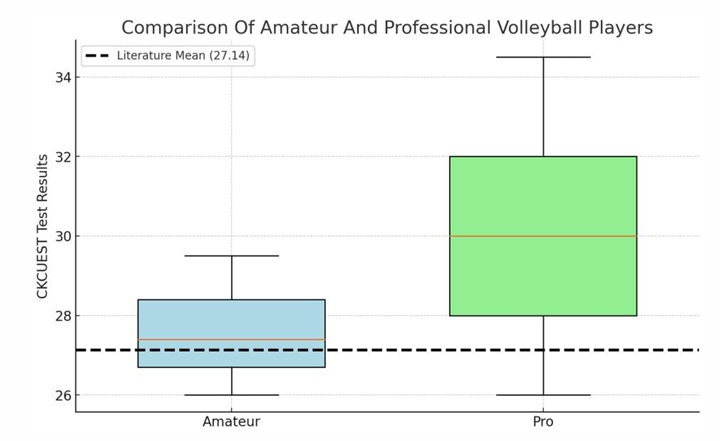
The Closed Kinetic Chain Upper Extremity Stability Test (CKCUEST) is a validated and widely used test for upper extremity assessment in both clinical and field settings. However, the applicability of normative data (27,14 touches) to specific populations, such as both amateur and professional volleyball players, remains uncertain. In this study, 50 volleyball players were recruited and divided into two groups with the aim of administering the functional test to the two groups and comparing the results with the normative data to verify its applicability.
Methods
26 amateur athletes were selected through collaboration with sports clubs playing in Serie D and Serie B and evaluated using the CKCUEST. The tests were conducted on the playing fields of the respective clubs. Data regarding 24 professional athletes were obtained through collaboration with Serie A1 sports clubs, which provided their own assessment results. Once the groups were formed, a comparison was made with normative data in literature.
Results
The results showed that the amateur group enacted a similar performance compared to the normative data (27, 744 touches), thus not presenting a statistically significant difference (p=0.477). However, in contrast, the group of professional athletes performed higher than the other two groups (32,250 touches), with significant difference (p<0.01), probably due to the remarkable difference in functional demand of their level of play.
Conclusion
The results suggest as much as the CKCUEST is validated as an effective tool for assessment, it is worth considering that some top-level athletes need to express levels of strength and control far greater than those so far examined by other papers in literature. This is of great importance when one wants to use the test as a criterion for decision making in return to sport after a shoulder injury, as the athlete may not be ready to sustain his performance demands safely. More research in this direction is therefore needed in order to use the test more critically, especially when it is to be used for return-to-sport decisions in elite sport settings.
REFERENCES
1. Declève, P., Van Cant, J., & Cools, A. M. (2021). Reliability of the Modified CKCUEST and correlation with shoulder strength in adolescent basketball and volleyball players. Brazilian Journal of Physical Therapy, 25(5), 536-543.
2. Guirelli, A. R., Dos Santos, J. M., Cabral, E. M. G., Pinto, J. P. C., De Lima, G. A., & Felicio, L. R. (2021). Relationship between upper limb physical performance tests and muscle strength of scapular, shoulder and spine stabilizers: A cross-sectional study. Journal of Bodywork and Movement Therapies, 27, 612-619.
3. Borms, D., & Cools, A. (2018). Upper-extremity functional performance tests: Reference values for overhead athletes. International Journal of Sports Medicine, 39(6), 433-441.
4. Torabi, T. P., Bencke, J., & van den Tillaar, R. (2024). The Closed Kinetic Chain Upper Extremity Stability Test (CKCUEST) performance in elite team handball players playing with shoulder pain, previous pain, or no pain. The International Journal of Sports Physical Therapy.
5. Taylor, J. B., Wright, A. A., Smoliga, J. M., DePew, J. T., & Hegedus, E. J. (2016). Upper-extremity physical-performance tests in college athletes. Journal of Sport Rehabilitation, 25(2), 146-154.