Does the fracture type matter? Comparison of gait patterns in patients after intertrochanteric and femoral neck hip fractures
Autori
Giardini Marica (Istituti Clinici Scientifici Maugeri IRRCS, Department of Physical and Rehabilitation Medicine Unit, Institute of Veruno, Italy)
Libiani Gianluca (Istituti Clinici Scientifici Maugeri IRRCS, Department of Physical and Rehabilitation Medicine Unit, Institute of Veruno, Italy)
Arcolin Ilaria (Istituti Clinici Scientifici Maugeri IRRCS, Department of Physical and Rehabilitation Medicine Unit, Institute of Veruno, Italy)
Corna Stefano (Istituti Clinici Scientifici Maugeri IRRCS, Department of Physical and Rehabilitation Medicine Unit, Institute of Veruno, Italy)
Godi Marco (Istituti Clinici Scientifici Maugeri IRRCS, Department of Physical and Rehabilitation Medicine Unit, Institute of Veruno, Italy)
Background and aims
Low-impact hip fractures are heterogeneous, with intertrochanteric fractures (ITFs) typically affecting frailer patients compared to femoral neck fractures (FNFs). Although the type of hip fracture does not influence functional recovery in older and more dependent patients, it does have an impact in younger or more functionally independent individuals at the start of rehabilitation [1]. Specifically, patients with ITF require longer rehabilitation to achieve functional gains comparable to FNF [1]. Previous studies included patients with several levels of autonomy at discharge, limiting specific analysis of gait recovery—although up to 90% of these patients lose independence in daily walking [2]. This study aimed to compare the gait patterns of independent inpatients with ITFs and FNFs at the time of discharge.
Methods
75 walking inpatients with FNF (82±6 years, 24% male) and 93 with ITF (82±7 years, 20% male), who were admitted to a rehabilitation institute and underwent individualized rehabilitation programs, were assessed at discharge by the instrumented Timed Up and Go (iTUG) Test, using their own walking aid. The iTUG test is an enhanced version of the traditional test, thanks to the addition of an inertial lumbar sensor; 21 variables, proven to be reliable in patients with femur fracture, were analysed [3]. Moreover, outcome measures (at admission and discharge) included length of stay (LOS), Functional Independence Measure (FIM) subscores and total score, Functional Ambulation Classification (FAC), 30s Sit-to-Stand (30s STS), and pain at rest and during mobilization.
Results
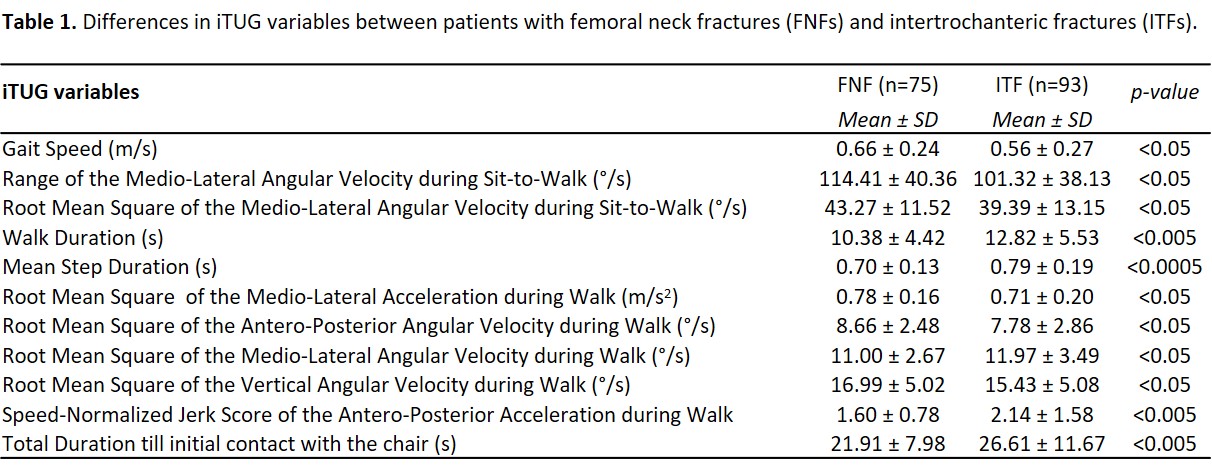
11/21 iTUG variables were different between ITF and FNF groups (at least, p<0.05), as showed in Table 1. No significant differences, neither at admission and at discharge, were observed between groups in LOS, 30s STS, FAC, pain at rest, subscores and total FIM scores. However, patients with ITF reported higher pain during mobilization (p<0.005 at admission; p<0.05 at discharge).
Conclusion
Results suggest that autonomous walking patients with different hip fractures, despite comparable scores in conventional clinical assessments, showed specific impairments in sensor-based mobility parameters, pointing to limitations in traditional measures to fully capture functional complexity. ITF patients exhibited altered temporal parameters, corresponding to a slower walking speed—10 cm/s lower than FNF patients. Moreover, the increased jerk and Root Mean Squares values are indicative of greater movement irregularity and instability, suggesting impaired gait control [4]. Also, pain results as a key factor to consider. These results confirm previous studies in the general hip fracture population, underscoring the need for fracture-specific rehabilitation strategies, particularly in ITF [1,5].
REFERENCES
[1] Arcolin I, et al. Injury. 2021;52(8):2373-2378. doi: 10.1016/j.injury.2021.04.001.
[2] Thingstad P, et al. Osteoporos. Int. 2016;27:933-942. doi: 10.1007/s00198-015-3313-9.
[3] Giardini M, et al. Gait Posture. In press.
[4] Antonelli M, et al. Appl. Sci. 2024;14(2):911. doi: 10.3390/app14020911.
[5] Dakhil S, et al. PloS one 2023;18(3):e02835515. doi: 10.1371/journal.pone.0283551.