Translation process of “International Guidelines and Good Practice Standards for Aquatic Physiotherapy Intervention” (IOAPT, 2025)
Autori
Guerri Lucia (Pt, freelance; master’s degree “Idrokinesiterapia”; AIFI NIS Fisioterapia in acqua; Brescia, Italy)
Coppola Lucia (Pt; MSc; Health Professional Department Azienda Ospedale Università Padova; Aquatic Therapeutic Exercise Association AQUATEA APS representative; AIFI NIS Fisioterapia in acqua; Padova, Italy)
Bianconi Tatiana (Pt; chief of rehabilitation, Spinal Unit ASST GOM Niguarda, Milano; AIFI NIS Fisioterapia in acqua; Milano, Italy)
Martinelli Vincenzo (Pt; freelance; Disability Manager; master’s degree “Idrokinesiterapia”; AIFI NIS Acqua; Bergamo, Italy)
Coladonato Adriano (Pt; Fisiogruppo Roma; AIFI NIS Fisioterapia in acqua; Roma, Italy)
Rocco Manuel ( Pt; MSc; master’s degree “Idrokinesiterapia”; Milano; AIFI NIS Fisioterapia in acqua; Milano, Italy)
Background and aims
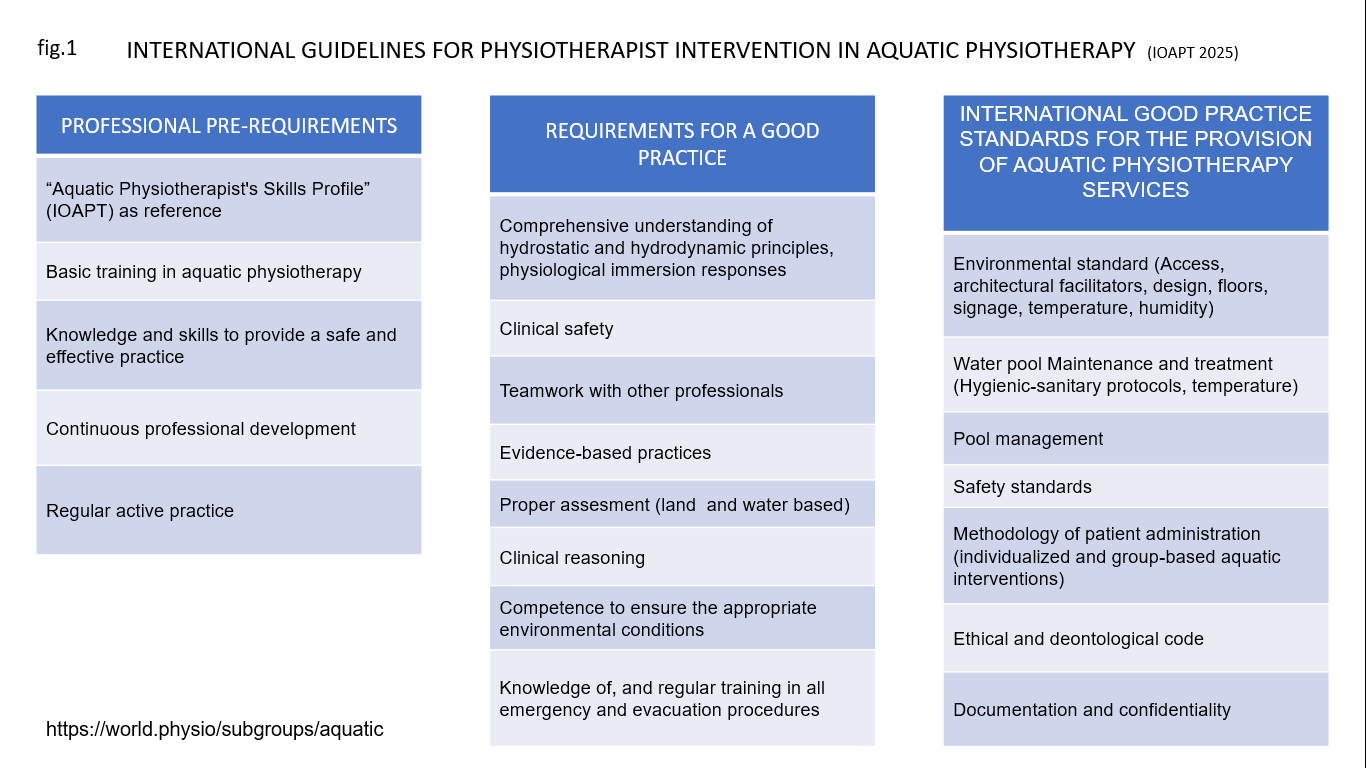
Aquatic physiotherapy is supported by scientific literature as complementary or alternative treatment, in a wide range of conditions of rehabilitative interest. In response to the global variability in education and practice, the International Guidelines and Good Practice Standards for Aquatic Physiotherapy Intervention—developed by the International Organisation of Aquatic Physiotherapists (IOAPT)—aim to establish a shared, high-quality framework for clinical practice. The document was collaboratively developed by international experts and reviewed by professionals from 14 countries to define standards for aquatic physiotherapy (figure 1). The Network di Interesse Specialistico on Aquatic Physiotherapy (NIS Fisioterapia in acqua), speciality group of Associazione Italiana di Fisioterapia (AIFI), having among its statutory objectives “Developing and applying a communication strategy to promote aquatic physiotherapy, clarify the role of the aquatic physiotherapist, and identify the most effective outreach methods” has deemed it relevant to translate the Guidelines into Italian.
Methods
The NIS Fisioterapia in acqua requested formal authorization from the IOAPT to initiate a structured translation process.
A working group was nominated to translate the manuscript, identify terminology issues, and conduct an initial peer review to resolve critical points by consensus. The panel was composed of 4 experienced professionals: TB, coordinator of a Rehabilitation center with therapeutic pool, LG and VM, master’s degree Idrokinesiterapia, LC, representative of a cultural association in aquatic physiotherapy. Due to lack of consensus, the opinion of two further experts was sought. All NIS members reviewed the draft for a second-phase review over one month.
Results
Certain issues have been identified and will be addressed in the process of culturally adapting the guidelines to the Italian context (e.g., Basic Life Support and required standard of knowledge).
It remains to be determined the translation of ‘aquatic physiotherapy’ into Italian to better reflect the physiotherapist’s scope of practice. The term idrokinesiterapista has been proposed, though it would diverge from the Spanish and Portuguese translations.
The completed version was then submitted to the IOAPT Commission for verification and formal approval.
Conclusion
The translated guidelines provide Italian physiotherapists with an authoritative reference to align national practice with international standards. The collaborative translation and review process, rooted in peer consultation and expert validation, reinforces the quality and applicability of the final document.The guidelines support the formal recognition of aquatic physiotherapy as a specialty and offer a robust tool for advancing education, practice, and patient outcomes at both national and global levels.
REFERENCES
https://world.physio/subgroups/aquatic
https://aifi.net/gis-nis/nis-fisioterapia-in-acqua/