“Do I need an imaging?” Exploring why patients with non-specific chronic low back pain request diagnostic instrumental evaluation: a phenomenological qualitative study
Autori
Graziana Lullo [Department of Medicine and Health Science “Vincenzo Tiberio”, University of Molise, 86100 Campobasso, Italy]
Gabriele Giannotta [Department of Medicine and Health Science “Vincenzo Tiberio”, University of Molise, 86100 Campobasso, Italy]
Andrea Tamborrino [Department of Medicine and Health Science “Vincenzo Tiberio”, University of Molise, 86100 Campobasso, Italy]
Firas Mourad [Department of Physiotherapy, LUNEX International University of Health, Exercise and Sports, Differdange, Luxembourg]
Massimo Esposto [Department of Medicine and Health Science “Vincenzo Tiberio”, University of Molise, 86100 Campobasso, Italy]
Giuseppe Giovannico [Department of Medicine and Health Science “Vincenzo Tiberio”, University of Molise, 86100 Campobasso, Italy]
Morten Hoegh [Department of Health Science and Technology, Faculty of Medicine, Aalborg University, Denmark]
Matteo Cioeta [Department of Medicine and Health Science “Vincenzo Tiberio”, University of Molise, 86100 Campobasso, Italy]
Background and aims
Chronic non-specific low back pain (cLBP) is widely acknowledged to have a multifactorial origin, yet many patients still request advanced imaging—especially magnetic resonance imaging (MRI)—even when clinical guidelines deem it unnecessary. This qualitative, phenomenological study set out to clarify why people with cLBP turn to MRI, exploring the beliefs that shape their expectations and the psychological impact of the results. By illuminating these drivers, the authors aimed to inform patient-centred communication strategies capable of aligning clinical practice with evidence-based recommendations.
Methods
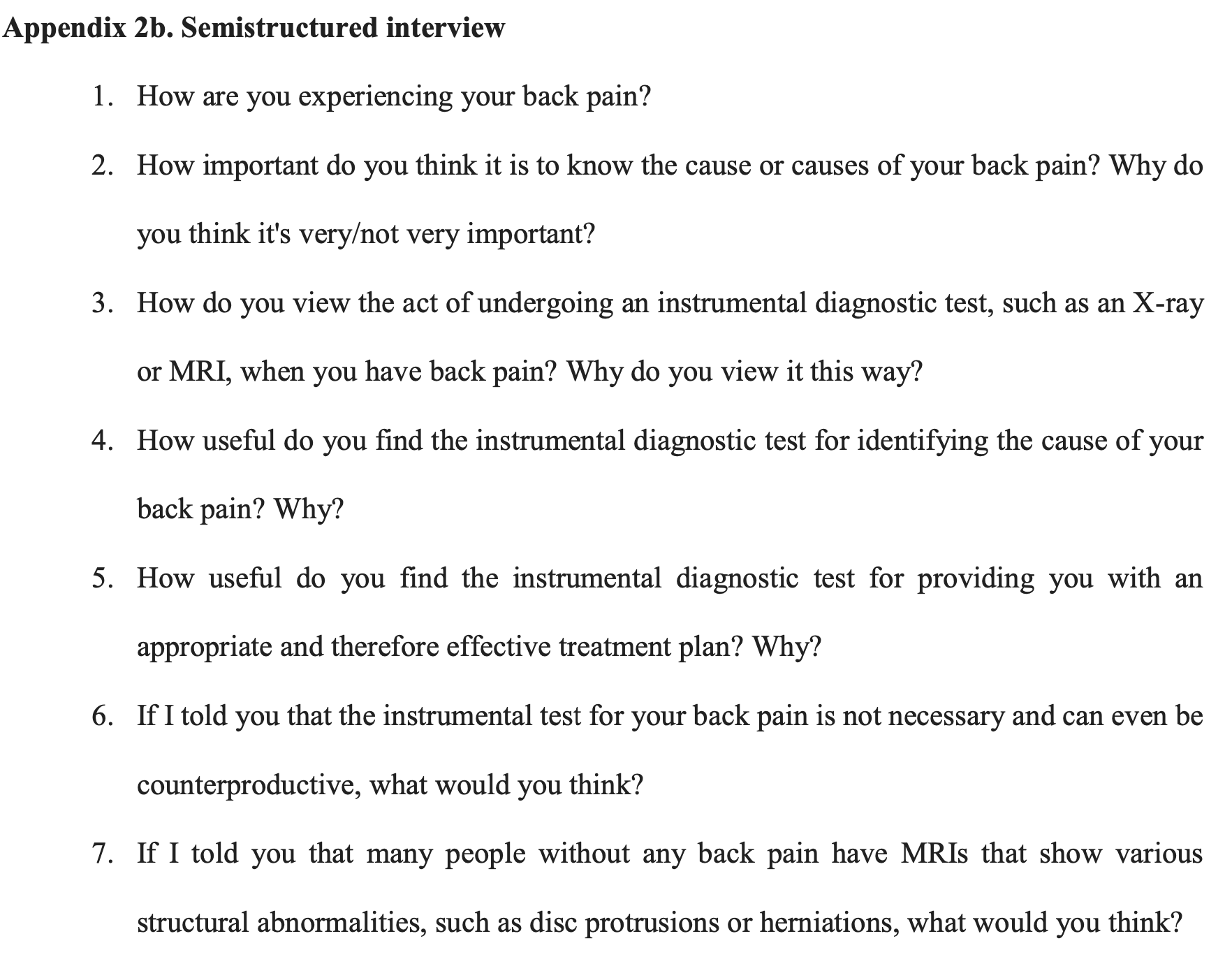
Eleven adults (six women, five men; mean age = 53 ± 15.7 years) living with cLBP participated in semi-structured, in-depth interviews. Questions probed how each individual interprets pain, perceives the usefulness of imaging, and copes with the findings. Interviews were transcribed verbatim and analysed thematically using an inductive, interpretative approach consistent with phenomenological traditions. Rigour was reinforced through investigator triangulation and member checking, ensuring that emergent themes authentically reflected participants’ lived experiences.
Results
Three overarching themes emerged:
-
Cognitive dissonance: need to ‘know the cause,’ but recognition of multifactorial pain. Participants simultaneously recognised that cLBP rarely stems from a single anatomical lesion and yet remained convinced that a visual confirmation of spinal changes would validate their pain and guide treatment.
-
Imaging as a treatment guide: seen as useful post-conservative treatment failure; mixed on necessity. Imaging was viewed as an unavoidable milestone once conservative measures (analgesics, physiotherapy, exercise) seemed ineffective. Patients believed that detailed morphology would replace “trial-and-error” management with a more tailored, efficient plan, even though most acknowledged guideline warnings against routine MRI.
-
Imaging has difference consequences: reassuring for some; anxiety-inducing and misleading for others. Some interviewees felt reassured when MRI identified disc herniations or protrusions, interpreting the images as objective proof of suffering that motivated adherence to rehabilitation. Others reacted with catastrophising thoughts, heightened fear of movement, and a sense of fragility—responses that can undermine functional recovery.
Conclusion
Patients’ requests for MRI in cLBP are driven less by ignorance of guidelines and more by a psychological quest for validation, precision, and control. Healthcare professionals should therefore complement evidence-based recommendations with clear, empathetic dialogue about the limited diagnostic and prognostic value of routine imaging. Explaining that structural changes are common in asymptomatic populations, involving patients in shared decision-making, and offering active, lifestyle-oriented alternatives may curb unnecessary imaging, promoting more effective self-management. Enhancing clinicians’ communication skills is thus pivotal to bridge the gap between guidelines and patient expectations in chronic low back pain care.
REFERENCES
1. Ferreira, Manuela L et al. Global, regional, and national burden of low back pain, 1990–2020, its attributable risk factors, and projections to 2050: a systematic analysis of the Global Burden of Disease Study 2021 he Lancet Rheumatology, Volume 5, Issue 6, e316 – e329
2. Oliveira CB, Maher CG, Pinto RZ, Traeger AC, Lin CC, Chenot JF, van Tulder M, Koes BW. Clinical practice guidelines for the management of non-specific low back pain in primary care: an updated overview. Eur Spine J. 2018 Nov;27(11):2791-2803. doi: 10.1007/s00586-018-5673-2. Epub 2018 Jul 3. PMID: 29971708.
3. Dagenais S, Galloway EK, Roffey DM. A systematic review of diagnostic imaging use for low back pain in the United States. Spine J. 2014 Jun 1;14(6):1036-48. doi:10.1016/j.spinee.2013.10.031.
4. Pike, A., Patey, A., Lawrence, R., Aubrey-Bassler, K., Grimshaw, J., Mortazhejri, S., Dowling, S., Jasaui, Y., De-implementing Wisely Research Group, & Hall, A. (2022). Barriers to following imaging guidelines for the treatment and management of patients with low-back pain in primary care: a qualitative assessment guided by the Theoretical Domains Framework. BMC primary care, 23(1), 143. https://doi.org/10.1186/s12875-022-01751-6
5. O’Keeffe M, Ferreira GE, Harris IA, Darlow B, Buchbinder R, Traeger AC, Zadro JR, Herbert RD, Thomas R, Belton J, Maher CG. Effect of diagnostic labelling on management intentions for non-specific low back pain: A randomized scenario-based experiment. Eur J Pain. 2022 Aug;26(7):1532-1545. doi: 10.1002/ejp.1981.