Autore: SGBGLI84

  • Alterazioni nella gait initiation dopo frattura di arto inferiore: la fisioterapia può prevenire l’apprendimento al non uso?

    Alterazioni nella gait initiation dopo frattura di arto inferiore: la fisioterapia può prevenire l’apprendimento al non uso?

    Alterazioni nella gait initiation dopo frattura di arto inferiore: la fisioterapia può prevenire l’apprendimento al non uso?

    Changes in gait initiation after lower limb immobilization: can physiotherapy prevent “learning non-use”?

    Autori

    Sgubin Giulia (Department of Life Science, University of Trieste, Trieste, Italy; ASUGI, Trieste, Italy; Department of Medicine, Surgery and Health Sciences, University of Trieste, Trieste, Italy)

    Trobec Belinda (Department of Medicine, Surgery and Health Sciences, University of Trieste, Trieste, Italy; ASUGI, Trieste, Italy)

    Canton Gianluca (Department of Medicine, Surgery and Health Sciences, University of Trieste, Trieste, Italy; ASUGI, Trieste, Italy)

    Zelesnich Francesca (Department of Medicine, Surgery and Health Sciences, University of Trieste, Trieste, Italy; ASUGI, Trieste, Italy)

    Sabot Raffaele (Department of Medicine, Surgery and Health Sciences, University of Trieste, Trieste, Italy; ASUFC, Udine, Italy)

    Deodato Manuela (Department of Medicine, Surgery and Health Sciences, University of Trieste, Trieste, Italy; ASUGI, Trieste, Italy)

    Murena Luigi (Department of Medicine, Surgery and Health Sciences, University of Trieste, Trieste, Italy; ASUGI, Trieste, Italy)

    Introduction

    The effects of inactivity and lack of load following a lower limb fracture on motor behavior are well known [1]. Walking and transitional movements such as gait initiation are bipedal activities in which load is progressively transferred between the two lower limbs within a variable base of support depending on the action [2].

    The lack of load after a fracture or lower limb surgery results in impaired load management, leading to reduced smoothness in body progression during walking.

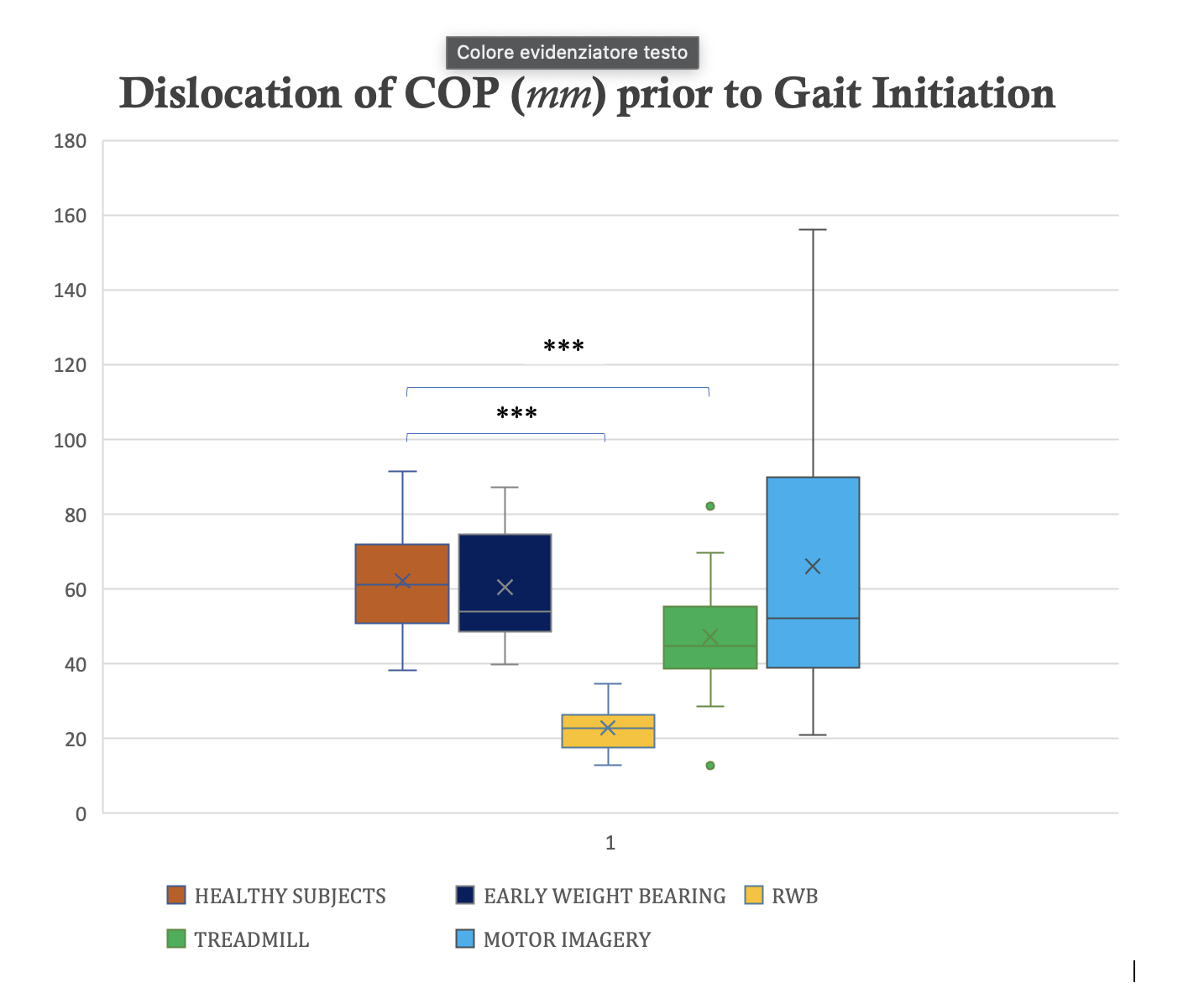
    This study analyzed the center of pressure (COP) lateral displacement prior to self-generated gait initiation.

    Methods

    Four groups of individuals with lower limb fractures were compared to a group of healthy.

    RWB group comprised patients who, according to healthcare system, did not access physiotherapy until weight-bearing was permitted.

    EWB group included patients who were operated on and immediately ready for weight-bearing on the operated limb.

    MOTOR IMAGERY group consisted of non-weight-bearing patients who were offered motor imagery exercises in combination with early rehabilitation.

    TREADMILL group included non-weight-bearing patients who received early rehabilitation and antigravity treadmill simulating walking without gravity.

    Subjects underwent clinical and functional evalutation and gait analysis at 3 months post-fracture; all subjects fully bear weight on both lower limbs.

    Data related to the COP lateral displacement preceding the heel-off were recorded in motion analysis laboratory using an optoelectronic system. Subjects were instructed to initiate walking with the limb that had the fracture.

    Results

    The analysis of the collected data identified a significant reduction in COP displacement during medio-lateral phase of anticipatory postural adjustments (APAs) after the period of inactivity in RWB and TREADMILL groups compared to the group of healthy subjects and the group of patients with early weight-bearing (P<.00001).

    EWB and MOTOR IMAGERY groups demonstrated a behavior similar to that of healthy subjects as early as 3 months post-operation (P=.92828 and P=.71138).

    Discussion and Conclusion

    The study highlighted the impaired load management in the groups of patients with lower limb fracture after cast immobilization during the task of gait initiation. Considering that the anticipatory postural adjustment (APA) occurred on the contralateral lower limb, these data support the line of studies [3] suggesting that motor behavior alterations, even in the presence of a fracture or “peripheral damage”, affect central movement control mechanisms.

    Furthermore, the study has allowed for the identification and quantification of movement strategies that are not otherwise measurable but are only observable in a clinical setting and persist in these patients despite the progressive recovery of weight-bearing.

    REFERENCES

    [1] Moisello C, et al. J Mot Behav. 2008;(40):165–176.

    [2] Winter DA. Gait Posture. 1995;(3):193–214.

    [3] Ebrahimabadi Z et al. Journal of Bodywork and Movement Therapies 2018;22(1):40–5.

  • Riabilitazione precoce con realtà aumentata e gamification dopo intervento chirurgico in pazienti con frattura di arto inferiore

    Early rehabilitation program with augmented reality and gamification after surgery in patients with lower limb fractures

    Introduction

    The rehabilitative pathway following surgery for lower limb fracture can be lengthy, significantly impacting both quality of life and work [ 1 ]. Weight-bearing guidelines are dependent on the operating surgeon, and typically, physiotherapy and functional retraining begin after a period of immobilization and weight-bearing restriction.

    After this period, patients often tend to underutilize the affected limb in functional tasks due to movement-related fear [ 2 ] or excessive control over the injured limb.

    Incorporating immersive and gamified exercise through augmented reality allows patients to shift the load correctly between both lower limbs. The challenging context serves as a catalyst in increasing  patient’s motivation to achieve their goals [ 3 ]. Furthermore, rehabilitation exergames contribute to increase patient engagement, thereby reducing the repetitiveness of the exercises.

    Methods

    Nineteen patients, ranging in age from 18 to 65 years, without severe comorbidities, and who were permitted early weight-bearing after surgery, were enrolled in the study.

    Eleven patients (control group) followed the standard rehabilitation protocol provided by the regional healthcare system, which included traditional physiotherapy. Conversely, eight patients (study group) participated in an early rehabilitation program (started on average 5 days post-surgery) that incorporated physiotherapy with exercises using the D-Wall Tecnobody® system. The exergames involved controlled weight transfers through pelvic movement, as well as the simulation of more complex gestures with the upper limbs, requiring proper control of the base of support.

    At 6 weeks and 3 months post-surgery, functional clinical questionnaires were administered. Simultaneously, the return to autonomy, work, and sports activities were investigated.

    Results

    At 6 weeks, the study group achieved complete (100%) return to full weight-bearing and autonomy, while 63% of patients in control group achieved full weight-bearing and 81% autonomy. In the study group, 66% had returned to work and 42% to sports activities, compared to 33% returning to work and 9% returning to sports in the control group. The groups showed statistical differences in NRS (p-value 0,046) and WOMAC (p-value 0,0013) questionnaires, with better scores in the study group. At 3 months, the difference between groups persisted in NRS score (p-value 0,0025), while the results of other questionnaires aligned, indicating functional recovery in both groups. No complications occurred.

    Overall, patients undergoing early physiotherapy intervention had an average of 11.42 physiotherapy treatments, while patients in the control group required the prescription of multiple physiotherapy session to achieve complete recovery, with an average of 28.18 (p-value 0,0012).

    Discussion and Conclusion

    The availability of current rehabilitation technologies, such as gamified exercises in augmented reality, offers the opportunity to transform traditional physiotherapy into a dynamic process. This allows patients to gain immediate awareness of the load-bearing possibilities on the operated limb within more complex movements, without developing protective mechanisms or avoiding the use of the fractured limb. This has the potential to decrease the inactivity period, the number of prescribed physiotherapy sessions, and the economic impact for patients receiving early weight-bearing recommendations after surgery.

    REFERENCES

    [ 1 ] Black JDJ et al., Early weight-bearing in operatively fixed ankle fractures: A systematic review, The Foot, 2013;23(2):78–85

    [ 2 ] Steven JL et al., Pain-related fear, catastrophizing and pain in the recovery from a fracture, Scandinavian Journal of Pain, 2010 ;1(1):38–42

    [ 3 ] S. Sandrone et al., Gamification and game-based education in neurology and neuroscience: application, challenges and opportunities, Brain Disorders, Vol. 1, 2021, 100008, ISSN 2666-4593