Autore: BRGSLV107

  • L’impatto di genere sull’attività fisica nella prevenzione dei disturbi muscoloscheletrici cronici: un’indagine web in Regione Lombardia (WeMoveForHealth)

    Gender impact on physical activity in musculoskeletal disorders prevention: a survey-based cross-sectional study in Lombardy Region, Italy (WeMoveForHealth)

    Autori

    Bargeri Silvia [IRCCS Istituto Ortopedico Galeazzi, Unit of Clinical Epidemiology, Milan, Italy]

    Palladino Chiara [University of Milan, Italy]

    Guida Stefania [IRCCS Istituto Ortopedico Galeazzi, Unit of Clinical Epidemiology, Milan, Italy]

    Bernardelli Giuseppina [Exercise Medicine Unit, Istituto Auxologico Italiano IRCCS, 20135 Milan, Italy; DISCCO Department, Dipartimento di Eccellenza 2023–2027 – University of Milan, 20122 Milan, Italy – IRCCS Istituto Auxologico Italiano – Servizio di Medicina dell’Esercizio, 20135 Milano, Italy]

    Banfi Giuseppe [IRCCS Istituto Ortopedico Galeazzi, Milan, Italy; Faculty of Medicine, Vita-Salute San Raffaele University, Milan, Italy]

    Background and aims

    Musculoskeletal disorders (MskDs) are among the leading causes of disability worldwide, with women experiencing a disproportionately higher burden. Although the preventive benefits of physical activity are well established by the World Health Organization (WHO), gender disparities in participation remain, particularly in Southern Europe. This study aims to examine gender differences in adherence to WHO physical activity recommendations in the Lombardy region, Italy.

    Methods

    We are conducting a cross-sectional online survey among adults aged 18–64 in the Lombardy region (Italy), launched in February 2025. The study was registered on ClinicalTrials.gov (NCT06747052) and approved by the Ethics Committee. The questionnaire was disseminated through flyers and online channels with support from Ospedale Galeazzi-Sant’Ambrogio, Milan. The primary outcome was adherence to WHO physical activity recommendations. We also collected socio-environmental variables, awareness about physical activity and MskD prevention, and perceived barriers. This preliminary analysis reports descriptive data from the first three (out of six) months recruitment.

    Results

    Preliminary results show that 723 participants answered the survey (55% of the estimated sample size) and 78% of them completed it fully. The sample included 69% women, 31% men, and 0.5% non-binary individuals, with a median age of 39 years. Most lived in medium-density urban areas (47%) and held a university degree (64%). Good health status was reported by 89%, and 50% reported at least one MskD. Overall, 61% of participants met WHO physical activity recommendations, with higher adherence among men (66%) than women (60%) and non-binary individuals (33%). Gender differences were found in household task division (73% women vs. 20% men), caregiving roles (14% women vs. 10% men), and full-time employment (69% women vs. 81% men). Awareness of physical activity’s preventive role was high across all groups (99%). Reported barriers included lack of time (69% women vs. 31% men), lack of motivation (65% women vs. 33% men vs. 2% non-binary), tiredness due to multiple commitments (76% women vs. 24% men), and family care responsibilities (75% women vs. 25% men).

    Conclusion

    Preliminary findings highlight gender disparities in physical activity participation. These insights can guide the development of inclusive and gender-sensitive strategies for the prevention of MskD, with particular attention to the needs and barriers faced by women and gender minorities.

    REFERENCES

    Liu S, Wang B, Fan S, Wang Y, Zhan Y, Ye D. Global burden of musculoskeletal disorders and attributable factors in 204 countries and territories: a secondary analysis of the Global Burden of Disease 2019 study. BMJ Open. 2022 Jun 29;12(6):e062183.

    Cule M, Guliani H. Are there gender based differences in participation and time spent in physical activity in Albania? Evidence from 2017-18 demographic and health survey. Arch Public Health. 2022 Aug 11;80(1):187.

    Ding D, Lawson KD, Kolbe-Alexander TL, Finkelstein EA, Katzmarzyk PT, van Mechelen W, Pratt M; Lancet Physical Activity Series 2 Executive Committee. The economic burden of physical inactivity: a global analysis of major non-communicable diseases. Lancet. 2016 Sep 24;388(10051):1311-24.

    Oliveira AJ, Lopes CS, Rostila M, Werneck GL, Griep RH, Leon AC, Faerstein E. Gender differences in social support and leisure-time physical activity. Rev Saude Publica. 2014 Aug;48(4):602-12.

    Guthold R, Stevens GA, Riley LM, Bull FC. Worldwide trends in insufficient physical activity from 2001 to 2016: a pooled analysis of 358 population-based surveys with 1.9 million participants. Lancet Glob Health. 2018 Oct;6(10):e1077-e1086.
  • Esplorazione delle definizioni di gender bias nella letteratura: una scoping review

    Exploring the definitions of gender bias in healthcare literature: a scoping review

    Autori

    Bargeri Silvia [IRCCS Istituto Ortopedico Galeazzi, Unit of Clinical Epidemiology, Milan, Italy; Department of Health Sciences, Faculty of Science, Vrije Universiteit Amsterdam, Amsterdam, the Netherlands]

    Schaap Laura [Department of Health Sciences, Faculty of Science, Vrije Universiteit Amsterdam, Amsterdam, the Netherlands; Amsterdam Public Health Research Institute, the Netherlands; Amsterdam Movement Sciences, Vrije Universiteit Amsterdam, the Netherlands]

    Innocenti Tiziano [Department of Health Sciences, Faculty of Science, Vrije Universiteit Amsterdam, Amsterdam, the Netherlands; GIMBE Foundation, Bologna, Italy]

    Ostelo Raymond [Department of Health Sciences, Faculty of Science, Vrije Universiteit Amsterdam, Amsterdam, the Netherlands; Amsterdam Movement Sciences, Vrije Universiteit Amsterdam, the Netherlands; Department of Epidemiology and Data Science, Amsterdam UMC, Vrije Universiteit & Amsterdam Movement Sciences, Musculoskeletal Health, Amsterdam, The Netherlands]

    Tomaiuolo Rossella [IRCCS Istituto Ortopedico Galeazzi, Milan, Italy; Faculty of Medicine, Vita-Salute San Raffaele University, Milan, Italy]

    Vidal-Itriago Andres [Medical Library, Vrije Universiteit Amsterdam, Amsterdam, The Netherlands]

    Rubinstein Sidney [Department of Health Sciences, Faculty of Science, Vrije Universiteit Amsterdam, Amsterdam, the Netherlands; Amsterdam Movement Sciences, Vrije Universiteit Amsterdam, the Netherlands]

    Background and aims

    There is a lack of clarity how gender bias is defined and understood in the literature, despite growing recognition in healthcare. Theoretical and conceptual definitions vary widely, and little is known about their relevance and transferability in different clinical contexts, including the musculoskeletal field. We aimed to systematically explore how gender bias is defined and characterized.

    Methods

    Study design: scoping review prospectively registered on Open Science Framework (https://osf.io/qxrwh). We searched MEDLINE, EMBASE, and Scopus up to January 2025, including studies providing structured definitions or conceptual frameworks to define and/or understand gender bias in any healthcare contexts. Analysis: General characteristics (e.g., healthcare populations, contexts) were extracted and definitions were grouped by main themes emerged. A checklist on gender constructs was adapted to describe relevance from an analytical perspective (e.g., inclusion, intersectionality) and potential for implementation (e.g., transferability in different contexts).

    Results

    The selection of studies has not yet been completed, however, based on the first half of full texts assessed for eligibility, 7 studies were included. All were conducted in high-income countries between 2008 and 2024. Most were theoretical papers or theory-guided reviews (71%). Gender bias was examined in multi-specialty fields (e.g., musculoskeletal, cardiology) (29%), pain-related conditions (e.g., back pain) (29%), and health systems-levels (43%). Two main themes emerged: (i) gender bias as unjustified clinical assumptions about sex or gender differences, reflected in stereotypes (e.g., brave man, emotional women) or gender neglect (43%); (ii) gender bias as structural issue driven by institutional norms and systemic inequality (e.g., embedded gender norms) (43%). From an analytical perspective, the studies on health-systems contexts used intersectional perspectives and inclusive language beyond male-female binary. In terms of potential for implementation, two studies proposed potentially transferable frameworks to other contexts.

    Conclusion

    Preliminary findings suggest that existing definitions of gender bias in healthcare vary in conceptual focus, with few providing inclusive, non-binary and potentially transferable frameworks for clinical context. These gaps highlight the need to better understand how gender bias is conceptualized and addressed within health systems and clinical practice, such as in the musculoskeletal field.

    REFERENCES

    1. Miani C, Wandschneider L, Niemann J, Batram-Zantvoort S, Razum O. Measurement of gender as a social determinant of health in epidemiology-A scoping review. PLoS One. 2021;16:e0259223.
    2. Hamberg K. Gender bias in medicine. Womens Health (Lond). 2008;4:237-43.
    3. Risberg G, Johansson EE, Hamberg K. A theoretical model for analysing gender bias in medicine. Int J Equity Health. 2009;8:28.
    4. Peters MDJ, Godfrey C, McInerney P, Munn Z, Tricco AC, Khalil, H. Scoping Reviews (2020). Aromataris E, Lockwood C, Porritt K, Pilla B, Jordan Z, editors. JBI Manual for Evidence Synthesis. JBI; 2024. Available from: https://synthesismanual.jbi.global. Accessed on 24/11/2024.
    5. Tricco AC, Lillie E, Zarin W, O’Brien KK, Colquhoun H, Levac D, et al. PRISMA Extension for Scoping Reviews (PRISMA-ScR): Checklist and Explanation. Ann Intern Med. 2018;169:467-73.
  • Prestazioni di sei chatbots di intelligenza artificiale rispetto alle linee guida di pratica clinica nel prendere decisioni informate per il dolore radicolare lombosacrale: uno studio trasversale

    Prestazioni di sei chatbots di intelligenza artificiale rispetto alle linee guida di pratica clinica nel prendere decisioni informate per il dolore radicolare lombosacrale: uno studio trasversale

    Prestazioni di sei chatbots di intelligenza artificiale rispetto alle linee guida di pratica clinica nel prendere decisioni informate per il dolore radicolare lombosacrale: uno studio trasversale

    Comparative performance of six artificial intelligence chatbots in providing health advice for radicular lumbosacral pain against clinical practice guidelines: a cross-sectional study

    Autori

    Bargeri Silvia [IRCCS Istituto Ortopedico Galeazzi, Unit of Clinical Epidemiology, Milan, Italy]

    Guida Stefania [IRCCS Istituto Ortopedico Galeazzi, Unit of Clinical Epidemiology, Milan, Italy]

    Turolla Andrea [Department of Biomedical and Neuromotor Sciences (DIBINEM), Alma Mater University of Bologna, Bologna, Italy] [Unit of Occupational Medicine, IRCCS Azienda Ospedaliero-Universitaria di Bologna, Bologna, Italy]

    Castellini Greta [IRCCS Istituto Ortopedico Galeazzi, Unit of Clinical Epidemiology, Milan, Italy]

    Pillastrini Paolo [Department of Biomedical and Neuromotor Sciences (DIBINEM), Alma Mater University of Bologna, Bologna, Italy] [Unit of Occupational Medicine, IRCCS Azienda Ospedaliero-Universitaria di Bologna, Bologna, Italy]

    Palese Alvisa [Department of Medical Sciences, University of Udine, Udine, Italy]

    Cook Chad [Department of Orthopaedics, Duke University, Durham, NC] [Duke Clinical Research Institute, Duke University, Durham, NC] [Department of Population Health Sciences, Duke University, Durham, NC]

    Rossettini Giacomo [School of Physiotherapy, University of Verona, Verona, Italy] [Department of Human Neurosciences, University of Rome ‘Sapienza Roma’, Rome, Italy] [Musculoskeletal Pain and Motor Control Research Group, Faculty of Sport Sciences, Universidad Europea de Madrid, 28670 Madrid, Spain] [Musculoskeletal Pain and Motor Control Research Group, Faculty of Health Sciences, Universidad Europea de Canarias, Tenerife, 38300 Canary Islands, Spain]

    Gianola Silvia [IRCCS Istituto Ortopedico Galeazzi, Unit of Clinical Epidemiology, Milan, Italy]

    Introduction

    Large Language Models (LLMs) are advanced deep learning systems designed to understand, generate, and interact with human language. In the field of LLMs, artificial intelligence (AI) chatbots represent emerging tools that are trained to generate human-like text based on large amounts of data. This technological advancement is particularly significant in healthcare, where patients increasingly rely on AI chatbots for information on health conditions, treatment options, and preventive measures, essentially serving as virtual assistants. Specifically, for musculoskeletal pain conditions of the lumbar spine, the performance of AI chatbots in aligning with clinical practice guidelines (CPGs) for providing answers to complex clinical questions on lumbosacral radicular pain is still unclear.

    Methods

    We conducted a cross-sectional study evaluating AI chatbots’ responses against CPGs recommendations for diagnosing and treating lumbosacral radicular pain. Eligible recommendations were extracted from a previous systematic review of CPGs and were categorized into ‘should do’, ‘could do’, ‘do not do’, or ‘uncertain’. Clinical questions derived from these CPGs were posed to the latest versions (updated in April 2024) of the following six AI chatbots: ChatGPT-3.5, ChatGPT-4, Microsoft Copilot, Google Gemini, Claude, and Perplexity. We assessed the AI chatbots performance by (i) measuring the internal consistency of their answers through the percentage of text similarity when a question was re-asked for three times, (ii) evaluating the reliability between two independent reviewers in grading chatbots responses using Fleiss’ kappa coefficients and (iii) comparing the accuracy of AI chatbots answers to CPG recommendations, determined by the frequency of agreement among all judgments.

    Results

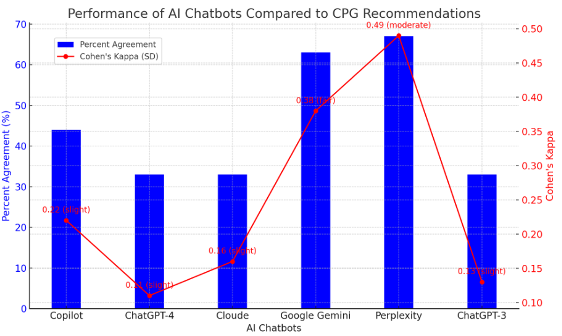
    Nine clinical questions were tested. Overall, we found highly variable internal consistency in the responses from chatbots for each question (median range 26% to 68%). The intra-rater reliability was “almost perfect” for both reviewers in Copilot, Perplexity, and ChatGPT-3.5, and “substantial” in ChatGPT-4, Claude, and Gemini. Inter-rater reliability was “almost perfect” in Perplexity (0.84, SE: 0.16) and ChatGPT-3.5 (0.85, SE: 0.15), “substantial” in Copilot (0.69, SE: 0.20), Claude (0.66, SE: 0.21), and Google Gemini (0.80, SE: 0.18), and “moderate” for ChatGPT-4 (0.54, SE: 0.23). Compared to CPGs recommendations, Perplexity had the highest accuracy (67%), followed by Google Gemini (63%) and Copilot (44%). Conversely, Claude, ChatGPT-3.5, and ChatGPT-4 showed the lowest, each scoring 33% (Figure 1 and 2).

    Discussion and Conclusion

    Despite the variability in internal consistency and good intra- and inter-rater reliability, the AI chatbots’ responses often did not align with CPGs recommendations for diagnosing and treating lumbosacral radicular pain. Clinicians and patients should pay attention when using these AI models, since one-third to two-thirds of the recommendations provided may be inappropriate or misleading according to specific chatbots.

    REFERENCES

    Clusmann J, Kolbinger FR, Muti HS, et al. The future landscape of large language models in medicine. Commun Med. 2023;3(1):141. doi:10.1038/s43856-023-00370-1

    Park YJ, Pillai A, Deng J, et al. Assessing the research landscape and clinical utility of large language models: a scoping review. BMC Med Inform Decis Mak. 2024;24(1):72. doi:10.1186/s12911-024-02459-6

    Khorami AK, Oliveira CB, Maher CG, et al. Recommendations for Diagnosis and Treatment of Lumbosacral Radicular Pain: A Systematic Review of Clinical Practice Guidelines. J Clin Med 2021; 10(11).

    Norman GR, Streiner DL. Biostatistics: The Bare Essentials. People’s Medical Publishing House; 2014.

  • Molte meta-analisi sono in accordo sull’efficacia e la sicurezza della riabilitazione con realtà virtuale dopo l’ictus: una overview di revisioni sistematiche

    Agreement among multiple meta-analyses on the effectiveness and safety of virtual reality rehabilitation after stroke: an overview of systematic reviews

    Introduction

    Worldwide, stroke is the second leading cause of death and a major cause of disability, with over 12 million new strokes reported each year. With advances in health technologies, the range of interventions for stroke survivors is in continuous expansion. Among these, virtual reality (VR) in neurorehabilitation has proved an engaging, interactive, patient-centred, and relatively inexpensive modality to enhance functional recovery. We aim to conduct an overview of systematic reviews exploring the agreement on the effectiveness and the safety of VR technologies for clinical outcomes in stroke survivors to give a comprehensive balance of effects.

    Methods

    We searched multiple databases up to 17 January 2023 for systematic reviews comparing any kind of VR technology (with or without conventional therapy) versus conventional therapy alone. The primary outcome was upper limb function and activity. The secondary outcomes were gait, mobility and balance, limitation of activities, participation, cognitive and mental function and adverse events. Methodological quality was assessed using the A MeaSurement Tool to Assess systematic Reviews (AMSTAR 2) and the certainty of evidence (CoE) using the Grading of Recommendations, Assessment, Development, and Evaluations (GRADE) approach. Considering reviews assessing the same clinical questions on the same outcome measurement, we examined concordance and discordance of meta-analyses effects sizes (i.e., effective intervention vs no difference) using a conceptual framework based on the Jadad algorithm.

    Results

    We included 58 reviews of 345 unique primary studies. Overall, 42 (72.4%) had conducted meta-analysis  Many reviews assessed mixed (e.g., both subacute and chronic) (69%) or chronic onset of stroke (17.2%) and were judged critically low in quality by AMSTAR 2 (77.2%). For the primary outcome, meta-analyses reported discordant findings in the direction of effects. Applying the Jadad algorithm, VR with or without conventional therapy seems to be more effective than conventional therapy alone on upper limb function (Fugl-Meyer Assessment for Upper Extremity [ FMA-UE ]), with low to moderate CoE and possible to definite clinical relevance (Figure 1). For secondary outcomes there was uncertainty about the superiority or no difference between groups due to substantial heterogeneity of measurement scales (Figure 2). A few reviews (n=6) reported the occurrence of mild adverse events.

    Discussion and Conclusion

    Current evidence suggests that multiple meta-analyses agreed on the superiority of VR combined or not with conventional therapy over conventional therapy on FME-UE. These findings support the hypothesis that VR may help to improve the recovery of upper limb motor function and quality of movement. As a safe intervention, clinicians should consider embed VR technologies into their practice and adapt them according to patients’ needs and preferences. Caution in the interpretation of findings is warranted given the poor methodological quality of the reviews.

    REFERENCES

    Collaborators, G. B. D. Stroke. “Global, Regional, and National Burden of Stroke and Its Risk Factors, 1990-2019: A Systematic Analysis for the Global Burden of Disease Study 2019.” Lancet Neurol 20, no. 10 (Oct 2021): 795-820.

    Imbimbo, I., D. Coraci, C. Santilli, C. Loreti, G. Piccinini, D. Ricciardi, L. Castelli, et al. “Parkinson’s Disease and Virtual Reality Rehabilitation: Cognitive Reserve Influences the Walking and Balance Outcome.” Neurol Sci 42, no. 11 (Nov 2021): 4615-21.

    Jadad, A. R., D. J. Cook, and G. P. Browman. “A Guide to Interpreting Discordant Systematic Reviews.” [In eng]. Cmaj 156, no. 10 (May 15 1997): 1411-6.

  • Ci sono differenze di sesso e genere negli interventi valutati dagli studi randomizzati controllati sulla lombalgia? Uno studio di meta-ricerca

    Are there sex and gender differences in low back pain interventions of randomized controlled trials? A meta-research study

    Introduction

    Low back pain (LBP) is the leading cause of Years Lived with Disability worldwide. The global prevalence of LBP is higher among females compared with males across all age groups (1). To improve LBP management, various rehabilitation interventions recommended by high quality clinical practice guidelines are effective (2). However, treatment effects can be different in male and female. This can also depend on the recruitments of participants in the randomized controlled trials (RCTs). Thus, we investigated the prevalence of different sex and gender participants in LBP trials to improve knowledge in sex and gender differences, enhancing tailored healthcare and external validity of randomized controlled trials.

    Methods

    We performed a cross-sectional meta-research study starting from 46 RCTs included in a recent published network meta-analysis (3) about the effectiveness and safety of pharmacological and non-pharmacological interventions in acute and subacute LBP. We extracted data on the percentage of different sex and gender participants and the sex balance (i.e., defined as 45%-55% of women participation) in each treatment intervention. We also assessed if studies reported outcome data according to sex and/or gender.

    Results

    Overall, 45 RCTs (98%) provided information about sex (86.7% in general population, 13.3% in work-related population) for 14 treatment interventions in 85 arms. No study reported data on gender (i.e.., sex and gender terms were used interchangeably). More than half study arms (56.4%) were sex unbalanced, favoring more men in 58.3%. Median percentage of women was 48% (IQR 40%-54.6%) in the general population (n=75 arms of interventions) and 47.2% (8.6%-53.3%) in the work-related population (n=10 arms). In the general population, women were less recruited in cognitive behavioral interventions (35.5%) while more recruited in heat wrap (59.5%). In the work-related population, women were less recruited in back school interventions (8.6%) while more recruited in exercise (57.2%) (Figure 1). Only two studies reported outcome data considering sex.

    Discussion and Conclusion

    Women seem to be under-represented in some interventions delivered for LBP, with unbalanced recruitment in more than half studies. We call for balancing the enrollment of different sex and gender participants in clinical research to ensure that LBP interventions are equally safe and effective for all patients.

    REFERENCES

    1.         Collaborators GBDLBP. Global, regional, and national burden of low back pain, 1990-2020, its attributable risk factors, and projections to 2050: a systematic analysis of the Global Burden of Disease Study 2021. Lancet Rheumatol. 2023;5(6):e316-e29.

    2.       Oliveira CB, Maher CG, Pinto RZ, Traeger AC, Lin CC, Chenot JF, van Tulder M, Koes BW. Clinical practice guidelines for the management of non-specific low back pain in primary care: an updated overview. Eur Spine J. 2018 Nov;27(11):2791-2803.

    3.         Gianola S, Bargeri S, Del Castillo G, Corbetta D, Turolla A, Andreano A, et al. Effectiveness of treatments for acute and subacute mechanical non-specific low back pain: a systematic review with network meta-analysis. Br J Sports Med. 2022;56(1):41-50.