THE UNMET NEEDS OF CANCER SURVIVORS IN THE AUSL IRCCS REGGIO EMILIA: A QUALITATIVE STUDY
THE UNMET NEEDS OF CANCER SURVIVORS IN THE AUSL IRCCS REGGIO EMILIA: A QUALITATIVE STUDY
Autori
Angela Contri (Clinical and Experimental Medicine Program, University of Modena and Reggio Emilia, Italy)
Luca Ghirotto (Psycho-Oncology Unit, Azienda USL – IRCCS Reggio Emilia, Italy)
Stefania Costi (Physical Medicine and Rehabilitation Unit, Azienda USL– IRCCS Reggio Emilia, Italy; Department of Surgical, Medical, Dental and Morphological Sciences Related to Transplant, Oncology and Regenerative Medicine, University of Modena and Reggio Emilia, Modena, Italy)
Introduction
The growing number of cancer survivors worldwide highlights the importance of providing services that address their specific unmet needs. Individuals are identified as ‘cancer survivors’ (CS) from the moment of diagnosis throughout their lifetime.
CS face a range of physical, psychological, informational and practical challenges that often result in unmet needs that go unrecognised and unaddressed.
Understanding and measuring the unmet needs of CS is critical to identifying gaps in their care experience and providing opportunities for patient-centred care. Unmet needs may be closely linked to contextual factors such as socio-economic and cultural factors. Therefore, this issue and the provision of patient-centred services should be explored in the context of application.
The aim of this qualitative study is to explore the unmet needs perceived by CSs in our context (AUSL-IRCCS Reggio Emilia, Italy), in order to identify areas for redesign and improvement of services aimed at patient outcomes.
Methods
A cross-sectional, qualitative study was conducted from April 2023 to March 2024 through focus groups and individual interviews, as part of a sequential mixed-methods design.
Patients were invited to participate if were ≥18 years of age, had a diagnosis of cancer (not skin-related) with a 5-year survival of at least 65%, and had completed the acute phase of treatment at the Reggio Emilia Oncology Centre.
Caregivers were invited to participate if identified as caregivers by the contacted patients.
Caregivers with oncological disease in active treatment were excluded.
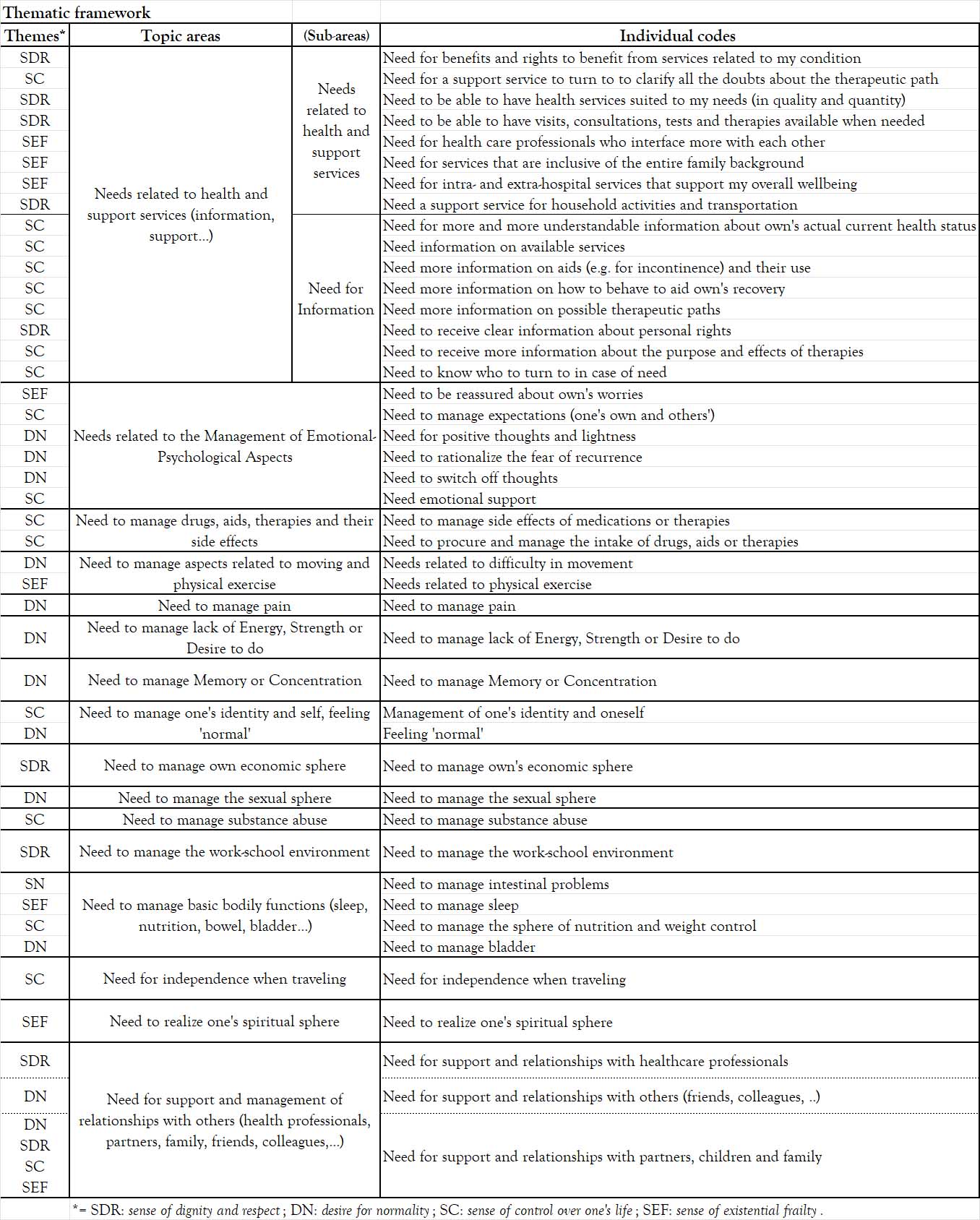
Thematic framework analysis was employed to examine the perspectives of patients and caregivers on the unmet needs of CSs. An inductive framework guided the processing of data coming from the pre-interview material, while a deductive one guided the analysis of data gathered during interviews and focus groups.
The protocol of this study was registered on ClinicalTrials.gov (ID NCT06236373).
Results
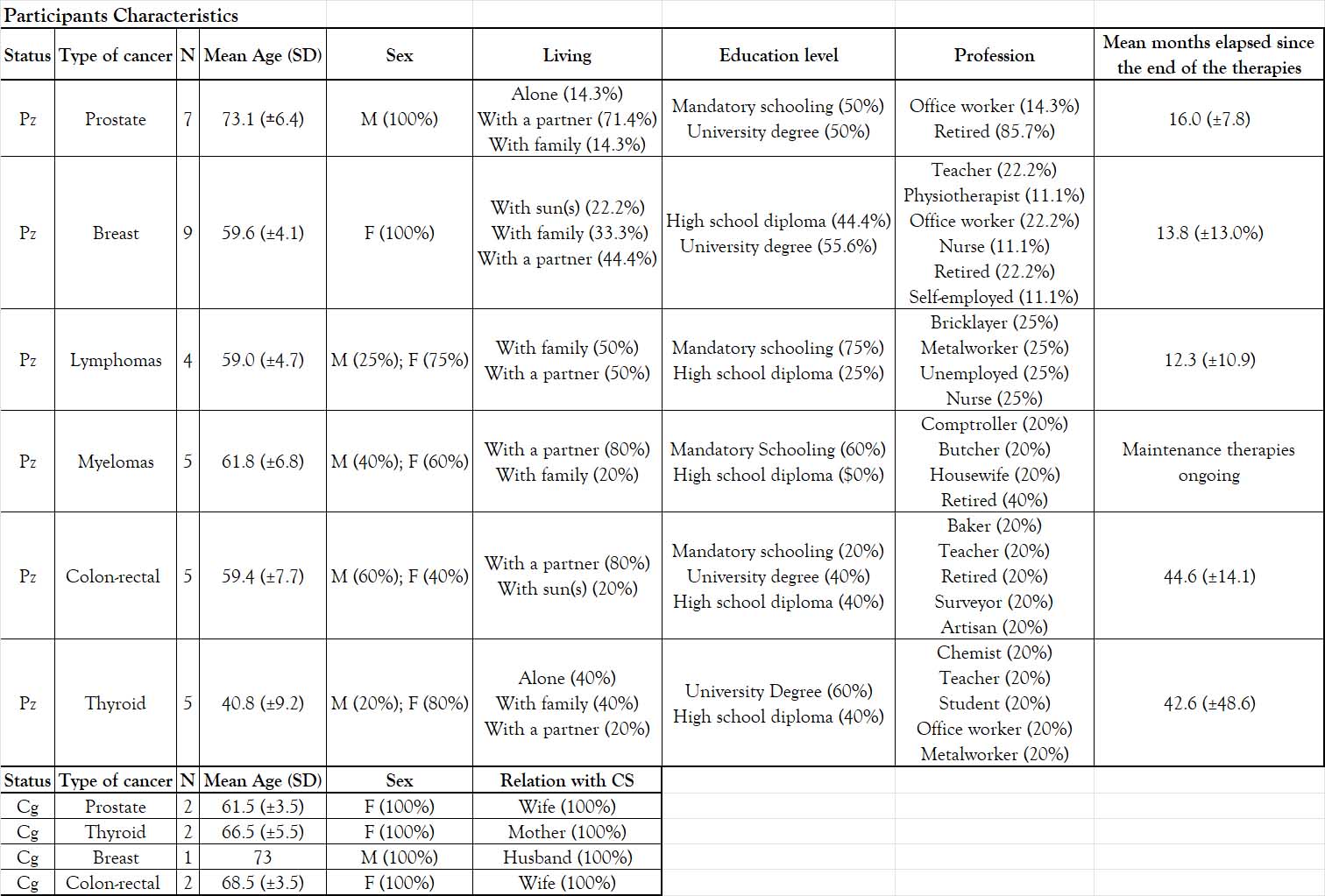
We collected data from 42 participants, comprising 35 patients and 7 caregivers.
The top three needs in terms of perceived frequency resulted to be: managing the sexual sphere, managing drugs and therapies side effects, and realising one’s spiritual sphere. When CSs were asked about the importance they attributed to those needs, regardless of whether they experienced them or not, the order of importance was completely disrupted from the frequency-based one. The top three in the importance-based order were: managing lack of memory and/or concentration, managing aspects of movement and exercise, and managing drugs and therapies side effects.
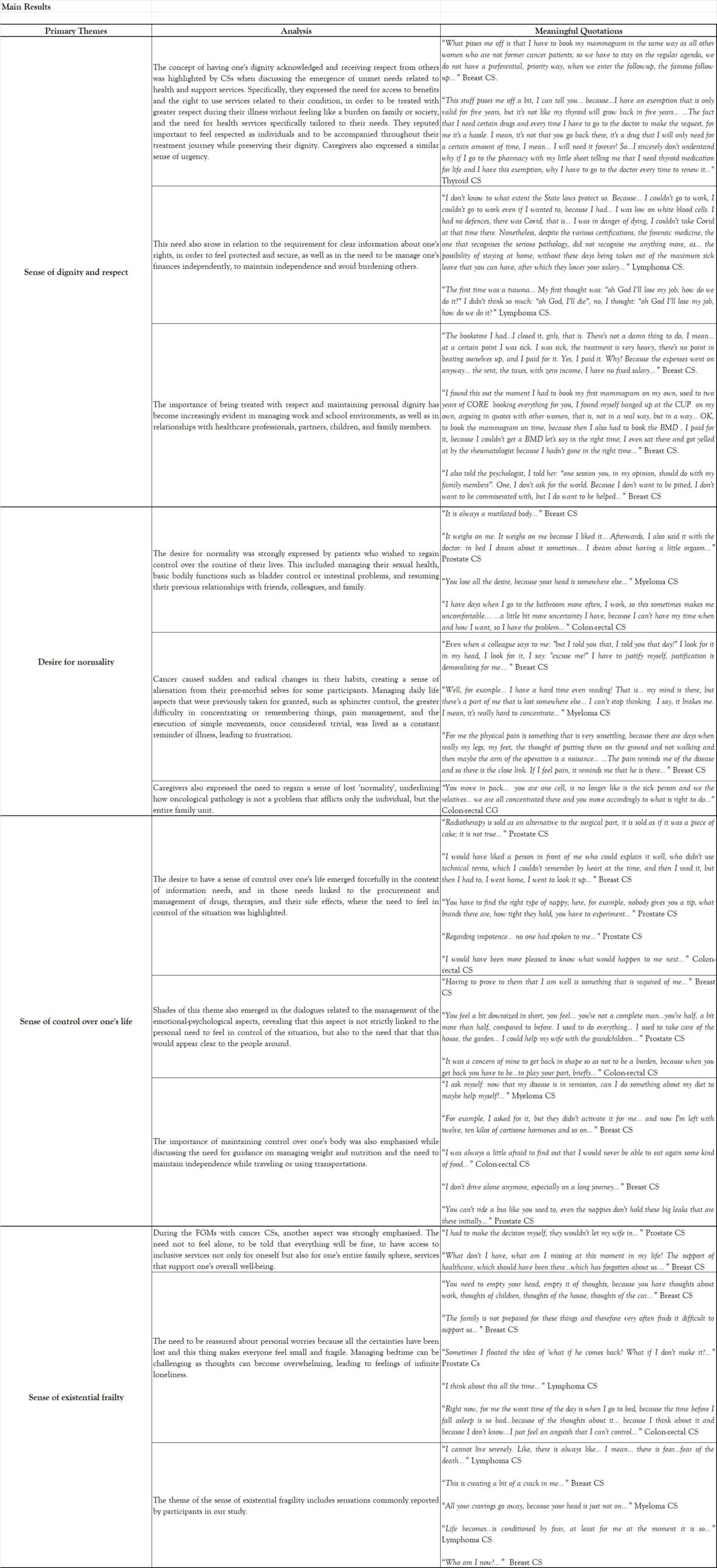
Four primary themes were identified, encompassing 16 sub-themes.
The main themes were: ‘sense of dignity and respect’, ‘desire for normality’, ‘sense of control over one’s life’, and ‘sense of existential frailty’. These overarching themes encapsulate the underlying significance of the unmet needs articulated by the participants.
Discussion and Conclusion
This research has enabled us to identify which unmet needs are perceived by our patients to be the most common and the most urgent.
Living as a CS entails integrating the experience of illness into one’s life narrative and cultivating a fulfilling life despite illness. This journey involves overcoming and adapting to the challenges of the illness, managing its impact on the mind and body, and ultimately empowering CS to thrive and flourish.
Analysis of this data will help identify patterns and needs across all cancer patients, enabling organisations to prioritise, and thus address, the most pressing ones.
It is essential for the healthcare system to foster a culture of continuous improvement. By understanding and addressing the unmet needs of cancer patients, healthcare services can implement a patient-centred approach that not only improves patient satisfaction, but also contributes to the overall well-being of all individuals.
REFERENCES
Gale NK, Heath G, Cameron E, Rashid S, Redwood S. Using the framework method for the analysis of qualitative data in multi-disciplinary health research. BMC medical research methodology. 2013;13:117-117.
Xiao J, Ng MSN, Yan T, Chow KM, Chan CWH. How patients with cancer experience dignity: An integrative review. Psychooncology. 2021;30:1220-1231.
Tong A, Sainsbury P, Craig J. Consolidated criteria for reporting qualitative research (COREQ): a 32-item checklist for interviews and focus groups. Int J Qual Health Care. 2007;19:349-357.
Fitch MI, Lockwood G, Nicoll I. Physical, emotional, and practical concerns, help-seeking and unmet needs of rural and urban dwelling adult cancer survivors. European Journal of Oncology Nursing. 2021;53:101976.
MacDonald C, Theurer JA, Doyle PC. “Cured” but not “healed”: The application of principles of palliative care to cancer survivorship. Social Science & Medicine. 2021;275:113802.