THE BOOK POWER: HOW BIBLIOTHERAPY CAN HELP ONCOLOGICAL PATIENTS. A SCOPING REVIEW
Autori
Francesca Sposito
Francesco Bonanno
Antonio Di Dio
Giada Di Marco
Silvia Saraceno
Filippo Cavallaro
Introduction to clinical case
The impact of cancer is not limited to its physical pathology; it also profoundly disrupts psychological well-being. The literature highlights the importance of enhancing resilience in oncology patients to preserve mental health and quality of life (1). Whitin the spectrum of verbal therapy techniques (including expressive writing and video narratives), bibliotherapy is defined as the utilization of books as a form of therapy in the context of physical or mental disorders (2). Recommended books should feature narratives with a background like the patient’s life. Bibliotherapy is based on the concept of ‘catharsis’, defined as liberation from suffering. The patient is required to achieve complete immersion in the reading material and empathize with the character. Bibliotherapy represents a form of self-help that oncology patients can utilize to address diagnosis, communicate with family and friends, adapt to change, and establish a new sense of normalcy.
Methods
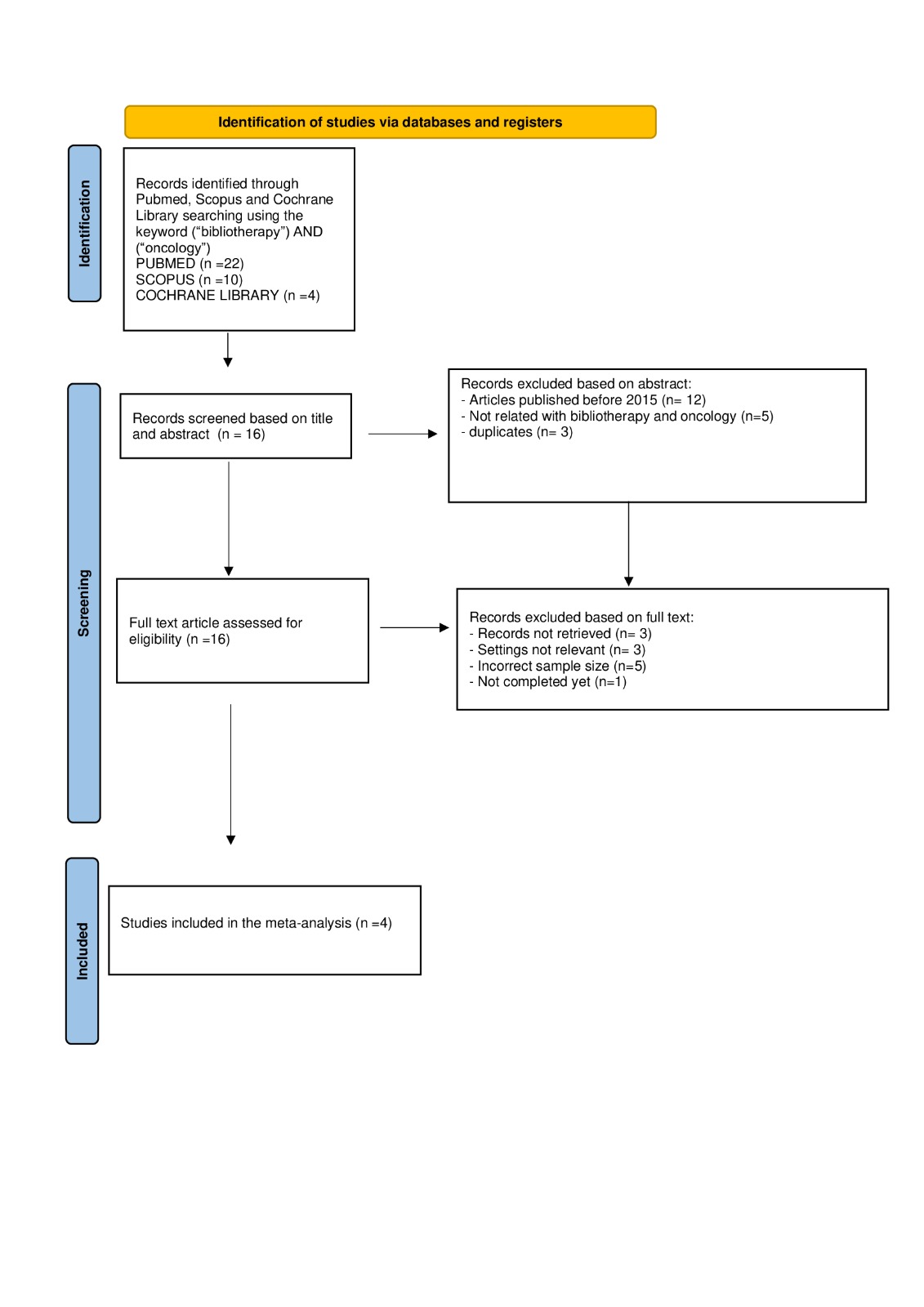
Authors searched English articles published from 2015 to 2025 according to the Preferred Reporting Items for Systematic Reviews and Meta-Analyses (PRISMA) principles. The electronic databases PubMed, Scopus, Cochrane Library were investigated, using the following key words, which were combined to achieve maximum search strategy sensitivity: (“bibliotherapy”) AND (“oncology”). First, articles were screened by title and abstract, using the following inclusion criteria for selection: (1) written in English language; (2) published on indexed journals; and (3) dealing with bibliotherapy and oncology patients. The exclusion criteria were (1) reviews; (2) papers written in other languages than English; and (3) data not dealing with bibliotherapy and oncological setting. Second, the full texts of the selected articles were screened with further exclusions according to the previously described criteria. A PRISMA flowchart of the selection and screening method is provided in Figure 1.
Results
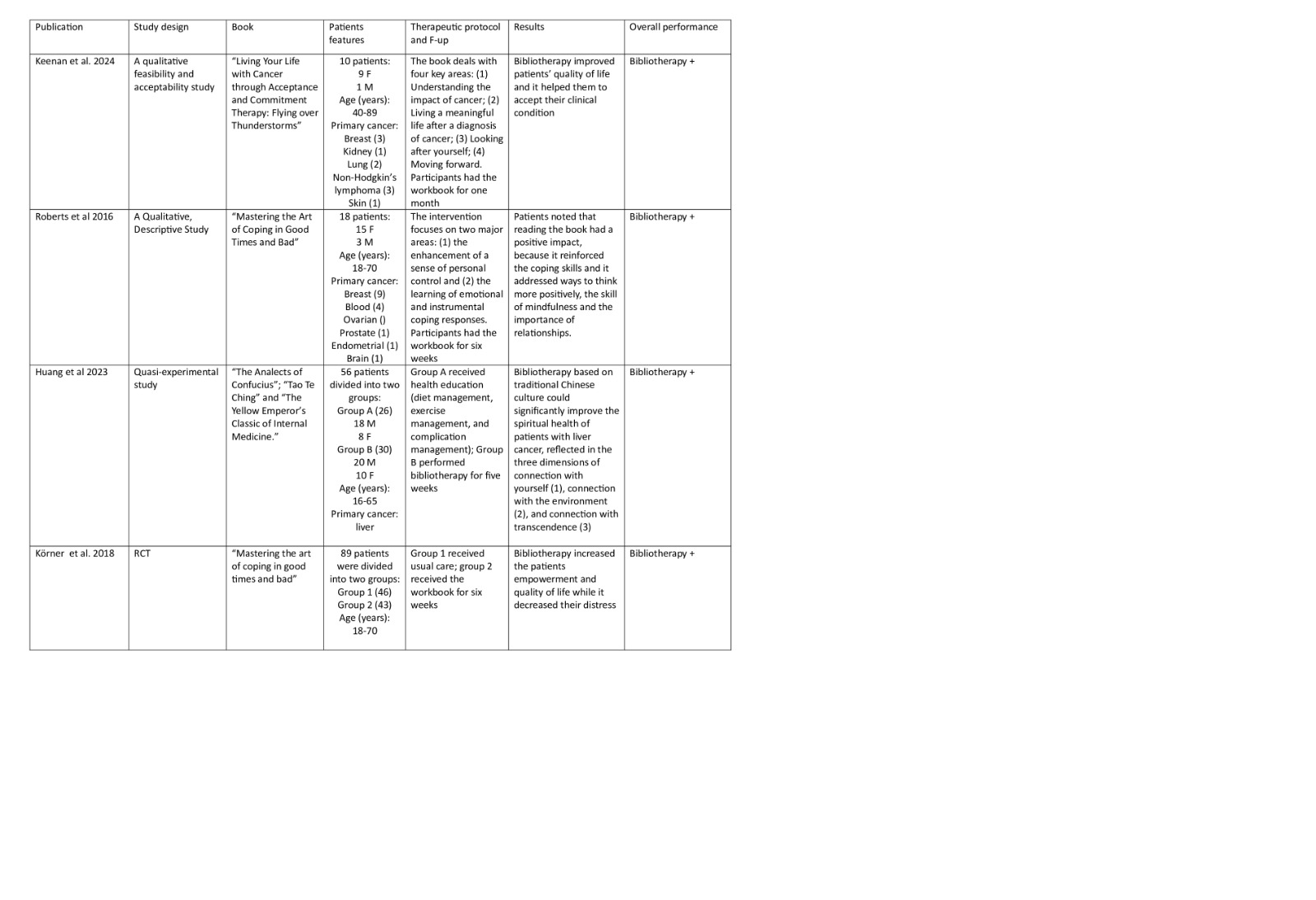
Figure 2 summaries the principal key point of each article analyzed. All the authors proposed different books to improve patients’ quality of life and to reinforce relationship and meditation skills. These results highlight the central role of bibliotherapy as a valid method for accompanying and guiding the oncological patient throughout his treatment pathway.
Discussion and clinical relevance
Based on literature research, the authors have defined the contribution of bibliotherapy in the non-pharmacological management of mental health in oncology patients. Reading materials recommended by specialists have been associated with an enhanced perception of intrapersonal functioning and decreased suffering in individuals affected by cancer (3). The role of bibliotherapy is not curative; instead, it supports the patient in achieving enhanced adaptation to their disease.
REFERENCES
- Tamura S, Suzuki K, Ito Y, Fukawa A. Factors related to the resilience and mental health of adult cancer patients: a systematic review. Support Care Cancer. 2021 Jul;29(7):3471-3486. doi: 10.1007/s00520-020-05943-7. Epub 2021 Jan 29. PMID: 33512578.
- Jones JK, Evans JF, Barfield RC. The Utility of Verbal Therapy for Pediatric Cancer Patients and Survivors: Expressive Writing, Video Narratives, and Bibliotherapy Exercises. Front Pediatr. 2021 Feb 4;9:579003. doi: 10.3389/fped.2021.579003. PMID: 33614548; PMCID: PMC7889798.
- Keenan E, Morris R, Vasiliou VS, Thompson AR. A qualitative feasibility and acceptability study of an acceptance and commitment-based bibliotherapy intervention for people with cancer. J Health Psychol. 2024 Apr;29(5):410-424. doi: 10.1177/13591053231216017. Epub 2023 Dec 29. PMID: 38158736; PMCID: PMC11005316.