Effectiveness of remotely-delivered Psychologically-Informed Physical Therapy (PIPT) for people with chronic pain: a systematic review with meta-analysis
Autori
Matteo Cioeta [Department of Medicine and Health Science “Vincenzo Tiberio”, University of Molise, Campobasso, Italy]
Luca Giacobbe [Department of Human Neurosciences, Sapienza University of Rome, 00185 Rome, Italy]
Marco Medugnp [Department of Human Neurosciences, Sapienza University of Rome, 00185 Rome, Italy]
Davide Lampasi [Department of Human Neurosciences, Sapienza University of Rome, 00185 Rome, Italy]
Leonardo Pellicciari [IRCCS Istituto delle Scienze Neurologiche di Bologna, Bologna, Italy]
Giuseppe Giovannico [Department of Medicine and Health Science “Vincenzo Tiberio”, University of Molise, Campobasso, Italy]
Germano Guerra [Department of Medicine and Health Science “Vincenzo Tiberio”, University of Molise, Campobasso, Italy]
Giovanni Galeoto [Department of Human Neurosciences, Sapienza University of Rome, 00185 Rome, Italy]
Background and aims
To evaluate the effectiveness of remotely-delivered Psychologically-Informed Physical Therapy (PIPT) for individuals with chronic pain (CP) through a systematic review and meta-analysis
Methods
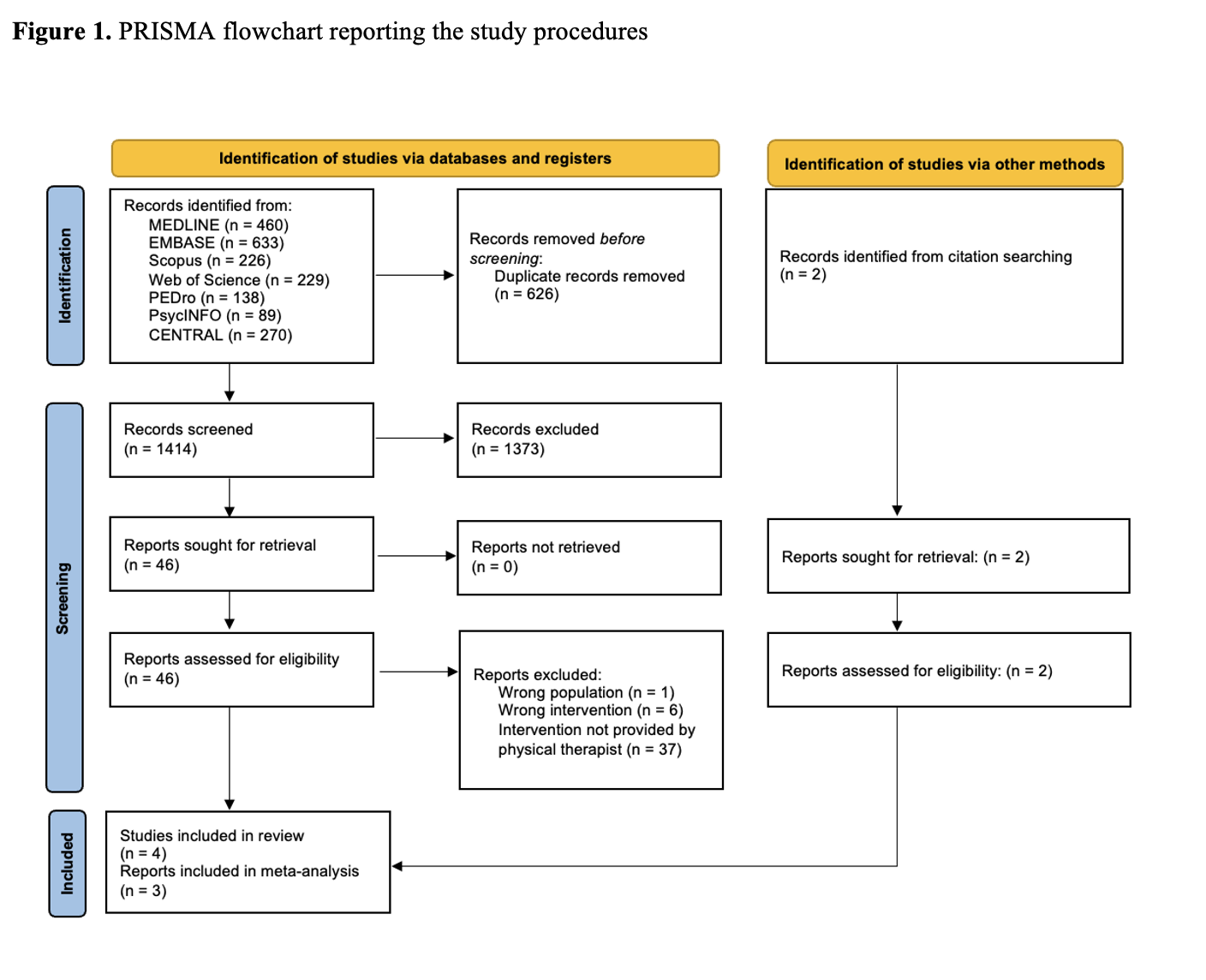
Seven databases were searched up to May 2025. Randomized controlled trials (RCTs) assessing the effects of PIPT by physiotherapists for people with CP were included. Primary outcomes were pain and disability; secondary outcomes included quality of life, self-efficacy, kinesiophobia, and costs. The risk of bias was assessed using the Cochrane RoB 2.0 tool. Random effect meta-analyses were performed. GRADE approach was used to rate the certainty of evidence.
Results
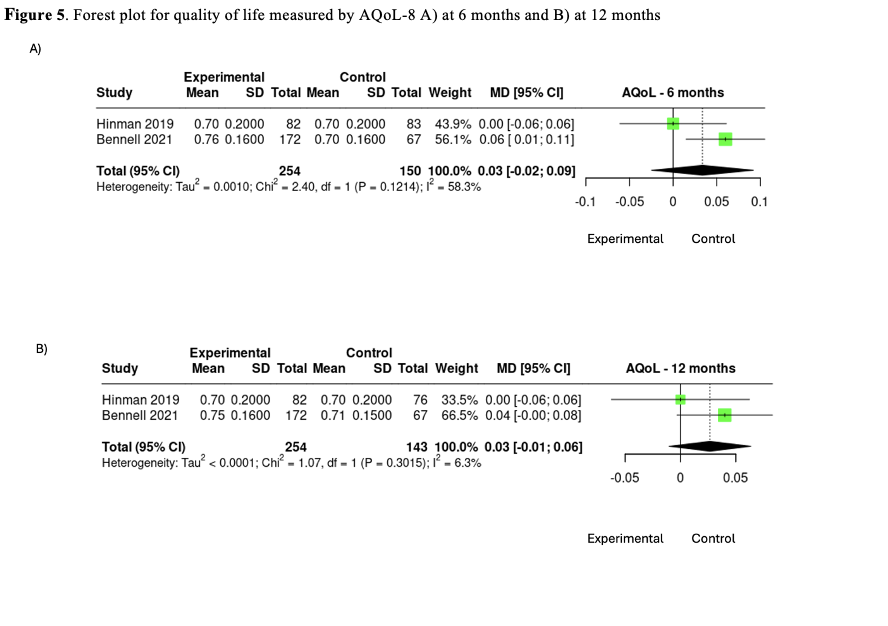
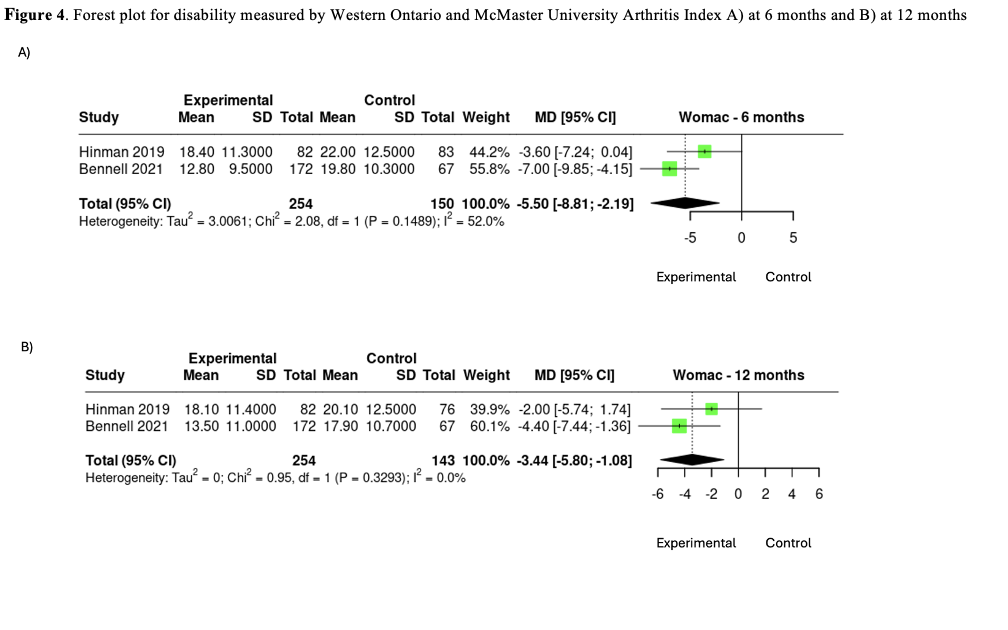
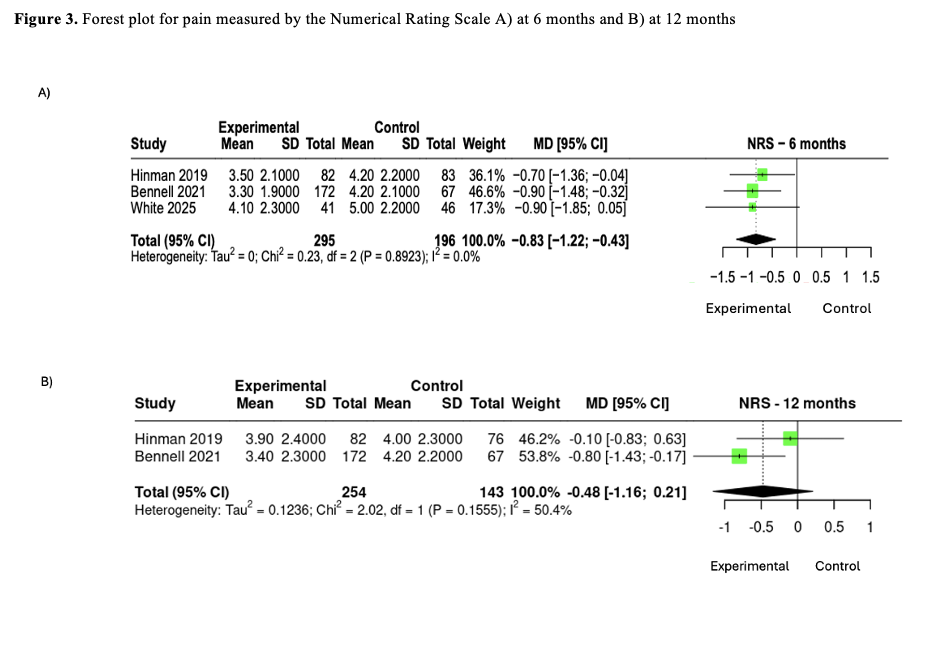
Four RCTs (n=911 participants) involving patients with knee osteoarthritis were included. The meta-analysis showed low certainty of evidence that remotely-delivered PIPT reduces pain (MD = -0.81 at 6 months; -0.50 at 12 months) and moderate certainty of evidence that it can reduce disability (MD = -3.44 at 6 months; -5.71 at 12 months) compared to other remote interventions. Quality of life improvements were also reported but did not exceed the minimal clinically important difference. One study showed improved self-efficacy but no significant effects on kinesiophobia or healthcare costs. The risk of bias was assessed as ranging from some concerns to high.
Conclusion
Remotely delivered PIPT appears effective in improving pain and disability in individuals with osteoarthritis. Although effect sizes were small, these findings support the integration of psychological principles into telerehabilitation. Further research is warranted to explore its generalizability to other chronic pain conditions and to compare its effectiveness against psychologist-led interventions.
REFERENCES
- Treede RD, Rief W, Barke A, Aziz Q, Bennett MI, Benoliel R, Cohen M, Evers S, Finnerup NB, First MB, Giamberardino MA, Kaasa S, Korwisi B, Kosek E, Lavand’homme P, Nicholas M, Perrot S, Scholz J, Schug S, Smith BH, Svensson P, Vlaeyen JWS, Wang SJ. Chronic pain as a symptom or a disease: the IASP Classification of Chronic Pain for the International Classification of Diseases (ICD-11). Pain. 2019 Jan;160(1):19-27. doi: 10.1097/j.pain.0000000000001384. PMID: 30586067.
- Main CJ, Steven Z. George, Psychologically Informed Practice for Management of Low Back Pain: Future Directions in Practice and Research, Physical Therapy, Volume 91, Issue 5, 1 May 2011, Pages 820–824, https://doi.org/10.2522/ptj.20110060
- Main CJ, Ballengee LA, George SZ, Beneciuk JM, Greco CM, Simon CB Psychologically Informed Practice: The Importance of Communication in Clinical Implementation, Physical Therapy, Volume 103, Issue 7, July 2023, pzad047, https://doi.org/10.1093/ptj/pzad047
- Doorley JD, Lentz TA, Yeh GY, Wayne PM, Archer KR, Vranceanu AM. Technology-Enhanced Delivery Models to Facilitate the Implementation of Psychologically Informed Practice for Chronic Musculoskeletal Pain. Phys Ther. 2022 Dec 30;103(1):pzac141. doi: 10.1093/ptj/pzac141. PMID: 36210757; PMCID: PMC10071498.