Autore: PTRMRZ121

  • Recupero dello sbilanciamento durante il cammino

    Recupero dello sbilanciamento durante il cammino

    Recupero dello sbilanciamento durante il cammino

    Recovery of gait perturbation

    Autori

    Maurizio Petrarca (Movement Analysis and Robotics Laboratory (MARlab), Bambino Gesù Children’s Hospital, IRCCS, Rome, Italy)

    Martina Favetta (Movement Analysis and Robotics Laboratory (MARlab), Bambino Gesù Children’s Hospital, IRCCS, Rome, Italy)

    Sacha Carniel (Movement Analysis and Robotics Laboratory (MARlab), Bambino Gesù Children’s Hospital, IRCCS, Rome, Italy)

    Simone Gazellini (Movement Analysis and Robotics Laboratory (MARlab), Bambino Gesù Children’s Hospital, IRCCS, Rome, Italy)

    Azzurra Speroni (Movement Analysis and Robotics Laboratory (MARlab), Bambino Gesù Children’s Hospital, IRCCS, Rome, Italy)

    Gessica della Bella (Movement Analysis and Robotics Laboratory (MARlab), Bambino Gesù Children’s Hospital, IRCCS, Rome, Italy)

    Lettori Donatella (Movement Analysis and Robotics Laboratory (MARlab), Bambino Gesù Children’s Hospital, IRCCS, Rome, Italy)

    Susanna Summa (Movement Analysis and Robotics Laboratory (MARlab), Bambino Gesù Children’s Hospital, IRCCS, Rome, Italy)

    Alain Berthoz (Laboratoire de Physiologie de la Perception et de l’Action, Collège de France, 11, rue Marcelin Berthelot, 75005 Paris, France)

    Introduction

    Walking is characterised by the ability to adapt the function to dynamical events derived from internal and external body perturbations. Gait perturbations could arise from irregular terrain, leading to expected or unexpected disturbances which are compensated by Anticipatory, Predictive and Reactive strategies [1]. Compensation abilities are compromised in pathological conditions [2], meanwhile, they are still developing in children. The purpose was to detect gait strategies and the key joints involved in the counter-reacting perturbation.

    Methods

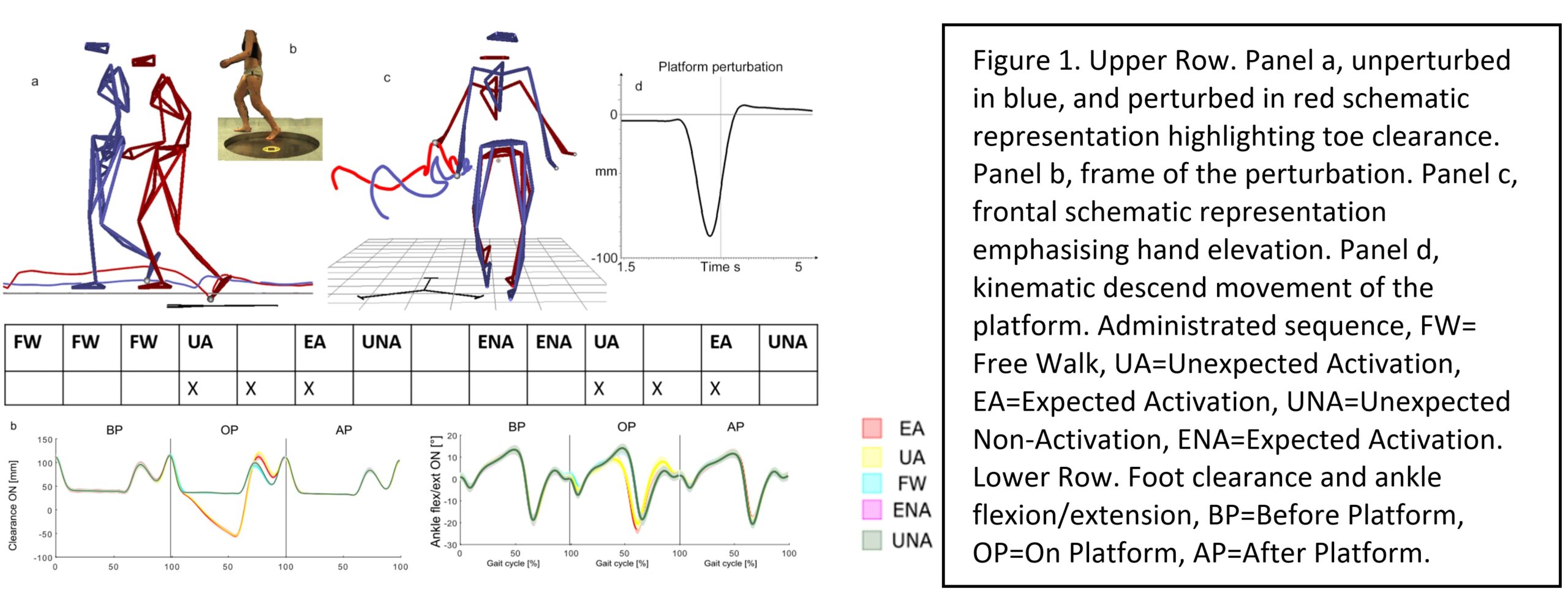
    To address this question, we developed an ad-hoc robotized platform (Mufy, IT) for inducing perturbations during walking [3]. We recruited ten healthy young adults (3 males and 7 females, with a mean age of 31 ± 7 years). Participants walked along a path where the upper plate of a Stewart Platform was camouflaged. A control in force moved the platform vertically downward when participants stepped on it. The fall down of the platform was normalized based on the leg length and mass of the participants personalizing the stiffness of the simulated spring. The platform descended 10% of the leg length. The sequence repetition to induce expected or unexpected conditions was defined (See Figure 1, Upper Row). Each sequence was repeated with both legs. We conducted a full body 3D gait analysis of three strides before, on, and after the platform using an optoelectronic system with 12 cameras (Vicon, UK) to gather kinematics data.

    Results

    Statistical analysis was performed using one-dimensional Statistical Parametric Mapping to compare perturbed conditions (both expected or unexpected) to normal walking. The main findings revealed alterations in spatiotemporal parameters (p<0.0001), increased clearance (p<0.02 expected perturbation, p<0.01 unexpected perturbation, p<0.009 for unexpected non-activation), and increased dorsiflexion of the ankle (p<0.001) (see Figure 1, Lower Row), with minor effects on knee and hip flexion, hands elevation and anteversion of pelvis and trunk.

    Discussion and Conclusion

    In summary, our observations indicated an overlap between Anticipatory and Predictive strategies. Nevertheless, we find evidence of Anticipatory strategies looking at the increased foot clearance during the unexpected absence of perturbation and signs of Predictive strategies looking at hand elevation during the presence of perturbation. The perturbations were mainly absorbed at the ankle level raising the importance of focusing on this joint to assess the residual ability for gait compensation.

    REFERENCES

    [1] Patla, A. EEE Eng in Med and Biology Magazine, 22(2), 48-52 (2003).

    [2] Pacilli, A. et al. Gait Posture 42, S4–S5 (2015).

    [3] Summa, S. et.al. Sensors, 19, 3402 (2019).
  • Reintegro della funzione di cammino dopo rimozione della causa disfunzionale: cinque anni di storia in una popolazione di giovani con obesità

    Reintegro della funzione di cammino dopo rimozione della causa disfunzionale: cinque anni di storia in una popolazione di giovani con obesità

    Reintegro della funzione di cammino dopo rimozione della causa disfunzionale: cinque anni di storia in una popolazione di giovani con obesità

    Function recovery and obesity: five years of gait recovery

    Autori

    Martina Favetta (Movement Analysis and Robotics Laboratory (MARlab), Neurorehabilitation Unit, Bambino Gesù Children’s Hospital, IRCCS, Rome, Italy)

    Susanna Summa(Movement Analysis and Robotics Laboratory (MARlab), Neurorehabilitation Unit, Bambino Gesù Children’s Hospital, IRCCS, Rome, Italy)

    Domenico Ottavio Adorisio (Pediatric Surgery Unit, Bambino Gesù Children’s Hospital, IRCCS, Rome, Italy)

    Francesco De Peppo (Pediatric Surgery Unit, Bambino Gesù Children’s Hospital, IRCCS, Rome, Italy)

    Romina Caccamo (Pediatric Surgery Unit, Bambino Gesù Children’s Hospital, IRCCS, Rome, Italy)

    Gessica Della Bella (Movement Analysis and Robotics Laboratory (MARlab), Neurorehabilitation Unit, Bambino Gesù Children’s Hospital, IRCCS, Rome, Italy)

    Maurizio Petrarca (Movement Analysis and Robotics Laboratory (MARlab), Neurorehabilitation Unit, Bambino Gesù Children’s Hospital, IRCCS, Rome, Italy)

    Introduction

    This work is a completion of the study of Summa et al.  [1] that showed several gait alterations in obese adolescents 1-year (T1) after the Laparoscopic Sleeve Gastrectomy (LSG) surgery. We studied the gait pattern after five years (T5) from LSG surgery to evaluate if the gait pattern has normalized

    Methods

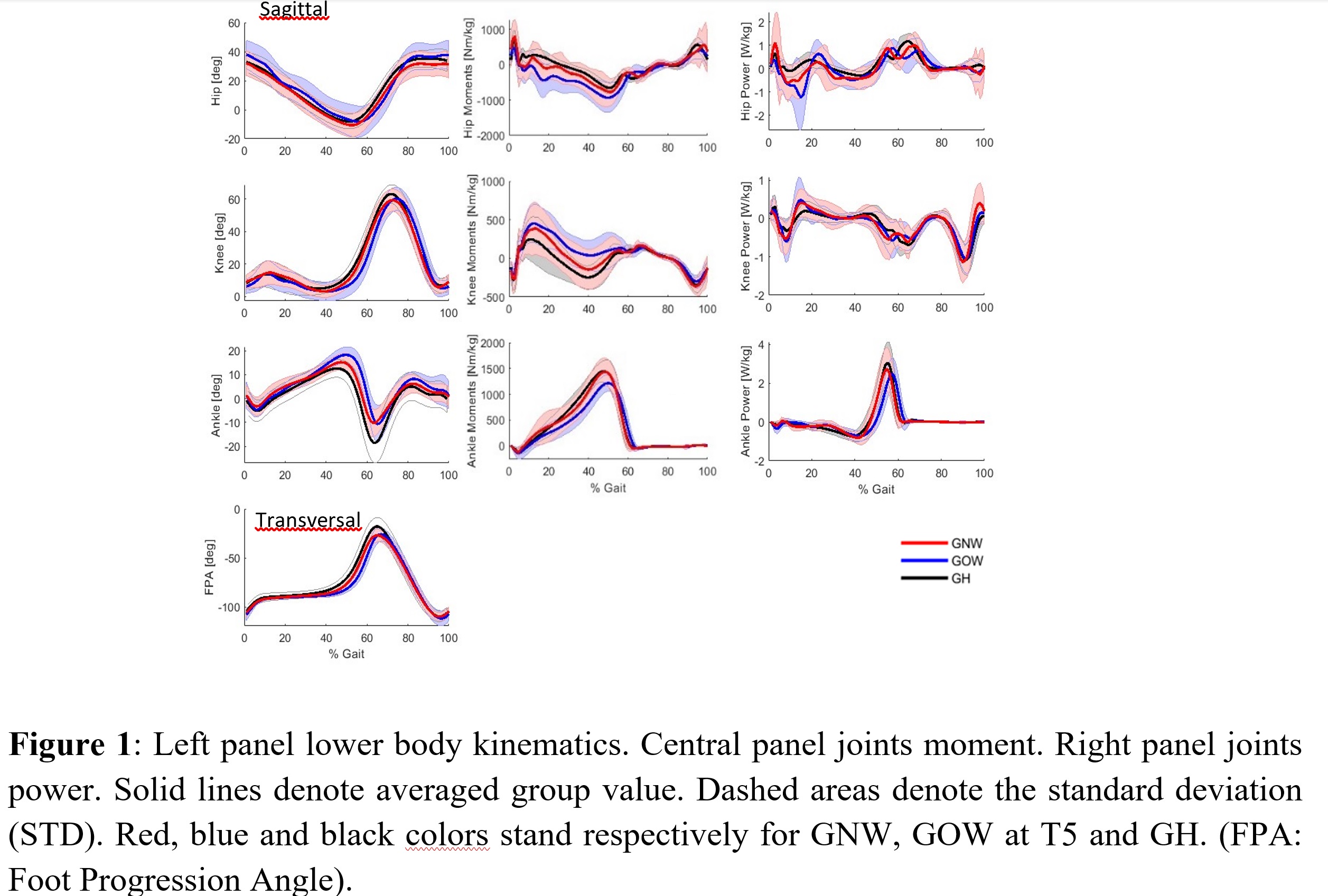
    Thirteen patients with a Body Mass Index (BMI) < 30 (Normal Weight Group=GNW group); 4 females and 9 males; age 20.9 ± 2.4; weight 79.6 ± 10.2 kg, BMI 26 ± 2.4 kg/m2, participated in the study. Eight patients with a Body Mass Index (BMI) > 30 (Overweight Group=GOW group); 6 females and 2 males; age 21 ± 3.2; weight 94.2 ± 12 kg, and the averaged BMI was 35.5 ± 3.4 kg/m2, participated in the study. These groups were acquired 5 years after the intervention. A control group of 10 healthy subjects (GH) was introduced as a benchmark of “normal gait” (7 female and 3 males; age 18.7 ± 4.9; weight 57.3 ± 11.5 kg; BMI 21.7 ± 2.0 Kg/m2). 3D gait analysis was conducted using an optoelectronic system with twelve cameras (Vicon MX, UK) and two force plates (AMTI, Or-6, US). We evaluated kinematics and kinetics while walking. We looked at the differences between the gait pattern at T5 of GNW and GOW vs the gait pattern of GH.

    Results

    Five years after surgery the averaged total weight loss of GNW was 44.7 ± 12.2 kg, the averaged total change in BMI was 16.7 ± 2 kg/m2. For the GOW the averaged total weight loss was 19.5 ± 3.7 kg, the averaged total change in BMI was 9 ± 0.1 kg/m2. At T5 GNW compared to GH showed a normalization of several kinematics alterations at pelvis, hip, and knee levels. Instead, the ankle still showed an increase of maximum dorsiflexion and a reduction of maximum plantar flexion. GOW compared to GH still showed several alterations above all at knee and ankle levels. Indeed, we highlighted an increase of hip extension moment, a reduction of knee extension moment, an increase of ankle maximum dorsiflexion, a reduction of ankle dorsal moment. See figure 1.

    Discussion and Conclusion

    The bulk of the masses, during the patient’s growth, affects the gait pattern once they are removed. After 5 years some alterations persist in some dynamic gait components. Gait recovery also required time and experience of motor function in daily life. The results encourage an individualized rehabilitative intervention of sensory-motor re-education for restoring dynamic gait components after a patient-specific assessment.

    REFERENCES

    [1] S. Summa, et al. Surg. Obes. Relat. Dis. 15 (2019) 374–381.

  • Studio dell’inizio del cammino: indicazioni riabilitative

    Studio dell’inizio del cammino: indicazioni riabilitative

    Studio dell’inizio del cammino: indicazioni riabilitative

    Gait initiation and rehabilitative indications

    Autori

    Maurizio Petrarca (Movement Analysis and Robotics laboratory (MARlab), Bambino Gesù Children’s Hospital, IRCCS, Rome Italy)

    Martina Favetta (Movement Analysis and Robotics laboratory (MARlab), Bambino Gesù Children’s Hospital, IRCCS, Rome Italy(

    Azzurra Speroni (Movement Analysis and Robotics laboratory (MARlab), Bambino Gesù Children’s Hospital, IRCCS, Rome Italy)

    Iacopo lovalè (Movement Analysis and Robotics laboratory (MARlab), Bambino Gesù Children’s Hospital, IRCCS, Rome Italy)

    Paolo Tavassi (Movement Analysis and Robotics laboratory (MARlab), Bambino Gesù Children’s Hospital, IRCCS, Rome Italy)

    Gessica Della Bella (Movement Analysis and Robotics laboratory (MARlab), Bambino Gesù Children’s Hospital, IRCCS, Rome Italy)

    Donatella Lettori (Movement Analysis and Robotics laboratory (MARlab), Bambino Gesù Children’s Hospital, IRCCS, Rome Italy)

    Introduction

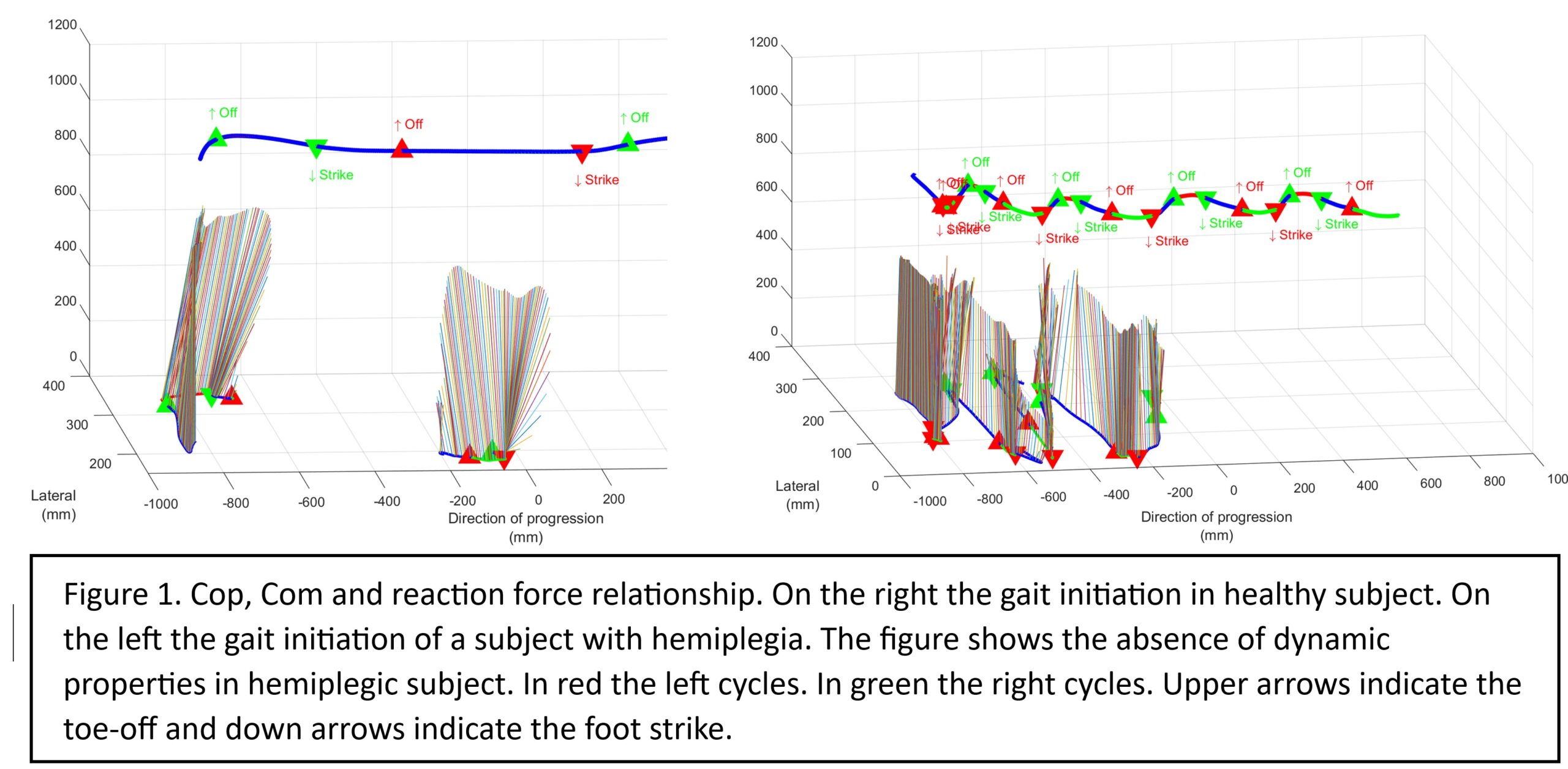
    In the control of the interactions between the body and the ground, the control variable is the Centre of Pressure (CoP), while the controlled variable is the Centre of Mass (CoM) [1]. In other words, variations in the centre of pressure on the ground govern the movement of the body’s centre of mass. However, this depends on the task and context. The redundancy of the organism’s dynamic solutions allows this role to be reversed [2]. But what are the differences in individuals with CNS pathologies?

    Methods

    It is necessary to analyse other variables: the ground reaction vector and electromyography. In this initial phase of the study, we proceeded using a graphical method. We graphed, using MATLAB (USA), the displacement of the CoP, and the displacement of the CoM along with the ground reaction vector in healthy subjects and people with neurological pathologies using data from the VICON system (UK).

    Results

    The longitudinal projection of the ground reaction vector is well-known in walking, but much information is contained in the other two projections. The Centre of mass is directed towards the contralateral side from a push of the hindfoot of the leg that is about to swing. The CoM is simultaneously accelerated forward. To govern this trajectory, the CoP transfers under the supporting foot while the ground reaction vector continues to point at the CoM, until the double support phase when the control is transferred to the contralateral leg. Dynamically speaking, the CoM is never outside the base of support but is constantly controlled by the dynamic pushes exerted by the ground reaction vector. Co-activation of lower limb muscles responsible for the initial push is observed. The movement initiation is determined by their resultant, leading to a push on the ground with the hindfoot. In hemiplegic patients, a lack of push and load transfer is observed, CoM variations are used to keep the CoP within the base of support, contrary to healthy individuals [3]. (Figure 1) The hemiplegic who cannot implement this alternative solution is the one who does not walk.

    Discussion and Conclusion

    In conclusion, load transfer is an alternative solution for governing the upright stance immediately available when is no longer feasible the dynamic push strategy. This alternative is immediately available thanks to the redundancy of the organism’s dynamic solutions. Practising load transfer is a training activity for a pathological condition that should be conducted after verifying that there are no conditions for restoring dynamic function.

    REFERENCES

    [1] P. G. Morasso, G. Spada, R. Capra. Human Movement Science. doi.org/10.1016/S0167-9457(99)00039-1

    [2] J. P. Scholz et al. Exp Brain Res. doi: 10.1007/s00221-006-0848-1

    [3] M. Petrarca. In book: Progress in Motor Control, Springer, DOI:10.1016/B978-0-443-23987-8.00001-8