IMPATTO DELLA FATICA SUL CAMMINO E L’EQUILIBRIO IN SOGGETTI CON SCLEROSI MULTIPLA
EFFECTS OF FATIGUE ON WALKING PERFORMANCE AND DYNAMIC BALANCE IN SUBJECTS WITH MULTIPLE SCLEROSIS
Autori
Anastasi Denise (Università degli studi di Sassari)
Introduction
Fatigability is a critical impairment in multiple sclerosis (MS) directly impacting activities of daily living [1]. Identification of the stability changes during a fatiguing task using an objective assessment, might result in early prediction of falls during activities of daily living, tailored rehabilitation programs, and better management of the pathology during daily activities for people with MS (PwMS). Several studies demonstrated the effectiveness of circuit training for improving walking and balance [2,3], but to date there are no studies focused on the effect of fatigue on motor skills.
Thus, the aims of this study are: 1) to assess the effect of experimentally induced exertion on walking and balance, and 2) to assess the effect of a “circuit training” intervention compared to a standard rehabilitation treatment on walking, dynamic balance and the impact of fatigue in PwMS.
Methods
Thirty-one PwMS (age: 51.52±11.28 years, EDSS 4(3.5-6)points) and 8 Healthy Subjects (HS, age: 46.25±6.27years) were recruited. Kinematic data were collected using a 9-camera SMART-D motion capture system. PwMS and HS were asked to walk over ground at a steady cadence (subjective spontaneous cadence augmented of the 15%). Subjects were asked to rate their physical exertion every minute on the Borg scale, and the test ended when PwMS referred a fatigue of 17 (very hard), while the HS test lasted 30 minutes. We computed the following gait parameters: speed, stride length, single stance time (SS), cadence, and stance time. While, for dynamic stability we considered: step width trunk range of motion on frontal (TRUNK _ML), and horizontal plane (TRUNK _AP), Center of Mass displacement on frontal plane (CoM_ML), and head range of movement on frontal plane (HEAD _ML). Finally, we calculated the percentage of mechanical energy recovery.
A subgroup of 28 PwMS was included in a randomized controlled pilot study, in which there was an experimental group that performed a circuit rehabilitation program (CG) and a usual care control group (UG). The experimental intervention concerned an initial part of walking on a treadmill with alternating intense and recovery phases, followed by balance and functional strengthening exercises without breaks. Both treatments lasted 45 minutes, twice a week for 6 weeks. Clinical and instrumental assessment were repeat at the end of the rehabilitation intervention. A Linear Mixed model with random intercepts was used to analyse the between-group differences in gait and dynamic balance parameters before and after the intervention.
Results
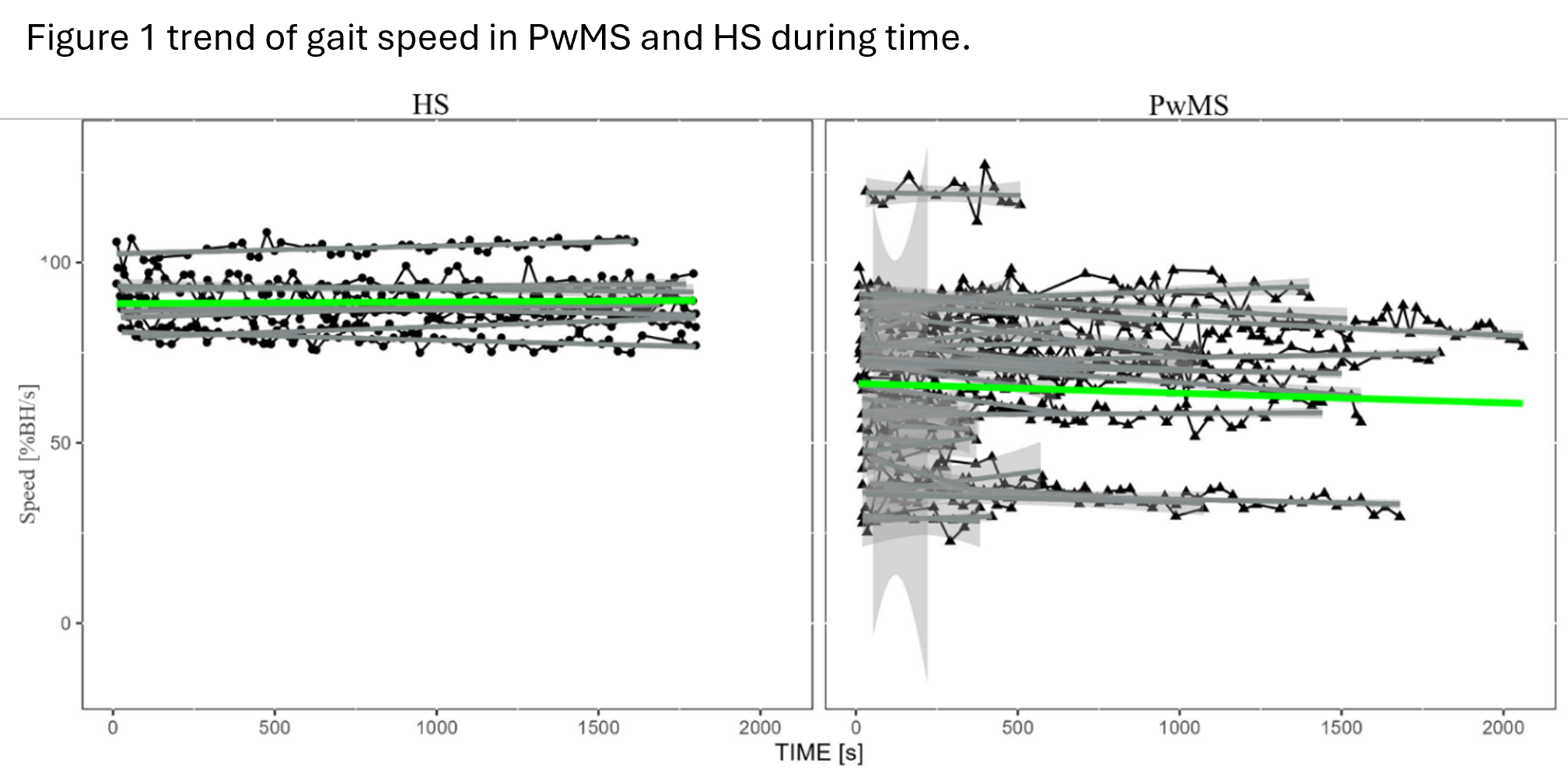
PwMS reached a perceived fatigue “very hard” walking for15.6±11.3minutes) while HS walked for 30 minutes without exertion (RPE<11points). PwMS showed an increase in speed of 0.008%BH/s per minute, with respect HS who showed an increase of 0.0006%BH/s per minute (p <0.001, Figure 1) and a small reduction of cadence of 0.05 step/min per minute, while HS slight increase it of 012 step/min per minute. p <0.001), indicating a gait deterioration over time in PwMS. We also found changes in dynamic stability with a statistically significant between-group increase of HEAD _ML (PwMS: 0.59mm per minute, HS: 0.20mm per minute p <0.001) and TRUNK _ML (PwMS: 0.03 deg per minute, HS: 0.00744 deg per minute, p <0.001, Figure 2). No between group different were found in the other indexes.
With respect the RCT study, the analysis of the primary outcome, the MFIS_PH, a greater reduction in perceived fatigue was observed in the EG than in the CG (CG: T0 = 15.6±9.0 pt, T1 = 11.6±7.7 pt, UG: T0 = 16.3±8.1 pt, T1 = 13.6±8.7 pt, F = 3.82, p=0.05). No statistically differences were found in the trends of the variables between CG and UG.
Discussion and Conclusion
The use of the fatiguing test can highlight motor changes due to fatigue, which vary in different subjects. It seems to have the potential to better guide rehabilitation treatment, highlighting characteristics not evident in normal assessments performed in a non-fatiguing condition. In future studies it could be used to better tailor the rehabilitation intervention and obtain greater effectiveness in managing fatigue in PwMS. The experimental intervention seems to improve the management of fatigue in ADL, it remains to be understood how to better direct the intervention based on the proposed assessment in a state of fatigue.
REFERENCES
[1] Mills, R. J., and Young, C. A. (2008). A medical definition of fatigue in multiple sclerosis. QJM 101, 49–60.
[2] Sethy, D., Bajpai, P., and Kujur, E. S. (2010). Effect of task related circuit training on walking ability in a Multiple Sclerosis subject. A single case study. NeuroRehabilitation 26, 331–337.
[3] Tramonti, C., Di Martino, S., and Chisari, C. (2020). An intensive task-oriented circuit training positively impacts gait biomechanics in MS patients. NeuroRehabilitation 46, 321–331.