Autore: Manuela

  • Efficacia di un trattamento dual task su parametri neurofisiologici e clinici in pazienti con emicrania: un trial randomizzato controllato

    Efficacia di un trattamento dual task su parametri neurofisiologici e clinici in pazienti con emicrania: un trial randomizzato controllato

    Efficacy of a dual task protocol on neurophysiological and clinical outcomes in migraine: a randomized control trial

    Autori

    Manuela Deodato (Department of Medical, Surgical and Health Sciences, University of Trieste, Trieste, Italy )

    Background and aims

    The main aim of this study was to investigate the efficacy of a dual task protocol in people with episodic migraine with respect to both active exercises only and cognitive task only treatments, concerning some neurophysiological and clinical outcomes.

    Methods

    A randomized control trial was adopted. It was approved by the institutional review board (CEUR ID3672) and it was registered on ClinicalTrials.gov (NCT05596058). The inclusion criteria were: Episodic migraine diagnosis (ICHD-3); Age between 18 and 65 years. While exclusion criteria were: migraine with aura; contraindications to TMS; other neurological or psychiatric disorders; cardiac implantable devices; drug intake that may change the cortical excitability; migraine prophylaxis treatment in the last 3 months; comorbidities such as depression, anxiety, sleep disorders.

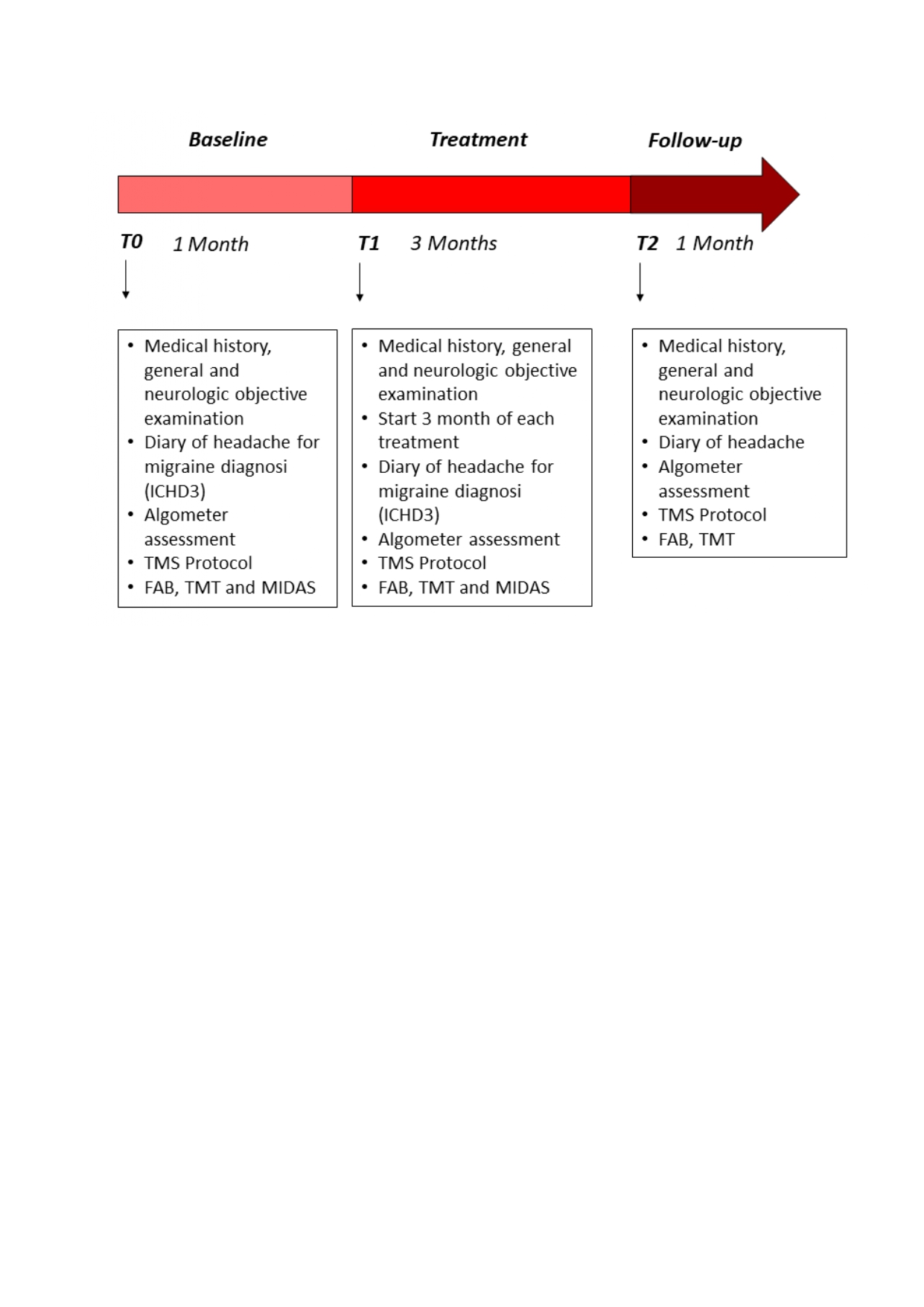
    Some neurophysiological and clinical outcomes were collected: resting motor threshold (rMT), short intracortical inhibition (SICI) and facilitation (ICF), pressure pain threshold (PPT), trail making test (TMT), frontal assessment battery (FAB), headache-related disability (MIDAS) and headache parameters. Then, participants were randomized into three groups: active exercise only (n = 10), cognitive task only (n = 10) and dual task protocol (n = 10). After 3 months of each treatment and after 1-month follow-up the same neurophysiological and clinical outcomes were revaluated.


    Results

    A total of 30 adults with episodic migraine were included. The active exercise-only group consisted of 2 men and 8 females (36.5 ± 13.9); the cognitive task-only group consisted of 2 men and 8 females (mean age 42.7 ± 11.2); the dual task protocol group consisted of 2 men and 8 females (mean age 48.3 ± 9.7). A significant time x group effect was only found for the trapezius muscle (p = 0.012, pη2 = 0.210), suggesting that PPT increased significantly only in active exercise and dual task protocol groups. A significant time effect was found for rMT (p < 0.001, pη2 = 0.473), MIDAS (p < 0.001, pη2 = 0.426), TMT (p < 0.001, pη2 = 0.338) and FAB (p < 0.001, pη2 = 0.462). A repeated measures ANOVA for SICI at 3 ms highlighted a statistically significant time effect for the dual task group (p < 0.001, pη2 = 0.629), but not for the active exercises group (p = 0.565, pη2 = 0.061), and for the cognitive training (p = 0.357, pη2 = 0.108).


    Conclusion

    The dual task protocol seems to have a more evident effect on both habituation and sensitization outcomes than the two monotherapies taken alone in people with migraine.

    REFERENCES

    • Goadsby PJ, Holland PR, Martins-Oliveira M, et al (2017) Pathophysiology of migraine: A disorder of sensory processing. Physiol Rev 97:. 10.1152/physrev.00034.2015
    • Coppola G, Pierelli F, Schoenen J (2009) Habituation and migraine. Neurobiol Learn Mem 92:. 10.1016/j.nlm.2008.07.006
    • Lemmens J, de Pauw J, van Soom T, et al (2019) The effect of aerobic exercise on the number of migraine days, duration and pain intensity in migraine: A systematic literature review and meta-analysis. J Headache Pain 20. 10.1186/s10194-019-0961-8
    • Deodato M, Granato A, Martini M, et al. Neurophysiological and Clinical Outcomes in Episodic Migraine Without Aura: A Cross-Sectional Study. J Clin Neurophysiol. 2023 doi: 10.1097/WNP.0000000000001055.
  • Effetti neurofisiologici e clinici di trattamenti farmacologici e non farmacologici nell’emicrania

    Effetti neurofisiologici e clinici di trattamenti farmacologici e non farmacologici nell’emicrania

    Effetti neurofisiologici e clinici di trattamenti farmacologici e non farmacologici nell’emicrania

    Neurophysiological and Clinical effects of Non-pharamacological and Pharmacological Treatments on Habituation and Sensitization outcomes in Migraine

    Autori

    Manuela Deodato (Department of Medical, Surgical and Health Sciences, University of Trieste, Trieste, Italy )

    Introduction

    Migraine represents a common neurologic condition that leads to adverse effects on physical/cognitive functioning and to a considerable socioeconomic burden among many countries1.  On the one side, part of this burden is due to multiple comorbidities that increased the headache-related disability2. On the other side, part of this burden is due to its complex physiopathology that is still an object of studies for a better understanding of underlying mechanisms and for a better choice of its treatments3. Neurophysiology studies have established that migraine is “a brain state of altered excitability” in a “migraine brain” genetically predisposed3,4. In fact, migraine people present a general increase response to sensory stimuli due to two opposing processes: lack of habituation and sensitization4. The aim of this PhD project was to investigate the effects of two emerging pharmacological and non-pharmacological treatments with respect to habituation and sensitization outcomes.

    Methods

    Three studies were conducted. In each study, the same neurophysiologic and clinical habituation and sensitization outcomes were used:  Algometer assessment, Transcranial Magnetic stimulation, Neuropsychological tests on executive functions, the Migraine Disability Assessment Scale and headache diary.  

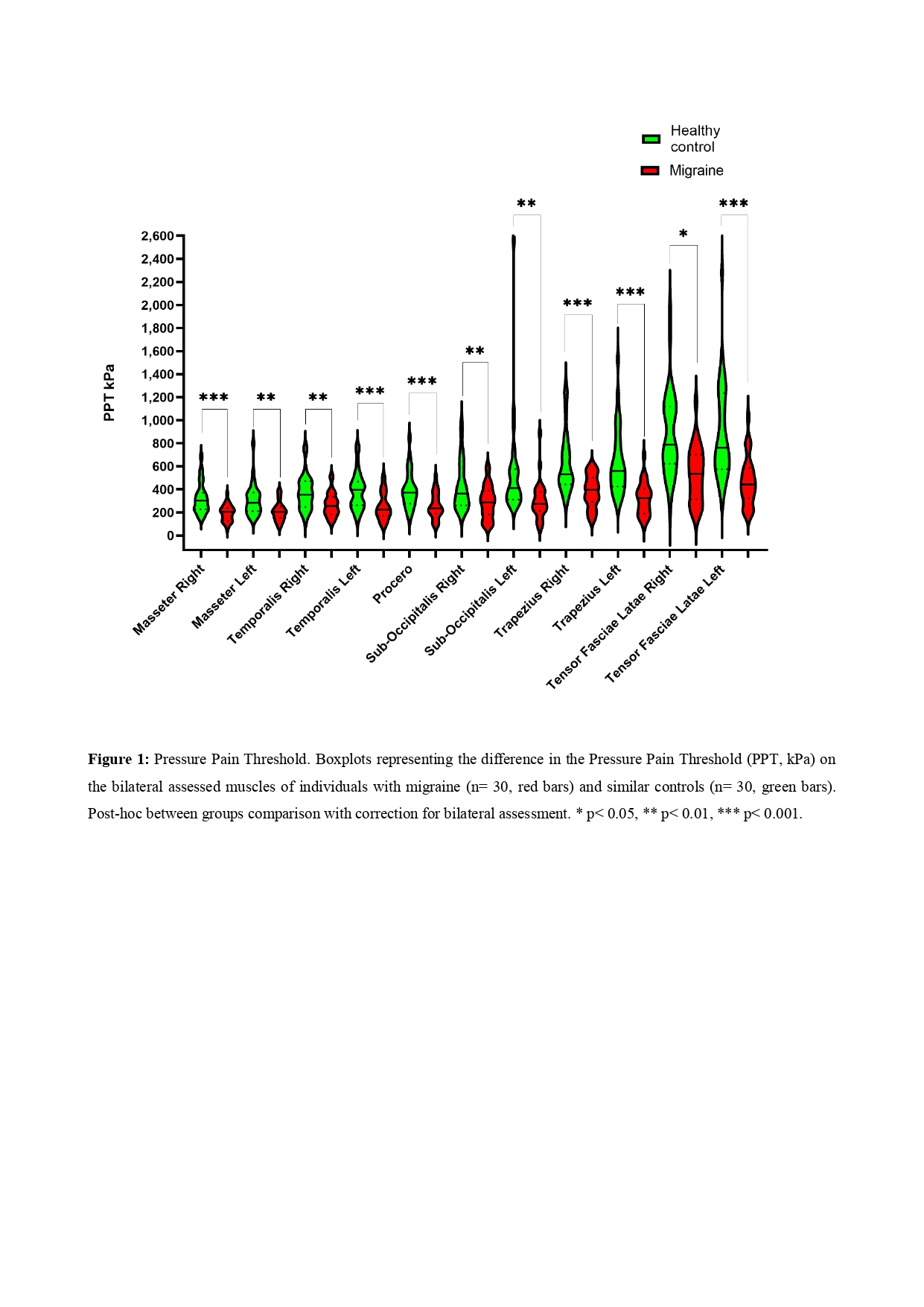
    1) Study 1, a cross sectional study, compared habituation and sensitization outcomes in 30 migraine people with respect to 30 healthy controls.

    2) Study 2, a randomized control trial, compared the dual task protocol in migraine people with active exercise only and with cognitive training only, concerning habituation and sensitization outcomes (3 months of each treatments plus 1-month follow-up).

    3) Study 3, an observational study, compared the two emerging pharmacological and non-pharmacological treatments, respectively, monoclonal antibody and dual task protocol, on habituation and sensitization outcomes (3 months of each treatments plus 1-month follow-up).


    Results

    Study 1 reported that people with migraine were characterized by a statistically significant alteration of all habituation/sensitization neurophysiological and clinical outcomes with respect to healthy controls. Study 2 suggested that active exercise was useful in sensitization outcomes, while cognitive training in habituation outcomes. As a consequence, the Dual task protocol resulted more useful than two monotherapies, active exercise and cognitive training alone, through a more evident effects on habituation and sensitization outcomes. Finally, Study 3 shows similar general peripheral and central effects of both dual task protocol and monoclonal antibody treatments in patients with migraine. However, monoclonal antibody therapy seems to be more useful for some sensitization outcomes (reduction of drug intake, migraine frequency and migraine responders rates) while dual task protocol seems to be more useful for habituation outcomes (improvement in intracortical inhibition).


    Discussion and Conclusion

    Taken together, the findings from these three studies suggest the coexistence of both central and peripheral adaptive neurophysiological mechanisms in people with migraine that can be objectively measured with validated techniques5. Such techniques can also be useful to evaluate the efficacy of different therapies: our preliminary results suggest that non-pharmacological interventions, such as physiotherapy, can significantly improve habituation and sensitization outcomes in this patients’ population. Particularly, a dual task protocol, active exercise with concomitant cognitive training, may up-regulate the cortical connectivity related to cognitive task due to an activity-dependent learning that increase the synaptic strength and promote the associative learning and neuroplasticity6. Future studies could include the effect of the combination of both monoclonal antibody and dual task protocols on habituation and sensitization outcomes.


    REFERENCES

    1. GBD 2019 Diseases and Injuries Collaborators. Global burden of 369 diseases and injuries in 204 countries and territories, 1990-2019: A systematic analysis for the Global Burden of Disease Study 2019. Lancet, 2020
    2. Caponnetto V, Deodato M, Robotti M, et al. Comorbidities of primary headache disorders: a literature review with meta-analysis. J Headache Pain, 2021
    3. Goadsby PJ, Holland PR, Martins-Oliveira, et al. Pathophysiology of Migraine: A Disorder of Sensory Processing. Physiological Reviews, 2017
    4. Coppola G, Di Lorenzo C, Schoenen J et al. Habituation and sensitization in primary headaches. The Journal of Headache and Pain, 2023
    5. Deodato M, Granato A, Martini M, et al. Neurophysiological and Clinical Outcomes in Episodic Migraine Without Aura: A Cross-Sectional Study. J Clin Neurophysiol, 2024
    6. Deodato M, Granato A, Buoite Stella A. et al. Efficacy of a dual task protocol on neurophysiological and clinical outcomes in migraine: a randomized control trial. Neurol Sci, 2024
  • The impact of an Italian student-led physiotherapy clinic on physiotherapy student clinical reasoning and patients satisfaction

    The impact of an Italian student-led physiotherapy clinic on physiotherapy student clinical reasoning and patients satisfaction

    L’Impatto di una Student-led clinic italiana sul ragionamento clinico degli studenti di fisioterapia e sulla soddisfazione dei pazienti

    Autori

    Manuela Deodato (Department of Medical, Surgical and Health Sciences, University of Trieste, Trieste, Italy )

    Raffaele Sabot (Department of Medical, Surgical and Health Sciences, University of Trieste, Trieste, Italy )

    Francesca Zelesnich (Department of Medical, Surgical and Health Sciences, University of Trieste, Trieste, Italy )

    Giulia Sgubin (Department of Medical, Surgical and Health Sciences, University of Trieste, Trieste, Italy )

    Alex Buiote Stella (Department of Medical, Surgical and Health Sciences, University of Trieste, Trieste, Italy )

    Alessandra Galmonte (Department of Medical, Surgical and Health Sciences, University of Trieste, Trieste, Italy )

    Luigi Murena (Department of Medical, Surgical and Health Sciences, University of Trieste, Trieste, Italy )

    Introduction

    An optimal clinical environment represents an excellent place to develop clinical reasoning and clinical practice, which provide optimal decision making and, as a consequence, optimal patient management 1. Student led-clinics represent an innovative practical experience for physiotherapist students2. The aim of student-led-clinic is the development of clinical reasoning and professional skills through a teaching methodology by health care professional supervisors that could lead to an optimal patient management1–3. In fact, this model could provide benefits both in the student education and in health care systems2. Currently, there is few data on the impact of these models on the development of students clinical reasoning, nor on the patients satisfaction 2,4. Therefore, the aim of the present study is to evaluate the impact of an Italian Student-led clinic in the clinical reasoning of the physiotherapy students. The second aim is to evaluate the patients satisfaction in this model.

    Methods

    A quantitative cross-sectional survey was conducted on 102 university students and on 101 patients (Institutional review board of University of Trieste n. 70268; 8.05.2024) in accordance with the STrengthening the Reporting of OBservational Studies in Epidemiology. Concerning students, the questionnaire “Evaluation of Clinical reasoning during internship” was developed with the following domains: medical history, physiotherapy evaluation, the selection of rehabilitation goals, progression of treatment, patient education, discussion of clinical cases with the tutors/students. As regard to patients, the validated “Physical Therapy Satisfaction Survey (PTOPS)”5 was used and the questionnaire “Patients experience in Palestra Didattica” was developed that assess: Student–supervisor relationship, Quality of physiotherapy care, Style of supervision and Student qualities. The Guidelines for developing and validating questionnaire were respected 6 for the two developed questionnaires.

    Results

    The first interesting finding was that the impact of clinical reasoning of the physiotherapy students was statistically significantly improved in the PD student-led clinic with respect to other traditional models in 7 of 8 items take in to consideration. Another important finding was that the patients satisfaction assessed with the PTOPS survey was statistically significantly higher in the PD model compared with traditional models in 20 of 34 items: in 5 of 12 items of Depersonalization domain, in 4 of 6 items of Inaccessibility domain, in 7 of 10 items of Ambience domain and in 4 of 10 items of Cost domain. Finally, the “Patients experience in Palestra Didattica” questionnaire highlighted high rate of positive answers concerning, Student–supervisor relationship, Quality of physiotherapy care, Style of supervision and Student qualities.

    Discussion and Conclusion

    The student-led physiotherapy clinic Palestra Didattica represents an innovative clinical-learning environment that allow to meet both the health care systems and University needs, but also the student clinical education and patient care needs. Three main factors improve the patients and students experience in this model with respect to traditional models: 1) the collaborative interaction among students/patients/academic tutors that lead to patient-centered care and to student-centered learning experience; 2) the learning experience based on active learning methodology and on a real clinical experience with patients that promote clinical reasoning; 3) a dedicated environment in which education, service and research join together that enhance the relationship between health care systems and Universities, which, in turn, bridge the gap between theory and practice in order to promote both best practice for health service and an excellent quality of students learning experience.


    REFERENCES

    1. Furze JA, Black L, Mcdevitt AW, et al. Clinical Reasoning: The Missing Core Competency in Physical Therapist Education and Practice. Physical Therapy 2022.
    2. Wynne D, Cooper K. Student-led rehabilitation groups and clinics in entry-level health education: a scoping review. JBI Evidence Synthesis 2021.
    3. Kent F, Martin N, L. Keating J. Interprofessional student-led clinics: An innovative approach to the support of older people in the community. J Interprof Care 2016.
    4. Niwa L, MacLellan CL. Learning and satisfaction in a student-led clinic. Clinical Teacher 2021.
    5. Vanti C, Bonetti F, Ceron D, et al. Cross-cultural adaptation and validation of the Physical Therapy Outpatient Satisfaction Survey in an Italian musculoskeletal population. BMC Musculoskeletal Disorders 2013.
    6. Tsang S, Royse CF, Terkawi AS. Guidelines for developing, translating, and validating a questionnaire in perioperative and pain medicine. Saudi Journal of Anaesthesia 2017.