Autore: CSTSFN101

  • Responsività alla riabilitazione della stabilità dinamica locale del tronco in soggetti con atassia cerebellare degenerativa primaria.

    Responsività alla riabilitazione della stabilità dinamica locale del tronco in soggetti con atassia cerebellare degenerativa primaria.

    Responsività alla riabilitazione della stabilità dinamica locale del tronco in soggetti con atassia cerebellare degenerativa primaria.

    Responsiveness to rehabilitation of local dynamic stability of the trunk in subjects with primary degenerative cerebellar ataxia.

    Autori

    Castiglia Stefano Filippo [Department of Medico-Surgical Sciences and Biotechnologies, “Sapienza” University of Rome-Polo Pontino, Latina, Italy; Department of Brain and Behavioral Sciences, University of Pavia, Pavia, Italy]]

    Trabassi Dante [Department of Medico-Surgical Sciences and Biotechnologies, “Sapienza” University of Rome-Polo Pontino, Latina, Italy]

    Conte Carmela [Department of Medico-Surgical Sciences and Biotechnologies, “Sapienza” University of Rome-Polo Pontino, Latina, Italy]

    Varrecchia Tiwana [Department of Occupational and Environmental Medicine, Epidemiology and Hygiene, INAIL, Monteporzio Catone, Italy]

    Chini Giorgia [Department of Occupational and Environmental Medicine, Epidemiology and Hygiene, INAIL, Monteporzio Catone, Italy]

    Ranavolo Alberto [Department of Occupational and Environmental Medicine, Epidemiology and Hygiene, INAIL, Monteporzio Catone, Italy]

    Casali Carlo [Department of Medico-Surgical Sciences and Biotechnologies, “Sapienza” University of Rome-Polo Pontino, Latina, Italy]

    Serrao Mariano [Department of Medico-Surgical Sciences and Biotechnologies, “Sapienza” University of Rome-Polo Pontino, Latina, Italy; Movement Analysis Lab, Policlinico Italia, Roma]

    Introduction

    Ataxic gait is characterized by incoordination between the upper and lower bodies, which results in increased upper body oscillations with a lack of local trunk stability, transforming the trunk into a generator of perturbations during walking [1]. Recently three trunk acceleration – derived gait indexes, namely the harmonic ratios (HRs), short-time longest Lyapunov’s exponent (sLLE), and step-to-step coefficient of variation (CV), showed the best ability to characterize the trunk behavior during gait of swCA[2,3]. This study aimed to assess the responsiveness to the rehabilitation of HR, sLLE, CV in a sample of subjects with primary degenerative cerebellar ataxia (swCA), and investigate the correlations between their improvements (∆), clinical characteristics, and spatio-temporal and kinematic gait features.

    Methods

    The trunk acceleration patterns in the antero-posterior (AP), medio-lateral (ML), and vertical (V) directions during gait of 21 swCA were recorded using a magneto-inertial measurement unit placed at the lower back before (T0) and after (T1) a period of inpatient rehabilitation. For comparison, a sample of 21 age- and gait speed-matched healthy subjects (HSmatched) was also included. Cohen’s d with Hedge’s correction was used to calculate internal responsiveness. To identify significant differences between swCA and HS at T0 and T1, the unpaired t-test or Mann–Whitney test was used. The external responsiveness was assessed using an anchor-based method using the smallest detectable change of the SARA scale (3.5 points) criterion for clinical improvement[4].

    Results

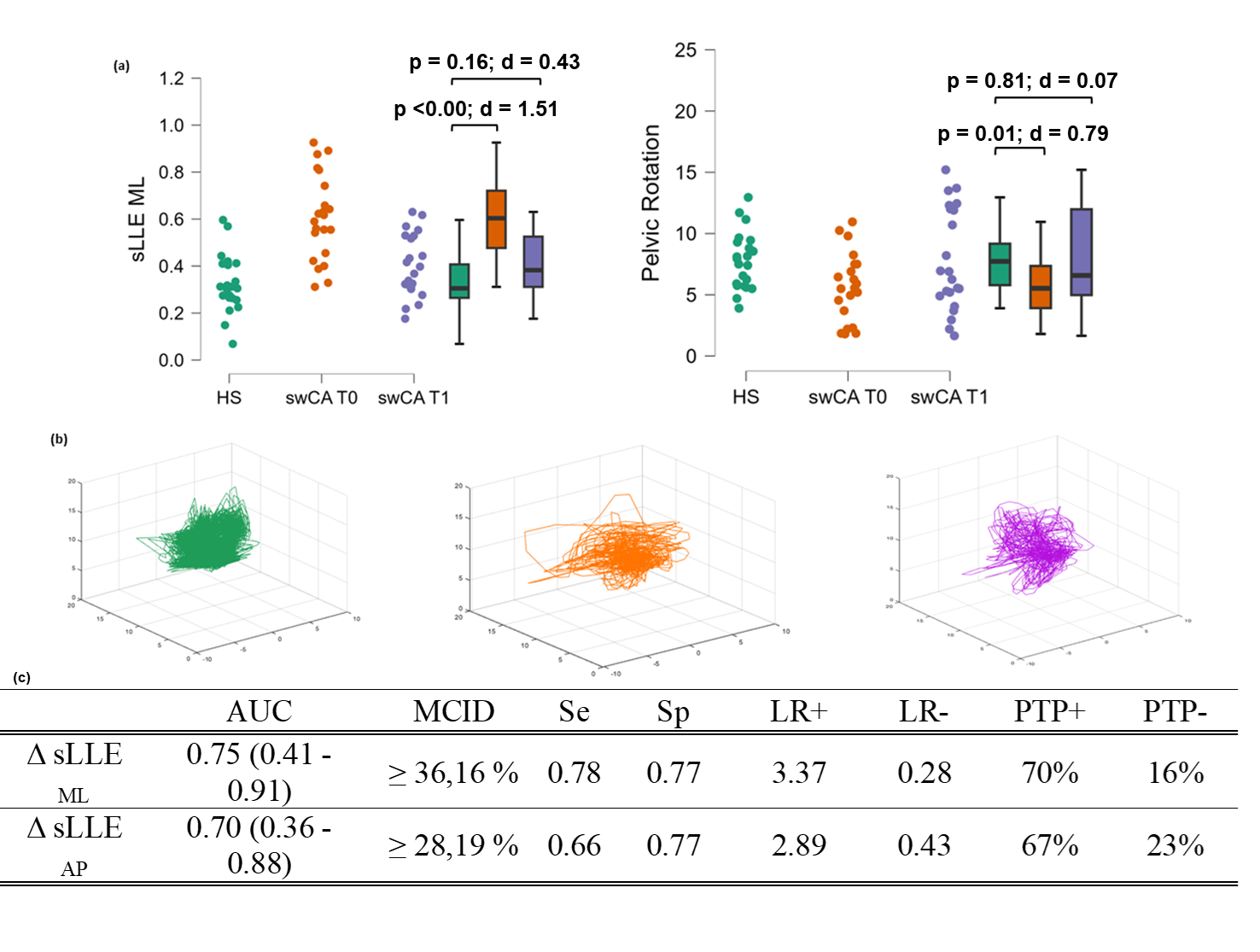
    At T1, sLLE in the AP (sLLEAP) and ML (sLLEML) directions significantly improved with moderate to large effect sizes (sLLEAP: p = 0.03; d= 0.75; sLLEML: p=0.00; d = 0.86), as well as SARA scores (p = 0.00; d = 0.73), stride length (p = 0.04; d = 0.46), and pelvic rotation (p = 0.03; d = 0.49). sLLEML and pelvic rotation also approached the HSmatched values at T1 (Fig. 1, a), suggesting a normalization of the parameter. HRs and CV did not significantly modify after rehabilitation. ∆sLLEML correlated with ∆ of the gait subscore of the SARA scale (∆SARAGAIT) (ρ = 0.41; p = 0.03) and ∆stride length (ρ = 0.51; p = 0.01). ∆sLLEAP correlated with ∆pelvic rotation (ρ = 0.41; p = 0.03) and ∆SARAGAIT (ρ = 0.43; p = 0.03). The minimal clinically important differences (MCID) for sLLEML and sLLEAP were ≥ 36.16% and ≥ 28.19%, respectively, as the minimal score reflecting a clinical improvement in SARA scores (Fig. 1, c).

    Discussion and Conclusion

    sLLE in the ML and AP directions revealed good internal and external responsiveness, and moderately correlated with the improvements in SARAGAIT subscore, stride length, and pelvic rotation [5]. The findings of this study suggest that trunk stability can be effectively quantified using sLLE and improve after rehabilitation. Because of the usability and affordability of magneto-inertial measurement units, sLLE can be considered a useful additional outcome measure for assessing the effectiveness of intensive rehabilitation treatments, particularly when focusing on improvements in trunk stability during gait. Further studies including larger populations are needed to confirm these results and investigate long-term responsiveness.

    REFERENCES

    [1]Manto M, Serrao M, Filippo Castiglia S, Timmann D, et al. Neurophysiology of cerebellar ataxias and gait disorders. Clin Neurophysiol Pract. 2023 Jul 20;8:143-160.

    [2]Castiglia SF, Trabassi D, Tatarelli A, et al. Identification of Gait Unbalance and Fallers Among Subjects with Cerebellar Ataxia by a Set of Trunk Acceleration-Derived Indices of Gait. Cerebellum. 2023 Feb;22(1):46-58.

    [3]Caliandro P, Conte C, Iacovelli C, et al. Exploring Risk of Falls and Dynamic Unbalance in Cerebellar Ataxia by Inertial Sensor Assessment. Sensors (Basel). 2019 Dec 17;19(24):5571

    [4]Schmitz-Hübsch T, Fimmers R, Rakowicz M, et al.Responsiveness of different rating instruments in spinocerebellar ataxia patients. Neurology. 2010 Feb 23;74(8):678-84

    [5]Castiglia SF, Trabassi D, Conte C, et al. Local Dynamic Stability of Trunk During Gait is Responsive to Rehabilitation in Subjects with Primary Degenerative Cerebellar Ataxia. Cerebellum. 2024 Jan 27. doi: 10.1007/s12311-024-01663-4. Epub ahead of print.

  • Effetti immediati dell’esercizio di allungamento dei muscoli rotatori del tronco sui parametri del cammino in soggetti con malattia di Parkinson: uno studio clinico randomizzato controllato

    Immediate effects of trunk rotator stretching exercise on gait parameters in subjects with Parkinson’s disease: a randomized clinical trial

    Introduction

    Reduced trunk rotation and pelvic mobility, which are associated with a higher risk of falling and one of the best predictors of gait improvement following rehabilitation [ 1 ], are characteristics of subjects with Parkinson’s disease (swPD) [ 2 ]. The Progressive Modular Rebalancing System (PMR) proved to be an effective multimodal exercise therapy strategy with a trunk mobility focus that can enhance the effects of cognitive strategies in swPD gait training [ 3 ]. The purpose of this study was to compare the immediate effects of PMR trunk rotator stretching exercise to active upper trunk rotation exercise (Control) on gait parameters in swPD.

    Methods

    An expert neurologist screened 40 swPD for inclusion before randomly assigning them to the PMR or control exercise groups using sealed envelopes. Gait trials were collected using a magneto-inertial measurement unit placed at the lower back before (T0) and immediately after (T1) a single exercise session. Spatio-temporal parameters, pelvic kinematics, and harmonic ratios (HR) in three spatial directions were calculated. Four physical therapists who were not aware of the gait assessment carried out the PMR or control exercise. The entire procedure took between 10 and 15 minutes. To assess differences between groups, the independent sample t-test or Mann-Whitney test was used. Within-group differences were assessed using the paired sample t-test or the Wilcoxon test.

    Results

    At T1, there were significant differences in pelvic obliquity and HR in the antero-posterior (AP) direction between the PMR and control groups (Fig. 1). The PMR group improved in pelvic obliquity, pelvic rotation, HR in the AP and medio-lateral directions, gait speed and cadence, and double support time. Pelvic obliquity and cadence improved in the control group (Fig. 1).

    Discussion and Conclusion

    PMR trunk rotation stretching was more effective than upper trunk rotation exercise in improving pelvic mobility and harmonic ratio during gait in swPD patients in a single exercise session. Implementing a PMR trunk rotation stretching exercise into a gait rehabilitation program may enhance the effects of gait training by improving pelvic mobility and trunk behavior during gait.

    REFERENCES

    Serrao, Mariano et al. “Progressive Modular Rebalancing System and Visual Cueing for Gait Rehabilitation in Parkinson’s Disease: A Pilot, Randomized, Controlled Trial With Crossover.” Frontiers in neurology vol. 10 902. 29 Aug. 2019, doi:10.3389/fneur.2019.00902

    Trabassi, Dante et al. “Machine Learning Approach to Support the Detection of Parkinson’s Disease in IMU-Based Gait Analysis.” Sensors (Basel, Switzerland) vol. 22,10 3700. 12 May. 2022, doi:10.3390/s22103700

    Serrao, Mariano et al. “Prediction of Responsiveness of Gait Variables to Rehabilitation Training in Parkinson’s Disease.” Frontiers in neurology vol. 10 826. 2 Aug. 2019, doi:10.3389/fneur.2019.00826

    Castiglia, Stefano Filippo et al. “Harmonic ratio is the most responsive trunk-acceleration derived gait index to rehabilitation in people with Parkinson’s disease at moderate disease stages.” Gait & posture vol. 97 (2022): 152-158. doi:10.1016/j.gaitpost.2022.07.235

  • Il rapporto armonico è l’indice di cammino derivato dall’accelerazione del tronco più reattivo alla riabilitazione nelle persone con malattia di Parkinson in stadi moderati della malattia.

    Harmonic ratio is the most responsive trunk-acceleration derived gait index to rehabilitation in people with Parkinson’s disease at moderate disease stages.

    Introduction

    Harmonic ratios (HRs), recurrence quantification analysis in the antero-posterior direction (RQAdetAP), and stride length coefficient of variation (CV) have recently been shown to characterize gait abnormalities and fall risk in people with Parkinson’s disease (pwPD) at moderate disease stages. This study aimed to i) assess the internal and external responsiveness to rehabilitation of HR, RQAdetAP, and CV, ii) identify the baseline predictors of normalization of the gait stability indexes, and iii) investigate the correlations between the gait indexes modifications (∆) and clinical and kinematic ∆s in pwPD at Hoehn and Yahr disease staging classification 3.

    Methods

    The trunk acceleration patterns of 21 pwPD and 21 age- and speed-matched healthy subjects (HS) were acquired during gait using an inertial measurement unit at baseline (T0). pwPD were also assessed after a 4-week rehabilitation period (T1). Each participant’s HR in the antero-posterior (HRAP), medio-lateral (HRML), and vertical directions, RQAdetAP, CV, spatio-temporal, and kinematic variables were calculated. Unpaired t-test or Mann-Whitney test and Cohen’s d were used to identify significant differences between pwPD and HS at T0 and normalization at T1. Multiple linear regression analysis was performed to identify the predictors of improvement. Partial correlation analysis adjusting for Δgait speed was performed between the Δs. Area under the ROC curves (AUCs) and minimally clinically important differences (MCID) were calculated to assess external responsiveness.

    Results

    After rehabilitation, pwPD improved in HRAP, HRML, gait speed, stride length, cadence, pelvic obliquity, pelvic rotation, and UPDRS-III, with medium-to-large effect sizes (0.52 > d < 0.82). At T1, HRAP, HRML, stride length, and pelvic rotation were no longer different from HS, suggesting a normalization of these parameters (Fig. 1). Lower HRs and higher pelvic rotation values at baseline predicted ∆HRs. ΔHRAP correlated with ΔHRML, Δstride length and Δpelvic rotation, regardless of Δgait speed (Fig. 2). ΔHRAP ≥ 21.47 %, Δstride length ≥ 10.09 %, and Δpelvic rotation ≥ 8.59 %, respectively, were required to normalize HRAP with 95 %, 88 %, 74 %, and 81 % probability. ΔHRML ≥ 36.94 %, Δstride length ≥ 22.67 %, and Δpelvic rotation ≥ 37.67 %, were required to normalize HRML with 92 %, 71 %, 73 %, and 90 % probability. RQAdetAP and step length CV were not responsive to rehabilitation.

    Discussion and Conclusion

    HRAP and HRML improved to normative values after rehabilitation and showed high internal and external responsiveness. When using inertial measurement units, HRAP and HRML can be considered as responsive outcome measures for assessing the effectiveness of rehabilitation on trunk smoothness during walking in pwPD at moderate disease stages. Subjects with reduced trunk mobility at baseline were more likely to improve their HRs and focusing on exercise programs on pelvic rotation and stride length (Fig. 3) could optimize the rehabilitative planning in order to tailor gait interventions in pwPD at moderate disease stages.

    REFERENCES

    Castiglia, Stefano Filippo et al. “Ability of a Set of Trunk Inertial Indexes of Gait to Identify Gait Instability and Recurrent Fallers in Parkinson’s Disease.” Sensors (Basel, Switzerland) vol. 21,10 3449. 15 May. 2021, doi:10.3390/s21103449

    Trabassi, Dante et al. “Machine Learning Approach to Support the Detection of Parkinson’s Disease in IMU-Based Gait Analysis.” Sensors (Basel, Switzerland) vol. 22,10 3700. 12 May. 2022, doi:10.3390/s22103700

    Serrao, Mariano et al. “Prediction of Responsiveness of Gait Variables to Rehabilitation Training in Parkinson’s Disease.” Frontiers in neurology vol. 10 826. 2 Aug. 2019, doi:10.3389/fneur.2019.00826

    Hubble, Ryan P et al. “Trunk Exercises Improve Gait Symmetry in Parkinson Disease: A Blind Phase II Randomized Controlled Trial.” American journal of physical medicine & rehabilitation vol. 97,3 (2018): 151-159. doi:10.1097/PHM.0000000000000858