Autore: Andrea Celso

  • DISPOSIZIONALISMO CAUSALE E PRATICA CLINICA PSICOLOGICAMENTE INFORMATA COMBINATA CON LA TERAPIA MANUALE IN UNA PAZIENTE CON NECK PAIN CRONICO

    DISPOSIZIONALISMO CAUSALE E PRATICA CLINICA PSICOLOGICAMENTE INFORMATA COMBINATA CON LA TERAPIA MANUALE IN UNA PAZIENTE CON NECK PAIN CRONICO

    CAUSAL DISPOSITIONALIST PSYCHOLOGICALLY-INFORMED PRACTICE COMBINED WITH MANUAL THERAPY IN A PATIENT WITH PERSISTENT NONSPECIFIC NECK PAIN (NS-NP): A CASE REPORT

    Autori

    Celso Andrea [Azienda sanitaria Friuli Occidentale, Pordenone, Italy]

    Introduction to clinical case

    Neck pain is one of the most common musculoskeletal disorders and is a major problem in modern society.

    It can be considered a multifactorial disease with a point prevalence of between 10% and 40% of population that will experience symptoms in any one year.

    In the following case report are shown the results of a combined physiotherapy treatment, merging manual therapy and functional rehabilitation with a psychologically-informed practice framework guided by a causal dispositionalist lens, including Motivational Interviewing (MI), Mindfulness-based Therapy with Acceptance and Commitment Therapy (ACT).

    Methods

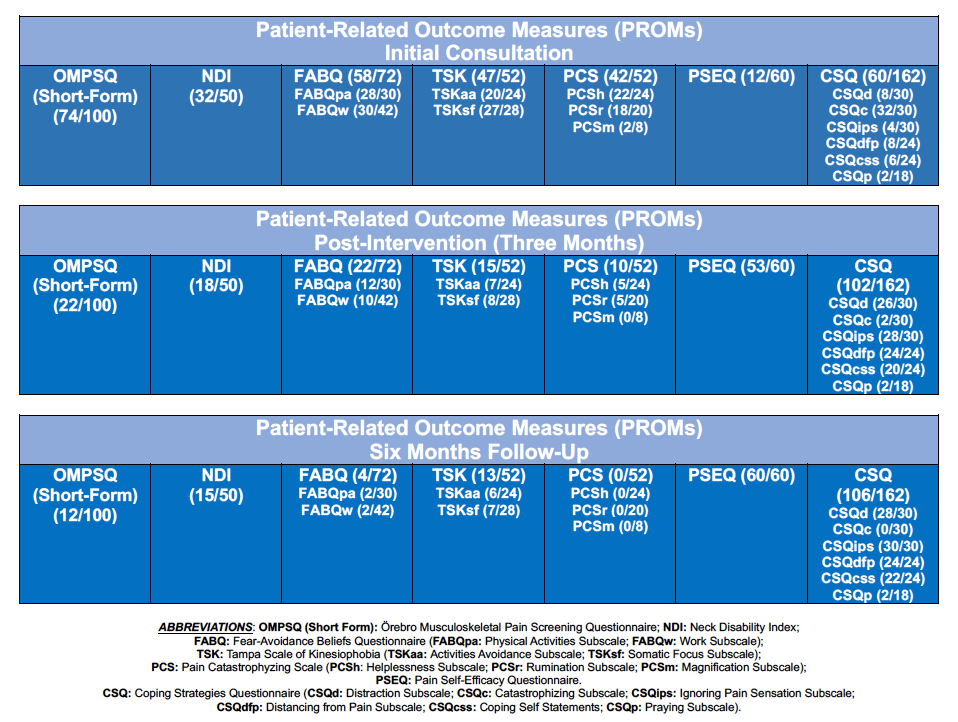
    n 1 female, 58-years-old industry secretary, with a one year history of persistent nonspecific neck pain was treated in three months period and evaluated with initial, post-intervention screening and one-year follow-up, with administration of Patient-Related Outcome Measures such as Örebro Musculoskeletal Pain Screening Questionnaire (OMPSQ) and consequent further functional, and psychosocial assessment with Neck Disability Index (NDI), Fear-Avoidance Beliefs Questionnaire (FABQ), Tampa Scale of Kinesiophobia (TSK), Pain Catastrophizing Scale (PCS), Coping Strategies Questionnaire (CSQ) and Pain Self Efficacy Questionnaire (PSEQ), as measures to evaluate patient’s clinical profile, engagement in treatment and self-management strategies learning.

    The therapeutic encounters were characterized by the implementation of specific manual techniques addressed to the cervical and thoracic spine merged with therapeutic exercise to reduce pain hypersensitivity and restore functional movements.


    Results

    A dispositionalist patient-centred and psychologically informed practice clinical reasoning framework guided the therapeutical journey, where specific manual techniques Motivational Interviewing (MI), Mindfulness and ACT principles enabled to improve psychological flexibility and enhance personal engagement and self-management activation at the end of therapeutic program and at one-year follow-up, at outcomes re-evaluation comparing to baseline.


    Discussion and clinical relevance

    In persistent pain states the therapeutic pathway should be shaped towards a multidimensional framework whose the main objective is to reach meaning(s) of pain experience, where the uniqueness of single clinical presentation can be effectively met and managed. Further, be acquainted in Mindfulness and ACT’s core principles, directly reduces avoidance and promote openness, bringing the possibility to build present-focused awareness, and coordinate greater engagement in goal-oriented and values-based activities, representing a good viaticum that prompt patient’s recovery and thrive.


    REFERENCES

    1. Sterling, Michele. Neck pain: much more than a psychosocial condition. JOSPT. 2009;39(5):309-311.
    2. Bernal-Utrera C, Gonzalez-Gerez JJ, Anarte-Lazo E, Rodriguez-Blanco C. Manual therapy versus therapeutic exercise in non-specific chronic neck pain: a randomized controlled trial.Trials. 2020;21, 1-10.
    3. Worsfold C. Functional rehabilitation of the neck. Phys Ther Rev. (2020);25(2):61-72.
    4. Anjum RL, Copeland S, Rocca, E. Rethinking causality, complexity and evidence for the unique patient: A CauseHealth resource for healthcare professionals and the clinical encounter. Springer 2020.
    5. Main CJ, Simon CB, Beneciuk JM, Greco CM, George SZ, Ballengee LA. The psychologically informed practice consultation roadmap: a clinical implementation strategy.Phys Ther. 2023;103(7), pzad048.
  • MINDFULNESS & ACCEPTANCE AND COMMITMENT THERAPY NEL LBP ASPECIFICO PERSISTENTE – CAMBIAMENTO DEL MINDSET E DELL’ADERENZA AL TRATTAMENTO DEI PAZIENTI: A CASE SERIES

    MINDFULNESS & ACCEPTANCE AND COMMITMENT THERAPY NEL LBP ASPECIFICO PERSISTENTE – CAMBIAMENTO DEL MINDSET E DELL’ADERENZA AL TRATTAMENTO DEI PAZIENTI: A CASE SERIES

    MINDFULNESS & ACCEPTANCE AND COMMITMENT THERAPY NEL LBP ASPECIFICO PERSISTENTE – CAMBIAMENTO DEL MINDSET E DELL’ADERENZA AL TRATTAMENTO DEI PAZIENTI: A CASE SERIES

    MINDFULNESS & ACCEPTANCE AND COMMITMENT THERAPY (ACT) APPROACH IN PERSISTENT NON-SPECIFIC LOW BACK PAIN – ASSESSING PATIENTS’ MINDSET CHANGE AND TREATMENT ENGAGEMENT: A CASE SERIES

    Autori

    Dr. Celso Andrea [Azienda sanitaria Friuli Occidentale – AsFO, Distretto delle Dolomiti Friulane, Maniago (PN), Italy]

    Dr.ssa Canderan Monica [Azienda sanitaria Friuli Occidentale – AsFO, Distretto delle Dolomiti Friulane, Maniago (PN), Italy]

    Introduction

    Persistent Non-specific Low Back Pain (NsLBP) constitutes a major global challenge1-3 and a source of significant suffering, disability and healthcare costs4. In this case-series, we present the results of a combined physiotherapy treatment merging Mindfulness-based Therapy5 with Acceptance and Commitment Therapy (ACT)6-7. ACT has been shown to have positive effects in chronic pain8, and meta-analyses showed improvements in pain intensity, physical functioning, depression and anxiety, and quality of life (QoL)9.

    Methods

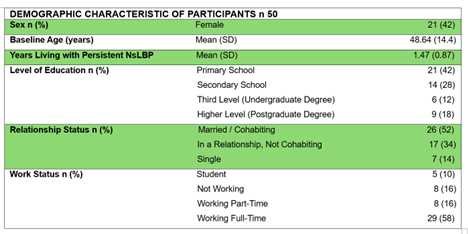
    n 50 with Non-specific Low Back Pain (NsLBP) patients (29 M, 21 F) was consecutively enrolled in one-year period and evaluated with initial, post-intervention (six months) evaluation and one-year follow-up, with administration of Patient-Related Outcome Measures (PROMs) such as Örebro Musculoskeletal Pain Screening Questionnaire (OMPSQ) and consequent further functional and psychosocial assessment with Roland Morris Disability Questionnaire (RMDQ), Fear Avoidance Beliefs Questionnaire (FABQ), Tampa Scale of Kinesiophobia (TSK), Pain Catastrophizing Scale (PCS), Coping Strategies Questionnaire (CSQ) and Pain Self-Efficacy Questionnaire (PSEQ), as measures to evaluate patients’ mindset change and treatment engagement. Physiotherapy treatment was based on Mindfulness sessions with body scan audio record and meditation walks merged with ACT principles to teach simple psychological skills, to promote psychological flexibility, and to address facilitators and barriers to self-management.

    Results

    Under a dispositionalist patient-centred approach10-11, the therapeutic process was multidimensional in nature, encompassing biomedical, psychological, social, and experiential components, and enables the construction of an intersubjective12 space between the clinician and the patient, where the characteristics of both can find a space headed towards a narrative shared sense-making process13 and an appropriate engagement to foster the therapeutic alliance14-16. Psychologically informed practice17-19 guided the therapeutical journey, where Motivational Interviewing (MI)20 framework, Mindfulness and ACT principles enabled to improve psychological flexibility and enhance personal engagement and self-management activation, as shown at the end of therapeutic program (six month) and at one-year follow-up, at outcomes re-evaluation comparing to baseline.

    Discussion and Conclusion

    A multidimensional patient-centred approach21 under a dispositionalist causal framework of reference, with the aim of whole person scrutiny22, may representing a good viaticum that prompt patients’ recovery and thrive. The recovery of functional levels and implementation of self-management programs23 consent to cope successfully with LBP complaint, under a shared clinical decision-making and personal empowerment lens. Further, be acquainted in Mindfulness and ACT’s core principles, directly reduces avoidance and promotes openness, bringing the possibility to build present-focused awareness, and coordinate greater engagement in goal-oriented and values-based activities.

    REFERENCES

    1. Hartvigsen J, et al. Lancet 2018.
    2. Buchbinder R, et al. Lancet 2018.
    3. Foster NE, et al. Lancet 2018.
    4. Murray CJL, et al. Lancet 2012.
    5. Cherkin DC, et al. JAMA 2016.
    6. Hayes, SC. Behav Ther 2004.
    7. Tatta J, et al. Phys Ther 2022.
    8. Hann KEJ et al.  J Context Behav Sci 2014.
    9. Veehof MM, et al. Cogn Behav Ther 2016.
    10. Anjum RL, et al. Springer 2020.
    11. Low M. J Eval Clin Pract 2017.
    12. Low M. In Touch. 2018.
    13. Launer J. Routledge, London 2018.
    14. Testa M, et al. Man Ther 2016.
    15. Rossettini G, et al. BMC Musculoskelet Disord 2018.
    16. McParlin Z, et al. Front Behav Neurosci 2022.
    17. Nicholas MK, George SZ. Phys Ther 2011.
    18. Main CJ, George SZ. Phys Ther 2011.
    19. Ballengee LA, et al. J Pain Res 2021.
    20. Nijs J, et al. Phys Ther 2020.
    21. Hutting N, et al. Musculoskelet Sci Pract 2022.
    22. Belton J, et al. Chiropr Man Ther 2022.
    23. Hutting N, et al. J Orthop Sports Phys Ther 2019.
  • PRATICA CLINICA FISIOTERAPICA INFORMATA DALLA TERAPIA BASATA SULL’ACCETTAZIONE E L’IMPEGNO (ACT) NEL NON-SPECIFIC CHRONIC LOW BACK PAIN (NSCLBP): A CASE-REPORT

    ACCEPTANCE AND COMMITMENT THERAPY (ACT) INFORMED PHYSIOTHERAPY PRACTICE IN NON-SPECIFIC CHRONIC LOW BACK PAIN (NSCLBP): A CASE-REPORT

    Introduction

    Non-specific chronic low back pain (NSCLBP) is a common condition and source of significant suffering, disability and healthcare costs1.

    In this case-report we show the results of a combined physiotherapy treatment with the third wave generation of Cognitive Behavioural Therapy (CBT), the Acceptance and Commitment Therapy (ACT)2.

    ACT has been shown to have positive effects in chronic pain3, and meta-analyses of ACT for chronic pain showed improvements in pain intensity, physical functioning, depression and anxiety, and quality of life (QoL)4.

    Methods

    48-year-old male industry worker with CLBP for one year.

    Recently divorced, he lives with his young daughter.

    His general health is fine and he enjoys cycling in the weekend.

    One year ago at job during heavier work than usual, constant LBP (NRPS 5/10 at rest) spreading to the right buttock without legs’ irradiation. At MRI discal bulging from L3 to S1, without evidence of herniation.

    He has continued to work (NRPS 8/10 at worst).

    Aggravating factors: sitting and spine loading during lifting tasks.

    Only rest reduces pain and no further neurological symptoms are present.

    Psychosocial factors: worries and fear about job, guarding behaviours and notes of kinesiophobia. His sleep is disrupted because of pain.

    PROMs (t0 – 6/12 follow-up): OMPSQ, RMDQ, FABQ, TSK, PSEQ and CPAQ as shown in the tables: [ A1 ]

    Main request: “to get strategies to manage pain and to re-establish work capacity”.

    Results

    The diagnostic triage5 excluded red flags for serious pathologies6 and absence of neural findings tips for diagnosis of NSCLBP.

    Under a dispositional framework7,8 the clinical picture -persistent stage, pain features related to mechanical behaviour with nociceptive contribution9, psychosocial aspects of fear-avoidance behaviour10 about work capacity, kinesiophobia and low self-efficacy- can be depicted in a graph with arrows  showing the dispositions that tend towards manifestation and maintaining of the condition or that are preventive under a causal lens[ A2 ]

    The vectorial model shows treatment goals at a glance11; it lasted 6 months, in 9 sessions, with main goals:

    # make sense of pain and disability12

    # expose gradually to provocative movements13

    # set therapeutic path in a narrative way14 through principles of ACT, to restore patient’s autonomy and foster self-management strategies[A3,4]

    Discussion and Conclusion

    After different and failed rehabilitation attempts, in our episode of care it has been possible to exclude serious pathologies – and through a causal dispositionalist framework that sets apart a person-centred approach – he has been able to recover his functional levels and implement a self-management15,16 program that consent him to cope successfully with his complaint, under a shared clinical decision-making and personal empowerment lens. Further, be acquainted in ACT’s core principles, directly reduces avoidance and promotes openness, bringing the possibility to build present-focused awareness, and coordinate greater engagement in goal-oriented and values-based activities.

    REFERENCES

    1. Murray CJL. Lancet 2012.
    2. Hayes SC. Behavior therapy 2004.
    3. Hann KEJ, McCracken LM. J Context Behav Sci 2014.
    4. Veehof MM. Pain 2011.
    5. Bardin LD. Med J Aust 2017..
    6. Finucane LM. J Orthop Sports Phys Ther 2020.
    7. Anjum RL, Copeland S, Rocca E. Rethinking causality, complexity and evidence for the unique patient: A CauseHealth resource for healthcare professionals and the clinical encounter. Springer 2020.
    8. Smart KM. Clin J Pain 2011.
    9. Vlaeyen JWS. Pain 2016.
    10. Lin I. Br J Sports Med 2020.
    11. Low M. J Eval Clin Pract 2017.
    12. Caneiro JP. Braz J Phys Ther 2021.
    13. Caneiro JP. Phys Ther 2022.
    14. Launer J. Narrative based practice in health and social care: conversations inviting change. 2018. Routledge, London.
    15. Hutting N. J Orthop Sports Phys Ther 2019.
    16. Hutting N. Musculoskelet Sci Pract 2022.