Association Between Pain Intensity, Range of Motion, Disability, and Health-Related Quality of Life Variables in Frozen Shoulder: A Cross-Sectional Study
Autori
Brindisino Fabrizio (Department of Medicine and Health Science “Vincenzo Tiberio”, University of Molise, Campobasso, Italy)
Feller Daniel (Department of General Practice, Erasmus MC, University Medical Center, Rotterdam, The Netherlands)
Andriesse Arianna (Medical Translation Private Practice c/o Andriesse Medical Translator, Lecce, Italy)
Venturin Davide (Department of Medicine and Health Science “Vincenzo Tiberio”, University of Molise, Campobasso, Italy)
Poser Antonio (Physiotherapy private practice Kinè c/o Viale Venezia 13/Q San Vendemiano, Italy)
Background and aims
While the relationship between disability and pain is well established [1], recent studies have highlighted the association between health-related, social and psychological factors, and negative functional outcomes in patients with Frozen Shoulder (FS) [2]. This study analyzes the association between pain, disability, health-related quality of life domains, and range of motion (ROM) during the first physiotherapy consultation in FS patients.
Methods
This cross-sectional study followed the STROBE guidelines [3]. Participants were recruited between January and October 2024. Each participant anonymously filled out the Shoulder Pain and Disability Index, the Disabilities of the Arm, Shoulder, and Hand (DASH) questionnaire, and the 36-Item Short Form Health Survey. ROM restrictions in flexion, abduction, and external rotation with the arm by the side were assessed. Statistical analysis was performed using multivariable linear regression —modeling all independent variables simultaneously— and adjusting for confounding factors.
Results
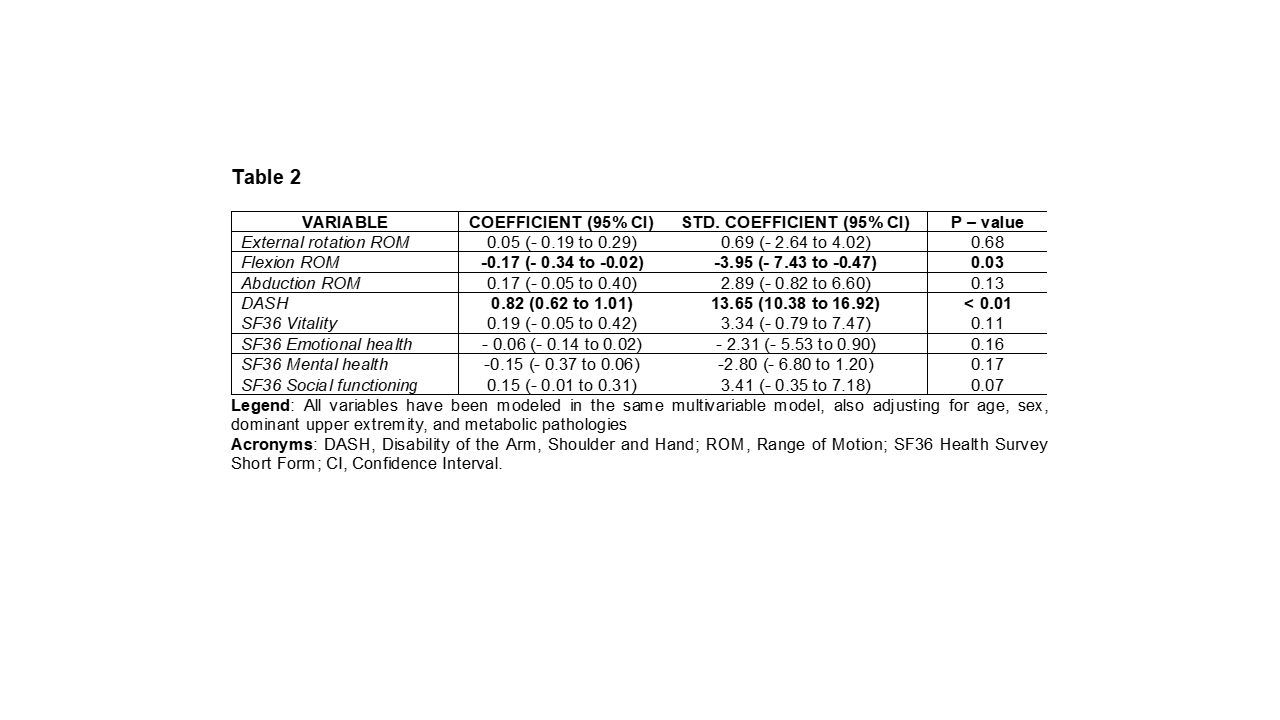
A total of 149 subjects were included (53% female). Significant correlations were found between pain and disability (standardized coefficient = 13.65, 95% CI 10.38 to 16.92, p < 0.01), as well as between pain and flexion restriction (standardized coefficient = -3.95 95%CI -7.43 to -0.47, p=0.03).
Conclusion
Our findings confirm that pain is a primary determinant of disability in FS patients, even at early stages. A significant association between pain and flexion limitation was also observed, with flexion being the most sensitive movement to pain. The lack of correlation with health-related quality of life variables suggests that, while pain limits physical function, its psychological impact—assessed through such outcome measures used—may not yet be evident. This study provides strong evidence of the association among pain, disability, and ROM in flexion during the initial physiotherapy consultation for FS, suggesting that early clinical focus on pain management may help reduce disability, improving overall patient outcomes.
REFERENCES
[1] Mertens MG, Struyf F, Verborgt O, Dueñas L, Balasch-Bernat M, Navarro-Ledesma S, et al. Exploration of the clinical course and longitudinal correlations in frozen shoulder: The role of autonomic function, central pain processing, and psychological variables. A longitudinal multicenter prospective observational study. Musculoskeletal Science and Practice. 2023;67:102857.
[2] Brindisino F, Silvestri E, Gallo C, Venturin D, Di Giacomo G, Peebles AM, et al. Depression and Anxiety Are Associated With Worse Subjective and Functional Baseline Scores in Patients With Frozen Shoulder Contracture Syndrome: A Systematic Review. Arthroscopy, sports medicine, and rehabilitation. 2022;4:e1219-e34.
[3] von Elm E, Altman DG, Egger M, Pocock SJ, Gøtzsche PC, Vandenbroucke JP. The Strengthening the Reporting of Observational Studies in Epidemiology (STROBE) Statement: guidelines for reporting observational studies. International journal of surgery (London, England). 2014;12:1495-9