Translation of the Aquatic Physiotherapist’s skills profile, an official document of International Organisation of Aquatic Physiotherapists (IOAPT)
Autori
Manuel Rocco, Pt, MSc, master’s degree “idrokinesiterapia”, Milano, NIS Fisioterapia in Acqua, Italia
Adriano Coladonato, Pt, MSc, Fisiogruppo Roma, NIS Fisioterapia in Acqua, Italia
Background and aims
Aquatic physiotherapy is a growing specialty within physiotherapy that requires a distinct set of advanced competencies for safe and effective practice. To support the development and recognition of this field, the Aquatic Physiotherapist’s Skills Profile was developed by the International Organisation of Aquatic Physiotherapists (IOAPT). The document outlines the competencies, roles, and training requirements of physiotherapists practicing in aquatic environments, aiming to establish a globally accepted standard of education and practice.
Methods
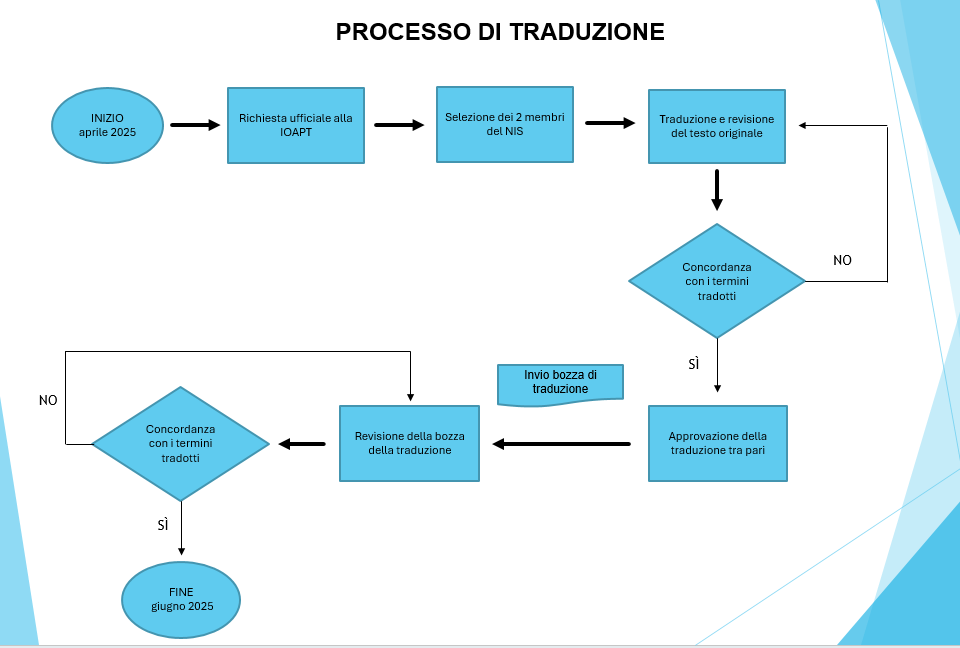
This document was created through collaboration between international experts and based on educational frameworks and clinical practice models from IOAPT member countries. It details knowledge and skill sets across academic levels and clinical roles, including entry-level and advanced training, ethical responsibilities, and research engagement. To make these standards accessible in Italy, the Network di Interesse Specialistico (NIS Fisioterapia in acqua), a National Scientific Group on Aquatic Physiotherapy, requested authorization from IOAPT to translate the document. Following approval, a working group of two physiotherapists members translated and reviewed the text through peer collaboration. A second review phase, lasting one month and involving all NIS members, ensured accuracy and consensus before submission to IOAPT for final approval, resolving any inconsistencies in the vocabulary (Fig.1).
Results
The document identifies aquatic physiotherapy as a distinct professional practice requiring both foundational physiotherapy education and additional specialty-specific skills. These include the application of hydrodynamic principles, clinical reasoning in aquatic environments, patient assessment and safety management, and the ability to design and implement individualized aquatic programs. It outlines competencies required for practice in diverse settings (e.g., hospitals, community pools, private clinics) and includes academic and non-academic training pathways with structured progression from basic to advanced levels. The document also emphasizes the importance of research, ethical standards, and interprofessional collaboration.
Conclusion
The Skills Profile represents a significant advancement in the formal recognition of aquatic physiotherapy as a specialty. It provides an essential reference for institutions, educators, and clinicians seeking to align training and practice with international standards. The rigorous, multi-phase translation process carried out by the NIS ensures the Italian version maintains the integrity and applicability of the original. This initiative supports the professional development of aquatic physiotherapists in Italy and encourages the integration of global benchmarks into national educational and clinical frameworks, ultimately enhancing the quality of care and safety for patients across aquatic rehabilitation contexts.
REFERENCES
- Sá C, Dixon J, Humaran Martinez Y, Molares Soler K, Aravena Okuinghttons G, Chandolias K, So B. Aquatic Physiotherapist’s Skills Profile, 22 March 2025.
- Bielli S, Bozzolan M, Cortini S, Galantini P, Giacobazzi M, Montevecchi V, Spada M. La formazione Core del fisioterapista.
- Binetti l, Valente D. Tradizione e innovazione nella formazione Universitaria delle professioni sanitarie: Il Core curriculum, dal core contents al core competence. Società editrice Universo, Roma, 2003.
- Irion JM, Brody LT (2009) Introduction and historical overview. In Aquatic Exercise for Rehabilitation and Training, Brody LT, Geigle PR, eds. Human Kinetics, USA, pp. 3-25.
- Becker BE (2009) Aquatic therapy: scientific foundations and clinical rehabilitation applications. PM R. 2009 Sep;1(9):859-72.