Addressing workforce shortages in physiotherapy: A critical narrative review
Autori
Tedoldi Nicola (Fondazione Teresa Camplani, Casa di Cura Domus Salutis, Brescia, Italy)
Rossettini Giacomo (Department of Physiotherapy, Faculty of Medicine, Health and Sports, Universidad Europea de Madrid, Villaviciosa de Odón, Spain)
Da Ros Alessandra (Management Department, University of Verona, Verona, Italy)
Background and aims
The availability of physiotherapists is a critical determinant of healthcare quality and system performance. Their presence ensures timely access to rehabilitation and contributes to improved patient outcomes [1]. However, global health systems are increasingly facing a mismatch between the supply and demand of physiotherapists. A projected shortfall of 18 million health workers by 2030 signals a pressing need for action – physiotherapists included [2]. This imbalance poses significant risks to the continuity, accessibility, and quality of physiotherapy services. Addressing this challenge through evidence-based and targeted strategies is essential to meet current and future health system demands [3].
Methods
To support this aim, we conducted a critical narrative review, following international guidelines and the SANRA (Scale for the Assessment of Narrative Review Articles) reporting standards [4]. The review sought to explore key factors influencing the physiotherapy workforce by: (a) identifying an appropriate theoretical framework to understand the phenomenon; (b) critically analyzing existing literature on known determinants; and (c) outlining implications for healthcare policy and future research directions.
Results
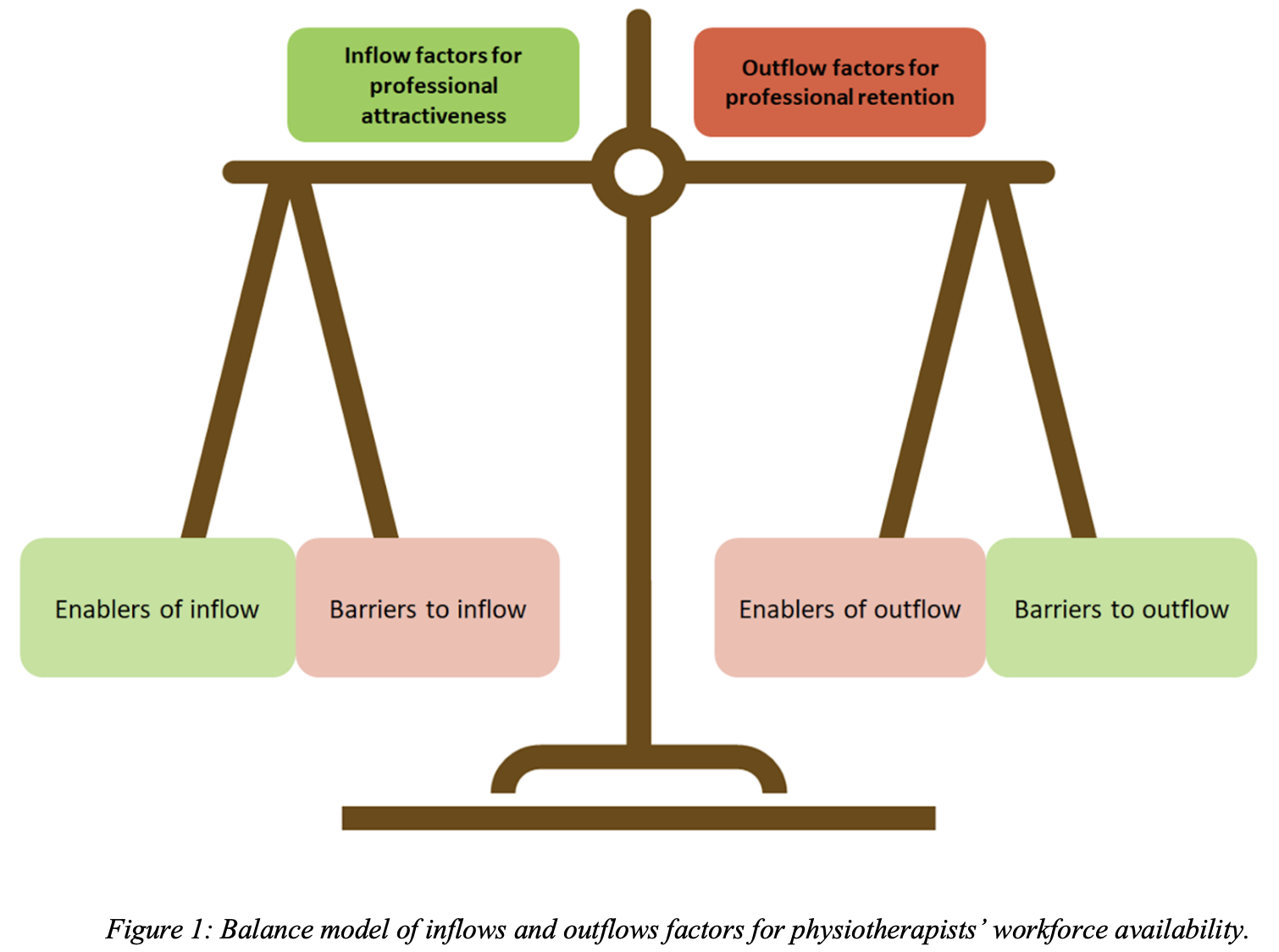
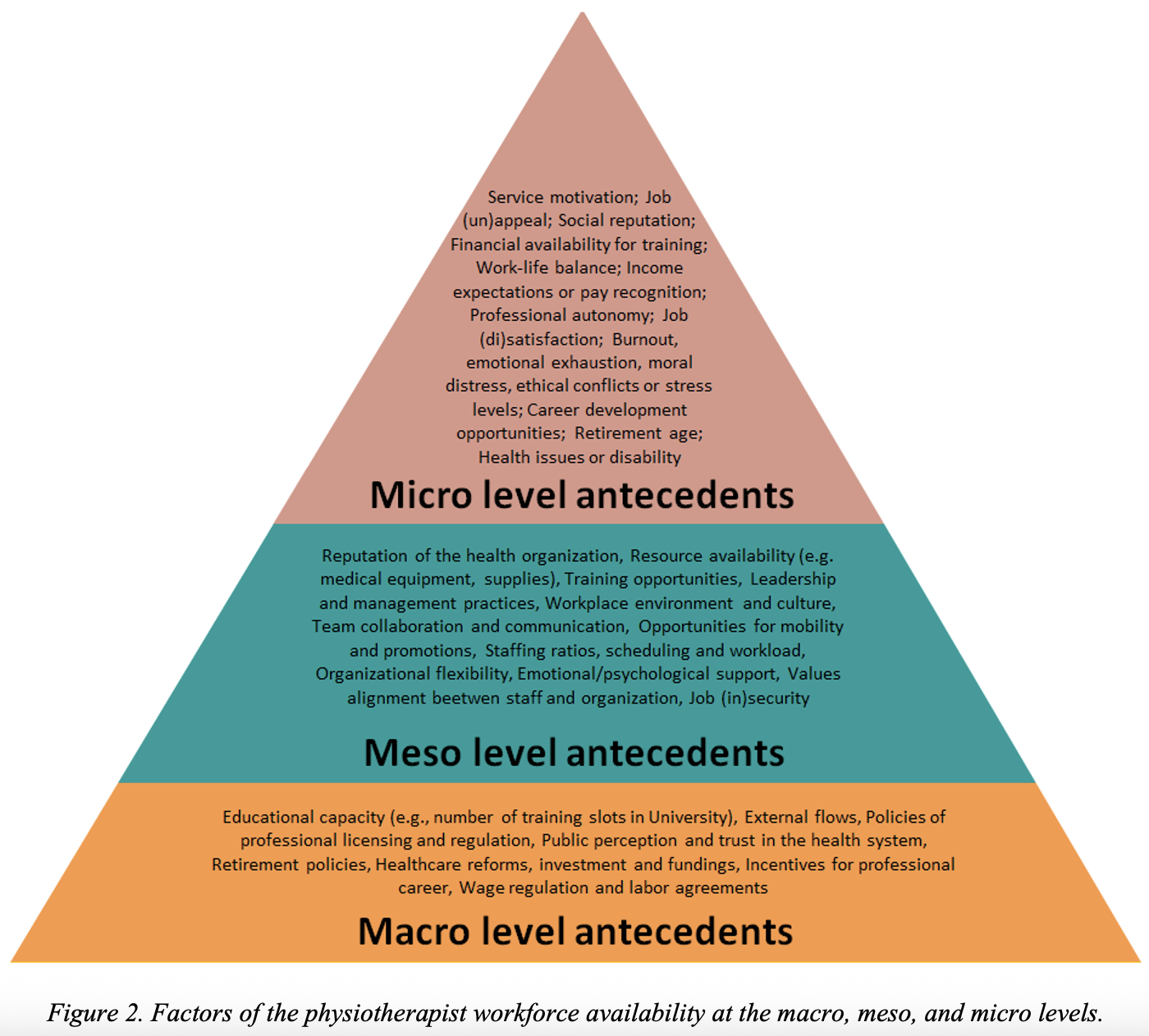
A total of 29 studies were included: 16 primary studies and 13 secondary studies. The selected studies originated from a variety of countries and healthcare systems, reflecting a broad range of organisational, economic, and policy contexts. We adopted the supply-demand model – the most widely used framework in health workforce planning – as the conceptual foundation of our analysis [5]. We focused specifically on the supply side of the physiotherapy workforce, viewed as a balance between two opposing flows: inflow and outflow (Fig. 1). Inflow factors include mechanisms that increase the number of active physiotherapists, such as graduation, immigration, or professional re-entry. In contrast, outflow factors reduce workforce availability through retirement, emigration, or attrition from the profession. To integrate the evidence, we classified these factors across three levels of influence: macro (health system), meso (organizational), and micro (individual professional) (Fig. 2).
Conclusion
Our critical narrative review underscores the urgency of implementing strategic interventions to sustain a resilient physiotherapy workforce. Managerial measures may include expanding educational capacity, enhancing retention, and promoting work-life balance. In light of ongoing innovation and technological transformation in healthcare, future research should also explore how emerging trends impact workforce dynamics – an area that remains under-investigated. While the proposed framework offers broad applicability, effective implementation must be context-sensitive, accounting for national variations in economic conditions, labor markets, and healthcare system structures.
REFERENCES
- Nwankwo ONO, Auer C, Oyo-Ita A, Eyers J, Wyss K, Fink G, Bosch-Capblanch X (2024) Human resources for health: a framework synthesis to put health workers at the centre of healthcare. BMJ Glob Health.
- WHO Regional Office for Europe (2022) Health and care workforce in Europe: time to act.
- Cieza A (2019) Rehabilitation the Health Strategy of the 21st Century, Really? Arch Phys Med Rehabil 100:2212–2214
- Baethge C, Goldbeck-Wood S, Mertens S (2019) SANRA—a scale for the quality assessment of narrative review articles. Res Integr Peer Rev 4:1–7
- Lopes MA, Almeida ÁS, Almada-Lobo B (2015) Handling healthcare workforce planning with care: where do we stand? Hum Resour Health.