CHILDREN MOTOR SKILLS ASSESSMENT IN WATER: DEVELOPMENT AND CONTENT VALIDITY OF A NEW SCALE
Autori
Granelli Giulia, pt MsC, [Rehabilitation Service, Casa di Cura Villa Erbosa, Bologna]
Bottarelli Daniela, ppt, [Pediatric Area Service, Fondazione Teresa Camplani Domus Salutis, Brescia]
Cerboneschi Margherita, pt MsC [Rehabilitation Service. Meyer Children Hospital IRCCS. Firenze]
Coppola Lucia, pt, MsC [President Aquatic Therapeutic Exercise Association, Health Professional Department Azienda Ospedale Università Padova]
Background and aims
Thanks to its intrinsic properties, water represents for children with several pathologies a playful and rewarding experience, which contributes to the improvement of motor functions. This rehabilitation setting has beneficial effects on the general state of health, provides psychomotor development and creates a positive impact on the quality of life of the whole family.
Many studies demonstrate that children’s motor repertoire is assessed pre- and post-treatment, using outcome measures and rating scales administered “on land”. In Italy, there isn’t a standardised instrument that measures and monitors changes in motor performance in the paediatric population directly in the water environment. Therefore the aim of this study is to update and develop the ‘Scale for assessing a child’s motor skills in water’, drawn up in 2020 by a colleague physiotherapist, and to verify its content and face validity.
Methods
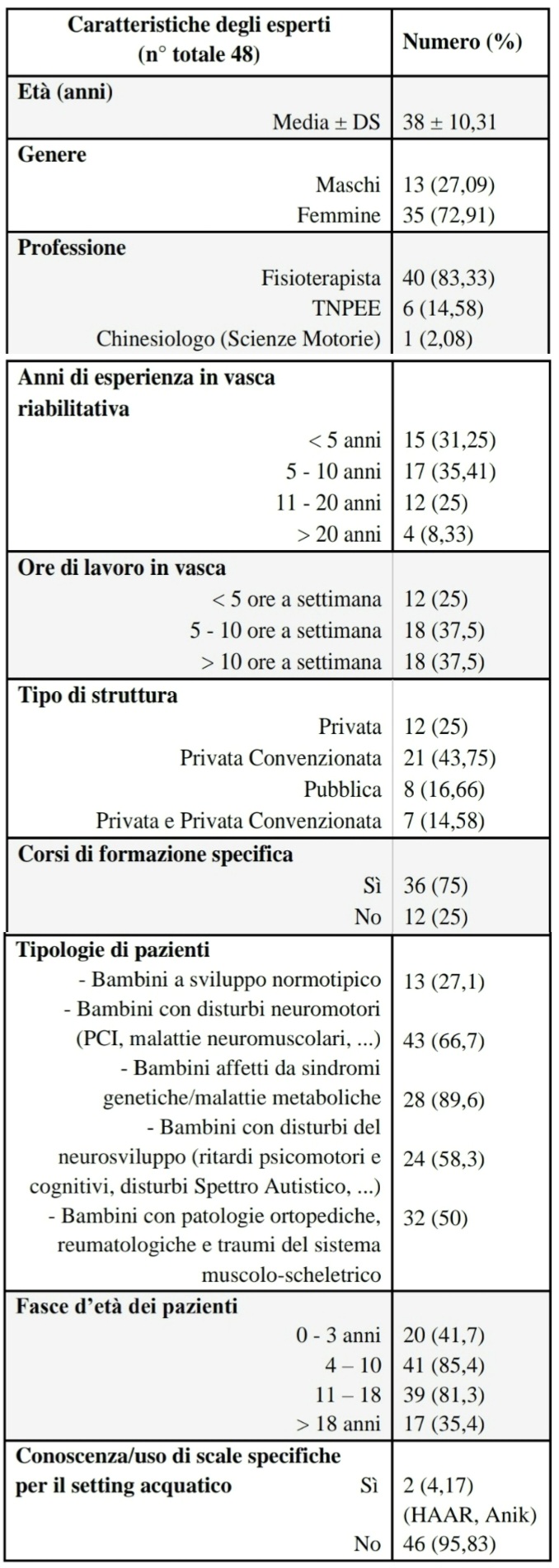
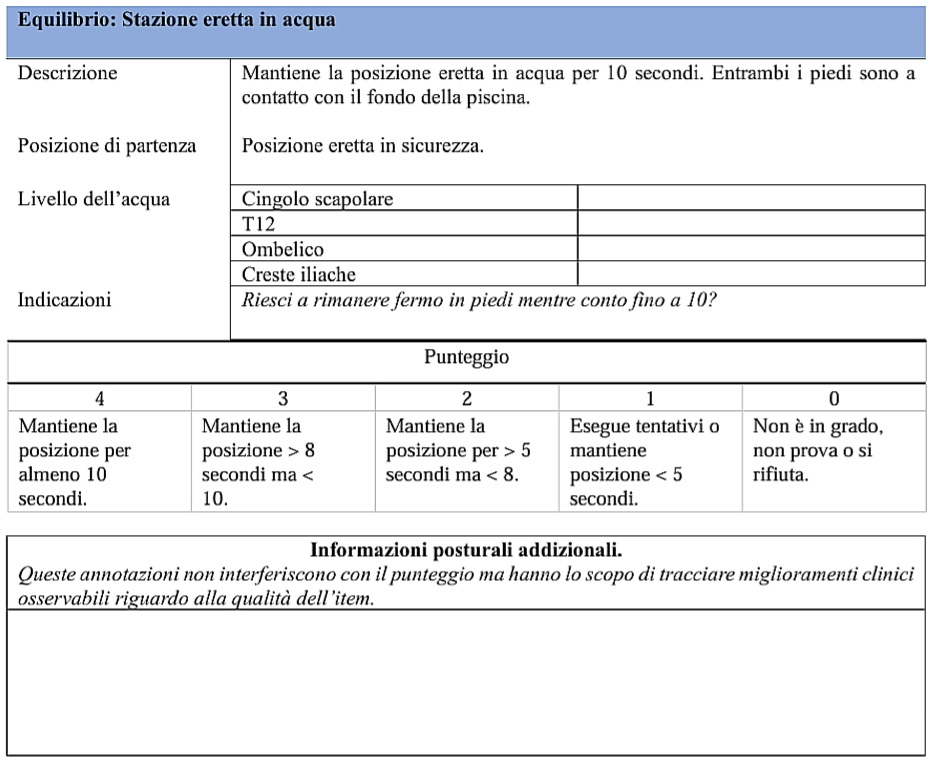
A critical literature review and a series of focus groups among physiotherapists, psychomotricity and kinesiologists experts in aquatic physiotherapy, guided the revision and updating of the first version of the scale. Then, through an online survey, the panel of professionists assessed the items via four content validity indicators (relevance, relevance to the purpose of the scale, clarity, appropriateness of scores) and provided narrative feedback (fig 1 an item and fig 2 the panel). The content validity of the instrument was determined by calculating the Content Validity Index (CVI) at item (I-CVI) and scale (S-CVI/Ave) level, the Content Validity Ratio (CVR) and Fleiss’ Kappa statistical coefficient.
In the design and planning phase, the Paediatric GIS of Associazione di Fisioterapia was consulted, particularly in the choice of statistics used.
Results
Forty-eight expert professionals participated in the study. According to I-CVI (≥ 0.78) and S-CVI (≥ 0.90) values, content validity was assessed as moderate on all scale items for relevance, clarity and adequacy of scores. Adequate relevance indices (CVR ≥ 0.29) were achieved for all the items, except for four revisable ones; the calculation of Fleiss’s Kappa showed a slight, non-random degree of agreement between the assessors. The qualitative comments provided by the experts highlighted the opportunity to make the scale clearer and more comprehensive for the next steps of the research.
Conclusion
The results of this study confirm that the new version of the scale is valid, relevant and adequate for detecting and monitoring the child’s motor skills in the aquatic setting. This research needs more studies to optimize the instrument and continue the validation process.
REFERENCES
- ICF: World Health Organization, International Classification of Functioning, Disability and Health: Children & Youth Version, Geneva, Switzerland, 2007.
- Yusoff M., “ABC of Content Validation and Content Validity Index Calculation”, Education in Medicine Journal, 11. 49-54.
- www.aquatea.it
- Karastamati C., Chandolias K., Grammatikou G., Hristara-Papadopoulou A., “The Effectiveness of Hydrotherapy-Halliwick Concept in Children With Juvenile Idiopathic Arthritis: Assessment and Treatment”, The Journal of Aquatic Physical Therapy, 2021, 29(2):35-39.
- Shariat A., Najafabadi M., Kelly dos Santos I., Anastasio A., Milajerdi H., Hassanzadeh G., Nouri E., “The Effectiveness of Aquatic Therapy on Motor and Social Skill as Well as Executive Function in Children With Neurodevelopmental Disorder: A Systematic Review and Meta-analysis”, Archives of Physical Medicine and Rehabilitation, 2023.