Shoulder pain: To image or not to image?
Autori
Brindisino Fabrizio (Department of Medicine and Health Science “Vincenzo Tiberio”, University of Molise, Campobasso, Italy)
Paul Salamh (Krannert School of Physical Therapy, University of Indianapolis, 1400 East Hanna Avenue, Indianapolis, IN)
Chad Cook (Department of Population Health Sciences, Duke University, Durham, NC, USA)
Jeremy Lewis (Therapy Department, Central London Community Healthcare National Health Service Trust, Finchley Memorial Hospital, London, UK)
Alvisa Palese (Department of Medical Sciences, University of Udine, Udine, Italy)
Germano Guerra (Department of Medicine and Health Science “Vincenzo Tiberio”, University of Molise, Campobasso, Italy)
Jacopo Bonavita (Neurorehabilitation Unit, Villa Rosa Hospital, APSS Trento, Trento, Italy)
Giacomo Rossettini (School of Physiotherapy, University of Verona, Verona, Italy)
Background and aims
Imaging findings should be interpreted within the broader context of an individual’s shoulder symptoms [1]. While imaging is valuable in identifying specific structural pathologies, findings are often equivocal. Defining what imaging changes constitute “normal”, “abnormal”, “unrelated”, “solely causative” findings, and which are, “contributory”, or “associated” with symptoms is a clinical minefield. It is arguable that many so called “abnormalities” have been labeled as such because they represent deviations in structure from idealized and flawless anatomical drawings.
Methods
To promote consideration for the role of “bio” in shoulder symptoms and encourage debate among clinicians and researchers, this opinion paper aims to stimulate discussion on the value of imaging in management of musculoskeletal shoulder pain. We sought to capture diverse perspectives by incorporating input from various health disciplines working within the musculoskeletal field, aimed at providing a comprehensive perspective to our manuscript.
Results
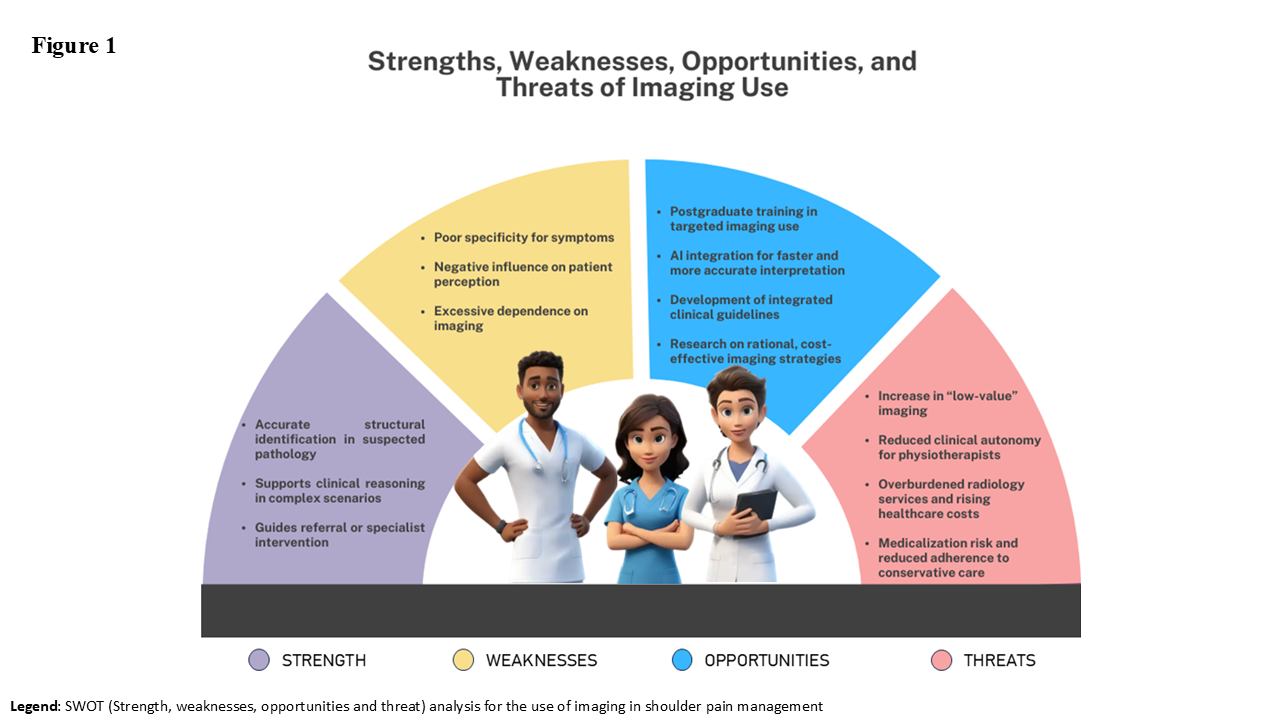
Although the judicious requests of imaging may improve clinician understanding of a specific clinical scenario, between 20–50% of imaging requests are inappropriate or of “low value” (e.g., a service offering no or minimal benefit) [2]. Conversely, strategies aimed at reducing low-value imaging have the potential to decrease costs by as much as 95% without compromising patient well-being [2].
Studies investigating this issue, question the clinical utility of routine imaging for treatment planning, given the high prevalence of anatomical variations in asymptomatic shoulders [1,3]. Indeed, while imaging may identify tissue pathology, it often cannot reliably determine the clinical significance of these findings or their correlation with specific symptoms. Acceptance of imaging findings (i) without defining what abnormal is based upon and (ii) without stating the prevalence of such findings in people without symptoms, may lead to over medicalization and detrimentally impact on healthcare sustainability [4].
Conclusion
Clinical practice frequently lacks balance and frequently is conducted at the ends of a spectrum. With one end being rigid reliance on structural imaging and the other its rejection in favor of a psychosocial narrative. To promote a judicious, resourceful, and evidence-based utilization of imaging, research should emphasize a comprehensive bio-psycho-social care pathway. Within this framework, all relevant domains should be engaged and weighted according to the specific clinical context. A balanced, context-driven use of imaging, grounded in clinical reasoning and embedded in a biopsychosocial model, can enhance diagnosis, inform treatment, and support shared decision-making. Imaging is a valuable tool when used wisely: the question is not whether to use it, but when, why, and for whom.
REFERENCES
[1] Tran G, Cowling P, Smith T, Bury J, Lucas A, Barr A, et al. What Imaging-Detected Pathologies Are Associated With Shoulder Symptoms and Their Persistence? A Systematic Literature Review. Arthritis Care & Research. 2018;70:1169-84.
[2] Kjelle E, Brandsæter IØ, Andersen ER, Hofmann BM. Cost of Low-Value Imaging Worldwide: A Systematic Review. Applied Health Economics and Health Policy. 2024;22:485-501.
[3] Gill TK, Shanahan EM, Allison D, Alcorn D, Hill CL. Prevalence of abnormalities on shoulder MRI in symptomatic and asymptomatic older adults. Int J Rheum Dis. 2014;17:863-71.
[4] Ingraham B, Miller K, Iaia A, Sneider MB, Naqvi S, Evans K, et al. Reductions in High-End Imaging Utilization With Radiology Review and Consultation. Journal of the American College of Radiology : JACR. 2016;13:1079-82