Autore: ZTTMRK82

  • Tassonomia e implicazioni cliniche del controllo motorio nel dolore muscoloscheletrico lombare: una scoping review

    Tassonomia e implicazioni cliniche del controllo motorio nel dolore muscoloscheletrico lombare: una scoping review

    Taxonomy and Clinical Implications of Motor Control in Musculoskeletal Low Back Pain. A Scoping Review

    Autori

    Federico Fiorini (University of Rome La Sapienza Department of Human Neuroscience, Rome,Italy)

    Mirko Zitti (University of Rome La Sapienza Department of Human Neuroscience, Rome,Italy)

    Rebecca Andreutto (University of Rome La Sapienza Department of Human Neuroscience, Rome,Italy)

    Graziano Raffaele(University of Rome La Sapienza Department of Human Neuroscience, Rome,Italy)

    Fabio Fiorentino(University of Rome La Sapienza Department of Human Neuroscience, Rome,Italy)

    Rachele Paciotti(University of Rome La Sapienza Department of Human Neuroscience, Rome,Italy)

    Lorenzo Storari(University of Rome La Sapienza Department of Human Neuroscience, Rome,Italy)

    Fabiola Garzonio(University of Rome La Sapienza Department of Human Neuroscience, Rome,Italy)

    Giulia Ganassin(University of Rome La Sapienza Department of Human Neuroscience, Rome,Italy)

    FIlippo Maselli(University of Rome La Sapienza Department of Human Neuroscience, Rome,Italy)

    Background and aims

    Motor control impairments (MCI) are a clinical manifestation of musculoskeletal low back pain (MSK-LBP). However, no consensus exists on the definition of motor control (MC). Various definitions highlight neurological and musculoskeletal aspects, while the most effective strategies for managing MC impairments in MSK-LBP remain unclear.

    This review aims to map different MC definitions, understand its role, and explore its influence within MSK-LBP.

    Methods

    A comprehensive literature search was conducted across four databases (MEDLINE, Cochrane Library, Scopus, and Web of Science) for articles published up to November 15, 2024. Eligible sources included systematic reviews, narrative reviews, randomized controlled trials, expert opinions, validation studies, editorials, and clinical commentaries. No publication date restrictions were applied.

    Only articles published in English were considered for inclusion.

    The drafting of the manuscript adhered to the Preferred Reporting Items for Systematic Reviews and Meta-Analyses extension for Scoping Reviews (PRISMA-ScR) guidelines.

    The study protocol was prospectively registered on the Open Science Framework (OSF) at OSF.IO/D4TAC

    Results

    A total of 3596 records were identified, of which only 26 studies met the eligibility criteria.

    The most recent literature defines MC as “an area of physics exploring laws of nature defining how the nervous system interacts with other body parts and the environment to produce purposeful, coordinated actions”.

    Motor control exercise has medium and long-term positive effects in the rehabilitation of musculoskeletal chronic low back pain. However, it appears to be comparable to other forms of exercise.


    Conclusion

    MC depends on central nervous system function, but its direct correlation with MSK-LBP remains unclear. Current evidence does not support MC exercises for acute or subacute MSK-LBP, potentially due to misclassification of interventions not adhering to MC principles. It remains uncertain whether MCI is a primary pain generator in MSK-LBP or a consequence of the condition.

    REFERENCES

    1. Low M. A Time to Reflect on Motor Control in Musculoskeletal Physical Therapy.The Journal of orthopaedic and sports physical therapy 201848(11): 833–836.
    2. Levin, M. F., & Piscitelli, D. Motor Control: A Conceptual Framework for Rehabilitation.Motor control 202226(4): 497–517.
    3. Ganesh, G. S., Kaur, P., & Meena, S. Systematic reviews evaluating the effectiveness of motor control exercises in patients with non-specific low back pain do not consider its principles – A review. Journal of bodywork and movement therapies 202126: 374–393
    4. Kantak, S. S., Johnson, T., & Zarzycki, R. Linking Pain and Motor Control: ConceptualizationMovement Deficits in Patients With Painful Conditions.Physical therapy 2022102(4).
    5. Van Dieën, J. H., Reeves, N. P., Kawchuk, G., van Dillen, L. R., & Hodges, P. W. Motor Control Changes in Low Back Pain: Divergence in Presentations and Mechanisms. The Journal of orthopaedic and sports physical therapy 201949(6): 370–379
  • Quali tipologie di esercizio di controllo motorio sono maggiormente utilizzate per modificare il dolore nel breve termine nei pazienti con pelvic girdle pain: una revisione narrativa

    Quali tipologie di esercizio di controllo motorio sono maggiormente utilizzate per modificare il dolore nel breve termine nei pazienti con pelvic girdle pain: una revisione narrativa

    Types of Motor Control Exercises Most Effective for Short-Term Pain Relief in Patients with Pelvic Girdle Pain: A Narrative Review

    Autori

    Alessandro Mantia, University of Rome La Sapienza Department of Human Neuroscience, Rome,Italy

    Mirko Zitti, University of Rome La Sapienza Department of Human Neuroscience, Rome,Italy

    Lorenzo Storari, University of Rome La Sapienza Department of Human Neuroscience, Rome,Italy

    Fabiola Garzonio, University of Rome La Sapienza Department of Human Neuroscience, Rome,Italy

    Graziano Raffaele, University of Rome La Sapienza Department of Human Neuroscience, Rome,Italy

    Fabio Fiorentino, University of Rome La Sapienza Department of Human Neuroscience, Rome,Italy

    Rebecca Andreutto, University of Rome La Sapienza Department of Human Neuroscience, Rome,Italy

    Filippo Maselli, University of Rome La Sapienza Department of Human Neuroscience, Rome,Italy

    Introduction

    Pelvic girdle pain (PGP) is described in the literature as a subset of low back pain (LBP) characterized by pain perceived between the posterior iliac crest and the gluteal fold, particularly near the sacroiliac joints. This condition can present in a nonspecific form: during pregnancy or postpartum (pregnancy-related PGP), which is also the most prevalent form; as a result of mechanical alterations due to trauma or microtrauma (non-pregnancy-related PGP); or in a specific form following fractures, infections, or arthritis. There are different intervention modalities available in the literature and for years, researchers have been investigating and studying the best approach for managing this condition and the associated biopsychosocial impairments.The aim of this study focused on the effectiveness of motor control (MC) exercises in reducing pain in the short term, and whether these really have the characteristics to stimulate MC.

    Methods

    The narrative review was carried out by searching various medical-rehabilitation databases (Pubmed, Cochrane, PEDro database, Scopus, EMBASE, Web Of Science) and was done following the methodology described by Gasparyan et al. The research was carried out taking into consideration different study designs (i.e. systematic reviews and RCTs) published between 2013 and 2023 only in english language. The research included all studies that considered patients with PGP or sacroiliac dysfunctions and involved interventions consisting of MC exercises or lumbopelvic stabilization exercises. Excluded from the review were articles that lacked an experimental or control group or did not exclusively involve motor control exercise interventions, pediactric population and papers not in english language.

    Results

    A total of 3151 studies were identified, from these five studies were included (including 4 RCTs and 1 systematic review).The primary outcome investigated was pain reduction. It was observed that these exercises were ineffective in reducing pain in the short term when implemented alone. The qualitative analysis underscored that the exercises utilized to date lack specificity and structure, not following the dictates proposed by the various motor control theories

    Discussion and Conclusion

    From the analysis conducted, it has been highlighted that the exercises currently utilized are generally lacking in specificity and structure, not adhering to the principles proposed by various motor control theories. Based on the available data and the structure of these exercises, it is therefore not possible to definitively state whether MC exercises are more or less effective in reducing short-term pain in patients with both pregnancy-related and non-pregnancy-related PGP.Future studies are warranted to enhance understanding, within the rehabilitation field ,regarding the structuring of MC exercises. This will enable better programming and evaluation of the effects of a alone motor control exercise approach in managing PGP and its short-term pain reduction.

    REFERENCES

    Stuge B. Evidence of stabilizing exercises for low back- and pelvic girdle pain – a critical review. Brazilian J Phys Ther [Internet]. 2019;23(2):181–6. Available from: https://doi.org/10.1016/j.bjpt.2018.11.006

    Weis CA, Pohlman K, Draper C, Stuber K, Hawk C. Chiropractic Care for Adults With Pregnancy-Related Low Back , Pelvic Girdle Pain , or Combination Pain : A Systematic Review. :15–8.

    Pousette S, Gutke A, Betten C, Ar KD. Treatments for pregnancy-related lumbopelvic pain : a systematic review of physiotherapy modalities. 2015;94:1156–67.

    Kennedy DJ, Engel A, Kreiner DS, Nampiaparampil D. Review Article Fluoroscopically Guided Diagnostic and Therapeutic Intra-Articular Sacroiliac Joint Injections : A Systematic Review. 2015;1500–18.

    O’Sullivan PB, Beales DJ. Diagnosis and classification of pelvic girdle pain disorders-Part 1: A mechanism based approach within a biopsychosocial framework. Man Ther. 2007;12(2):86–97.

    Mapinduzi J, Ndacayisaba G, Mahaudens P, Hidalgo B. Effectiveness of motor control exercises versus other musculoskeletal therapies in patients with pelvic girdle pain of sacroiliac joint origin: A systematic review with meta-analysis of randomized controlled trials. J Back Musculoskelet Rehabil. 2022;35(4):713–28.

    Motor Control Translating Research Into Clinical Practice 5th 2017.

    Yuri A, Lilit G, Blackmore H, Kitas GD. Writing a narrative biomedical review : considerations for authors , peer reviewers , and editors. 2011;1409–17.

  • Efficacia della realtà virtuale sulla riduzione del dolore nei differenti distretti anatomici in ambito muscoloscheletrico: Una revisione sistematica della letteratura con metanalisi

    Efficacia della realtà virtuale sulla riduzione del dolore nei differenti distretti anatomici in ambito muscoloscheletrico: Una revisione sistematica della letteratura con metanalisi

    Efficacia della realtà virtuale sulla riduzione del dolore nei differenti distretti anatomici in ambito muscoloscheletrico: Una revisione sistematica della letteratura con metanalisi

    Effectiveness of virtual reality on pain in different anatomical regions in the musculoskeletal field: a systematic review with metanalysis.

    Autori

    Mirko Zitti, University of Rome La Sapienza Department of Human Neuroscience, Rome,Italy

    Martina Regazzetti, IRCCS San Camillo Hospital, Lido of Venice,Italy

    Giorgia Pregnolato, IRCCS San Camillo Hospital, Lido of Venice,Italy

    Sara Federico, IRCSS San Camillo Hospital, Lido of Venice,Italy

    Luisa Cacciante, IRCSS San Camillo Hospital, Lido of Venice,Italy

    Blazej Cieslik, IRCSS San Camillo Hospital, Lido of Venice,Italy

    Andrea Ricci, Alma Mater Europea, Maribor, Slovenia

    Filippo Maselli, University of Rome La Sapienza Department of Human Neuroscience, Rome,Italy

    Lorenzo Storari, University of Rome La Sapienza Department of Human Neuroscience, Rome,Italy

    Pawel Kiper, IRCSS San Camillo Hospital, Lido of Venice,Italy

    Introduction

    Musculoskeletal pain is one of the primary symptoms that prompt patients to seek physiotherapy consultations. The use of virtual reality in physiotherapy is rapidly expanding across various areas. While it is already well-studied in the neurological field, there is a notable lack of research in the musculoskeletal domain. This review aims to investigate the effectiveness of virtual reality in pain relief in different anatomical regions.

    Methods

    The research, conducted on MEDLINE (via PubMed), Cochrane Library, Scopus, Web of Science and Embase, included randomized controlled trials that evaluate the effectiveness of virtual reality interventions, whether immersive, specialized non-immersive and through gaming platforms. The treatment was compared to conventional rehabilitation. Primary outcomes focused on pain, with secondary outcomes assessing quality of life. Search was carried out up to October 31, 2023. All patients 18+ with  musculoskeletal disorders in various anatomical regions, both treated conservatively and post-surgery, were included. However, central and peripheral neurological disorders, as well as rheumatic diseases, were excluded. All those treatments included under telerehabilitation, teleconsultation methods, robotic interventions and exoskeletons were excluded. The selection of studies was performed by four independent reviewers. Two of them have experience in musculoskeletal physiotherapy, and the other two have experience in virtual reality . Pairs were formed consisting of a reviewer expert in virtual reality and one in musculoskeletal physiotherapy. The meta-analysis was performed using RevMan 5.4 and a subgroup analysis was also done between immersive virtual reality, specialized non-immersive virtual reality and exergaming. The quality of the evidence was assessed with the Cochrane risk of bias tool(RoB2).This study is registered on PROSPERO, number CRD42023466977.

    Results

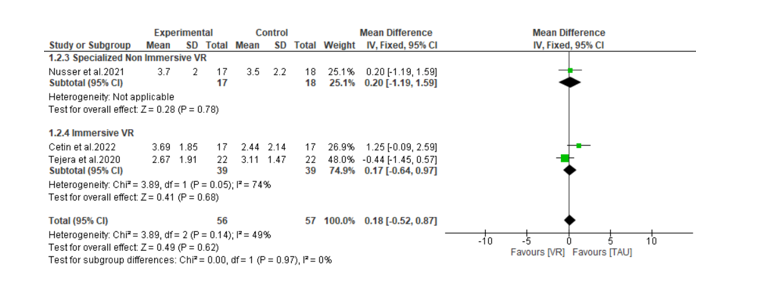
    Out of 1265, twenty-seven articles met the eligibility criteria, with 1191 participants overall. Twenty articles contributed to the meta-analyses. Significant results were found regarding pain relief in knee district (SMD=-0.33; CI -0.55; -0.10; I21 13%, P < 0.004), especially for the subgroup specialized non-immersive virtual reality (SMD=-0.32; CI -0.62; -0.03; P <0,003; I2 = 10%,). For the other districts, the heterogeneity found was too high to draw strong recommendations.


    Discussion and Conclusion

    Virtual reality demonstrates potential in treating pain associated with musculoskeletal disorders; however, interventions must be tailored to individual patients and their specific conditions. Given the moderate to low methodological quality of the studies included, along with the heterogeneity in VR modalities, dosages, and exercise programs, further research is required to determine its true efficacy in alleviating pain across various musculoskeletal disorders. Larger, more comprehensive studies, designed to address specific conditions and employing distinct virtual reality interventions, are necessary to provide deeper insights into the effectiveness of virtual reality in pain management within the musculoskeletal domain.

    REFERENCES

    Chaplin E, Karatzios C, Benaim C. Clinical Applications of Virtual Reality in Musculoskeletal Rehabilitation: A Scoping Review. Healthcare [Internet]. 2023 Dec 15 [cited 2024 Apr 26];11(24):3178. Available from: https://www.mdpi.com/2227-9032/11/24/3178

    Rutkowski S, Kiper P, Cacciante L, Cieślik B, Mazurek J, Turolla A, et al. Use of virtual reality-based training in different fields of rehabilitation: A systematic review and meta-analysis. J Rehabil Med [Internet]. 2020 [cited 2024 Apr 26];52(11):jrm00121. Available from: https://medicaljournalssweden.se/jrm/article/view/3752

    Gumaa M, Rehan Youssef A. Is Virtual Reality Effective in Orthopedic Rehabilitation? A Systematic Review and Meta-Analysis. Physical Therapy [Internet]. 2019 Oct 28 [cited 2024 Apr 26];99(10):1304–25. Available from: https://academic.oup.com/ptj/article/99/10/1304/5537309

    Brady N, McVeigh J, McCreesh K, Rio E, Dekkers T, Lewis J. Exploring the effectiveness of immersive Virtual Reality interventions in the management of musculoskeletal pain: a state-of-the-art review. Vol. 26. 2021.

    Collado-Mateo D, Merellano-Navarro E, Olivares P, Garcia-Rubio J, Gusi N. Effect of exergames on musculoskeletal pain: A systematic review and meta-analysis. Vol. 28. 2018.

    Padilla-Castañeda MA, Sotgiu E, Barsotti M, Frisoli A, Orsini P, Martiradonna A, et al. An Orthopaedic Robotic-Assisted Rehabilitation Method of the Forearm in Virtual Reality Physiotherapy. Journal of Healthcare Engineering [Internet]. 2018 Aug 1 [cited 2024 Apr 26];2018:1–20. Available from: https://www.hindawi.com/journals/jhe/2018/7438609/

    Nagpal AS, Raghunandan A, Tata F, Kibler D, McGeary D. Virtual Reality in the Management of Chronic Low Back Pain: A Scoping Review. Front Pain Res [Internet]. 2022 Mar 7 [cited 2024 Apr 26];3:856935. Available from: https://www.frontiersin.org/articles/10.3389/fpain.2022.856935/full


  • Sviluppo di un nuovo modello riabilitativo in ambiente tecnologico:soddisfazione e monitoraggio del recupero funzionale nel paziente neurologico.Studio longitudinale pilota:risultati preliminari

    Development of a new advanced technological neurorehabilitation model:patient satisfaction and functional recovery monitoring in neurological patients.Preliminary results of a pilot longitudinal study

    Introduction

    Robotic and virtual reality devices have shown promising results in improving motor recovery in several neurological conditions. Additionally, the use of motion detection sensors and environmental control systems is rapidly advancing. Indeed, the possibility of applying motion detection and home-automation sensors in technological rehabilitation rooms may allow the synchronization of environmental data with patients’ clinical history, with the goal to facilitate the monitoring of patients’ functional recovery. In HoSmartAI project (EU Horizon, grant No. 101016834) we have been testing the level of productivity, functional recovery, and patients’ perception of a new technological solution, resulting from the installation of home-automation sensors in a technologically advanced room for motor neurorehabilitation.

    Methods

    The study is a pilot longitudinal study conducted in IRCCS San Camillo Hospital (Venice, Italy) within the EU Horizon project HoSmartAI. We enroll adult patients with diagnosis of neurological pathology and motor impairment. The treatment consists of one hour/day for 15 days of motor treatment in the HoSmartAI room using technological devices.

    The primary outcome is productivity, while secondary outcome include clinical and patients’ experience measures, such as: Trunk Control Test (TCT), Reaching Performance Scale (RPS), Box and Blocks Test (BBT), Nine-hole Pegboard Test (NHPT), Berg Balance Scale (BBS), 10-meter walking test, Functional Ambulation Categories (FAC), number of falls, System Usability Scale (SUS), Short Form Patient Satisfaction Questionnaire (PSQ-18), User Experience Questionnaire (UEQ) and EuroQol questionnaire (EQ-5D-3L).

    Results

    In the preliminary analysis, we included 12 patients, on average 60.66 ±12.52 years old, with diagnosis of: Stroke (n=4), Parkinson(n=3), Multiple Sclerosis (n=2), Neuropathy (n=1), Genetic Paraparesis (n=1) and Spinal Cord ischemia (n=1).  Inferential analyses of the variables indicated a significant improvement in the following measures BBS (T0: 34.90 + 18.98; T1: 40.00 + 16.28, p=0.14) and FAC (T0: 2.80 + 1.98; T1: 3.40 + 1.83, p= 0.04). Moreover,  the level of perceived quality of life was improved (EQ-5D vas score: T0: 47.91+ 20.50; T1: 61.66 + 11.9, p= 0.04). Finally, patients referred a good level of usability (SUS: 78.75 +17.04).

    Discussion and Conclusion

    Despite the small sample size, preliminary data collected so far suggest that undergoing a rehabilitation pathway in a technologically advanced environment could increase functionality status of patients, in addition to enhancing awareness and self-perception of health status. As more data become available, we will define the productivity increasing the number of patients treated in the same time. Moreover, future implications will be needed to understand the clinical features of those patients who may work safely in a co-presence setting. It will also be essential to analyze the usability of the room and technologies to identify those that are most manageable and user-friendly for the patients.

    REFERENCES

    Langhorne, P.; Coupar, F.; Pollock, A. Motor recovery after stroke: a systematic review. Lancet Neurol 2009,
    8, 741-754, doi:10.1016/S1474-4422(09)70150-4.

    Molteni, F.; Gasperini, G.; Cannaviello, G.; Guanziroli, E. Exoskeleton and End-Effector Robots for Upper
    and Lower Limbs Rehabilitation: Narrative Review.

    Abbruzzese, G.; Marchese, R.; Avanzino, L.; Pelosin, E. Rehabilitation for Parkinson’s disease: Current
    outlook and future challenges. Parkinsonism & Related Disorders 2016, 22, S60-S64,
    doi:https://doi.org/10.1016/j.parkreldis.2015.09.005.

    Manuli, A.; Calabrò, R.S. Effects of domotics on cognitive, social and personal functioning in patients with
    Parkinson’s disease: A pilot study.

    Maggio, M.G.; Maresca, G.; Russo, M.; Stagnitti, M.C.; Anchesi, S.; Casella, C.; Zichitella, C.; Manuli, A.; De
    Cola, M.C.; De Luca, R.; et al. Effects of domotics on cognitive, social and personal functioning in patients
    with chronic stroke: A pilot study