SVAS, a prevention project for primary schools: exploring opinions and satisfaction of teachers involved in the project.
Autori
D’Urso Alina [Azienda Sanitaria Locale Cn2, Alba (CN), Italy]
Galante Ambra [GIS Fisioterapia Pediatrica – AIFI, Rome, Italy]
Tusoni Francesca [Università degli studi dell’Aquila, L’Aquila, Italy]
Background and aims
‘La schiena va a scuola’ (SVAS) is a project aimed at promoting the spinal health of primary schoolchildren. The project is carried out by specially trained physiotherapists registered with the Italian physiotherapy association (AIFI). The project includes two training meetings for pupils (in classroom) and an online training webinar for parents and teachers. Each project is supervised by a teacher, who is responsible for its implementation. The purpose of this study was to explore teachers’ perspectives on the project and to gather their feedback to improve it.
Methods
All the teachers that supervised the project in 2025 were invited to complete an ad-hoc questionnaire. The questionnaire was designed to investigate teachers’ opinions and satisfaction with the project (9 items), collecting feedback on changes in students’ or parents’ behaviour (2 items) and gather suggestions to improve the project (2 items). To ensure anonymity and prevent response bias, we did not collect personal data and used a QR code to share the link to the Google Form. We performed a descriptive analysis of the collected data (frequencies and percentages), by using the software R. Open questions were coded and analysed as categorical variables.
Results
257 teachers from 14 regions in Italy completed the questionnaire. The majority of respondents found the project content useful and addressed in a comprehensive and, at the same time, engaging way for the pupils. The methods and timing of the project were deemed appropriate to the project content, and to the teaching and organisational needs of the school (fig.1).
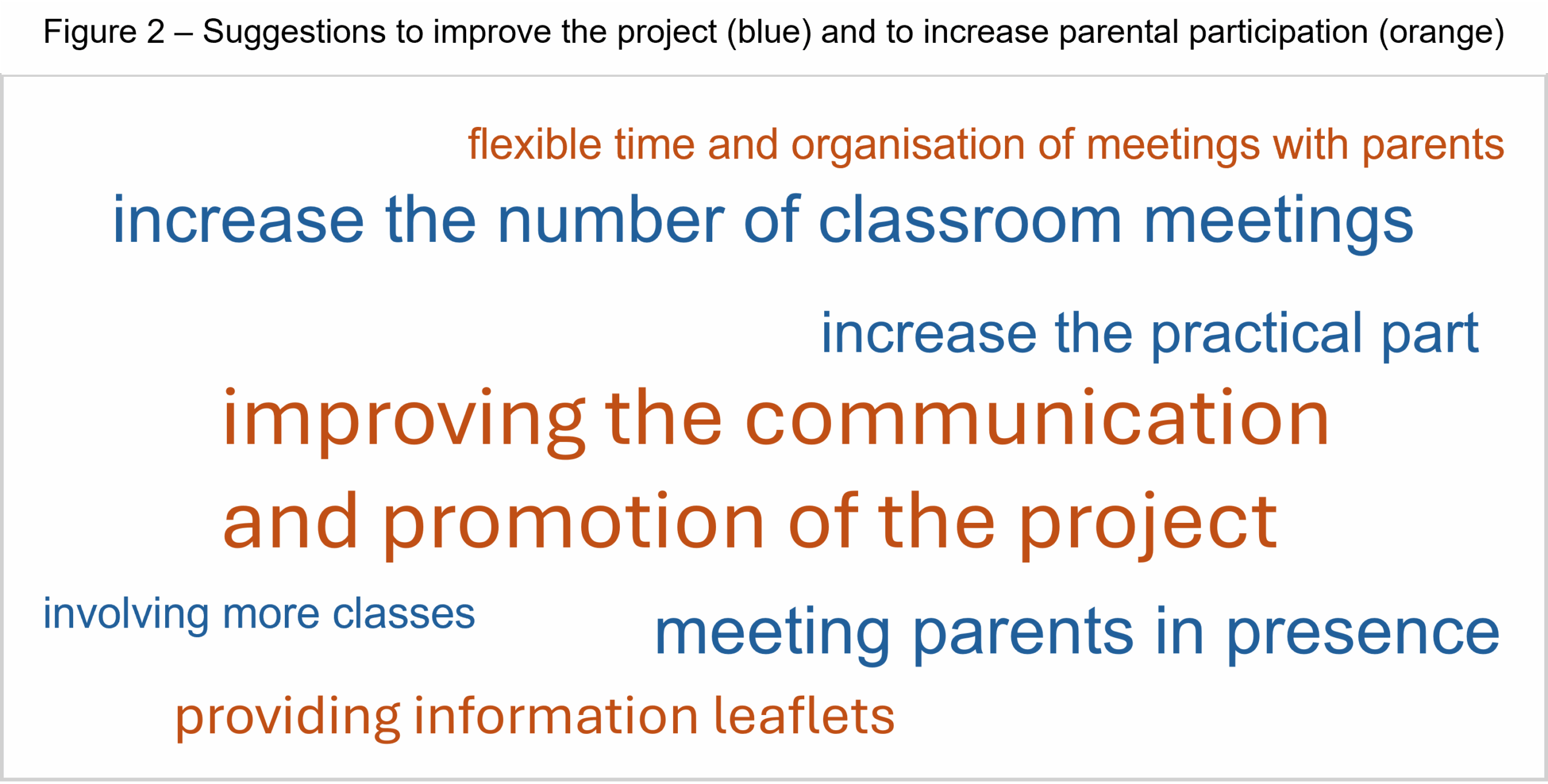
Regarding adherence to the project, less than 20% of the teachers reported that their class were able to perform the proposed exercises regularly, while almost 60% reported that the class performed them occasionally. Most of the teachers observed a fair change in pupils’ habits (73.1%), particularly regarding posture and backpack management. However, they reported perceiving a less marked change in parents’ habits (46.3%). Teachers also provided useful suggestion to improve the project and to increase parental participation in the proposed training (fig.2).
Over 70% of respondents were very satisfied with the project, assigning it a high global score (5/5). All teachers reported they would recommend the project to other classes (fig.3).
Conclusion
Overall, the project was highly appreciated by the participating teachers. It proved to be quite effective in changing children’s habits. Future research should explore the validity of the changes proposed by the teachers to improve the project outcomes.
REFERENCES
- ‘La schiena va a scuola’ official website, available at https://schiena.aifi.net/