The importance of identifying red flags in patients with elbow pain: a systematic review
Autori
Rossi Federico [Department of Medicine and Health Science “Vincenzo Tiberio”, University of Molise, Campobasso, Italy; Department of Biomedical and Neuromotor Sciences (DIBINEM), Alma Mater Studiorum, University of Bologna, Bologna, Italy]
Cioeta Matteo [Department of Medicine and Health Science “Vincenzo Tiberio”, University of Molise, Campobasso, Italy]
Palatini Alice [Department of Medicine and Health Science “Vincenzo Tiberio”, University of Molise, Campobasso, Italy]
Maggialetti Giuseppe [Department of Medicine and Health Science “Vincenzo Tiberio”, University of Molise, Campobasso, Italy]
Mancazzo Lidia [Department of Medicine and Health Science “Vincenzo Tiberio”, University of Molise, Campobasso, Italy]
Giannotta Gabriele [Department of Medicine and Health Science “Vincenzo Tiberio”, University of Molise, Campobasso, Italy]
Pellicciari Leonardo [IRCCS Istituto delle Scienze Neurologiche di Bologna, Bologna, Italy]
Giovannico Giuseppe [Department of Medicine and Health Science “Vincenzo Tiberio”, University of Molise, Campobasso, Italy]
Prato Ilaria [Department of Medicine and Health Science “Vincenzo Tiberio”, University of Molise, Campobasso, Italy]
Background and aims
Elbow pain, though uncommon, can herald serious pathology. Given the paucity of guideline‑based screening directives, this systematic review consolidates red‑flag findings to help hand therapists and other frontline clinicians recognise and promptly refer serious elbow disorders.
Methods
Results
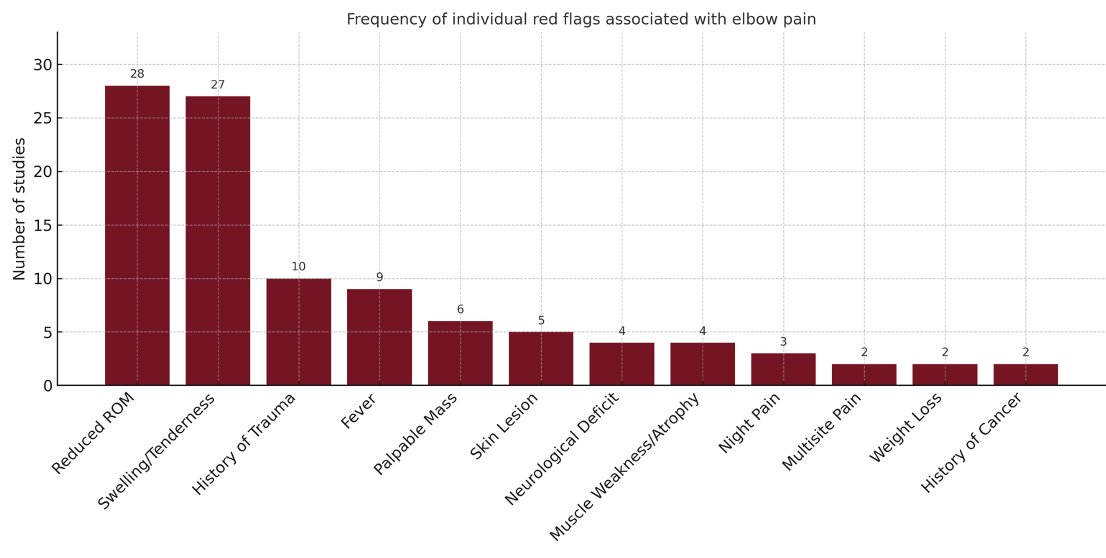
Among 6 509 records screened, 52 studies (369 patients—4 retrospective and 1 prospective cohort, 8 case series, 39 case reports) met the inclusion criteria, most addressing oncologic (30 %) or orthopaedic (28 %) causes of elbow pain, with smaller proportions of infectious (17 %), vascular (11 %), systemic (11 %) and neurological (2 %) conditions. Across studies, reduced elbow range-of-motion and local swelling/tenderness were the most prevalent red flags, while palpable masses, night pain and trauma history selectively signalled oncologic or orthopaedic pathology; upper-limb hypertension, bruising or pallor pointed to vascular compromise, and fever or constitutional symptoms suggested infection or systemic disease. Radiography was universal for mechanical lesions, MRI or biopsy confirmed most tumours, and blood-pressure measurement or histology were crucial for vascular and infectious diagnoses, respectively. Although these patterns offer a pragmatic screening framework for first-contact clinicians, the evidence base is limited by a predominance of case reports/series and moderate-to-high risk of bias, underscoring the need for higher-quality prospective research to refine elbow red-flag algorithms.
Conclusion
Reduced elbow range of motion and local swelling are the most consistently reported red flags across oncologic, infectious, orthopaedic, vascular, systemic and neurological conditions. Incorporating systematic screening for these indicators—alongside targeted history, blood-pressure measurement and a brief neurological check—can sharpen clinicians’ differential diagnosis and accelerate referral. Prospective studies are now needed to quantify the diagnostic accuracy of these red flags and refine evidence-based guidelines for elbow pain management.
REFERENCES
- Goodman and Marshall’s Recognizing and Reporting Red Flags for the Physical Therapist Assistant – Edition 2 – Edited by Charlene Marshall, BS, PTAElsevier Health Inspection Copies. Accessed May 5, 2025. https://www.inspectioncopy.elsevier.com/book/details/9780323878791
-
Committee on Diagnostic Error in Health Care, Board on Health Care Services, Institute of Medicine, The National Academies of Sciences, Engineering, and Medicine. Improving Diagnosis in Health Care. (Balogh EP, Miller BT, Ball JR, eds.). National Academies Press (US); 2015. Accessed May 2, 2025. http://www.ncbi.nlm.nih.gov/books/NBK338596/
- Cochrane Handbook for Systematic Reviews of Interventions. Accessed February 14, 2024. https://training.cochrane.org/handbook