Autore: GDTMTT200

  • La tDCS monopolare potrebbe influenzare i riflessi del tronco encefalico: Uno studio computazionale e neurofisiologico

    La tDCS monopolare potrebbe influenzare i riflessi del tronco encefalico: Uno studio computazionale e neurofisiologico

    La tDCS monopolare potrebbe influenzare i riflessi del tronco encefalico: Uno studio computazionale e neurofisiologico

    Monopolar tDCS might affect brainstem reflexes: A computational and neurophysiological study

    Autori

    Guidetti Matteo [‘‘Aldo Ravelli” Center for Neurotechnology and Experimental Brain Therapeutics, Department of Health Sciences, University of Milan, Milan, Italy]

    Anna Maria Bianchi [Department of Electronics, Information and Bioengineering, Politecnico di Milano, Milan, Italy]

    Marta Parazzini [Institute of Electronics, Computer and Telecommunication Engineering, CNR, Milan, Italy]

    Natale Maiorana [‘‘Aldo Ravelli” Center for Neurotechnology and Experimental Brain Therapeutics, Department of Health Sciences, University of Milan, Milan, Italy]

    Marta Bonato [Institute of Electronics, Computer and Telecommunication Engineering, CNR, Milan, Italy]

    Rosanna Ferrara [‘‘Aldo Ravelli” Center for Neurotechnology and Experimental Brain Therapeutics, Department of Health Sciences, University of Milan, Milan, Italy]

    Giorgia Libelli [‘‘Aldo Ravelli” Center for Neurotechnology and Experimental Brain Therapeutics, Department of Health Sciences, University of Milan, Milan, Italy]

    Alberto Priori [‘‘Aldo Ravelli” Center for Neurotechnology and Experimental Brain Therapeutics, Department of Health Sciences, University of Milan, Milan, Italy]

    Tommaso Bocci [‘‘Aldo Ravelli” Center for Neurotechnology and Experimental Brain Therapeutics, Department of Health Sciences, University of Milan, Milan, Italy]

    Introduction

    Transcranial direct current stimulation (tDCS) has recently gained great interest due to its feasibility and available clinical evidences1. Several findings 2,3 suggest it can generate significant electric fields (EF) in subcortical regions, possibly modifying their activity. Several authors have tried to steer the EF to target deeper brain structures by setting number and position of scalp electrodes – a strategy called multi-electrode tDCS4,5. For example, monopolar montages (i.e., with reference over right deltoid) might induce greater concentration of currents6 and greater intensities of EF in thalamus and midbrain, compared to cephalic montages7. A way to evaluate the effect of the stimulation on brainstem is to assess trigeminal reflexes (e.g., blink reflex – BR, masseter inhibitory reflex – MIR), whose arcs relies on brainstem neural circuits (pons, medulla oblongata)8,9. In this study, we aimed to assess whether a monopolar multi-electrode tDCS (anodes over motor cortices, cathode over right deltoid) montage might selectively affect deep brain structures through computational predictions and neurophysiological assessment of BR and MIR.

    Methods

    A MRI-based human head model10 was used to model the EF induced by the experimental protocol of stimulation. Sponge electrodes were modelled, with a uniform electrical potential (± 1 V) over the surface. The peak (99th percentile), median, 25th and 75th percentile of the EF amplitude distribution in thalamus (THA) and mid-brain (MB), and the percentage of area where EF amplitude was greater than 25% (V25), 30% (V30), and 50% (V50) of the peak in the grey matter were considered. All values were normalized to the 99th percentile of EF in the grey matter. Then, the experimental protocol of stimulation (single session, 2 mA for 20 min, anode rubber pads: 25 cm2, reference pad: 35 cm2) was applied to 10 healthy subjects (mean ± SD age: 31.5 ± 9.7, 5 women). BR (reflex threshold, latencies of RI, RII ipsilateral and RII contralateral) and MIR (onset latencies and duration of SP1 and SP2) characteristics were recorded before (T0) and after (T1) the stimulation. Computational estimations were reported descriptively, while neurophysiological data were analysed through paired t-Test (T0 vs T1) to assess the effect of the treatment (p-value < 0.05 set as significant).

    Results

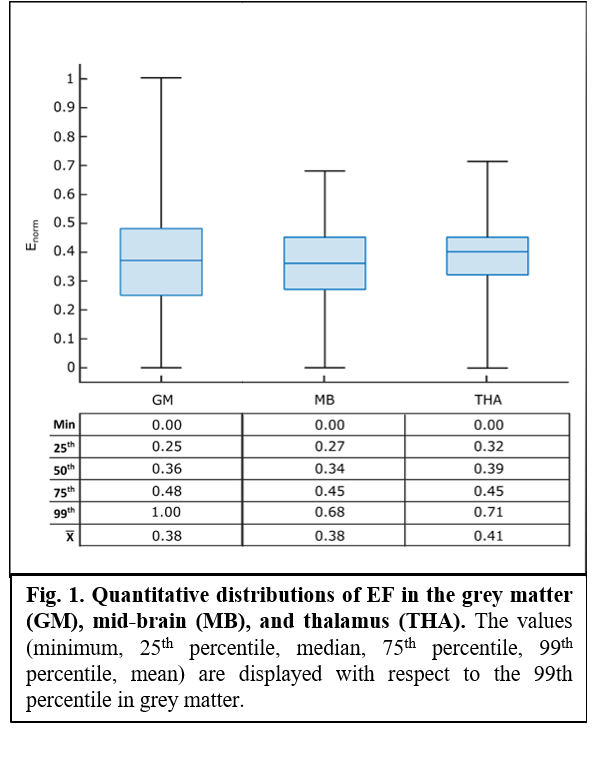
    Computational predictions suggest that the experimental protocol of stimulation might induce normalized medians (MB = 0.34; THA = 0.39), 25th (MB = 0.27; THA = 0.32) and 75th (MB, THA = 0.45) percentiles in deeper regions roughly comparable to those in the grey matter, with peak values always above ~70% of the peak in the grey matter (fig.1 and fig.2). Similarly, values of volume percentage suggest a concentration of EF for MB (V30 = 62.25%; V50 = 17.62%) and especially for THA (V30 = 81.02%; V50 = 17.18%) (fig.3). As for neurophysiological assessments, a significant reduction in latency (ms) of RI [right BR: t(9) = 5.24, p < 0.001; left BR: t(9) = 3.21, p = 0.01] and increase of SP1 duration (ms) of MIR [t(9) = -2.46, p = 0.03] was found (fig.4).

    Discussion and Conclusion

    In this study, we assessed the trends of EF distributions in MB and THA during a monopolar multi-electrode tDCS. Our results suggest that this montage might induce a deep and focal distribution of EF, as previously proposed11; however, none of previous studies were clinically confirmed, nor considered to use an extracephalic electrode. Since neurons in deep brain regions are directly sensitive to weak DC electric fields12, an effect similar to those induced by tDCS at cortical level might be expected. Indeed, we clinically tested computational predictions in healthy subjects. Clinical findings seem to confirm that monopolar multi-electrode tDCS induces changes in BR, suggesting a neuromodulatory effect on brainstem. We can hypothesize that tDCS may interfere with diencephalic nuclei (e.g., reticular formation, locus ceruleus) strictly connected to pontine and medullary areas from which BR originate13. The translation potentiality of these results is great, and the possibility to directly influence brainstem activity would be of great value for many clinical applications, e.g., rehabilitation of cranial nerves disfunctions or Parkinson’s disease.

    REFERENCES

    1 Lefaucheur, J.-P. et al. Clin Neurophysiol 128, 56–92 (2017)

    2 Parazzini, M. et al. Bioelectromagnetics 33, 476–487 (2012)

    3 Guidetti, M. et al. Biomedicines 10, 2333 (2022)

    4 Dmochowski, J. P. et al. J Neural Eng 8, 046011 (2011)

    5 Guler, S. et al. Journal of neural engineering 13, (2016)

    6 Noetscher, G. M. et al. IEEE Transactions on Biomedical Engineering 61, 2488–2498 (2014)

    7 Parazzini, M. et al. Clinical Neurophysiology 124, 1039–1040 (2013)

    8 Esteban, A. Neurophysiologie clinique = Clinical neurophysiology 29, 7–38 (1999)

    9 Ongerboer De Visser, B. W. et al. Brain : a journal of neurology 101, 285–294 (1978)

    10 Christ, A. et al. Physics in Medicine and Biology 55, 23 (2010)

    11 Khorrampanah, M. et al. Computers in Biology and Medicine 125, 103998 (2020)

    12 Reato, D. et al. The Journal of neuroscience : the official journal of the Society for Neuroscience 30, 15067–15079 (2010)

    13 Fearon, C. et al. Journal of Parkinson’s Disease 11, 261–269 (2021)

  • Atteggiamento dei fisioterapisti italiani verso i principi dell’EBP: uno studio trasversale attraverso l’Evidence Based Practice Questionnaire

    Atteggiamento dei fisioterapisti italiani verso i principi dell’EBP: uno studio trasversale attraverso l’Evidence Based Practice Questionnaire

    Attitude of Italian physiotherapists towards EBP principles: a cross-sectional study through the Evidence Based Practice Questionnaire

    Autori

    Deretti Lorenzo ((Bachelor’s Degree in Physiotherapy, Department of Clinical and Experimental Sciences, University of Brescia, Brescia, Italy))

    Negri Alessandro (Bachelor’s Degree in Physiotherapy, Department of Clinical and Experimental Sciences, University of Brescia, Brescia, Italy)

    Bertoni Gianluca (Department of Neurosciences, Rehabilitation, Ophthalmology, Genetics, Maternal and Child Health, University of Genoa, Genova, Italy; Department of Clinical and Experimental Sciences, University of Brescia, Brescia, Italy; Training Unit, Azienda Sociosanitaria Territoriale di Cremona, Cremona, Italy)

    Guidetti Matteo (“Aldo Ravelli” Center for Neurotechnology and Experimental Brain Therapeutics, Department of Health Sciences, University of Milan, Milan, Italy)

    Introduction

    ‘Evidence-based practice’ (EBP) refers to the conscientious, explicit, and judicious use of the best available evidence aimed at decision-making in patient care [1]. Pragmatically, it results in the integration of clinical expertise, the best evidence from the scientific literature, patient’s clinical condition and preferences [2]. Being physiotherapists (PTs) healthcare professionals, the Italian physiotherapist’s code of ethics mandates continuing professional education, beside the practice of good clinical practice according to research evidence – therefore, an EPB approach to professional practice (Art. 12 “Qualità ed appropriatezza delle cure e Art. 22 “Aggiornamento e formazione continua”) [3]. However, to date, there remain some critical issues in the fulfilment of this requirement [4], especially among Italian PTs [5]. Expanding previous knowledge [5], in this work we aim to investigate the attitude of Italian PTs towards EBP principles through a web questionnaire (Evidence Based Practice Questionnaire – EBPQ) [6].

    Methods

    In the present study, practice, opinions, skills, barriers, and facilitators of EBP in physiotherapy practice were investigated through the Italian EBPQ, consisting of 24 items with a Likert scale (scale from 1 to 7) [6]. The questionnaire was submitted to regularly registered Italian physiotherapists by Computer Assisted Web Interviewing (CAWI) method. In addition, demographic factors, such as gender (M, F), age (20-29, 30-39, 40-49, and > 50 years), region of work (northern Italy, other), years since graduation (<5; 6-10; >10 years), highest academic degree (bachelor’s, master’s and doctoral, master’s), field of activity (musculoskeletal, other), and time of actual activity (< 5, 6-20, > 20 years), were requested for analysis. After descriptive analysis, differences in EBPQ subscores between levels of demographic variables were considered. Since EBPQ subscores were found to be non-normally distributed (Kolmogorov-Smirnov test: p < 0.05), independent-samples Kruskal-Wallis (KW) analysis was used.

    Results

    139 PTs completed the survey with valid responses. Most of the participants were male (53.9%), young (45.3% < 29 yo) and working as freelancer (45.3%), in clinical care (100%), mostly with musculoskeletal diseases (72.6%). 64.6% of the responders have held the PT bachelor for <10 years (64.6%), which was the highest academic degree for the 62.5% of the sample (87, 62.5%). KW analysis to assess difference of EBPQ subitems scores across the levels of “years from the bachelor” showed significative differences for question on “how often I share new information with my colleagues” (χ2 [2] = 17.86, p < 0.001) and “ability to apply information to individuals” (χ2 [2] = 12.37, p = 0.002). Post hoc comparisons revealed that younger holders of PT bachelor (< 5yy) share new information significantly more often (for all comparisons, p < 0.005), and they can apply it significantly better to individuals (for all comparisons, p < 0.005) than older holders. KW analysis to assess difference of EBPQ subitems scores across the levels of “highest academic title” showed significative differences for question on “knowledge of how to retrieve evidence” (χ2 [2] = 20.76, p < 0.001), “ability to critically analyse evidence against defined standards” (χ2 [2] = 11.33, p = 0.003), “ability to determine the clinical applicability of the found material” (χ2 [2] = 7.34, p = 0.025). Post hoc comparisons revealed that PTs holding a level of education beyond bachelor’s degree show a greater knowledge on where to search for new information (for all comparisons, p < 0.005) and how to critically analyse it (for all comparisons, p < 0.005). Those holding the master’s degrees are statistically more able to determine the clinical validity of new research, compared to those holds a bachelor’s degree (p = 0.027).

    Discussion and Conclusion

    In this study, we assessed the practice, opinions and skills of EBP in physiotherapy clinical practice among PTs through a web version of the EBPQ. Our results suggest that “young PTs” (i.e., those holding a PT bachelor for <5 years) are more likely to share information found in the scientific databases, and to integrate them in the clinical practice. This could be explained by the short time since graduation, since university training lately is making the effort to focus on EBP concepts and practice, and by the short time to create a personal established clinical practice. Not surprisingly, PTs holding an academic grade higher than the bachelor’s degree (e.g., Master) reported a greater ability to search for and critically analyse new scientific information. This is in line with the greater research skills that higher academic courses are supposed to provide. Despite the limits of this study (e.g., little sample size and sample fairly representative of the general PT population), our results could serve as hint for further investigations and reflections on the use of EBP among Italian PTs – for example, how to bridge the generational gap.

    REFERENCES

    [1]        Sackett DL, Rosenberg WMC, Gray JAM, Haynes RB, Richardson WS. Evidence based medicine: what it is and what it isn’t. BMJ 1996;312:71–2. https://doi.org/10.1136/bmj.312.7023.71.

    [2]        Haynes RB, Devereaux PJ, Guyatt GH. Clinical expertise in the era of evidence-based medicine and patient choice. BMJ Evidence-Based Medicine 2002;7:36–8. https://doi.org/10.1136/ebm.7.2.36.

    [3]        Dalla A. CODICE DEONTOLOGICO DEI FISIOTERAPISTI n.d.

    [4]        Paci M, Faedda G, Ugolini A, Pellicciari L. Barriers to evidence-based practice implementation in physiotherapy: a systematic review and meta-analysis. Int J Qual Health Care 2021;33:mzab093. https://doi.org/10.1093/intqhc/mzab093.

    [5]        Castellini G, Corbetta D, Cecchetto S, Gianola S. Twenty-five years after the introduction of Evidence-based Medicine: knowledge, use, attitudes and barriers among physiotherapists in Italy – a cross-sectional study. BMJ Open 2020;10:e037133. https://doi.org/10.1136/bmjopen-2020-037133.

    [6]        Fernández-Domínguez JC, De Pedro-Gómez JE, Jiménez-López R, Romero-Franco N, Bays Moneo AB, Oliva-Pascual-Vaca Á, et al. Physiotherapists’ Evidence-Based Practice profiles by HS-EBP questionnaire in Spain: A cross-sectional normative study. PLoS One 2022;17:e0269460. https://doi.org/10.1371/journal.pone.0269460.

  • Riabilitazione motoria nei disturbi funzionali del movimento: una scoping review

    Motor rehabilitation in functional movement disorders: a scoping review

    Introduction

    Functional movement disorders (FMDs) are psychiatric disorders characterized by an heterogenous presentation involving sensory, cognitive, psychiatric, and especially motor (e.g., tremor, dystonia, weakness, gait disturbance) symptoms, in the absence of organic lesions or brain diseases that could account for the symptomatology. Despite the high degree of disability and the prevalence in the general population, the comprehension of FMDs pathophysiology is still limited, and treatments are sometimes tentative. Several studies have demonstrated the effectiveness of physiotherapy in managing the symptomatology, with promising effects on motor symptoms and quality of life. In this narrative review, we collect the available knowledge about the use of motor rehabilitation protocols in patients with FMDs to foster further investigations on this topic.

    Methods

    The search of articles specifically exploring physiotherapy treatment as a rehabilitation program for FMDs conditions was conducted on PubMed database between February and March 2023, using the following keywords: functional movement disorder, psychogenic movement disorder, physiotherapy, motor training, and rehabilitation.

    Results

    Different motor rehabilitation programs in terms of techniques, frequency, intervention and outcome are available in literature1. Several studies proposed protocols of short sessions (five consecutive days a week, one week) using mental distraction techniques (e.g., dual task exercises, mental imagery, mirror therapy) and sports activities (stationary bike, treadmills, and climbing)2–5 with mainly short-term improvements in functional mobility, self-perceived quality of life, gait, and level of disability. Only one study proposed longer protocols (>3 weeks) in which more complex activities (e.g., dance) were also included6, with improvements in gait and overall health level.

    Discussion and Conclusion

    The available literature suggests motor rehabilitation as a possible first-line treatment for the management of FMDs within the framework of a multidisciplinary approach to the patient, with improvement in both motor function and patient quality of life. Further studies are essential to better explore the effectiveness of motor rehabilitation, even in the long term, and to define new techniques and treatments for FMDs

    REFERENCES

    1 Nielsen, G. et al. J. Neurol. Neurosurg. Psychiatry 86, 1113–1119 (2015)

    2 Nielsen, G. et al. J. Neurol. Neurosurg. Psychiatry 88, 484–490 (2017)

    3 Nielsen, G. et al. J. Neurol. 262, 674–681 (2015)

    4 Czarnecki, K. et al. Parkinsonism Relat. Disord. 18, 247–251 (2012)

    5 Reid, M. et al. J. Neurol. Sci. 443, 120461 (2022)

    6 Jordbru, A. A. et al. J. Rehabil. Med. 46, 181–187 (2014)

  • Le onde d’urto modulano l’eccitabilità corticospinale: un proof of concept per nuove applicazioni riabilitativi?

    Shock waves modulate corticospinal excitability: a proof of concept for further rehabilitation purposes?

    Introduction

    Focused extracorporeal shock wave therapy (fESWT) is a physical therapy consisting in the application of a rapid sequence of single acoustic pulses directed to a target area1. The mechanisms of action has been vastly studied for various musculoskeletal disorders2. However, despite this considerable knowledge, the effect of fESWT on the central nervous system is still to be determined3, and the current knowledge comes mainly from studies on spasticity4. In this study, we try to elucidate possible neurophysiological mechanisms of fESWT action, both spinal and supra-spinal level, in order to widen the spectrum of its clinical applications.

    Methods

    In this proof-of-concept clinical study, ten healthy subjects were assessed before (T0), after (T1) and seven days after (T2) a single session of fESWT (1000 impulses to the right tibialis anterior belly muscle). Motor evoked potentials (resting motor threshold – RMT, maximal motor evoked potential and maximal compound muscle action potential ratio – MEPmax/CMAPmax ratio, cortical silent period – cSP, total conduction motor time – TMCT, direct and indirect central motor conduction time – dCMCT and iCMCT) and H-reflex (threshold, amplitude, maximal H reflex and maximal compound muscle action potential ratio – Hmax/CMAPmax amplitude ratio, latency) were considered as outcomes. RM-ANOVA with Holm-Bonferroni Post Hoc test was used to assess the effect of the treatment, and Pearson correlation coefficient to evaluate the relationship between the variation of RMT, cSP and Hr threshold.

    Results

    RMT significantly decreased from T1 (0.53 ± 0.02, mean ± S.E.) to T2 (0.49 ± 0.01, mean ± S.E.) (p < 0.05, Holm-Bonferroni Post Hoc test). H-reflex threshold increase from T0 (10.46 ± 1.64, mean ± S.E.) to T1 (12.61 ± 1.85, mean ± S.E.) (p < 0.05, Holm-Bonferroni Post Hoc test). Analysis disclosed a strong negative correlation between ∆3 cSP (i.e., T2 – T1 recordings) and ∆1 Hr threshold (i.e., T1 – T0 recordings) (r= – 0.66, p< 0.05), and a positive strong relationship between ∆3 cSP and ∆3 Hr threshold (r=0.63, p < 0.05).

    Discussion and Conclusion

    fESWT modulated the corticospinal tract excitability in healthy volunteers, possibly driving cortical effects as suggested by changes in RMT over time. Overall, from a functional perspective, the excitability of corticospinal pathways seems to have an early inhibition immediately after fESWT with a later facilitation after one week, as suggested by the correlation between Hr and cSP variations among different time intervals. Although preliminary, these results might expand the mechanisms knowledge and clinical use of fESWT.

    REFERENCES

    1 Choi, M. J. et al. Ultrasonics 110, 106238 (2021)

    2 Romeo, P. et al. Med. Princ. Pract. Int. J. Kuwait Univ. Health Sci. Cent. 23, 7–13 (2014)

    3 Dymarek, R. et al. Clin. Interv. Aging 15, 9–28 (2020)

    4 Yang, E. et al. J. Clin. Med. 10, 4723 (2021)