STUDIO DI AFFIDABILITÀ DELL’APPLICAZIONE “DrGoniometer” PER LA MISURAZIONE DEGLI ANGOLI ARTICOLARI DI GINOCCHIO E CAVIGLIA DURANTE IL CAMMINO IN SOGGETTI SANI
Reliability of the DrGoniometer mobile application in goniometric assessment of knee and ankle during gait in healthy subjects
Autori
Arrighi Lorenzo [Private practice, Milano, Italy]
Pellicciari Leonardo [IRCCS Istituto delle Scienze Neurologiche di Bologna, Italy]
Morandini Matteo [Degree in Physical Therapy, University of Florence, Florence, Italy]
Vannucchi Luca [Unit of Functional Rehabilitation, Department of Allied Health Professions, Azienda USL Toscana Centro, Florence, Italy]
Bravini Elisabetta [Rehability Bellinzona, Bellinzona, Switzerland]
La Porta Fabio [Private practice, Milano, Italy]
Vercelli Stefano [Rehabilitation Research Laboratory 2rLab, DEASS, University of Applied Sciences and Arts of Southern Switzerland, Manno, Switzerland]
Introduction
Valid and reliable measurement tools are essential for assessing human movement and supporting clinical decisions in physiotherapy. Mobile devices can now be considered mainstream tools for collecting physical activity data and enabling motion analysis. The DrGoniometer app (DrG; CDM srl, Milan, Italy) has been developed to provide a simple and fast measurement of joint motion. It is a virtual goniometer placed over an image previously captured by the device’s camera. It is reliable and valid in the photographic goniometry measurement of the elbow, knee, shoulder, and first metacarpo-phalangeal joint [1,2,3,4]. Recently, the application has been updated by including the ability to measure a frame acquired from a video, and its reproducibility was studied during the assessment of the break-point angle in the Nordic Hamstring exercise. However, the reliability of the goniometric measurement during gait has not yet been verified. Aim of this study was to calculate the inter- and intra-rater reliability of the app in measuring knee and ankle joint angles during gait, and the agreement between the app and a reference method, i.e., motion analysis.
Methods
Results
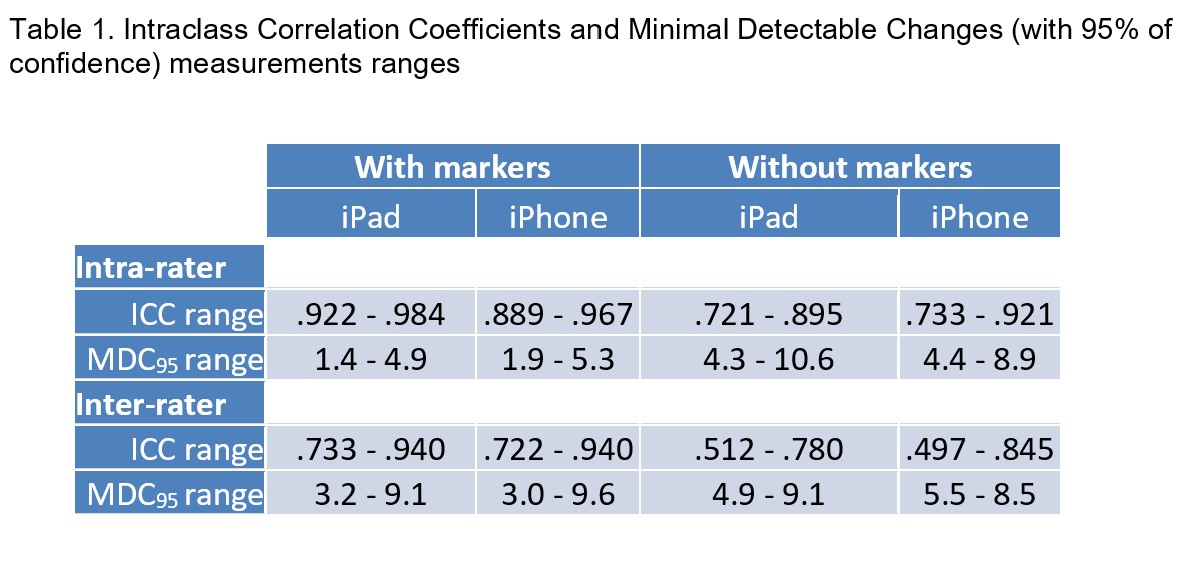
The intra-rater reliability was excellent with markers and moderate-to-excellent without markers. The inter-rater reliability with markers was moderate-to-excellent, moderate-to-good for iPad and poor-to-good for iPhone. ICCs and MDC95 are reported in Table 1. The Bland-Altman plots showed a substantial agreement of the measurements with the DrG using iPad and iPhone and the optoelectronic system (all upper and lower limits of agreement ranges were between +-10 to 15°).
Discussion and Conclusion
REFERENCES
1) Ferriero G, Vercelli S, Sartorio F, Muñoz Lasa S, Ilieva E, Brigatti E, Ruella C, Foti C.
Reliability of a smartphone-based goniometer for knee joint goniometry. Int J Rehabil
Res. 2013 Jun;36(2):146-51. 10.1097/MRR.0b013e32835b8269. PMID: 23196790.
2) Ferriero G, Sartorio F, Foti C, Primavera D, Brigatti E, Vercelli S. Reliability of a new
application for smartphones (DrGoniometer) for elbow angle measurement. PM R.
2011 Dec;3(12):1153-4. doi: 10.1016/j.pmrj.2011.05.014. PMID: 22192326.
3) Mitchell, Katy; Gutierrez, Simran Bakshi; Sutton, Stacy; Morton, Stephanie;
Morgenthaler, Andrea (2014). Reliability and validity of goniometric iPhone
applications for the assessment of active shoulder external rotation. Physiotherapy
Theory and Practice, 30(7), 521–525. 40
4) Otter, S.J., Agalliu, B., Baer, N. et al. The reliability of a smartphone goniometer
application compared with a traditional goniometer for measuring first
metatarsophalangeal joint dorsiflexion. J Foot Ankle Res 8, 30 (2015)